BehanVox: Let Puppets Do The Talking
This week in BehanVox: Amaravati’s shiny hollow promise, heat journal from Delhi, and more
Subscribe to our weekly newsletter that brings you top stories, news from the world, and our team’s reading recommendations.
Hello and welcome to BehanVox.
In a recent article, Tech Policy.Press has an interesting headline spun on the idea of NIMBY (not in my backyard) – No Data Centre In Anyone’s Backyard. It reports on what the rising tide of widespread and powerful public opposition to establish resource-draining data centres in the US implies – the centres will simply shift to countries like India, the UAE, Brazil or South Africa, where governments think little of overriding popular concerns and where the media will either not report on the opposition or be browbeaten into staying silent. It refers to the three ambitious data centre projects in Andhra Pradesh in this regard. These are acquisitions that are raising a lot of questions about the public purpose laws that facilitate them citing jobs employment generation. The CPM’s Srinivasa Rao has said that nearly 480 acres of fertile land are being allotted for the project in Anandapuram and Anakapalle and the impact this will have on farmers and Dalits.
If we need a precedent to see why these concerns should be addressed all we need to do is look at what the ongoing construction of the shiny new capital city of Andhra Pradesh has done to landless women farmers of the state. This week, we bring you an extensively reported story on the loss of employment suffered not just by the landless in this capital building but also what it did to the landed farmers who had backed the acquisition. We also bring you a fascinating interview on why music, theatre, puppetry are integral for any movement, social or political. And a profile of a homemaker in Delhi’s Sunder Nagri who turns to gardening for relief and repair amidst the scorching heat.
Before we get to these, Mumbai Actions Collective has a website put together to help trans and queer people in Maharashtra navigate the SIR process in the state. Do share widely.
Story So Far
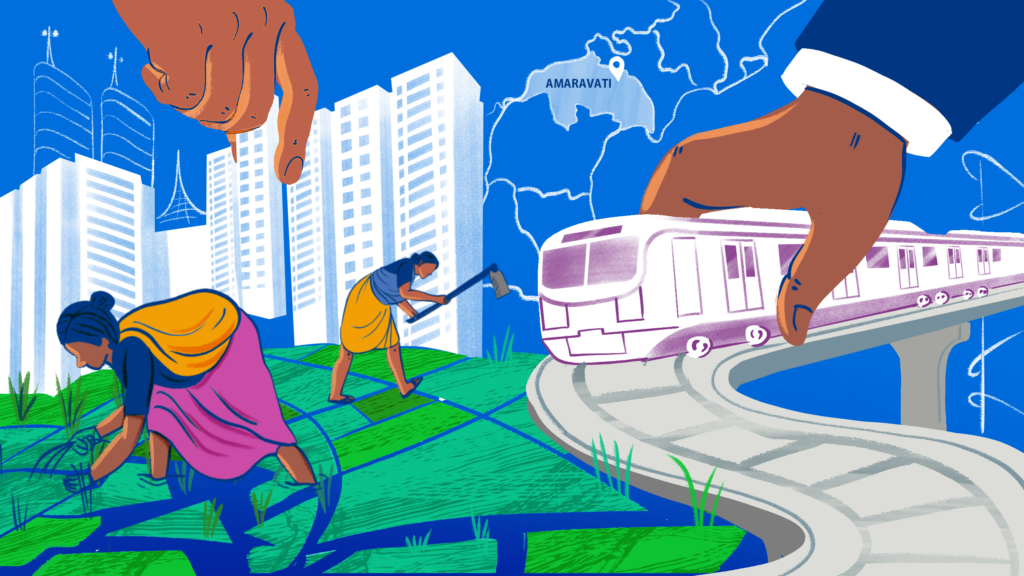
The fertile lands of Amaravati region were historically one of the most prized agricultural belts in Andhra Pradesh. Its farms supported up to three crops a year and provided two rounds of wage work a day alongside MGNREGS. This attracted labourers from surrounding areas and encouraged many families to settle in the region. In a reversal of convention, men moved into their wives’ villages in the area after marriage in a practice known as illarikam (matrilocal residence) because of this advantage.
Nidamarru village, which would have drawn workers from elsewhere, now does not have enough work for its own people. One of them is Uma, 26, generations of whose family have tilled this land. She now has to travel 10km to Pedavadlapudi-Kolanukonda road in an autorickshaw she shares with five other women from her village. And that too only on days when the jasmine fields are blooming. Otherwise, she has to seek out work in the cotton or chilli fields.
Bhaskar Basava reports on this employment crisis has been unfurling in the areas since 2014 when after the bifurcation of the erstwhile Andhra Pradesh, a new capital city had to be carved out. Citing a survey that claimed that most respondents wanted a capital city in the regions, land was acquired in the historically fertile belt. The loss of agricultural lands dealt a massive blow to the livelihoods of landless Dalit and women workers like Uma. An official estimate puts the number of such families at at least 17,000. The numbers are likely more.
Kumari (name changed), a 40-year-old backward class woman from Thullur, a village within the capital city of Amaravati, says that employment in these distant fields is neither regular nor adequate. She has to spend around Rs 50 of her daily earnings on her commute, leaving her with only Rs 250. “I got work for only 20 days,” she points out, adding that her earnings per month average around Rs 5,000.
The new city does not have jobs for women like Kumari or can only offer low paying work. The irony is that the rich landed families that backed the land acquisition are not happy either.
Read our story here.
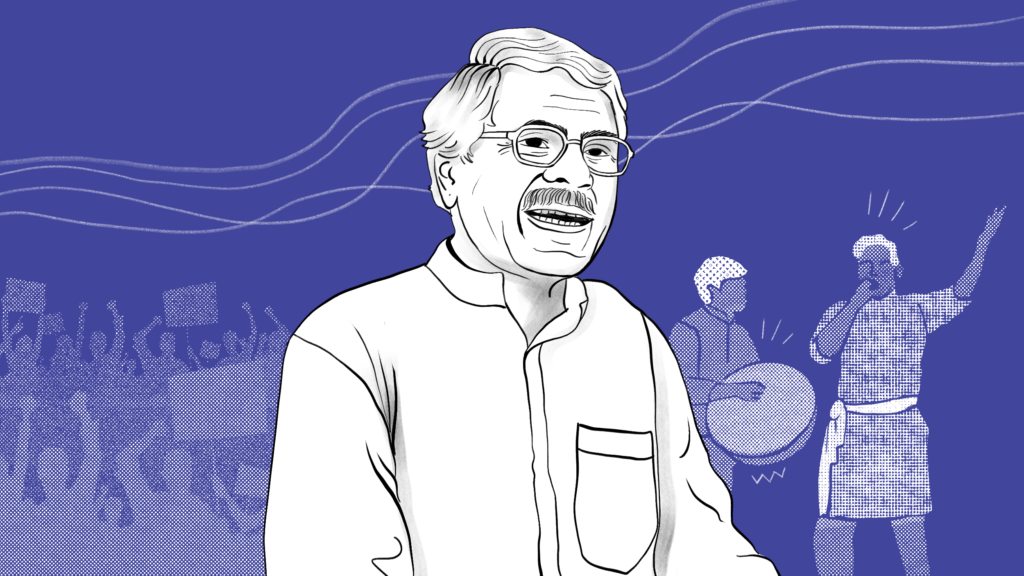
Music has energised practically every big protest movement. Theatre and puppetry have given voice to resistance, taking it to many more people. And if all these cultural inputs come from the soil on which the campaign takes root, they can become even more effective tools of collectivisation. There can be no better example of this in recent times than the work done by Shankar Singh, one of the three founders of the Mazdoor Kisan Shakti Sangathan (MKSS), a union of the working class that led many social movements including the Right to Food and Right to Work movements in India.
A man with tremendous zest, a strong singing voice and an uncanny ability to mobilise people, Shankarji, as he is better known, brought the folk music and puppet traditions of Rajasthan to the campaigns. He would pick up songs that everyone knew, give them a twist and turn them into devastating statements and questions on poverty, inequality and corruption.
In an interview this week with Bhanupriya Rao, he talks about how he incorporated songs like Choriwad into his work on the streets. And how he made puppets the voice of the oppressed.
“A puppet has a special power–it can say things boldly that a person might hesitate to say. When I take the puppet out of my bag, people stop and watch. The puppet asks questions and they are hard to talk back to. I say: ‘It’s not me saying things. It’s the puppet’,” he says.
Read our interview here.
Asha has built a sanctuary in and around her home. Long vines dangle from the balconies and planters – some fashioned out of old footballs – line the railings. Her love for gardening has grown into a humble expertise. She can rattle off facts and benefits of different species of plants and trees; in diaries she writes poems, simple lyrical verses that carry maxims about nurturing the environment. She turns to this world for comfort — no matter what tempers and temperatures run through the day, she finds relief and ritual in tending to these small, faithful blossoms.
But her sanctum now lays breached as temperatures cross dangerous thresholds. “The trees used to be so full of shade… now there is almost nothing,” Asha says. This anguish follows her in her daily chores, cycles of cooking and cleaning – and it exhausts her faster and more completely than before.
BehanBox profiled her experiences as part of Heat Diaries, a project that documents the degrees of losses and longings that communities experience while living under extreme climate realities. Read the first dispatch here.
Talking Point
‘Not Charity’: The Karnataka High Court has refused to stay the operation and implementation of the Karnataka Platform Based Gig Workers (Social Security and Welfare) Act, 2025. Also, Justice M. Nagaprasanna has asked employers of gig workers, such as Swiggy, Zepto, and Urban Company, to deposit the amount required to create the welfare fee under the act. “The amount demanded by the State is not sought as charity, benevolence, or voluntary contribution. It is demanded pursuant to a statutory mandate flowing from a duly promulgated legislation. That legislation is presently under constitutional scrutiny before this Court,” Justice Nagaprasanna said.
Voice of Defiance: Teejan Bai passed away this week at 70. Listening to her was a sensory experience on so many counts. She had a forceful voice that feared no vocal challenge and a confidence that came from breaking every rule since she was a young girl to take the stage in the male-dominated Chhatisgarhi form of Pandavani. Few music lovers outside the state knew of the style till Teejan travelled to cities with her ektara, her blood red sari cinched with a broad belt, her brilliant sense of drama and a commanding voice weaving together mythology, folk lore and commentary to create an indescribable musical theatre. Her life was tumultuous, married early and abandoned and many familial strifes but she let none of that come between her and her art. Her work also paved the way for other women to enter Pandavani.
Leaving AMMA: Revathy and Padmapriya, among the actors who spearheaded the campaign to improve work conditions in the Malayalam film industry for women, have quit the Association of Malayalam Movie Artists (AMMA). They were among the few women to remain in the organisation accused of being apathetic to conditions of women workers in the film industry. They were also among those who founded the Women in Cinema Collective (WCC) in 2017 after the sexual assault on an actor. They said in their resignation: “Once the attention faded, the same old order returned. Power keeps finding new ways to protect itself. The faces change. The methods change. But the structures enabling inequality remain untouched.”
Good Lord: Lord’s is finally hosting its first women’s Test match this week — England vs India. It is over 50 years since the first women’s match was held at the fabled London venue, with England beating Australia by eight wickets in a one-day international in 1976. At the time, women players still wore skirts.
BehanVox Recommends
Syria’s Women Commune: In the midst of devastation of war, Syria’s women are building women only communes– a sanctuary filled with flowers and fruit trees. Here, divisions between Arabs, Kurds and Yazidis are erased. Read this beautiful photo story.
Prison Memoirs: Varuhi Kalantar, an Armenian woman imprisoned in Istanbul’s Grand Prison, wrote a memoir back in the day of the Ottoman empire. This is the first known prison memoir by a woman in the region. She writes: “The idea that your small and insignificant fate is part of a society’s tragic and glorious destiny fills you with excitement. You fix your painfully numb gaze on the dream of a free and enlightened country.”
Hakimi and the Muslim Manosphere: In the last FIFA World Cup, Achraf Hakimi emerged as an unlikely hero – a symbol of Arab, Muslim and African pride — steering his Moroccan team to a semi-final. But after rape charges and divorce proceedings, the Muslim manosphere cannot separate the two Hakimis — hero and defendent of rape allegations, argues Zoha Qamar in the Politico.
Want to explore more newsletters? In Postcards, we send you missives on the places, people and ideas that brought Team BehanBox joy. Our monthly offering Postscript invites you, the reader, into our newsroom to understand how the stories you read came to be – from ideation to execution. Subscribe for more.


We believe everyone deserves equal access to accurate news. Support from our readers enables us to keep our journalism open and free for everyone, all over the world.