
‘Social Movements Become Stronger By Incorporating Songs, Drama, And Creativity’
In this instalment of BehanBox Talkies, Shankar Singh talks about the history, process and the importance of cultural symbols and performances in social movements in India
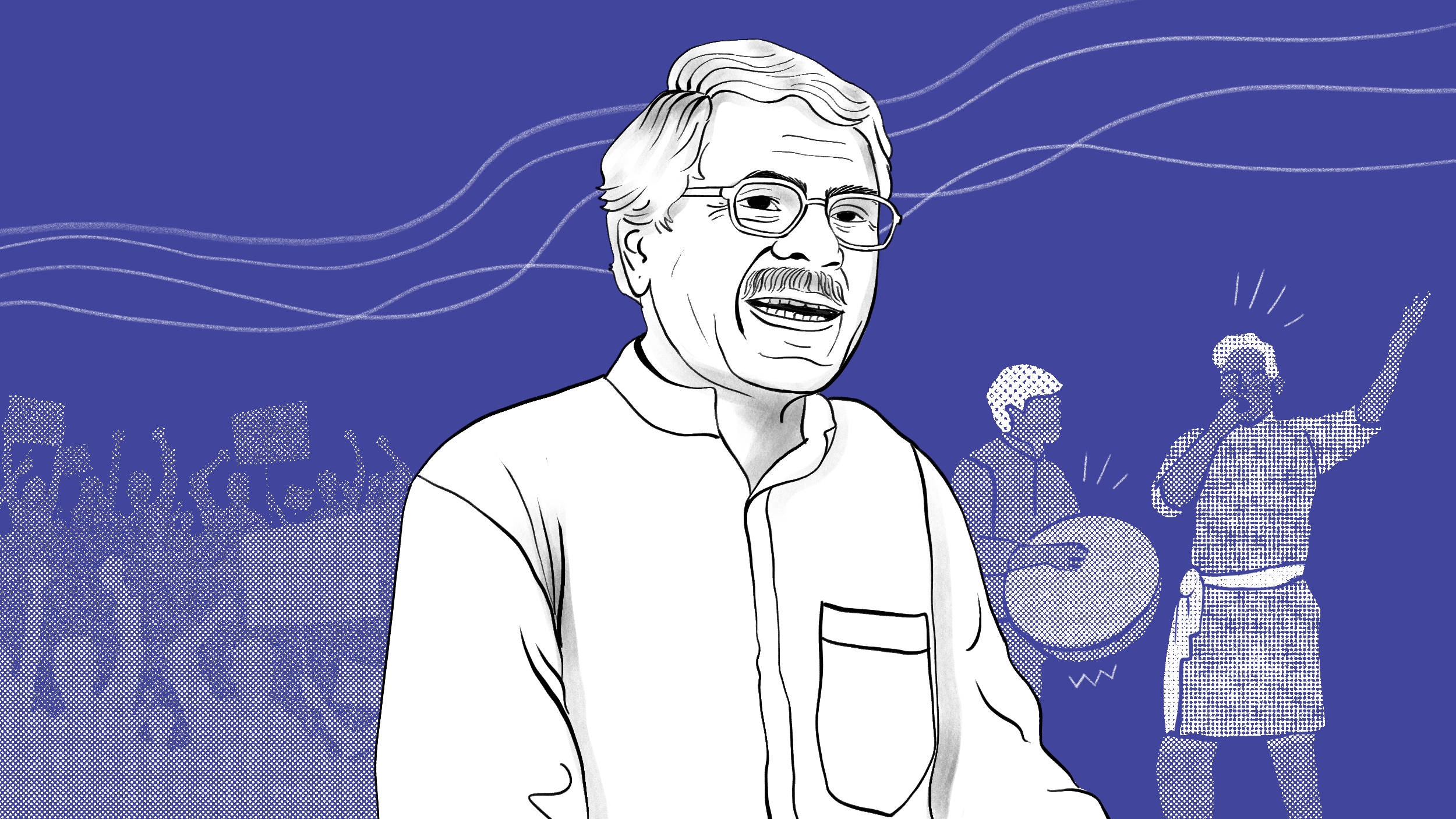
In the 1990s, as the Right to Information (RTI) movement gathered momentum in Rajasthan, one figure stood out for his extraordinary ability to connect with people: Shankar Singh. Tall, with his trademark thick-rimmed glasses, white khadi kurta and a jhola, he would lead gatherings through songs that were less performances than conversations with the crowd. Accompanied by dhols, cymbals, and an enthusiastic chorus, his songs blended satire, humour, and powerful political messages, often reaching the soaring notes of a Manganiyar folk singer.
Shankar Singh is one of the three founders of the Mazdoor Kisan Shakti Sangathan (MKSS), a union of the working class that led many social movements including the Right to Food and Right to Work movements in India. For many within the movement, he has been more than a leader—he is a friend, mentor, and source of camaraderie. While young activists and students often looked up in awe to figures like Aruna Roy and Jean Drèze, they found in “Shankarji” an approachable companion who translated complex questions of rights and entitlements into the language, songs, and cultural traditions of ordinary people.
Now 72, Shankar Singh remains as committed as ever. Today, he is helping organise resistance against the new VB-GRAM-G, a law that replaced the historic Mahatma Gandhi National Rural Employment Guarantee Act (MNREGA), which has now officially come into force. On the day we spoke, he had just returned from inspecting an MGNREGA worksite under the scorching sun in Beawar district and was on his way back to Devdungri, the home of MKSS. In a wide ranging interview, he tells us about the history, process and the importance of cultural symbols and performances in social movements in India.
Edited excerpts below:
Zindaabad Shankar ji! Let’s start from the beginning. Tell us about your early years and how you came to be part of some of the most significant rights based movements of contemporary India.
I’m from a village called Lutiana in Rajasthan’s Ajmer district. Like millions of other children, I grew up believing there was only one goal after finishing school in the village: get a job, earn a living, and support your family.
After school, I wanted to continue my education, but life had other plans. My father died when my mother was just 32, leaving her a widow with no means to support my studies. I was her only child, but in a village, survival comes before ambition. She worried constantly about raising me, my future and my marriage. So as soon as I finished Class 11, she got me married.
I wasn’t really thinking about what was happening to my life. In most families, these kinds of conversations—about purpose, choices, or what life means—just don’t happen. You’re simply told to earn some money, get a job somewhere, and make a living.
So I left home during that time and migrated. From that point on, it’s a matter of chance. The people you meet, and the way you meet them, can completely change the course and purpose of your life.
When I left home, I quickly realized that the education I’d received had little value in the work I was doing. I worked in a namkeen factory, a slate factory, an oil mill, selling kerosene, and even worked at a pakoda stall in Gujarat. All these were jobs with hardship and a lot of exploitation. I kept changing jobs, thinking the next one would be better.
Then one day, I happened to come across the work of an NGO that works in villages, with poor people. I asked, “What do you do here?” They said, “Social work. We go to villages, talk with people about why poverty exists, and find ways together to improve their situation.” They said they did this job with paid salaries. I thought to myself that this is a better job than the previous ones I was doing. So I started working there.
My actual work was to bring people together in the villages, talk to them, and help them develop an understanding of the issues they were facing. But then the question was: How do you talk to people? Who will listen to you, and why would they?
I had to find effective ways of expressing my ideas to make people listen. It was during that time that my entire focus shifted to figuring out what methods I could use to engage people’s attention and make them listen. That’s where puppetry and theatre came into the picture and I started using those forms.
You are one of the three, along with Aruna Roy and Nikhil Dey, to start the Mazdoor Kisan Shakti Sangathan. Tell us how MKSS came to be.
I met Aruna, by chance, as she was also working in the same organization. She had left her prestigious job at the Indian Administrative Service and came there to learn on issues of people. Living there, working among the people and building lasting friendships helped us really understand the village. But, Aruna realized something else too– this was a much bigger struggle than it seemed and it needed people to collectively raise their voices. So Aruna began working to organise people.
As for me, I was simply doing the work, and I loved it. People were gathering and listening to me. I was performing street theatre, and it filled me with energy. I remember thinking, “This is going to change the world in no time.” But I gradually realised that change wasn’t going to come nearly as easily as I’d imagined.
I worked at that NGO for four or five years. I was also still looking for a government job and I got one too. But by then I had changed. My mind had changed. I wanted to do only this work.
So I requested Nikhil and Aruna to come to the area around my village. It would be easier for me, and I could stay close to my wife, children and mother. That’s how the plan was hatched between Nikhil, Aruna, and me in Tilonia.
We chose the village of Devdungri, which was my sister’s marital home, and set up our base in her spare thatched cottage. It was secluded, so people could come and sit and talk without disturbing anyone. This was in 1987.
By this point, we already understood from our work in Tilonia that organising people was important to change a flawed system. Toh ab logon se dosti karne ke liye aapko tikna padega. Toh hum us ghar mein tike. Aaj tak tike hain. (To build friendships and connect with people, you have to live amongst them. And we stayed, to this day.) Building that friendship and trust took two or three years in Devdungri itself.
People had more questions about us than we had about them: “Why are you doing this work? Why did you leave an IAS job?” Nikhil’s father was an Air Marshal in the Air Force, so there were questions about what his son was doing here? For me it was less of an issue. They thought, he’s one of us. Even then, they suspected some hidden interest.
I remember one instance when I spoke about poverty and finding solutions together, one person in a meeting asked: “You’re worried about our poverty, what do you get out of it?” That’s when a big question started. We said we take the government mandated minimum wage. At that time, in 1987, the minimum wage was Rs 11 a day. We organised our own wages through support from friends.
We never entered the project-funding structure because that would limit us and open us up for pressure from the government. We stayed free and fearless.
When we first started raising issues of entitlements that were due to people, the government’s response was to scrutinise our funding. That’s when we founded MKSS, a collective of workers and labourers in the village. Gradually, through friendships and trust, a group of local people came together, and in 1990 we formally established the organisation. The MKSS was not just a group built for its own sake but to demand and secure their rights. They came together because they believed collective action could help them solve their problems.
Our friends and supporters pitched in with funds just enough for us to carry forward our work. Our expenses were modest, and those small contributions were enough. The local people contributed something just as important—they gave their time. They joined the protests, sat in dharnas, and stood with the movement. That’s how the organisation grew.
Whenever the government felt threatened, the first questions they asked were: “Where are you registered? Where does your funding come from?” We were not even registered and all our accounts were audited. There was nothing to hide.
What were the beginnings of the Right to Information movement?
It started with the issue of wages, where people said that they were not receiving even the minimum wage for the work they had done. So we said, let’s collectively ask the government. When we did, the officials responded that they were paid according to the amount of work done.
So, we then asked for the records of the work done–the measurement book, muster roll, bill vouchers. Show us the papers, we said. ‘There’s no law requiring us to show papers,’ we were told.
That’s where the struggle began. Aruna, having been an IAS officer, knew exactly how bureaucracy withholds information. Their whole soul is in the paperwork. She said that the government talks about transparency but doesn’t practise it, because there’s no accountability. So we realised that we need to fight for a law that gives the right to see these documents.
People began to believe that it was now their fight and when they felt it mattered to them, they joined in.
Among the most defining moments of these rallies, social audits and public hearings were your electric performances, using very local idioms, fun ways but very provocative songs and performances. How did these songs take shape and how important were they to the movement?
In the movement, everyone brought their own unique skills. Mine was about how I communicated with people and interacted with them in their own local context. I began to wonder if the songs they sing in their local everyday life can play a role in changing their circumstances.
Songs are usually written in a room by poets or professional lyricists. But in a struggle like this— in protests, dharnas and rallies–songs take on a different meaning. They become a companion and a necessity. After all, you cannot keep repeating the same slogans all day long.
In collective struggles, when people are sitting together in protest, ideas emerge about how to say things in a way that reflects their lived reality. That’s how many songs were created in local languages.
Tripurari Sharma, who taught at the National School of Drama in Delhi, came to our village and used theatre as a medium to engage with us. She never imposed a script, instead, she enabled us to develop the performance organically from our own realities.
Ten to 12 of us would gather as a group and stay together for days at a time. We would live in forest areas, cook our own food, and spend long hours reflecting on our local problems and how to translate them into theatre. The language, the words, the songs—everything emerged from our own lived reality and context.
Why would people listen to you if your speech, your lines, your words don’t have rhythm or an engaging way of expression? So we kept experimenting with songs that could hold people’s attention. The issues had to be relatable, and the lyrics had to be such that even a chorus could sing them together.
If you focus only on ‘perfect performance’, then it becomes just a stage programme. That’s not what we wanted.
This is why movements that incorporate songs, theatre, and creative expression become much stronger. The RTI and MGNREGA movements were not the only examples. Any movement gains greater power and reach when these forms of expression are part of it.
Do you remember any incident or story where a song emerged spontaneously from a dialogue with the community? And what were you thinking at that time when it was created?
I remember during a rally in Beawar, while we were singing, one of our colleagues said, “Yaar humne sarkar se kya aisa maang liya jo sarkar dene ke liye taiyaar nahi hai? Aur kyun mana kar rahi hai? Humne koi sona-chaandi maang liya? Mahal maang liya? Gaadi bangla maang liya? Inse koi luxury item maang liye? Kagazi toh maang rahe hain (what is it that we are asking from the government that it is not willing to give? Have we asked for gold or silver? or palaces, cars, bungalows, or any luxury items? We are only asking for papers).”
And right there, a song was born in Marwari language: “Main nahin manga (I didn’t ask for this).”
I would call out: “Arre, sona-chaandi (Gold and silver)!” and the crowd responded: “Main nahin manga!” “Bungla, gaadi!” — “Main nahin manga!” Pepsi, Coca-Cola, mehngi sharaab (expensive liquor) — “Main nahin manga!”
Phir kya chahiye aapko? (Then what do you want?)
“We want our wages! We want the muster roll copy! We want education in schools! We want the expenditure accounts of the panchayat!”
“Main manga! (I do want this!)”
And in that process of demanding, the song takes a form where people automatically start joining and the song becomes theirs. Listen to the song here.
Women were, and continue to be, a big part of these movements as they were an integral part of the labour in a village economy. Are there any songs that were created by them and their own lived realities?
In rural working-class life, women’s worlds are deeply shaped by culture and without it, their deprivation only deepens. They endure poverty, hardship, and everyday injustice, yet their lives are filled with songs.
These songs—unwritten and unrecorded—emerge naturally at every moment of life: birth, drought, death, and need. They are created on the spot, shaped by circumstance rather than authorship.In this way, women continually create songs that also carry their demands, turning lived experience into expression and expression into voice.
For example, one song in Marwari they created goes: “Dharna di do re prashasan, munde bol tho sari (We sat on a dharna, now speak up!)” They also include the administration’s voice in the song: “Main bol baan bolu, mara haath mein koni (I’ll speak, but it’s not in my hands).” The women respond: “Tane kaai ko dar lage, tu to kahvai to kyon nahin (what are you afraid of, Why don’t you speak)?” and then says: “Maane kursi ko dar laage aa to maane thapad gi (you’re afraid of losing your chair, hence you are silent)!”
Then the full chorus: “Majdooraro aayo re dhadilo, prashasan ki chaati dhadke — dare po mati (The workers have come boldly, let the administration’s heart tremble)!”
“Main to maa ko haq maanga, Dare po mati (I’m asking for my rights and that I will demand).”
Another popular protest song of the movement was the ‘Choriwad’ (corruption)song that we have heard quite often in rallies and social audits. How did that song happen?
One day at a dharna in Beawar, some women came and said they wanted to sing a bhajan in support of our rally. They sang about Krishna — how Kanha stole the butter, broke the pot, ran away with the gopis’ clothes. “Kanhuda makkhan kha gayo re, koi to munde bolo (Kanha ate the butter, won’t someone speak up?)”
That sparked an idea. We made a new version: “Choriwad ghano ho gayo re, koi to munde bolo (there’s been so much theft, won’t someone speak up?)”
And we named the corrupt officials: “O sarpanch rupaya khagyo!” — the sarpanch ate the money. Or “Secretary rupaya kha gayo! JN rupaya khagyo! BDO rupaya khagyo! Pradhan bhi rupaya khagyo!”
The crowd joined in. We listed every scandal of the time in that song.
We even ran a “Ghotala Rath” (scam chariot), taking off on LK Advani’s Rath Yatra, a procession on a cart loaded with symbols of corruption, singing: “Ghotala raj ki jai jai bolo! Bhrashtachar kar, Hari Hari bolo! (hail the reign of scams! Do corruption and chant God’s name)!” And “Hawala ka halwa chaat chaat khaya (they lapped up the halwa of hawala money)!”
Songs of the movement, as you rightly say, become a companion. They emerged in the moment but also travelled far and wide. Can you tell us how you were influenced and how RTI and other movement songs travelled to other movements?
Our friends Vinay and Charul of Loknaad joined us during the movement and created songs that became very popular. They began to spread widely, and other movements across states also started using them. One of their most popular songs was ‘Mere sapnon ko jaanne ka hak re (my dreams have a right to know). Another one is ‘Mere liye kaam nahin (my hands don’t have work). The song goes: “Insaan pairon pe khade huye, do haath tabhi aazaad huye. In do haathon ki mehnat se, dheere dheere aabaad huye. Par haath yahin ab khali hain, Kyonki inko koi kaam nahin (as humans stood erect on feet – two hands were freed and with the labour of these hands, there was progress. The same hands lay idle now, for they have no work).”
In Sitapur, Uttar Pradesh, Richa, who leads Sangathi, came here along with her team and we learnt from each other. In Arariya, Bihar, Kamayani and Ashish Ranjan of Jan Jagran Shakti Sangathan (JJSS) carried forward the organising of unorgansied workers there. We also learnt from the work of Baba Adhav, Abhay in Karnataka we visited them too and observed their methods. Later, we also started our own union.
This mutual learning strengthens your work. That is why these mediums are so important.
We have never seen Shankarji without his trusted friend–the puppet. Why do you use a puppet in your organising work?
I’ve used puppets since I first started working. They live in my bag. It has been 46 years now, I never leave without them. Once it was lost, I made another, a papier mache one. But I have had the muppet-type one for nearly half a century.
A puppet has a special power–it can say things boldly that a person might hesitate to say. When I take the puppet out of my bag, people stop and watch. The puppet asks questions and they are hard to talk back to. I say: ‘It’s not me saying things. It’s the puppet.’
Yeh sab cheezen, madhyam jo hai, woh hamare is ladai ke auzaar hain. Hamare andolan aur sangharsh ke auzaar hain (songs, drama, puppets — these are the tools of our movement, the weapons of our struggle).
Your organsising has rested in the power of your presence and the visceral physical presence and contact with the public. With the emergence of digital technology and tools like reels and videos, have they added to your arsenal or weakened the on-ground process?
Digital tools have given us some strength. Once, I was explaining in a village how government employees receive such large salaries. As part of an Accountability Yatra we were organising, I was calculating the salaries of government officials– from the office peon to the District Collector. At the same time, I was also counting their holidays. I said: “On all these days they are on leave, but their salaries are never deducted.
Someone filmed it on their mobile phone and it went viral. People were cursing and some were cursing me too — “This old man has lost his mind, counting salaries on a street corner!”
However, digital also has dangers– of fake videos and content and that can create harm.
The main question about digital technologies is–who holds the power?
For instance, the push for a paperless government has made Aadhaar central to accessing pensions, ration cards, and other public services. Yet many poor people still struggle to obtain Aadhaar, leaving them excluded from essential benefits.
At the same time, the Digital Personal Data Protection Act (DPDPA) risks weakening the Right to Information (RTI) by allowing authorities to deny access to information under the pretext of protecting personal data. While the government claims everything is now digital, it selectively discloses information that benefits it and withholds information that enables public accountability.
Digital technology should strengthen transparency. Since government records already exist online, information on public spending, welfare schemes, and service delivery should be proactively disclosed. Instead, access often requires RTIs, and even then, the government resists providing vital information.
For example, RTI requests revealed that nearly 250,000 pensioners who were officially recorded as dead were actually alive and had been wrongly denied pensions. Such findings show that access to information is essential for exposing administrative failures and protecting citizens’ rights.
Information is power. When the government controls information, it controls power. When citizens have access to it, they can hold authorities accountable for public spending, welfare delivery, and governance. Digital systems are valuable, but they must be designed to promote transparency and serve the public rather than concentrate power or enable exploitation.
RTI has exposed major scandals, including the electoral bonds controversy, and around 8 million RTI applications are filed annually. However, seeking transparency can come at a high cost, with more than 150 RTI activists reportedly killed for pursuing information
The new VB-GRAM-G becomes operational from 1 July even as the old law, MNREGA, becomes weak and on its way to being phased out. How are groups on the ground resisting it?
MGNREGA and RTI both came because of people’s pressure, not due to the government’s will. No country in the world guarantees the right to work. It was a powerful law– 100 days of guaranteed work per family, for anyone above 18, no upper age limit, no income criteria. The money went directly into women’s accounts and that was a huge empowerment.
During COVID-19, MGNREGA was the lifeline. When migrant workers returned home, their wives’ job cards were the only source of income.
The Prime Minister, Narendra Modi said in Parliament that the law was a ‘living monument to the failures of the Congress’. And now the government has come up with VB-GRAM-G. I call it Gram-G (gram refers to village) and they call it ‘Ramji’.
The government promises 125 days of work under the new scheme even while they have struggled to fulfill 100 days under the MNREGA. It’s a slow, deliberate destruction of the scheme.
We are now launching a “Kaam Maango Abhiyan (demand work campaign)”: go to your panchayat, demand work in writing, and get a receipt. If work isn’t given in 15 days, apply for unemployment allowance. Force accountability.

We believe everyone deserves equal access to accurate news. Support from our readers enables us to keep our journalism open and free for everyone, all over the world.
