How A Shiny New Capital City Left Landless Women Workers Jobless, Indebted
Amaravati, being built as the capital of Andhra Pradesh, sits on rich agricultural lands that famously employed workers across the region. Now, farm workers, especially women have few work options unless they can travel long distances

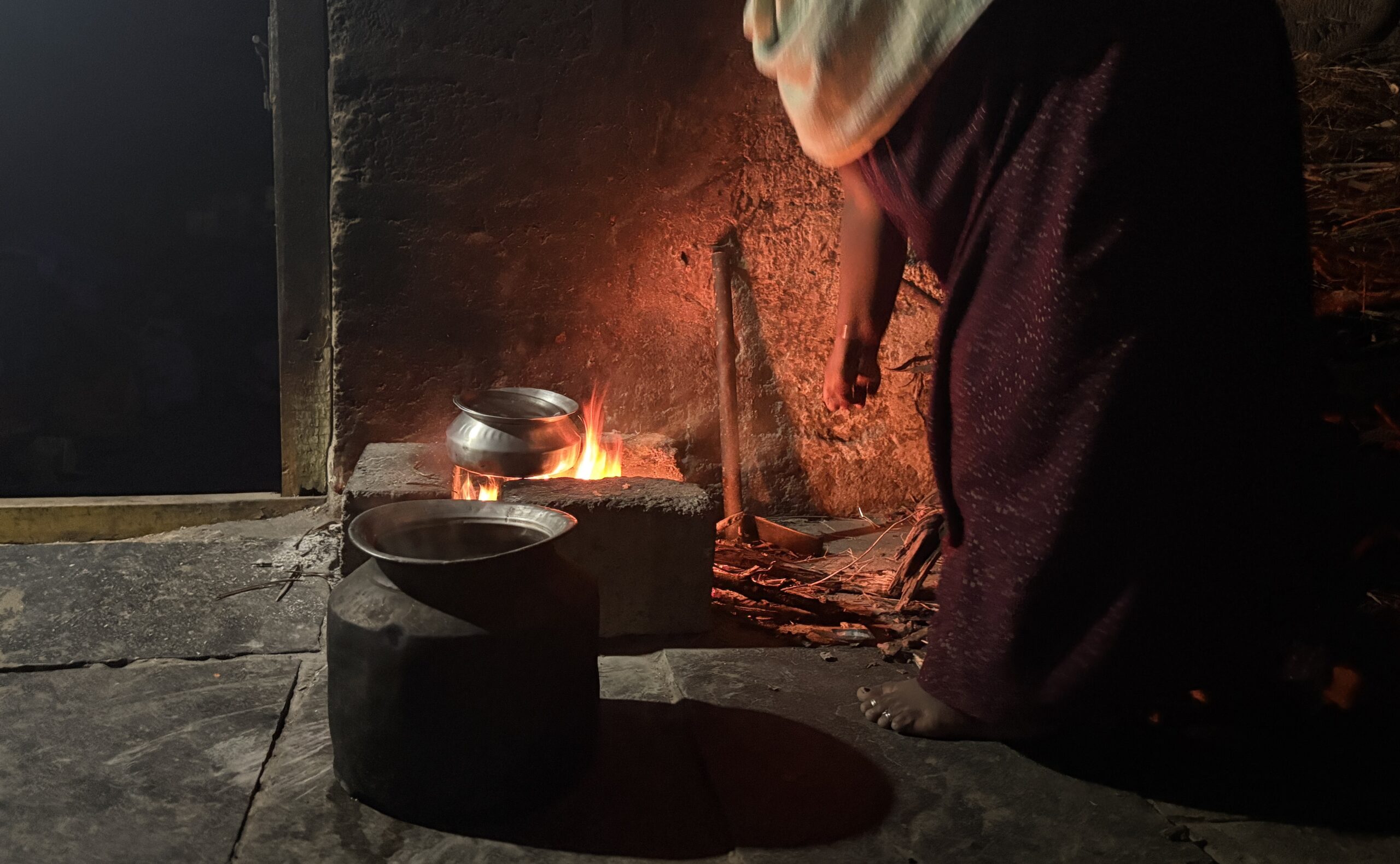
AS THE SUN SETS over the narrow lanes of Nidamarru village in Amaravati, the capital city region of Andhra Pradesh, a light drizzle begins to fall. Uma*, 26, a Dalit woman, calls out to her daughter playing on the street to return home. She then hurries to the firewood stove that sits in a corner of the verandah to cook for her family of six.
Uma, a mother of two, lives with her husband and her elderly in-laws. Since she does not own a mobile phone, she asks her son to cycle to the home of the mesthri (a well-networked senior worker), who lives four streets away to deliver a message – Uma will be replacing her mother-in-law at work the next day because the latter is visiting her ailing daughter.
The mesthri checks with a local farmer who says there is work available the following day on his jasmine fields. The news brings huge relief to Uma and her family. She has been an agricultural labourer since the early 2010s, and she works mostly in and around her village but over the last decade, finding work has become increasingly difficult.
“Earlier, both my mother-in-law and I used to get work regularly. Now, only one of us does and sometimes, neither,” she says.
For generations, families like Uma’s have relied on agricultural labour for their livelihood, sustained by the fertile lands along the banks of the Krishna river. But, in 2014, after the bifurcation of Andhra Pradesh, 24 revenue villages and a part of the Tadepalli municipality (with together total around 30 habitations) between Guntur and Vijayawada areas were earmarked for the development of Amaravati. The state defended its choice of a rich agricultural stretch as the site of the new capital by citing the survey report of the Sivaramakrishnan Committee set up to gauge preferred locations. Nearly 50% of respondents of the survey favoured the Guntur-Vijayawada region.
The capital city’s area extends over about 53,000 acres, as per the Andhra Pradesh Capital Region Development Authority (APCRDA), the statutory urban planning agency responsible for the development of the capital region. With 15000 acres already in the government’s hand, the state used multiple means to acquire the remaining. Landowners could pool land in exchange for residential and commercial plots in the new capital city. Around 28,000 farmers joined the scheme and pooled nearly 34,000 acres between 2015-2019.
There was also the Negotiated Settlement Policy which allowed for a mutually agreed on compensation package for landowners. Lastly, the land is also acquired through the commonly used Right to Fair Compensation and Transparency in Land Acquisition, Rehabilitation and Resettlement Act (LARR), 2013.
The land acquisition process is still on.
The Sivaramakrishnan Committee had cautioned against the large-scale conversion of fertile agricultural land in the Vijayawada-Guntur-Tenali-Mangalagiri (VGTM) region and its potential impact on the lives of workers like Uma. It observed that “the districts of Krishna, Guntur and West Godavari comprise some of the best agricultural lands in the country, contributing more than one per cent to the country’s rice production and are often referred to as the rice bowl of the country”.
A decade on, these concerns have become increasingly visible, we found in our field investigations across Nidamarru, Thullur, Ananthavaram villages conducted in January, May and June 2026. The region’s predominantly agrarian landscape has steadily given way to the construction of office and residential complexes. For landless agricultural workers like Uma, this has meant shrinking work opportunities, and few alternative sources of livelihood. And they also have little access to the emerging work opportunities in the newly built city for reasons that we will elaborate later. This precarity is leading to rising debts.
Search of Work
Amaravati’s transformation into a capital city has been tumultuous, and linked to the political history of the region.
After the bifurcation of the formerly united state in 2014, the then chief minister Chandrababu Naidu of Telugu Desam Party had mooted the idea of Amaravati as the capital of Andhra Pradesh even as Hyderabad went to Telangana (though it was to be the shared capital for 10 years). But Naidu was voted out five years later and with that the development of Amaravati stalled. His rival and successor YS Jagan Mohan Reddy of YSR Congress party rejected the idea of a single capital at Amaravati and proposed a three- city capital model that included Kurnool and Vishakhapatnam. With Naidu now back in power, Amaravati's transformation into a capital city is being accelerated with a view to completing it majorly by 2028.
All these changes have brought instability into the lives of the agricultural workers.
In Ananthavaram village, Lakshmi*, 55, a Dalit woman, sits chatting outside her home with her neighbours. She says work opportunities in the village have declined dramatically, especially since 2016 when construction activity began in Amaravati. But even as government buildings, roads, and educational institutions were being built, some parts of the proposed capital area continued to be used for agriculture in some neighbouring villages falling in Amaravati capital city as land pooling, land acquisition, and related activities also continued until 2019. However, as we said earlier, after YS Jagan Mohan Reddy came to power that year, much of the construction work came to a halt.
"After the construction stopped, farmers resumed cultivation on many of the pooled lands in the neighbouring villages falling in Amaravati capital city, and we continued to find work in agriculture," Lakshmi says. "But since the TDP-led NDA government returned to power in 2024 and revived the Amaravati capital project, construction has resumed on a large scale.”
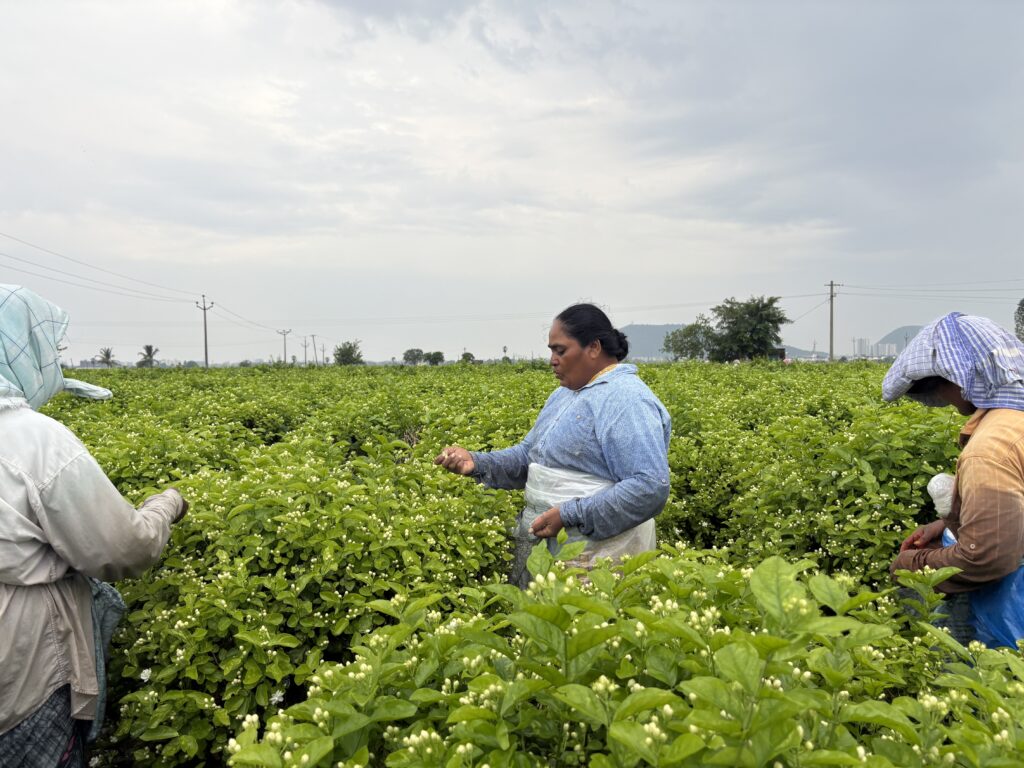
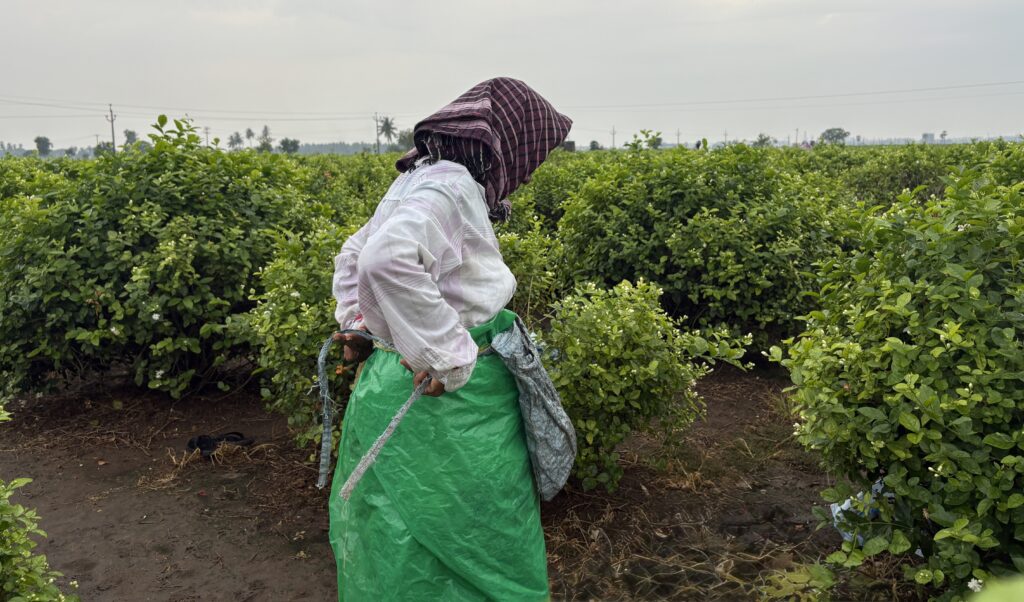
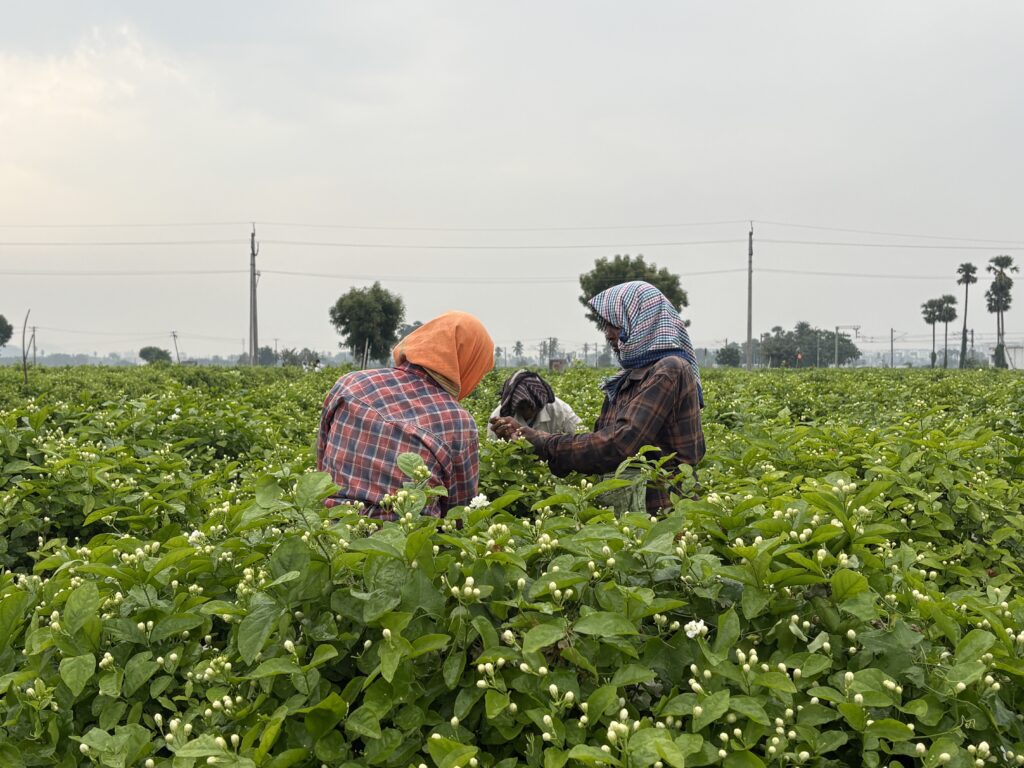
Many women now have to travel further in search of farm work. Uma arrives by 7am at Pedavadlapudi-Kolanukonda road, outside the capital’s limits and about 10 km from her home, in an autorickshaw she shares with five other women from her village. A light drizzle continues as dawn breaks in. She walks another kilometer to get to the muddy jasmine fields where she will work the whole day. Her task is to carefully choose and pluck the buds that are close to blooming. The women help each other tie a sanchi (cloth bag) around their waists to carry the flowers. As work begins, conversations quickly turn to politics, government schemes, village news, and the challenges they face in their daily lives. There is also laughter as they tease one another.
That day, Amaravati was at the centre of the conversation. According to the women, workers from villages close to Pedavadlapudi-Kolanukonda are usually enough to meet the demand for labour. Women from Amaravati are being hired only when there is extra work. They earn around Rs 300 for six hours of work, typically until 1 pm – the ideal time frame for plucking the buds. In some cases, farmers hire workers on a piece-rate basis, paying around Rs 50 for every kilo of buds collected.
Sinking into Debt
Kumari (name changed), a 40-year-old backward class woman from Thullur, a village within the capital city of Amaravati, says that employment in these distant fields is neither regular nor adequate. She has to spend around Rs 50 of her daily earnings on her commute, leaving her with only Rs 250. "I got work for only 20 days,” she points out, adding that her earnings per month average around Rs 5,000. Wages vary depending on the crop, season and the nature of the work.
Kumari compared this to the years immediately following the pandemic and before the 2024 elections, when she earned nearly Rs 9,000 a month during the summer season on jasmine fields. On some days, work extended beyond 1 pm, allowing workers to earn up to Rs 400-500. Women also had the option of taking on extra tasks such as deweeding the kalupu (wild grass), which got them another Rs 100-200. These jobs are no longer available.
The decline in income has also led to rising debt. Uma had borrowed Rs 60,000 through a microcredit programme run by the NGO, Spandana, in addition to contributions to a chit fund (a community savings-cum-loan scheme) and a Rs 50,000 DWCRA loan. (The Development of Women and Children in Rural Areas or DWCRA programme was introduced in the country in early 1980s to promote micro finance by organising women into self help groups with around 10-20 members.) Together, the repayments on these amount to nearly Rs 6,000 a month for Uma. Unable to cope, she recently borrowed another Rs 20,000 from a moneylender.
Why Women Are Hit Harder
By around 1 pm, Uma and many other women sign off for the day and begin the journey back to their villages. They may not have any work the next day – the jasmine needs warm weather for the buds to mature, and the rain was likely set to continue.
These changes have hit all agricultural workers but it is the women who have taken the biggest impact because migrating elsewhere for work is not an option for many of them.
Lakshmi and the women in her village say the men from their families have migrated to neighbouring cities such as Vijayawada and Guntur in search of work in agriculture, construction, services, petty trades and sand mining. But women have caregiving responsibilities that keep them tied to their village.
Ratna (name changed), an Adivasi woman, says she cannot travel for work because she cares for young children and her mother-in-law. "Now, if I leave for faraway places, it becomes difficult to manage the household," she says. Her husband, who earlier worked in banana fields loading and unloading harvested produce, now travels to Vijayawada for the same work. At times, he also takes up construction jobs when agricultural work is unavailable.
Women workers we interviewed say that daily wages increased to Rs 300 after the Covid-19 pandemic. Between 2014 and till the onset of the pandemic, daily wages generally ranged between Rs 150 and Rs 200.
In seasons when the jasmine does not bloom, the women also work under an informal contract system in cotton or chilli fields and the payment can be either per kg of yield processed or per acre. Under the per-acre contract system, groups of women negotiate a fixed amount with the farmer, typically now around Rs 6,000 to Rs 8,000 per acre. Payment is based on the completion of the task rather than the number of days worked. For instance, if four women agree to complete work on an acre for Rs 8,000 and finish it in two days, each woman receives Rs 2,000, which means earning Rs 1,000 per day. In work paid on a per-kilo basis, earnings vary depending on the crop. In jasmine fields, for instance, women workers currently earn between Rs 50 and Rs 70 per kg of flowers collected.
But regardless of what kind of system the workers adopted, earnings are now roughly half of what they earned between 2014 and the onset of the Covid-19 pandemic.
Insufficient Pensions
The state government has a pension scheme for those affected, the Amaravati Landless Poor Pension. At the time of land pooling in 2015 and 2016, around 21,300 families were identified as landless agricultural labourers in the capital city area. As part of the livelihood restoration package, each eligible family was entitled to a monthly pension of Rs 2,500 for a period of 10 years to 2024.
However, In February 2024, just three months before the state assembly elections, the pension was increased from Rs 2,500 to Rs 5,000 and its duration of the benefit was also extended until 2029. But workers say this offers little relief and is far less than what they earned before they lost agricultural work and lands.
For women like Lakshmi, who have lost all avenues of employment, the pension is now the only source of income. "What will happen after 2029 if the scheme is discontinued?" she asks.
Around 17,000 such landless families were identified as being impacted by the loss of agricultural work caused by the Amaravati capital project, according to V Ramulu, the Social Development Project Director at APCRDA. This is lower than the approximately 21,000 landless households recorded in earlier APCRDA surveys. Some families were removed from the beneficiary list following verification and eligibility review processes, Ramulu added. Many of those excluded were found to be beneficiaries of land ownership, he adds.
A majority of the landless workers receiving the pension belong to socially and economically marginalised communities. Nearly 80% were from Scheduled Caste (SC), Other Backward Class (OBC), Scheduled Tribe (ST), and Minority households, while the remaining 20% belonged to General category families.
Lost Guarantee
None of the women could clearly remember the last time they had worked under the Mahatma Gandhi National Rural Employment Guarantee Act (MGNREGA), set to be replaced by the Viksit Bharat Guarantee for Rozgar and Ajeevika Mission. Most said it was probably before the Amaravati capital project began, or in its initial phase.
According to a 2024 report, ‘Environmental and Social Systems Assessment (ESSA) - the Amaravati City Capital Development Program’, submitted to the World Bank and the Asian Development Bank (ADB), the funding agencies for the project, providing employment under MGNREGA for up to 365 days a year was stated as one of the measures intended to support landless families affected by the project. But, as villages were gradually absorbed into the capital city, access to the scheme largely disappeared since it applied only to rural areas.
The villages notified as part of the Amaravati capital city fall under three mandals: Thullur, Mangalagiri, and Tadepalli, clarifies V Shankar, Project Director of the District Water Management Agency (DWMA), Guntur, which is responsible for the implementation of MGNREGS in the district.
Some areas suffer for want of clarity in their classification. For example, according to Shankar, villages in the Mangalagiri and Tadepalli mandals are no longer eligible for employment under MGNREGS as they were incorporated into the Mangalagiri-Tadepalli Municipal Corporation (MTMC) in 2021. Thullur, however, remains a grey area. Although it continues to exist as a revenue mandal, all of its villages now fall under capital city jurisdiction. Eighteen villages had been brought under the capital city, and according to Shankar, the remaining three villages were also transferred to APCRDA jurisdiction about three months ago, bringing the entire mandal within the capital region.
"The question now is whether Thullur should be treated as an urban or rural area. We have recently sought clarification from the government,” says Shankar.
Limited Local Jobs
During field visits to Amaravati, we saw very few women from the affected villages at the many construction sites dotting Amaravati, including the residential complexes for government employees. Conversations with construction workers revealed that the workforce was overwhelmingly male, and mostly from West Bengal, Odisha, Jharkhand, Uttar Pradesh, and Bihar.
This could be because construction work is handed over to private contractors who bring labour in through subcontracting networks which prefer more desperate and pliable migrant workers, says Agricultural Workers' Union State general secretary V Venkateswarlu. Migrant workers are willing to work longer hours, stay on-site for extended periods, and often accept lower wages than local workers, he adds. This raises questions about the implementation of the Andhra Pradesh Employment of Local Candidates in Industries/Factories Act, 2019 that seeks to reserve 75% of jobs in private industries for local residents.
An APCRDA official, speaking on condition of anonymity, argues that agricultural workers find it hard to transition to construction because they lack specialised skills.
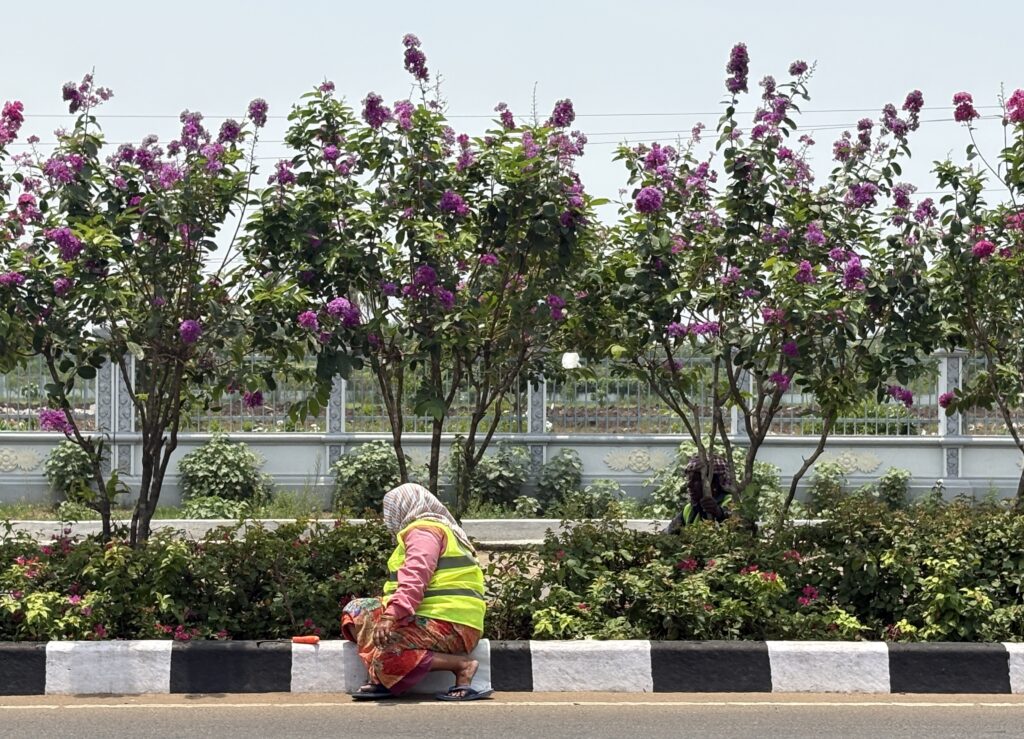
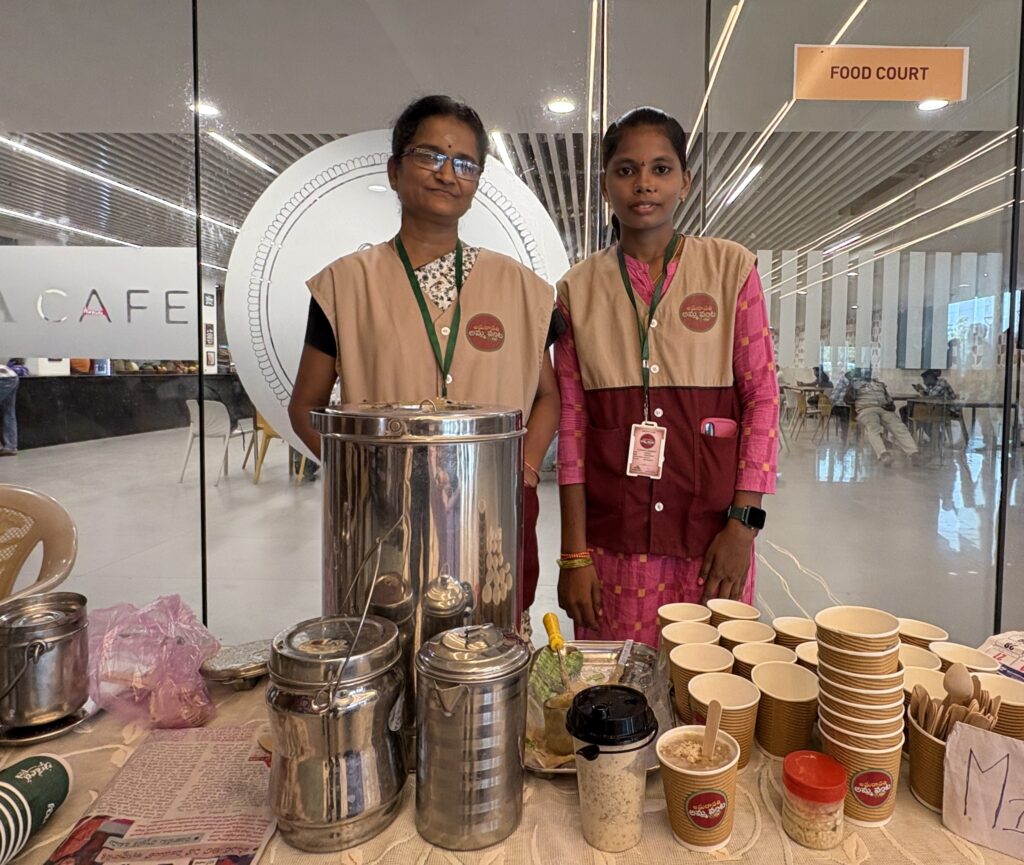
But you do see local women take on other tasks in the city – gardening, running the APCRDA canteen, and working as staff at nearby private colleges, government buildings and other institutions as staff, earning around Rs 10,000-15,000 a month. The data submitted by the APCRDA to the World Bank report in 2024, reports that there are 2,500 jobs for the local community.
But these numbers are not a fraction of those whose livelihoods have been affected, says D Rama Devi, president of the All India Agricultural Workers' Union of Andhra Pradesh. She points out that the Amaravati region was historically one of the most fertile agricultural belts in the state and its farms supported up to three crops a year. Its strong agricultural economy, which often provided two rounds of wage work a day alongside MGNREGS, attracted labourers from surrounding areas and encouraged many families to settle in the region. This economic stability also shaped local social practices: in some cases, men moved into their wives' villages after marriage in a practice known as illarikam (matrilocal residence), which contrasts with the more common patrilocal arrangement.
"Now, with the capital project reshaping the region and agricultural employment shrinking, people are increasingly being forced to migrate elsewhere in search of livelihoods," says Rema Devi.
Few Takers for Skills Training
According to V Ramulu of APCRDA, the government has been promoting skill development programmes to help affected families access alternative livelihoods. About 25,319 women in 2,427 self-help groups have accessed skill training and collectively secured or received over Rs 100 crore per annum in funding or credit through links with the National Bank for Agriculture and Rural Development (NABARD) and other banks, as per the World Bank's Amaravati Capital City Development Program: ESSA report as of October 2024.
But many landless women we interviewed were either unaware of these skill development programmes or were not interested in enrolling. The training sessions require time that they cannot afford. Several women also point out that they lacked the capital needed to start a business after completing the training. Any money they manage to borrow is usually used to repay existing debts, not explore new livelihood paths.
Ramulu argues that while there is demand in the job market for those skilled in computer applications, GST and Tally, social media management, and marketing, the women were more keen on courses related to food processing, housekeeping, gardening, and beautician services. Most of the women we interviewed had dropped out of school early to accompany their mothers to work, married off early and had no means to continue their education.
He adds that recently during the first phase of the programme, APCRDA conducted skill development training across 11 villages, with around 360 women participating in various courses. Among those trained in millet-based food production, around 50 women have started their own businesses. "We are supporting them by facilitating space in APCRDA canteens to sell their products and are also exploring ways to connect them with online business platforms," he says.
The APCRDA team is also assessing ways to improve outreach through awareness campaigns. He argues that the success of the programme should not be measured solely by the number of women who have started their own businesses because they do acquire skills to do so at some point. Some trained women, he maintains, have gone on to start small businesses and petty shops. According to APCRDA estimates, around 2,000 such small shops are currently operating in and around the capital city.
Bypassing Safeguards
Andhra Pradesh is among several states that have amended the Right to Fair Compensation and Transparency in Land Acquisition, Rehabilitation and Resettlement Act, 2013 (LARR Act). It exempted certain categories of projects from conducting a Social Impact Assessment (SIA), obtaining the consent of 70 to 80%, and the acquisition of multi-crop agricultural land.
Former Union Secretary and activist EAS Sarma alleges that these changes were brought to facilitate the land acquisition in Amaravati.
The state also introduced the Land Pooling Scheme under ‘Andhra Pradesh Capital City Land Pooling Scheme’, which we referred to earlier, as an alternative to conventional land acquisition under the LARR Act. Unlike the LARR framework, which mandates rehabilitation and resettlement benefits in addition to fair compensation, the Land Pooling Scheme relies on the “mutual consent” between the state and the landowners, who receive developed residential and commercial plots in return for surrendering their land.
However, ownership and cultivation often rests with different people in the Krishna region, Sarma says. "In many cases, the landowners are not the actual cultivators but absentee owners, while tenant farmers are the ones who depend on the land for their livelihood. Under the LARR Act, the SIA provides a participatory process that captures the broader impact of a project on all affected communities. That statutory participatory mechanism of LARR is absent under the Land Pooling Scheme,” he says.
Life After Land Pooling
Landowners who contributed land to the Amaravati capital project under the Land Pooling Scheme received developed residential and commercial plots amounting to approximately 20 to 30% of the land they had pooled, according to the APCRDA. They were also entitled to other benefits, including an annual annuity of Rs 30,000 to Rs 50,000 per acre for 10 years, later revised to Rs 57,000 to Rs 95,000 respectively and extended until 2029.
However, finding alternative livelihoods remains a challenge not only for landless workers but also for many landowning families. Govindhamma (surname withheld), 44, who belongs to the landowning Kamma community, says her family owned 10 acres on which cotton, chilli, and maize were grown before their land was pooled. The Kamma community had strongly supported the Amaravati project and participated in mobilisations demanding its continuation.
But the project did not go well for Govindhamma’s family which used to earn close to Rs 1,00,000 per acre annually from agriculture. She stopped working before her children were born and has since been engaged in household and caregiving responsibilities. She also participated in protests demanding the continuation of the Amaravati capital project. Today, her husband works as a supervisor in a private firm, earning around Rs 15,000 a month.
"We were promised alternative livelihood opportunities, but things are not happening the way they are promised,” she says. Yet, she remains hopeful that Amaravati will eventually develop into a city like Hyderabad, and that rising land values will, in time, compensate farmers for the loss of their agricultural livelihoods.
However, for small and marginal farmers, the allotted plots mean little. "Even if their value increases, we can benefit only if we have the money to construct buildings and rent them out, or if we sell the plots altogether. We don’t have any seed capital for construction, and if we sell the plots, we will be left with no land," says Karri Subba Rao, a Dalit farmer who gave away one acre for Amaravati.
Further, small farmers owning one or two acres supplemented their income through cattle rearing, with women cared for livestock and managing related work. Devi (name changed), a 52-year-old farmer whose family's one acre of land was pooled for the Amaravati capital project, says her family once relied on both farming and livestock. But after losing access to grazing land and fodder, they sold all four of their cattle recently. "Cattle rearing is no longer feasible for us," she said.
Even as the consequences of the first phase of Amaravati's land pooling continue to unfold, the APCRDA has initiated a second phase, proposing to pool another 16,000 acres across seven villages in the capital region. For the agricultural workers, and farmers, the experiences of those in the first phase have become a source of growing anxiety.
We believe everyone deserves equal access to accurate news. Support from our readers enables us to keep our journalism open and free for everyone, all over the world.