
Postscript #10: Our Year In Recap
Our last edition of Postscript! We reflect on the editorial choices we make and abandon. Plus all things behind the scenes
Subscribe to our monthly newsletter with all things behind the scenes.

Dear Behans,
As another eventful year comes to a close, we did a small reflective exercise in our tiny newsroom. We asked ourselves: What were we most proud of?
Malini, our editorial head, who has spent countless hours honing our stories, fussing over every detail and not letting a single unnecessary word pass, said, “I think everything.” For our campaigns manager Anjali, who joined us a few months ago, the “unwavering conviction” with which we do stories fulfilled them.
For us, that summed up not just the year gone by, but our entire ethos. Every choice at BehanBox is a careful one: the stories we report, the point of view, the data we use and indeed what we consider as data, the voices we centre, the visuals we use. Everything. As our Behans and readers, you’ve offered us heartwarming support and helped us see the meaning our work holds for you. In us, our behan Manita Kapoor saw “a rare platform that doesn’t sacrifice meaning and nuance for gathering more views, and yet manages to be very topical and interesting”. We strive to be that and more.
As we step into the next year, we are thinking deeply about our strategy, anchored in one central question: What change do we imagine through our stories, and how do we collectively, along with you, help make that possible?
As is tradition with year-end notes, we want to reflect on what we did, but not as a list of individual stories but share the larger ideas that shaped our reporting. So here goes.

The ASHA Archive
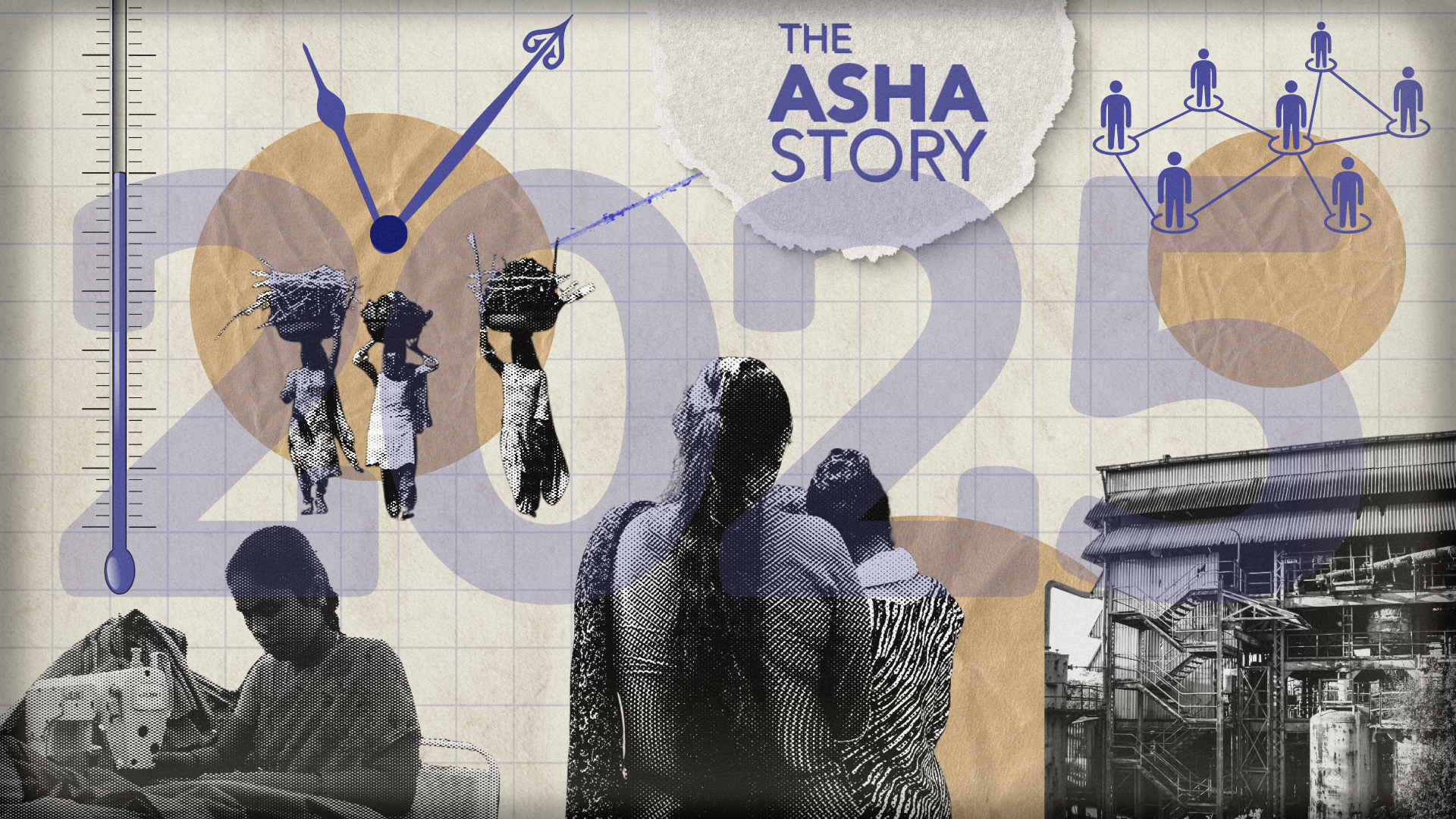
This is our pride and joy. After years of reporting on ASHA workers, and as the ASHA programme completed 20 years, we chose to memorialise their work through an archive that presents them in their full lives: as workers, women, health professionals, data collectors, community members, and agents of resistance. You can visit the temporary archive here. To our behan Tarangini Sriraman, this attention was “utterly rare”; ASHA workers figure in mainstream media only when they protest or go on strike.
This archive is both a shrine to their labour and a living record of their histories from the ground up. We are still building it, and it will have a home of its own in 2026. Until then, we invite you to browse these stories and help us find resources that can support the growth of this archive.
Women in Local Climate Action
We often report on women’s resistance—because in a Brahminical patriarchal society, everyday survival itself is resistance. This year, we wanted to go a step further and document how women take climate action into their own hands when the state and society fail them. Thus was born the ‘Women in Local Climate Action’ series.
We found deeply heartening stories: women saving mangroves, mapping tidal flooding, using indigenous knowledge to forecast droughts and building low-tech tools around it. These are just a few examples. We hope you find time this holiday season to read these stories. Our aim was not only to document these efforts, but also to urge investors and policymakers in the climate space to focus their attention on local women’s collectives and find a seat for them at the table at all global climate governance fora.
Violence, State, and Marginality
For years, we have tried to show how state violence is gendered and access to justice systems deeply shaped by marginality, especially caste and religion. Through our series ‘Justice and Marginality’, we examined the lives of historically criminalised NT-DNT communities, showing how the shadow of criminalisation continues to shape their present, their interaction with the police and other institutions of the state,even though the injustice has been corrected on paper.
This year, Priyanka Tupe carried this work forward, reporting on a disturbing suicide crisis among NT-DNT women and the ways in which liquor laws continue to criminalise them. While she was reporting, the Kumbh Mela was underway and a viral photograph of Monalisa had captured public attention. We asked the uncomfortable but necessary question: why is this not recognised as a workplace violation for her, and for the countless women whose workplace is the street?
Women in the Platform and Data Economy
Our ‘Women and Work’ vertical has long focused on informal labour. As economies evolve and new forms of work emerge, this year we turned our attention to women in the platform economy and AI value chains seeking to understand the issues within these sectors and track rapid changes that often escape public scrutiny. Saumya Kalia has done stellar work this year to help us reckon with these emerging realities. As readers, you noticed it too; Tarangini, for instance, said: “I love your keen attention to platform work, the dissection of time use in gendered labour, and understanding the politics of social reproduction.”
We reported on the platformisation of domestic work and the ride-hailing sector. When BluSmart, an EV ride-hailing app that had offered hope to many women drivers, went bust, we looked beyond the immediate fallout to ask critical questions about labour laws, corporate governance, and regulatory oversight. We also began examining where women stand in the data economy and AI supply chains, an area we will continue to focus on in 2026 as AI solutions and data centres proliferate.
And while we are on the subject of work, we looked at the impact of Trump’s tariffs on women workers in India, a uniquely BehanBox take (read here and here). When big changes happen, women are often invisible. We are here to change that.
Evictions, Home, and Resistance
At BehanBox, every story of state-driven violence holds within it stories of resistance. We have consistently covered evictions (see here, here, here and here) across the country, documenting what it means to lose a home and how such actions, apart from violating the law and human dignity, upend lives in ways that are hard to fathom (see here and here).
This year, we reported from Aarey, Thane, Nagarhole, Mumbai, and Honnavar. The pattern remains the same: corporate capture, brazen violations, and an absolute erasure of the poor from the imagination of development. For those excluded from power and privilege, the idea of “home” scarcely exists in policy or practice. We also traced how today’s evictions are rooted in laws, development paradigms, and colonial histories of forest governance.Yet, alongside this violence, there is resistance: solidarities emerge across bastis in Mumbai, are carried forward through generations like those led by women fishers in Honnavar, and many more. We hope our readers see this resistance and find ways to be part of it in their own cities and towns.
Bhopal Gas Tragedy
Forty-one years ago, a deadly gas leak in Bhopal killed thousands and permanently injured many more, with effects now visible across generations. Bhopal was a corporate crime that should have transformed how we think about corporate accountability, liability, and governance, especially in protecting the most marginalised who live in these “sacrifice zones.” Instead, the lessons learnt were perverse: governments learnt how to limit responsibility to ex gratia compensation; corporations mastered the skill of evading accountability and undermining judicial systems. We retold the story of corporate crime and its aftermath, and the resistance that women have carried out all these years.
As India moves into new and risky territories like nuclear energy, especially with the passing of the SHANTI bill, these stories serve as urgent reminders of the dangers we must confront.
That’s all for this month’s Postscript, Behans. Our eyes, ears, hearts, and inboxes are always open for your thoughts. Write to us or comment below.





We believe everyone deserves equal access to accurate news. Support from our readers enables us to keep our journalism open and free for everyone, all over the world.
