[Readmelater]

‘We Will Keep Up The Fight So There Will Be No More Bhopals’

It is Bhopal's women who have led the 41-year-long campaign for justice for the survivors of the gas tragedy, not for just clean water and medical care but also labour rights and corporate accountability

For 41 years, Rasheeda Bee, 67, has carried a single, unwavering conviction: Bhopal ko insaaf (justice for Bhopal.)

Before the night of December 2, 1984, she had never even heard the name Union Carbide. But after the lethal methyl isocyanate gas escaped from the company’s pesticide plant and swept through her city that night, that name, along with its successor Dow chemicals, has shaped her days and nights and fueled her lifelong fight for accountability. 

It is not just Rasheeda. Nasreen, Leela Bai, Savitri Devi, Reena Devi, Batti Bai, Sakina, Shumaira — and countless other women — and their determination have spearheaded and kept Bhopal’s fight for justice and accountability alive. Over the years, one slogan has captured their spirit: “Hum Bhopal ki naari hain, phool nahin chingari hain (we, Bhopal’s women are not flowers but fire).” 

Women who until 1894 were homemakers were thrust into the public domain as workers and campaigners for justice for Bhopal/ Rachna Dhingra

The 1984 toxic gas leak—one of the world’s worst industrial disasters—killed 22,000 people and left 150,000 with lifelong illnesses. Yet in the four decades since, Union Carbide Corporation (UCC) and its executives, charged with culpable homicide, have escaped criminal accountability and remain declared “fugitives from justice” by the Indian government.

The tragedy did not end with the leak. Union Carbide’s long-term dumping of poisonous waste in and around its Bhopal factory has contaminated soil and groundwater, creating a continuing public health emergency. Supreme Court records show nearly 100,000 residents in 48 nearby communities are forced to rely on toxic water laced with chemicals, pesticides, and heavy metals that accumulate in the body and damage vital organs and genetic material.

Interviews with campaigners reveal that Bhopal’s struggle for justice has never been a single issue fight. It is simultaneously a battle for labour rights for women workers, who for the first time stepped out of their purdahs and burqas, to become their families’ breadwinners after the catastrophe. The people who died that night were overwhelmingly from the working class, drawn from some of the most marginalised communities in Bhopal, who lived  in the settlements and bastis surrounding the Union Carbide plant. Over time, these women, along with economic and caregiving roles, also rose to lead a transnational struggle for ‘all Bhopals everywhere’. 

Out of this struggle emerged a constellation of grassroots organisations that would and continue to shape the movement for decades: the Bhopal Gas Peedit Mahila Udyog Sangathan, Mahila Stationery Karmachari Sangh, the Bhopal Group for Information and Action, Zahreeli Gas Kand Sangharsh Morcha, among others. 

In this two-part series marking the 41st anniversary of the Bhopal gas leak, we revisit the catastrophe’s enduring aftermath. In part 1, we traced the events of that night and the decades of devastation that followed–on people’s health, livelihoods, and the social fabric of the city. In this concluding part, we spotlight the many campaigns, innovative forms of resistance, and the ongoing struggle to hold the perpetrators accountable. This is a battle led, shaped, and sustained largely by women.

That Fateful Night

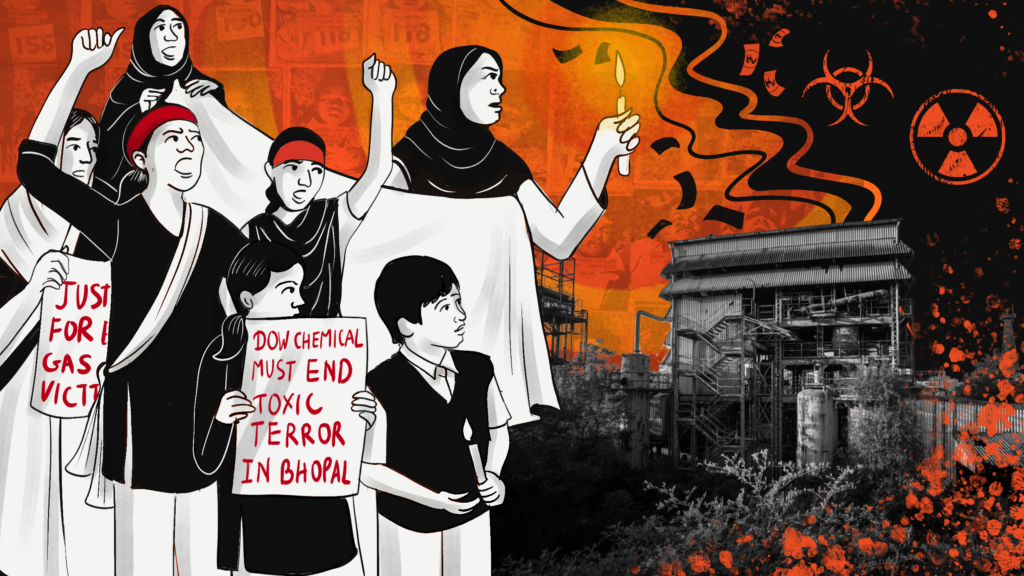
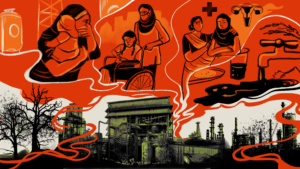
Illustration: Urvi Sawant

Rasheeda remembers the night of December 2 as if it were yesterday. It was past midnight and she had just finished rolling beedis, her daily home-based work, and was preparing to sleep when she saw what she describes as “insanon ka sailaab (a sea of people)” running in terror. 

Clutching her toddler, with her husband beside her, she fled. They had barely covered half a mile when they collapsed. Her eyes were swollen and her chest was burning.“Maut us din haseen lag rahi thi (death seemed welcome that day), she recalls over the phone.

When Rasheeda finally opened her eyes on December 4, half her family of 37 were gone. Bhopal lay shrouded in death—human bodies, animals, even fish floating lifeless in the lakes.
“Jo us din bache, woh aaj tak til til ke mar rahe hain (those who survived have been dying slowly since then),” she said. 

In the immediate aftermath, as the Madhya Pradesh government carried out ‘Operation Faith’ to contain the leak, Rasheeda and her family fled to Sohagpur near Hoshangabad, 150 km away. “Partition ke waqt jaisa aalam tha,” she says, of scenes reminiscent of Partition itself, as thousands fled Bhopal in panic, some even clinging to the roofs of trains. 

No one wanted to return to Bhopal after the disaster. But hunger left them no choice, and after six months, they came back to a city still reeling. That return marked the beginning of what would become a lifelong campaign for justice.

The Stationery Union

In the months following the tragedy, the Madhya Pradesh government set up a series of livelihood training centres—teaching leather work, agarbatti making, sewing, and other skills—to help women rebuild their lives. On November 25, 1985, Rasheeda Bee walked into one such centre, this one meant to train women in stationery making like binding,printing and file making . A hundred women sat inside—50 Hindu, 50 Muslim—all of them promised a daily wage of Rs 5, or Rs 150 a month.

“Every woman there had forgotten how to smile,” Rasheeda recalls. The centre offered something precious: a space for solidarity and sisterhood. “We shared our sorrows here.” But the training itself was minimal. The women felt they were learning little, if anything at all.

Three months later, they were abruptly asked to leave. With no real skills to carry forward, they were left anxious and uncertain. They were told to take their concerns to the collector, Pravesh Sharma. The women urged Aapa and Didi—Rasheeda Bee and Champa Devi Shukla—to speak on their behalf.

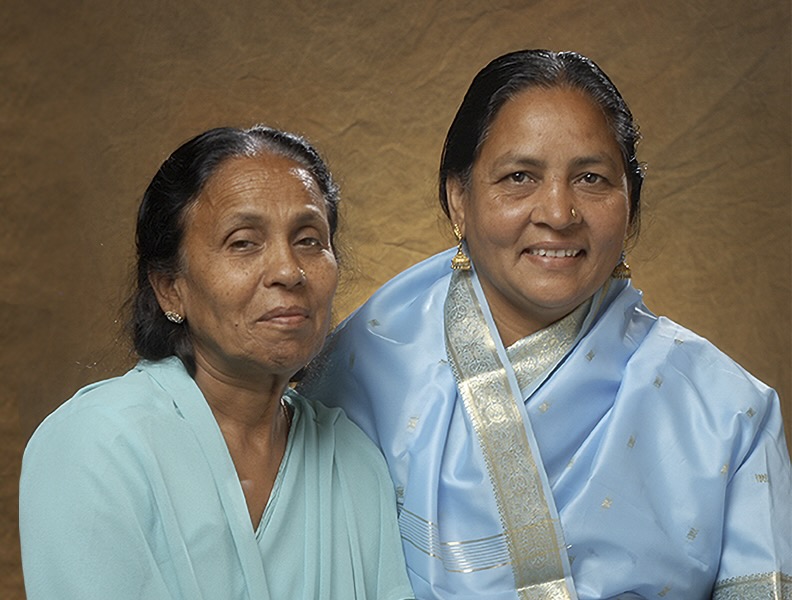
Rasheeda Bee (R) and Champa Devi Shukla (L) met at the stationery training cetre and wen on to become lifelong comrades in the fight for equal pay and coprorate accountability of Union Carbide and Dow Chemicals. They were jointly awarded the Goldman Environemntal Prize/ Goldman Prize website

This was the beginning of a lifelong partnership between Rasheeda Bee and Champa Devi: two women who would grow into comrades and leaders in Bhopal’s long fight for justice. 

When negotiations brought no results, the women were directed to meet the then chief minister, Motilal Vora. ‘Mukhyamantri kya hota hai, humein toh pata hi nahin tha ( we didn’t know who a chief minister was), she says. So the women set out walking to his residence and reached around 3 am. Next morning,his staff assured them that work would be arranged and assigned them to a printing press, where they were promised a wage of Rs 6 a day. But at the end of the month, that was all they received—Rs 6 in total. The women refused to accept it.

Aap rakh lo. Humara pet toh gas se bhar gaya hai (keep it, our stomachs have been filled by the gas we inhaled),” they told the officials at the press. 

After three months of waiting and no work, the women were advised to form a trade union so they could collectively bargain for their rights. So they travelled to Indore and formally registered one. Thus the Mahila Stationery Karmachari Sangh was born—a union that has since fought for fair wages, labour rights, pay parity, and corporate accountability of Union Carbide and its successor Dow Chemicals. 

This wasn’t the only women-led trade union born in the aftermath of the tragedy. The Bhopal Gas Peedit Mahila Udyog Sangathan has its origins in a sewing center with 800 women who while advocating for their labour rights also joined other groups in demanding justice for Bhopal.

In 1989, the women of the Stationery Union learned that as a 100-member establishment they were legally entitled to benefits under the Factories Act. When they demanded to be brought under the Act, the government refused and offered instead to raise the piece rate from 10 paise to 15 paise. Frustrated, the women staged their first dharna, sitting in protest for 27 days—a tactic they were told would compel the government to listen.

The government eventually moved them to a government printing press. At first, it seemed like a victory. But there was a glaring inequality: male employees were paid Rs 5,000 a month, male gas survivors Rs 2,500, and women gas survivors just Rs 435.

Determined to fight, the women went to court in 1990, filing a case for equal wages in the Industrial Tribunal. The battle was long and winding: after seven years, the Tribunal told them to approach the High Court; three years later, the High Court said the case belonged in the Labour Courts. Finally, in 2002, the Labour Court ruled in their favour: the women would be regularised and awarded Rs 2,00,000 as arrears, along with Rs 15,370 in wages.

The Labour Department challenged the decision in the High Court and then the Supreme Court, but in 2013, the Supreme Court upheld the judgement. After more than two decades, the women had won their rights.

In 2016, when the chief minister introduced minimum wages, the settlement remained uneven: the 25 women who had not gone to court received Rs 25,000, while the 75 who had fought in court were given Rs 15,000. “Ladai jaari haiI (the battle is on),” says Rasheeda of the case that has continued for 35 years.

Labour Rights To Environment Activism

In Bhopal, the early women led labour rights movements soon coalesced into the larger movement for corporate accountability. The political struggles for labour equality helped them see the connections to the larger issues. Champa Devi Shukla said in Suroopa Mukherjee’s book Surviving Bhopal : “We are living in changed times and our protest too had to change directions. It is through the union that I was given a forum to see my own sufferings in the perspective of the larger suffering of the people of Bhopal. I am now part of a people’s movement that helps women understand their rights as political beings.” Champa Devi lost her husband and son a decade after the disaster and both her daughters are chronically disabled.

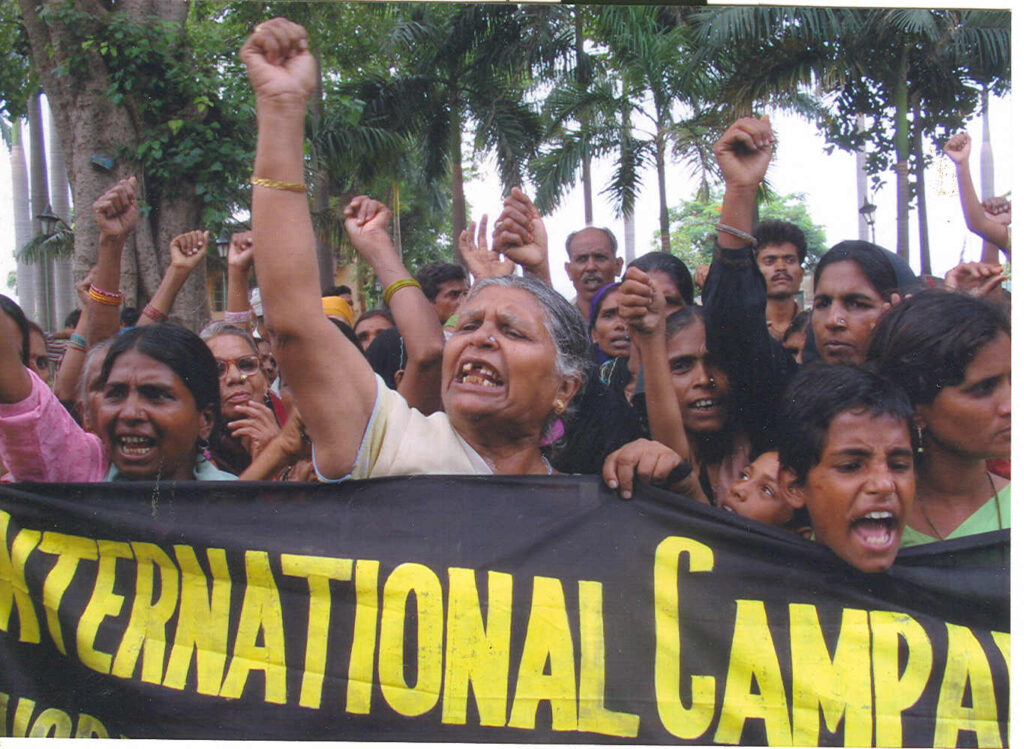
To make their voices heard, women often marched from Bhopal all the way to Delhi, carrying their demands directly into the corridors of power.

Padyatras were an arduous but necessary form of protest for Bhopal gas survivors. They took many marches to Delhi, 750 kms away to make their voices heard/ Rachna Dhingra

The first of these long marches took place in 1989. In 1985, the government introduced an interim pension of Rs 200 and gas survivors had to prove in tribunals that they were indeed ‘gas peedit’. Frustrated by the Madhya Pradesh government’s neglect of gas survivors’ demands, 100 women decided to march to Delhi. “Except we did not know where Delhi was, nor did we have the money for it [the journey],” recalls Rasheeda Bee. Yet the women placed their faith in their leaders: “Aapa aur Didi ne kaha hai, toh chalo (aapa and didi said let us go, so we were off),” they said and set off, many with young children in tow.

It was a sweltering June, and the tar on the roads melted and stuck to their feet. The women improvised, wrapping leaves around their feet as makeshift slippers. The milestone read: Delhi – 750 km. Along the way, they encountered bandits in the Chambal ravines, who offered support. “We would have accompanied you and raised our voices with the Prime Minister too if we could, they told the women, handing them Rs 450 for food.

After 38 grueling days, the women reached Delhi and set up camp at India Gate. About 25 of them went to meet Prime Minister Rajiv Gandhi, only to learn that he was on a fortnight long tour to Paris. They were instead advised to meet Chief Minister Vora, who they managed to meet 10 days later in the capital. He assured them that their demands would be addressed. That was the last time they saw him, says Rasheeda.

“We thought he is the chief minister and he tells the truth. Us din humein samajh aaya ki mukhyamantri toh jhooth ke bane hote hain (we realised that day that chief ministers are made of lies),” Rasheeda recalls wryly. 

 The women of Bhopal marched again in 1990 after the 1989 judgement quashed criminal proceedings against Union Carbide CEO Warren Anderson. In 1991, the Supreme Court reinstated the case against Anderson and other officials. In 2002, they marched to Delhi once more when the then home minister LK Advani directed the CBI to seek dilution of the charges against Anderson from culpable homicide to criminal negligence. They sat on a hunger strike for 21 days, following which the magistrate’s court in Bhopal reinstated the charges against Anderson and ordered his extradition to India.

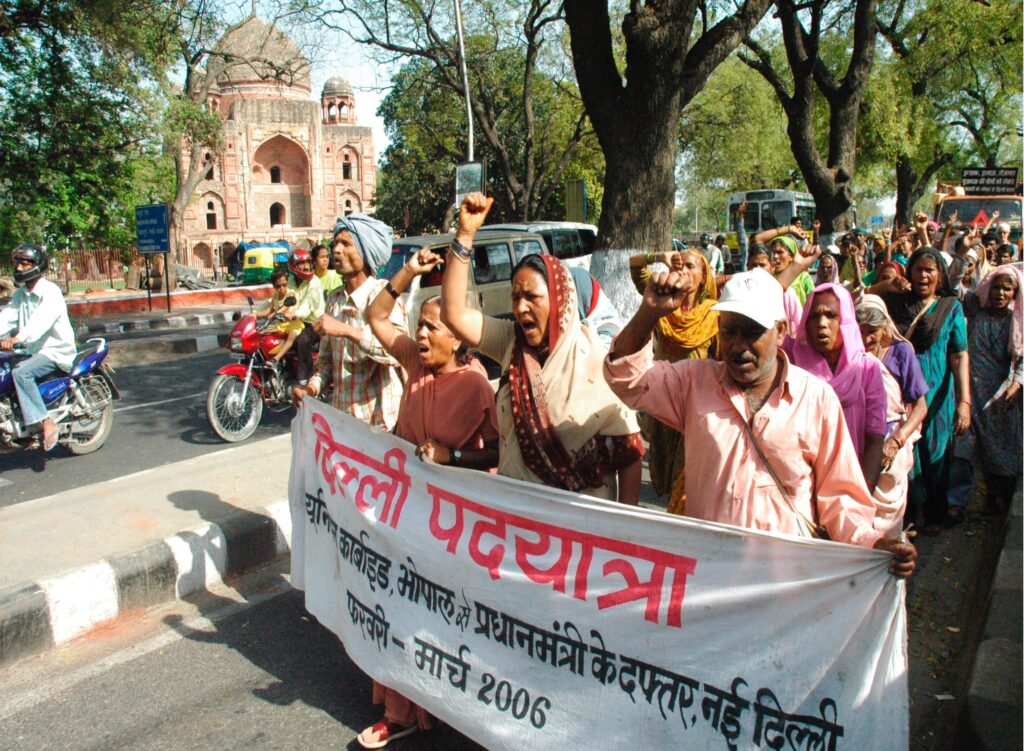
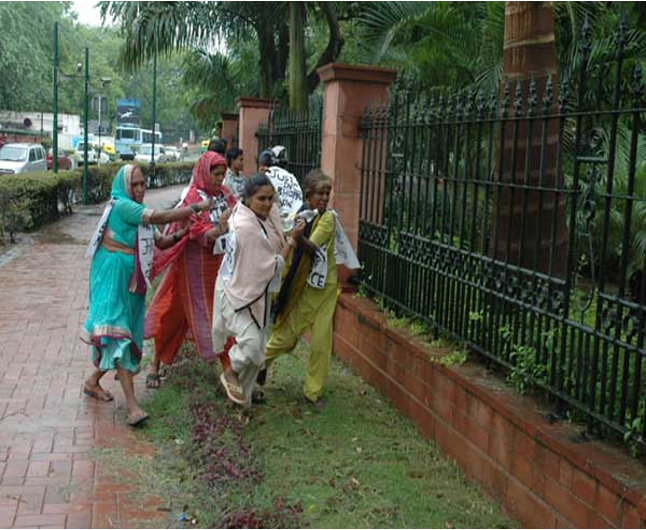
In 2006, women from Bhopal marched to Delhi and chained themselves to the gate outside the Prime Minister Manmohan Singh's residence compelling him to meet with them, the first Indian PM to do so/ Rachna Dhingra

In 2006 and 2008, the women marched to Delhi to demand clean drinking water. Savitri, Leela, Reena, and Rehana took part both times. “We had sores on our feet. People mocked us and the police even filed cases against us,” recalls Reena. In 2006, they met the then Prime Minister Manmohan Singh—the first PM to meet the survivors—and he sanctioned Rs 14 crore to lay pipelines to provide clean drinking water in the contaminated areas. When we mentioned Union Carbide and Dow, he covered his ears and said, ‘Bas, don’t mention those names,’” recalls activist Rachna Dhingra.

From Bhopal To Beyond: The Transnational Fight

The campaign groups realised very early that they had to take their cause globally, especially to the United States of America, where the Union Carbide Corporation (UCC) was registered, and especially as the US government played a big role in shielding the Indian factory was set up with a US government loan, says Rachna Dhingra, an activist of two decades in Bhopal. In 1989, they travelled to the annual shareholder meeting of the UCC to raise the issue of criminal liability. It was the year that the Supreme Court delivered the verdict on fixing the compensation liability at $470 million, 1/7th of the $3.3 billion that the Indian government had sought. Each survivor was to get Rs. 25,000 or $300.

In 2001, when Union Carbide merged with Dow Chemicals, 300 women from Bhopal marched to Dow’s Chembur office in Mumbai and splashed it with red paint. “Yeh Bhopal ka khoon hai (this is Bhopal’s blood),” they declared, demanding that Dow assume Union Carbide’s liabilities along with its assets. The next day, Dow filed a case against the women in the Bombay High Court, seeking Rs 70,000 for cleanup. “Aap humare insaanon ko lauta do, hum zindagi bhar ki kamai aapko de denge (give us back our loved ones and we will hand you our life’s earnings), Rasheeda Bee recalls saying.

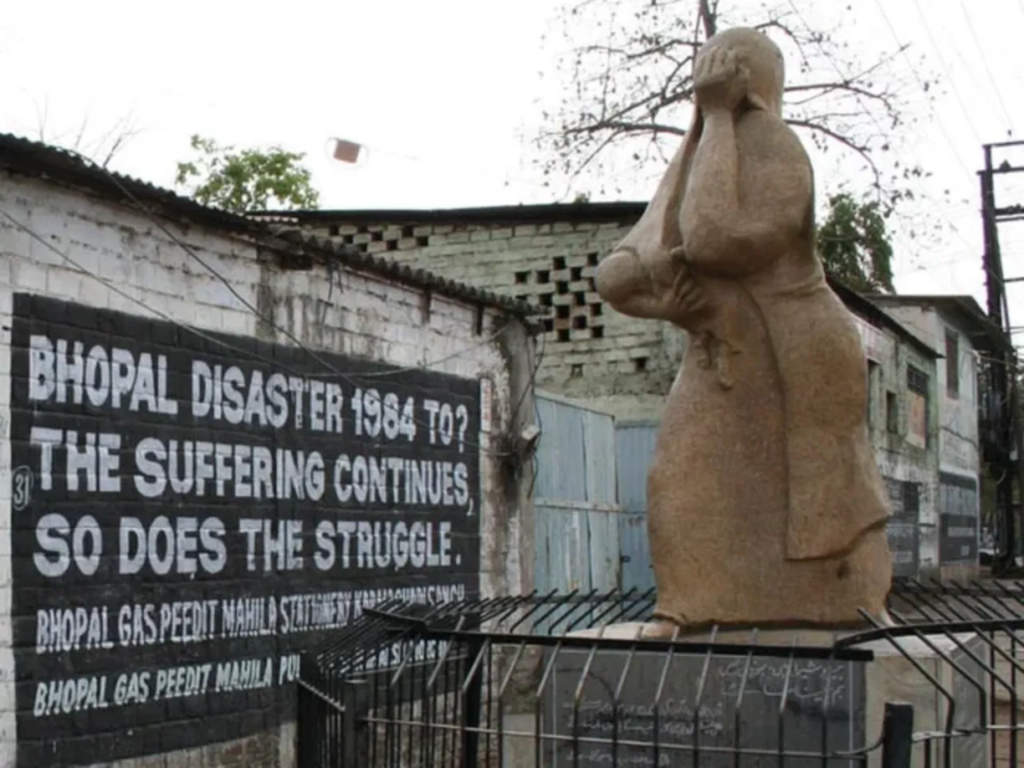
A memorial commemorating the disaster outside the Union Carbide factory/ Rachna Dhingra

Soon, Bhopal’s women survivors took their fight global, exposing Dow’s crimes. In 2003, they traveled to the Free Trade Agreement meeting in Johannesburg and met UN Secretary-General Kofi Annan, joining over 100,000 people protesting corporate environmental crimes.Rasheeda was among the 100,000 protestors who were fired upon by the local police for their demonstration against Dow Chemicals. 

They also launched the ‘Jhadoo Maro Dow Ko’ campaign, wielding brooms symbolically to demand that Dow clean up Bhopal. “Indian women pick up the broom to clean, but also when they are angry,” said Rasheeda. Wherever Dow had offices–in Michigan, Boston, London, Paris, Italy–women raised their brooms, an act that unsettled company officials worldwide. They would land at Dow’s shareholder meetings with their campaign slogan — Clean Up Bhopal.

Among those inspired was Rachna Dhingra, a young business studies student at the University of Michigan, who had met survivors including HH Trivedi, the first attending doctor on the night of the disaster. After graduating, she joined the consulting firm Accenture. Her first client turned out to be Dow Chemicals. She thought she could advocate from the inside and she did. “I tried for two years. and I realised that corporations do not have a soul. Their only allegiance is to their bottom line and profit,” she now says.

Rachna quit her job and moved to Bhopal and she has stood with the survivors in their relentless fight for justice for over two decades.

Innovative Modes of Protest

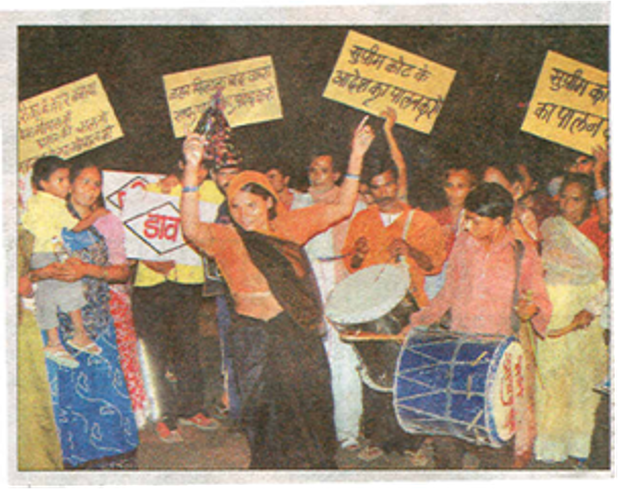
In 2005, even after the Supreme Court directed the Madhya Pradesh government to provide clean drinking water to the contaminated areas, nothing changed. Reena, a survivor whose entire family was disabled and died from the toxic fumes, recalls the frustration. In response, the International Campaign for Justice in Bhopal (ICJB)—comprising five groups—declared: “Ab mantriyon ki neend udate hain (let’s give ministers some sleepless nights).” Thus, the Neend Udaao Andolan was born.

Soon, 250 women locked themselves inside the office of the Director of Gas Relief, refusing to leave until arrangements for clean drinking water were made. A week later, 70 women and men from water-affected bastis went to the residence of Iqbal Ahmed, Principal Secretary of Bhopal Gas Tragedy Relief & Rehabilitation, in an upscale neighbourhood housing senior bureaucrats. They began performing a song they had composed, accompanied by four drummers:

“MP sarkar ka yahi hai funda, mangoge pani milega danda (this is the motto of the MP government: ask for water, and you get sticks).”

When the Madhya Pradesh government failed to comply with the High Court order to provide clean drinking water to the neighbourhoods surrounding the factory, they started an innovative Need Udao Campaign to provoke officials out of their stupor/ Rachna Dhingra

The women repeated the strategy across the city’s VIP enclaves. “We went to the houses of Babulal Gaur, Shivraj Chouhan, Uma Bharti and some would sing songs, some would whistle, others would strike a thali and then we would hide. They were bewildered: ‘Yeh awaaz kahan se aa rahi hai (where is this noise coming from)’,” recalls Nasreen of the Bhopal Gas Peedit Mahila Udyog Sangathan.

In the same year, women tied rakhis to the minister for gas relief operations, Babulal Gaur which said “Bhaiya, apni behno ko jahar sebachao, Kolar ka pani nal se dilao (brother, save your sisters from drinking poisoned water, get them water from the Kolar, a tributary of the Narmada).”

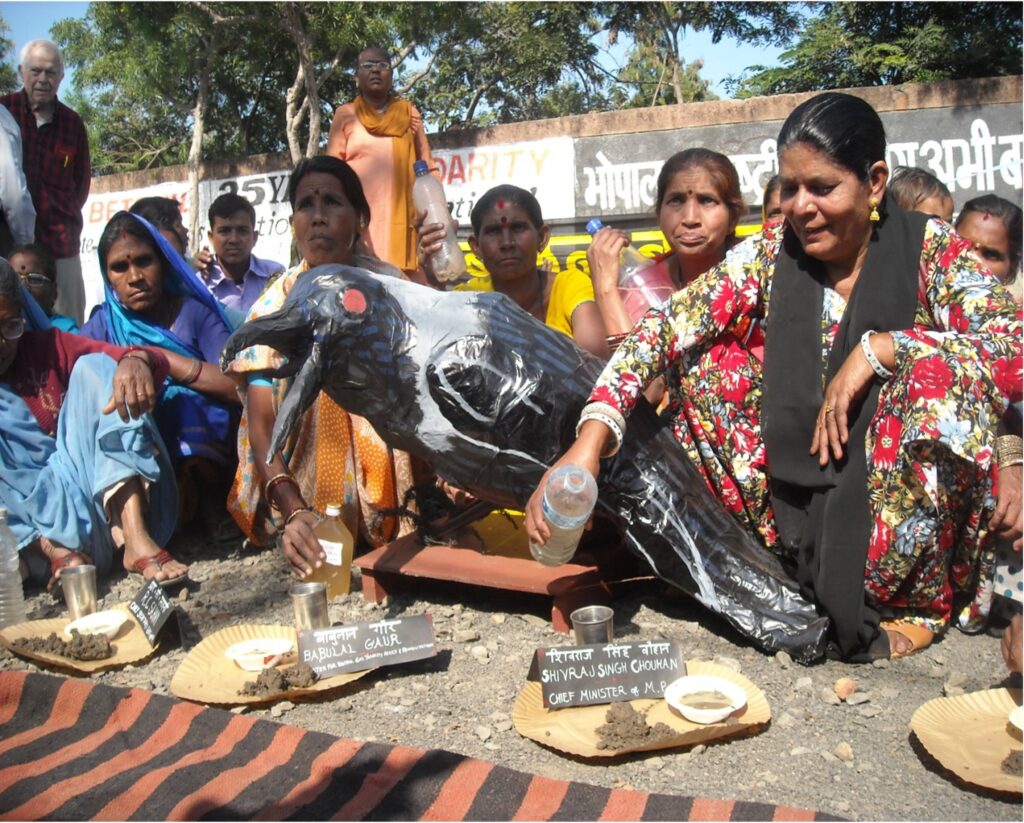
In 2009, when a senior government scientist declared that the toxic waste and contaminated soil at the Union Carbide factory were “harmless,” and the Madhya Pradesh government proposed turning the shuttered plant into a museum, the women responded with defiance. They organised a public feast called Vish Mukti Bhoj (poison-free feast), sending invitation cards to the Chief Minister and his entire cabinet listing the factory’s chemicals as delicacies on the menu.

Menu of the 'Vish Mukt Bhoj', another innovative protest method that women of Bhopal devised to counter the claims made by some scientists that the toxic waste was harmless/ Rachna Dhingra

By 2012, their relentless struggle bore fruit: every household in the 22 affected communities finally began receiving clean drinking water through newly laid pipelines.

Vish Mukt Bho (toxin free buffet) being served to ministers Babulal Gaur, Shivraj Singh Chauhan and others. The black crow is symbolic of lies being dsihed out by the government,said the campaigners/ Rachna Dhingra

Women As Data Collectors

With no reliable data coming from the state, women survivors in the bastis became their own data collectors. In 2006, when the pipeline project stalled despite sanctioned funds, the government installed 5-litre black water tanks as a stopgap measure. Women began monitoring the quantity and quality of water delivered to these tanks, says Sakina, a survivor.

Every Wednesday, they gathered at a nearby factory and prepared detailed monitoring charts, recording exactly how much water each tanker supplied and taking signatures from the drivers. Over time, this meticulously collected information became crucial evidence submitted to the Supreme Court to prove that water provision in the affected areas fell short of UN norms.

Yet the groups struggled to access individual-level data needed to challenge the government’s claims in court about the number of survivors and the extent of injuries. Rehana, for example, lost four members of her family on the night of the disaster. She barely survived—but the state classified her injuries as “minor.” How is that possible? asks Rachna.

“The government’s affidavit claims only 5,297 people died. Yet it pays widow pensions to 5,000 women. How is it logically possible that almost only married men died?” she asks.

To counter this, the campaigners have built an online application to collect verified, household-level data directly from survivors. Rehana’s son and other young people are now trained to gather this community-level information—data that will help strengthen the case for fair compensation in court.

Why Women Continue to Fight

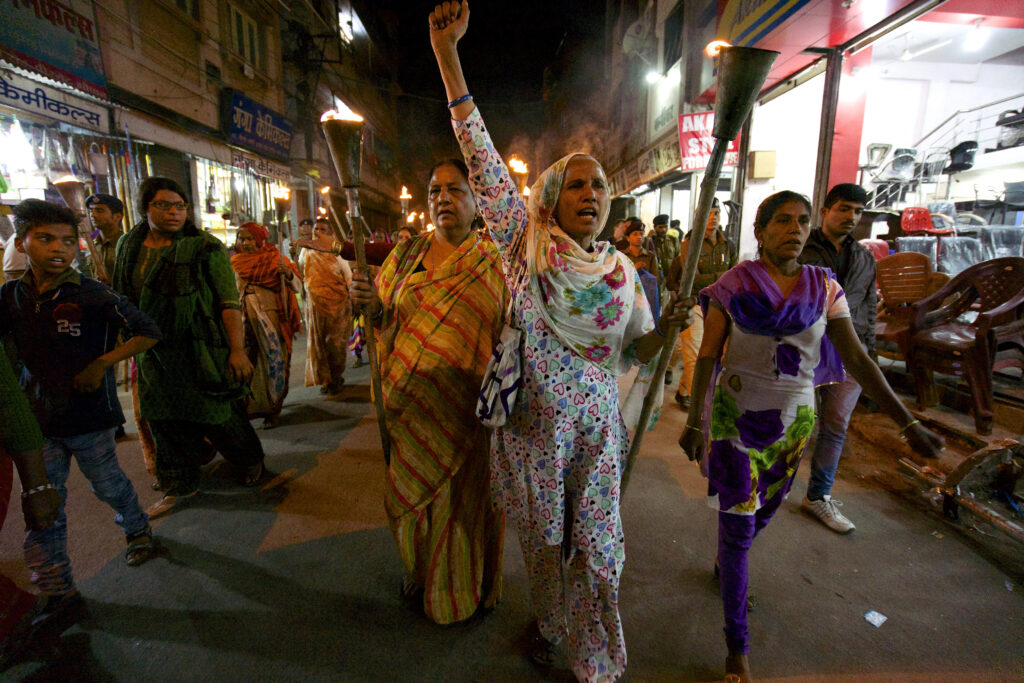
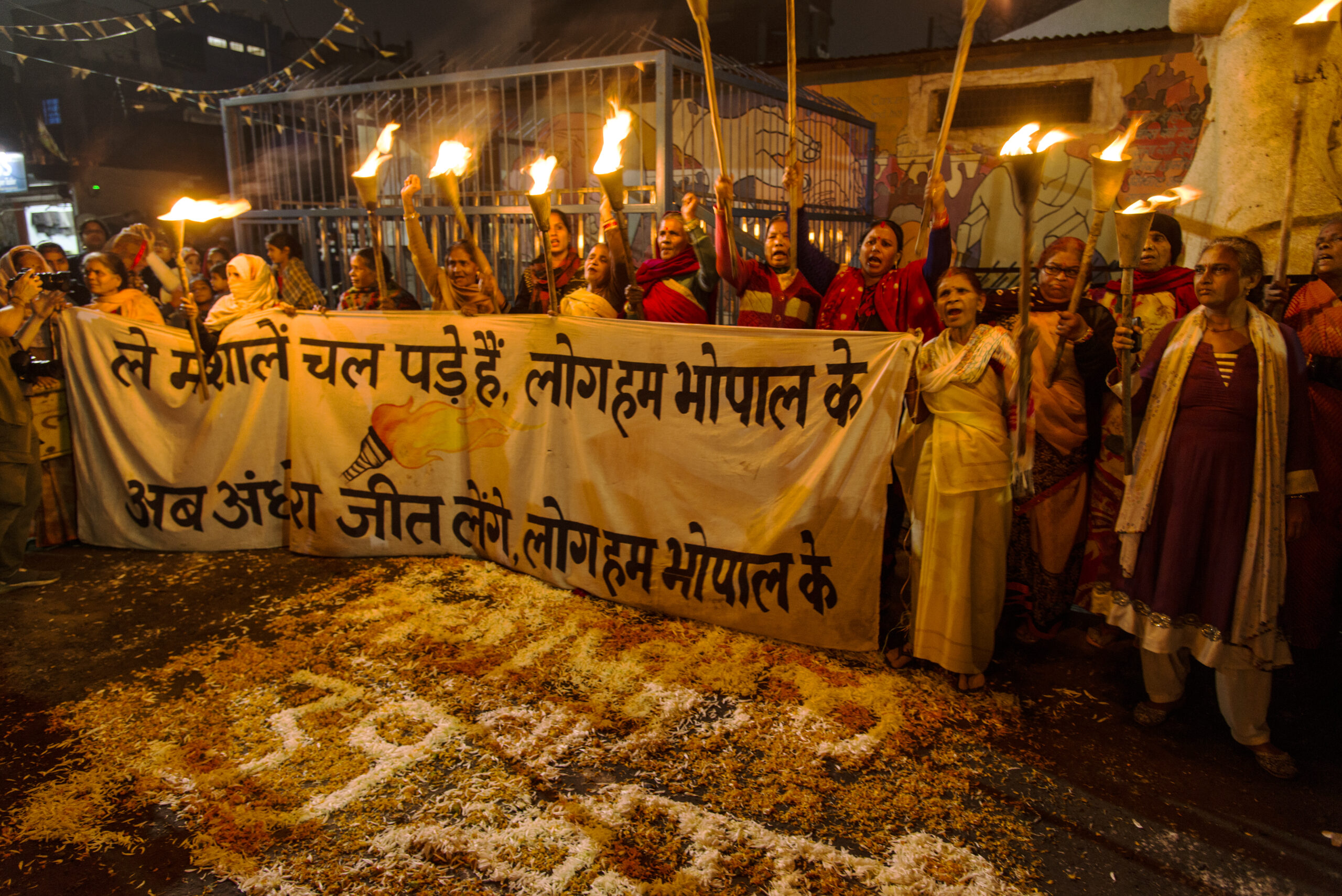
Rasheeda Bee and other women at the 40th anniversary torchlight vigil/ Giles Clarke

Humare saamne teen zaalim hain—company, kendra aur rajya sarkar. Inke paas saare sansaadhan hain. Hamara hausla hi hamari taakat hai (we have three tyrants to confront– the company, and the state and central governments–they have all the resources but we have courage and resolve),” says Rasheeda. Rachna class this a ‘David versus Goliath’ fight.

Her life, she says, has never been easy. Since joining the struggle for justice, she has had to set aside her own needs and dreams. Her husband was incapacitated for many years. “I would leave home at 9 AM and return after 8 PM. Then I would clean him and change his clothes,” she recalls. “Ghar humne upar wale ke hawaale kar diya (we left our home to the Almighty).”

Through grief, illness, poverty, and the heavy burden of caregiving, women have kept the demand for accountability alive. Rachna, for instance, spends four days every month in the courts at Jabalpur and Bhopal pursuing the compensation case for survivors. After 22 years, in October 2023, survivor groups were able to exert pressure on the US Congress to persuade Dow to appear before Indian courts. Yet, the matter of assuming liability for Union Carbide’s crimes and if as an American corporation they could be tried in Indian courts, still remains unsettled. 

It is a long and punishing fight: “Ladai badhti jaa rahi hai,” Rasheeda says. On December 3, 2025—the 41st anniversary of the disaster—Bhopal police filed a case against protestors for burning an effigy of the Rashtriya Swayamsevak Sangh. Yet Rasheeda Bee says she does not feel exhausted; she thinks of the many ways to seek justice.

With men compelled to work to earn a living, much of the responsibility of protest fell on women. They, too, worked for their families, but could take time out to sit on dharnas from morning till evening, to shed purdah and burkha, and to step onto the streets to fight.

Rasheeda has a message for younger generations: “It is good to earn money. But when you go to work for companies, scrutinise them. Check their history. Don’t work for companies that will do what Union Carbide and Dow did to Bhopal. Think of the planet’s future.”

She speaks of the 1,300 children in their Chingari Trust who live with severe deformities. “Every day I wish they could get better—but how?” she asks. “Young people must know how companies spread poison, and how they continue to do so.” In 2004, Rasheeda and Champa Devi set up the Chinagri Trust from the proceeds of the Goldman Environment Prize to treat disabled children affected by the gas tragedy.

For survivors like Batti Bai, the fight is personal. Now 45, she was only four on the night of the disaster. Her mother, father, and brother all died in the aftermath. “My parents saved me by wrapping me in wet blankets that night,” she says. “Whatever little we have achieved has been through this struggle.”

 This fight will not be allowed to flag to make sure that there are no more industrial disasters, says Batti Bai. “Taaki aur koi Bhopal na ho (so there are no more Bhopals),” she says 

  • Bhanupriya Rao is the founder of Behanbox. She is a researcher and advocate on gender and just governance.

Malini Nair (Editor)

Malini Nair is a consulting editor with Behanbox. She is a culture writer with a keen interest in gender.

Support BehanBox

We believe everyone deserves equal access to accurate news. Support from our readers enables us to keep our journalism open and free for everyone, all over the world.

Donate Now