
The Many Little Rebellions Of An Early Malayali Feminist
Excerpts from Kochattil Kalyanikkutty Amma's memoir 'Wayfarer Woman and the Wayside Lamps', translated by historian and feminist scholar J Devika and published by Zubaan Books
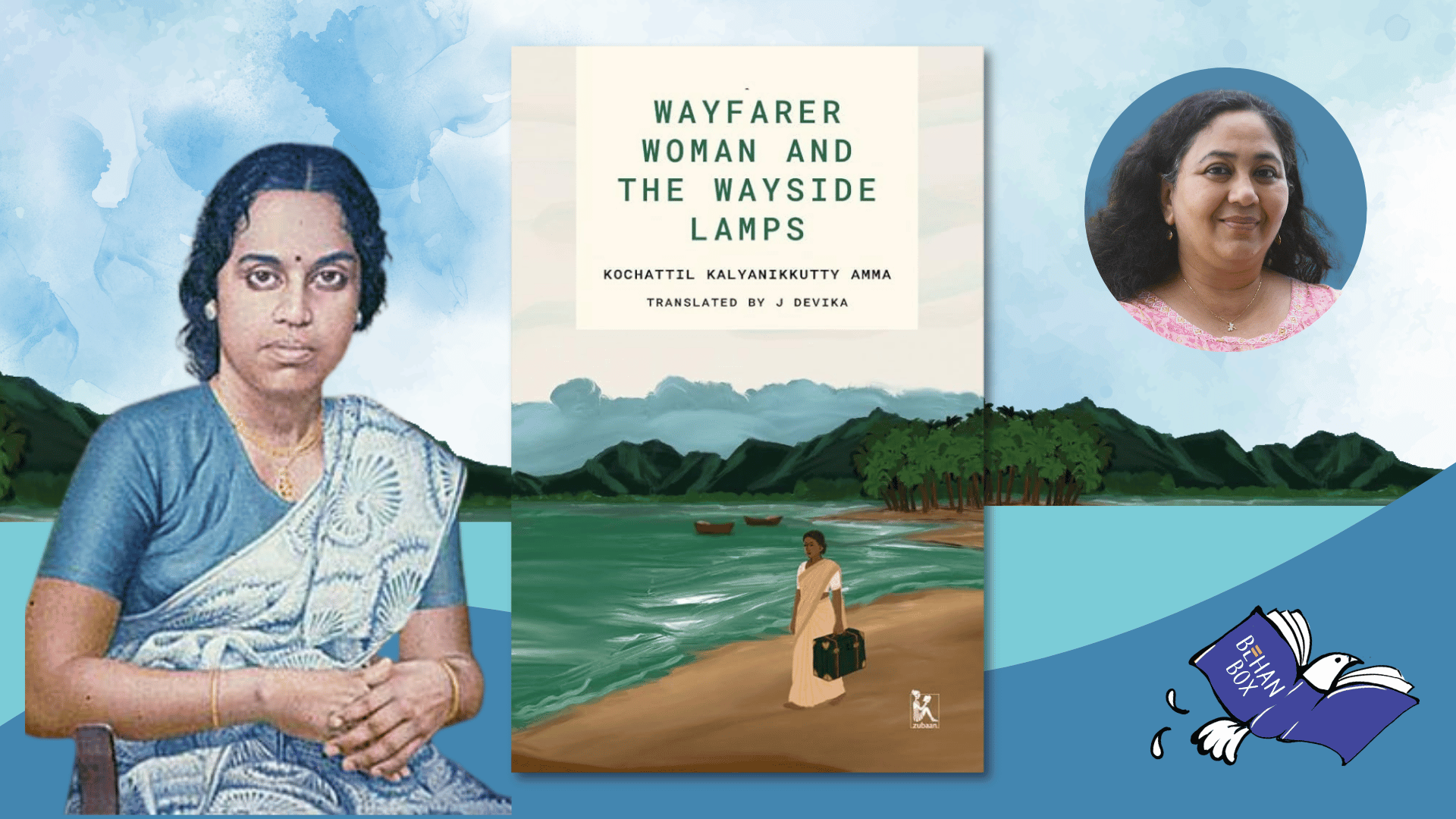
Historian and feminist scholar J Devika has written extensively on what she classifies as the ‘first-generation Malayali feminists’. They were among the first to get the benefit of modern education and question conventional understanding of a woman’s place in society. “This generation had been almost wiped out of regional and national historical memory—we had hardly heard of them in school…At best, they were remembered as ‘achievers’—the first woman to gain a college degree or enter the medical profession, and so on—or at worst, with a tinge of derision, as ‘bourgeois social uplift ladies’, but never as a force of change worth remembering,” says Devika in the introduction to her translation of Wayfarer Woman and the Wayside Lamps, the memoirs of one such pioneer, Kochattil Kalyanikkutty Amma (1908-1997).
Born in an upper-caste Nair family in the town of Thrissur, she studied in Madras, discovering the emerging world of theosophists. She talks about rejecting colonial misrepresentations of India, and her discovery of the world of theosophists. She returned home to become a science teacher but also stayed active in the nationalist movement. Known as a travel writer, her memoirs also talk of her fascinating forays into Europe, recorded in her travelogue, Njaan Kanda Europe (the Europe I saw).
Here are two edited excerpts from the translation published by feminist publishing house, Zubaan Books.
Kamaladevi Chattopadhyay visited Thrissur almost a year and half after I entered government service. She was welcomed at Judge Sri Ayyakkutty’s home in Koorkkanchery. His daughter, Parvaty had studied with me in school and college, and later married Sahodaran Ayyappan. First, my father and then my younger sister was their family doctor, and therefore, our friendship grew stronger.
The memory of Kamaladevi from three years back and of Harindanath’s poetry reading was still fresh in my mind, and so I was very excited when I went to Parvaty’s house for the function that Kamaladevi was chairing.
There were many people from outside Thrissur there; some of them were my relatives. One of them was Miss Onshot, a member of the Brahmavidya Sangham [Theosophical Society] and a native of Denmark, who had arrived in Thrissur some months back to teach locals a mode of exercise known as ‘theorhythm’.
After the meeting, we posed for a group photo, and only after that did those who were not locals realise that a feast had been prepared for us. Those who were not avarna left the place one by one, offering all sorts of excuses.
The food was served by a portly, middle-aged Pulaya woman who was dressed spotlessly. Among those who were seated for the feast were just two non-avarnas— Devaki, who was my student in high school, and myself.
Two days later, our group photo appeared in Sahodaran. The images of Devaki and myself were specially marked, and our names, castes, and participation in the inter-caste dining were mentioned. There was also another photo in the same magazine. It was of a young man with a bandaged wound or heavy bruise on his head standing next to a police officer and some others. The injured youth’s name was mentioned to be C Kuttan Nair. Being incapable of predicting the future, I did not pay much attention to this photograph.
The very next day, sharp criticism of my participation in the inter-caste feast appeared in the newspaper Sudarshanam. Kunnath Janardana Menon, the editor, wrote thus: ‘… this inter-caste dining befits not the daughter of a respectable Nair family; it suits a slut better …’ It was my mother who got to know of this first. She spoke with me, troubled. ‘I do not think what you did is wrong,’ she told me. ‘Among those who now blame you, surely there are many who inter-dine with other castes in secret. But it hurts me to see such things written about you. Couldn’t you wait till someone else did it first?’
I have always found it very hard to hurt my mother. I said: ‘Shouldn’t someone or the other take the initiative? Let it be me, Amme! Please don’t feel sad about this.’ That response made my mother laugh. ‘Alright, never mind! You don’t worry about this,’ she said and ended things there.
But would it end there? My father, the head of the household, remained to be faced. I was standing on the balcony of the second floor of my house and saw someone stride into Acchan’s dispensary, waving an open newspaper. These buildings were next to each other, and I could see quite clearly what went on in the veranda of the dispensary. The moment he stepped into the veranda, the man shouted for my father, ‘Hey, Krishna Menon!’ When my father came out, he asked, ‘Did you read this paper?’ My father knew about the matter—my mother had told him about it in detail the night before. But he pretended not to know and said, ‘No, tell me.’
The man began to read out a news story loudly. I could catch most of it. It was that honourable mention of ‘slut’ which fell on my ears most clearly. The man finished reading out the story. He waited for my father to respond. Acchan replied: ‘My daughter has anyway committed a great crime, hasn’t she? You may cast her out of the jati for it. She and I will settle down here, in this dispensary. And that ends the matter.’
The man left without another word. I had still not reached the real vaitharani, that impassable river of the netherworld…
I spent most hours of the day in school each week. I never sat in the Teachers’ Room in my free time; instead, I taught in the Science classroom or spent time in the Science lab. A few young teachers would come and sit there with me when they were unoccupied. I had good friends among them.
Most of the teachers who occupied the Teachers’ Room were middle-aged. Much debate about the goingson in the world outside happened there. The discussion about my participation in inter-caste dining grew very intense. It was not surprising—this happened six decades back, and conservatives could be expected to react only thus. For some days, their thoughts and chat were all about my future. If I could sit down with an avarna man and dine, some of them reasoned with impeccable logic, I could also marry such a man, and this would be after an elopement.
But they were mistaken in this matter. Two years after this prediction, I married quite publicly someone of my own caste—that is, without eloping with him first and with the full consent of my parents. But in the eyes of my critics, my bridegroom was a terrible wrongdoer. I had only participated in an inter-caste feast. But he? He had, along with the Ezhava leader T K Madhavan, led the Ezhavas to the temple of Thiruvarppu, in an effort to break the caste barrier there against avarna people. He had been attacked by the Nair employees of the temple with a railing from a broken wooden fence; they had wounded him in the head. Seeing this, the Ezhava protestors who were some distance behind tried to advance in anger. TK, who realised that this might jeopardise Gandhiji’s path of ahimsa, flung himself on the ground in front of them. It was a photo of Mr Kuttan Nair who stood with his head bandaged and of the policeman who had wiped the blood off his face that I had seen in Sahodaran magazine.
I have not met TK Madhavan, but my husband always spoke of him very highly. It is known that all protests, no matter what may have provoked them, die down in time. After my presence in the inter-caste feast, I began to be invited to meetings organised by the Ezhavas in places close to Thrissur on the occasion of Sreenarayana Guru Swamikal’s birthday. Also, we know that efforts like the Guruvayoor Satyagraha helped to diminish the opposition to avarna temple entry.
***
The All-India Education Conference that was held in December 1932 in Bangalore was of a standard much higher than any other conference I have ever been to in northern India. The exhibition organised there focused on education, especially the Chemistry section, which was very interesting indeed. Because the speeches and the debates were laced with warmth and humour, the atmosphere was very cordial.
There were excursions too, along with the sessions. We visited the Chamundeswari temple atop the Chamundi Hill, the Sivasamudram waterfall, and the gold mines of Kolar.
At the time of this conference, the city of Bangalore was the very epitome of cleanliness and beauty. The weather was healing to the body and enlivening to the mind. No wonder it came to be called Garden City.
During this conference, one of the blatant lies that the British had spread in the name of Indian History came to be exposed. We not only saw the Hindu temple next to the palace in Bangalore where Tipu Sultan had taken up residence but also the Sriranga Temple, a magnificent artistic wonder that stood next to Tipu’s fort in his capital, Srirangapatnam, and was completely intact. The guide who took us to the fort was a Hindu who could speak English. Inside the walls that surrounded it, there was a place where a heap of flowers covered the ground. He pointed to it and said, ‘This is the place where Tipu Sultan died, fighting valiantly, all alone against the British who had entered his fort through stealth. We cover this ground with flowers to honour him.’ He then pointed to another place a little distance away and said, ‘The Kaveri flows around the fort…’ He continued: ‘There is a shallow spot there. It was Tipu’s Brahmin minister, Poornayya, who showed the British the place so that they could cross it and enter the fort. He had ordered the doors of the fort to be closed from within. Tipu, who was outside the fort and by himself, courageously took on the British force that had gained access to the fort and died in combat. We spit there to protest against the traitor.’
When we told him about the forced conversion that Tipu ordered, his reply was, ‘If Tipu had indeed done that, would you have seen the Sriranga temple like you do now? Our knowledge is that he punished those who forced others to convert.’
So, to what extent is the white man’s Indian History the truth? First, Mir Kasim at Plassey, and later, powerful leaders such as the Pazhassi Raja, Velu Thampi Dalawa, and Tipu Sultan were subdued through using wily traitorous enemies of the nation! How much trouble have they taken to make sure that we do not realise what our country has lost!
It is pertinent to mention here what Dr Annie Besant wrote about British rule in India in her book England, India, and Afghanistan, written in 1879, much before she came to India: ‘…we exploited Hindustan not for her benefit, but for the benefit of younger sons, our restless adventurers, our quarrelsome and ne’er-do-well surplus population. At least for the sake of common honesty, let us drop our hypocritical mask and admit that we seized India from lust for conquest, from greed of gain, from the lowest and paltriest of desires.’
Extracted from Kochattil Kalyanikkutty Amma‘s memoir Wayfarer Woman and the Wayside Lamps, translated by historian and feminist scholar J Devika. The book is published by Zubaan Books in collaboration with the Ashoka Centre for Translation.

We believe everyone deserves equal access to accurate news. Support from our readers enables us to keep our journalism open and free for everyone, all over the world.
