
How A Pavement Book Bazaar Interprets The Way Delhi Is Inhabited
An excerpt from 'The Sunday Book Bazaar: Delhi’s Book Street and the Making of a Reading Public', which offers a tribute to one of Delhi's most permanently impermanent structures: the weekly chaotic book bazaar in Daryaganj
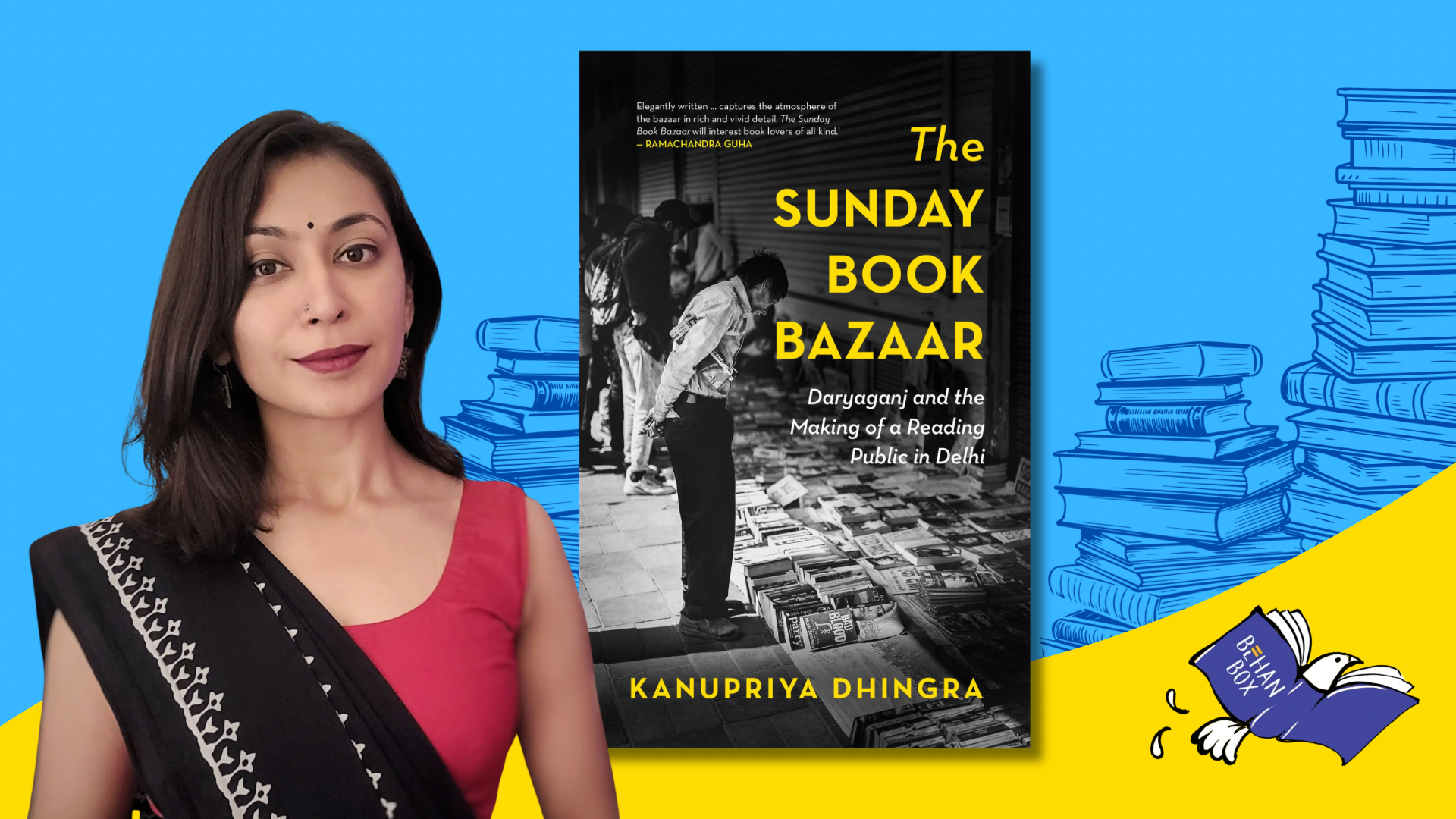
The recently published book, The Sunday Book Bazaar: Delhi’s Book Street and the Making of a Reading Public, authored by Kanupriya Dhingra and published by Speaking Tiger, is a tribute to one of Delhi’s most permanently impermanent structures — the weekly chaotic book bazaar in Daryaganj. In her introduction, Kanupriya points out that this defiant market — with no fixed address, air-conditioning or MRP stickers — must set itself up from scratch every single time. “It has outlasted the shops behind it, the cinema halls that frame it, and every prediction of its disappearance. It keeps returning, as things in Delhi tend to do, in a slightly different form but with the same insistence.” Here is an excerpt from the chapter ‘Patri Rhythms’:
Daryaganj Sunday Patri Kitab Bazaar is, at its core, a dynamic and polyrhythmic space—one in which multiple temporalities, speeds, and movements coexist. To explore the qualitative dimensions of daily practices and the subtle formation of patterns within the bazaar, I used time-lapse photography and handwritten field notes to trace the rise and fall of crowds, the clustering around particular stalls, and the gradual dispersal of people as evening approached.
In this stretch between Netaji Subhash Marg and Asaf Ali Marg, several rhythms overlap: the commercial rhythm of buying and selling books; the devotional rhythm of worshippers; the leisurely rhythm of tourists; the mechanical rhythm of traffic and transport; and the regulatory rhythm of police patrols from the nearby Daryaganj Police Station. As a rhythm analyst, my attempt was not merely to observe movement, but to identify the patterns, repetitions, pauses, and disruptions that structure this space over time. Cyclical rhythms such as seasons and weather, linear rhythms such as publication cycles and educational calendars, and legal as well as cultural interventions constantly shape the texture of the market.
Though rhythm is often understood in relation to music, in spatial contexts it becomes a matter of spatio-temporal organisation, where repetition across time and space produces meaning and memory. The Patri Kitab Bazaar, while possessing its own internal rhythms, also weaves itself into the longer, older rhythms of the street. It neither fully interrupts nor fully conforms to them. Rather, it produces a layered, polyrhythmic atmosphere in which the ordinary is briefly transformed.
Daryaganj has been many things, with or without the presence of the Sunday bazaar. And yet, for over sixty years, the experience of walking down Netaji Subhash Marg or Asaf Ali Marg on a Sunday was fundamentally altered by the presence of books. Though temporary in material form, the bazaar became a permanent fixture in the city’s cultural imagination—not simply as a market, but as a parallel visual, literary, and sensory world.
***
Setting up a stall in the Patri Kitab Bazaar is itself a kind of choreography—a careful negotiation between creativity, commerce, memory, and survival. As the early morning light settles over Old Delhi, booksellers begin assembling their designated patches of ground, aware that their livelihood depends not only on what they sell, but on how they display it.
As street vendors, the booksellers engage with both incidental and intentional buyers. Some arrive with lists, others with only curiosity. To attract both, vendors deploy a range of visual and spatial strategies—honed through years of observation and repetition. The moment when a passerby’s gaze meets a book—when seeing becomes stopping, and stopping becomes browsing—is where the magic of the bazaar unfolds. It is a deeply serendipitous encounter.
Cardboard and iron boxes serve simultaneously as storage and exhibition, bearing the weight of both centuries-old texts and contemporary mass-market paperbacks. Used books, rare volumes, pirated editions, paperbacks, school texts, classics, and mismatched-cover pocketbooks jostle for visibility, spilling beyond the designated 6 x 4 feet of space—sometimes arranged, often in haphazard heaps. The booksellers are faced not just with the task of selling, but with that of curating chaos.
School textbooks and competitive-exam materials are often arranged in orderly stacks, signalling seriousness and efficiency. These books must be seen clearly—their titles, boards, editions, and class levels instantly legible to students preparing for tests and to guardians making calculated, time-bound purchases. Visibility here is not a luxury but a requirement: a fraction of hesitation might mean losing a customer to the next stall. The neat stack, then, is both practical and rhetorical. It announces relevance, authority, and urgency, insisting that this is not material for meandering or discovery, but for necessity.
Fiction, on the other hand, tends to flow in unrulier heaps, offering itself more to chance than to order. Non-fiction, old paperbacks, pirated editions, and ‘books per kilo’ often disappear into these loose piles, where covers collide and familiar names surface only halfway, like remembered lines of verse. What may appear as disorder is, in fact, an intentional dispersal—a carefully cultivated mess designed to slow the body down. The buyer must stop, crouch, touch, and sift. Desire is awakened not through immediate recognition but through accident, intuition, and sudden nostalgia. The randomness here is well-intended, part of a seller’s embodied skillset, honed over years of watching how hands move, where eyes linger, and which gestures turn curiosity into purchase.
Over time, regular buyers learn to read these arrangements— to distinguish between the stalls where covers are displayed faceup and those that guard their treasures beneath layers of dust and dog-ears. This knowledge forms a silent literacy of space, quite separate from the formal logic of a ‘proper’ bookstore, one that privileges wandering over efficiency and sensation over order. In such spaces, reading begins long before a book is opened.
Unlike the fixed threshold of a formal bookshop—a door, a counter, an interior—the books on the patri mark territory through their very presence. Minimal structure, maximum provision. The stall exists somewhere between openness and occupation, between public and claimed. Rare books are given prominence at eye level, while more obscure titles wait quietly lower down, for the one reader who might recognise their value.
Handwritten signs float above the chaos: ‘Ek Dam’, ‘Sale— 50/-’, ‘Fix Price Matlab No Tension’, ‘Kripya Mol Bhav Na Karein’, ‘Self Service’. These placards are both instruction and performance, humour and assertion. Located near landmarks like Delhi Gate or the Delhi Gate Metro Station, the stalls become textured literary islands in an otherwise overwhelming cityscape.
In fact, Delhi Gate Metro Station (Exit 3) now operates as one of the bazaar’s newer entry points, a site where booksellers have been compelled to cultivate an especially acute form of spatial intelligence. In the years when the station was still under construction, the area was a continuously mutating landscape — churned earth, exposed pipes, skeletal pillars, and temporary fences that appeared and vanished without warning. Pavements were not merely blocked but undone. Routes that had once guided regular footfall dissolved into dust and debris. Yet the sellers returned each Sunday, reading the altered terrain with the kind of attentiveness usually reserved for changing tides. A slab of concrete left at the edge of a trench, a strip of ground spared from excavation, the brief widening of a corridor between barricades—these became provisional platforms for display. The bazaar did not resist disruption so much as it learned to think with it, folding the chaos of construction into its own weekly choreography.
When the station was finally completed in 2017, the environment was not so much restored as re-scripted. The Metro brought with it a new tempo of circulation: faster bodies, heightened surveillance, redefined notions of ‘public’ and ‘unauthorised’ space. Entry and exit points funnelled pedestrians along narrow, predetermined routes, often at odds with the slow, meandering logic of browsing. In response, the sellers recalibrated their presence. Stalls became more compact, stacks more vertical, layouts more strategic. Some edged closer to the flow of commuters, courting chance encounters; others retreated slightly, preserving pockets of stillness where regulars could squat and search uninterrupted. Infrastructural completion, in this context, did not signal security, but instead introduced a different kind of precarity—one governed by regulations, complaints, and the constant possibility of removal.
What emerges here is not simply a story of survival, but one of relational practice. The sellers were not passive occupants of a contested footpath; they were interpreters of the city’s changing grammar. They observed how bodies moved, how eyes travelled, where attention snagged, and adjusted their arrangements accordingly. Through these embodied calculations, a fragile but persistent ecology took shape. The bazaar endured not only because the city made space for it, but because its sellers repeatedly, quietly, and inventively made space for themselves. This resilience is central to understanding the bazaar—it is not just about books, but about persistence as a mode of inhabiting the city.
For the seasoned visitor, navigating these layered paths becomes ritual. They know where bargains lie, where first editions hide, and where negotiation is futile. For the first-time wanderer, each corner becomes an encounter—each stall a potential discovery. In this ever-shifting architecture of cardboard, rope, tarpaulin, cloth, and chance, the act of stall sajana emerges as an aesthetic, spatial, and economic practice. These temporary arrangements are never merely functional. They represent micro-architectures of knowledge and hope—built each Sunday with the full awareness of their impending dismantling. Each stall holds within it a strange balance: care and commerce, attachment and pragmatism, memory and impermanence.
For those who return week after week, the thrill never fades: the knowledge that somewhere, amid dust, paper, and disorder, a forgotten text might still be waiting—patiently—to be found.



We believe everyone deserves equal access to accurate news. Support from our readers enables us to keep our journalism open and free for everyone, all over the world.
