
Voice as an Unruly Force
An excerpt from a new book on female playback singers in Bombay cinema, and how Asha Bhosle’s malleable voice whispered and breathed life into these
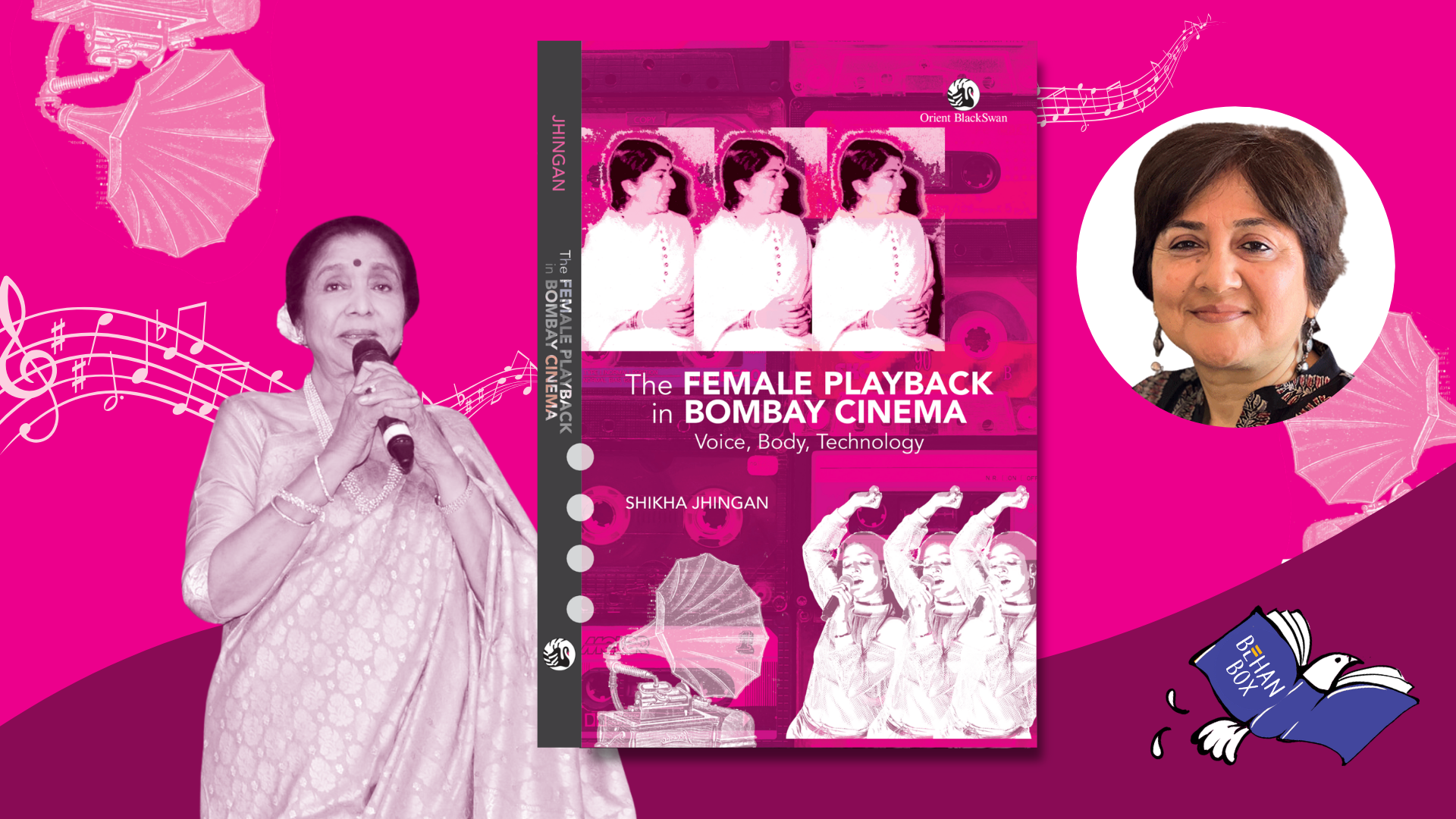
How did Bollywood use the female playback singer’s voice to embody characters such as courtesans, vamps, crooners, classical musicians, folk performers and street singers? What kind of nuances and underlying messages did these voices carry and how did they change over the years? Shikha Jhingan, a scholar of cinematic studies, explores these questions in her recent book, The Female Playback in Bombay Cinema: Voice, Body, Technology published by Wayne State University Press. We bring you an excerpt from the chapter on ‘Courtesans, Vamps, Crooners, and Street Singers’ that focuses on the dark and frenzied cabaret songs of the 1970s and how Asha Bhosle’s malleable voice whispered and breathed life into these.
In terms of both aural and visual registers, the space of the nightclub was reconfigured by the end of the 1960s through the staging of the cabaret song. Staged in hotels and nightclubs, cabaret numbers were crafted by creating a geography of illicit passion as the dancer moved across tables, forging a tactile relationship with the guests. The performance of the lead dancer simulated desire and danger in the spatial setting of the nightclub. As Mazumdar (2007, 88) notes, “violence, intrigue, death and sex lurk[ed] close to the vamp” as her bodily performance was staged to create “both revulsion and fascination.” I would like to demonstrate a marked transformation in the sonic field through dramatic, frenzied musical arrangements and an unusual shift in scale and tonalities in the playback voice in the films of the 1970s. This involved an enactment of sharp moral binaries between the heroine and the vamp figure seen in songs like “Mera naam hai Shabbo” (My name is Shabbo) from Kati Patang (Samanta, 1971). Moreover, the cabaret song was stripped of the overlapping tonalities of chorus voices, the rhythmic clapping, or the sound of the castanets that made the earlier nightclub an inclusive and lighthearted space for modern girls. This distinct shift in sonic registers was indicative of the seething sexual energy displayed by a lone female figure dancing to music with dark undertones. Though Asha Bhosle had already established herself as a versatile singer with a facility for sensuous songs, it was in this decade that she acquired a monopoly over cabaret numbers. The introduction of multiple- track recordings in the Bombay film studios in the 1970s also played an important role in the creation of soundtracks with greater density (Booth 2008). Marked by the use of unlimited bass, experimentation with scale, variations in rhythm, and the use of whispering, breathing, tittering, and grunting sounds, Asha’s malleable voice worked as an unruly force to produce the space of the nightclub. Unlike the nightclub songs of the 1950s and the early ’60s, the cabaret was now introduced through an extended musical section accompanied by fragmented shots of the dancer’s body. Choreographed movements like slithering, crawling, or lying on the floor or on a rotating deck became part of the dancer’s repertoire of gestures. This contact of the body with the floor was combined with overwhelming shifts in the scale of the voice with an emphasis on the lower registers.
The themed acts depicted in the cabaret numbers of the 1970s that spectacularized racial violence were often borrowed from the nightclubs of Paris. “Aa janane ja,” from Intaqam (Nayyar, 1969), a sensational number sung by Lata Mangeshkar, presents Helen with an ostrich feather fan, contact lenses, and exaggerated makeup as she starts enticing an encaged black- faced man. After an extended instrumental section with frenzied use of brass and string sections, Lata’s voice is introduced with an elongated vowel sound of Aaaaa, in a low register, bringing out the sensuality of the voice. The elaborate set, lighting, costumes, and diegetic presence of a brass band formed an important backdrop for Helen’s sensuous but highly intricate body movements, including slithering on the floor. The song illustrates Usha Iyer’s (2020, 18– 19) argument about the scaling of the production number in terms of its music, dance choreography, set design, and camera movements, to match the movement vocabularies of an accomplished dancer. The playback singer’s persona is stretched to “intensify the display of the female body,” especially when the body is that of an “acclaimed dancer.”
Kelley Conway (2001, 135) has elaborated on the cabaret song sequences of French films of the 1930s, incorporating live popular entertainment forms such as chanteuse réaliste, drawing upon the cabarets of Montmartre that emerged in France in the late nineteenth century. This realist genre became a shorthand for “female transgression” by depicting the lives of prostitutes navigating the Parisian underworld, and voicing “the intense emotions of sexual desire, melancholy, and despair” (137). In the cabaret songs of Bombay cinema, however, the song’s structure; the elliptical, staccato style of singing; and the inclusion of nonverbal breathy sounds created a fragmented aural terrain. In “Mera naam hai Jameela” (My name is Jameela) from Night in London (Brij, 1967), Helen enters the nightclub in a latex raincoat with her face covered by a parasol. As she turns to the camera, we see her lip- synching to Lata’s utterance of her name “Jameela, Jameela”.
The traditional use of refrain/mukhda with meaningful lyrics is delayed by an extended instrumental section backed by Lata’s voice singing the ‘O’ vowels. The fragmented style of vocal production, with an accent on breath as part of the song’s rhythmic style, signals a breach between what is captured on- screen and what remains veiled and unarticulated. In several cabaret numbers, the choreographic style is woven around a dark narrative theme: we see backup male dancers violently pinning down the female performer on the floor as the lead dancer moves to set herself free of their clutches. In “Mera kya sanam, meri khushi hai tumhari” (Oh what of me? My happiness is linked to yours) in Talash (Ralhan, 1969), a set piece captures Rita/Helen, a lone female figure, dancing with a group of men who appear intimidating, violent, and exhilarating all at once. Asha’s voice constantly moves between a deep, somber, and restrained quality and excessive and frenzied energy, thus playing a crucial role in producing the space of the nightclub, overlaid with danger and excitement. The alternating visual strategy of revealing and blocking our view in several songs is created through lighting, swish pans on bare fluorescent- colored surfaces, and blurred movements. In “Meri jawani pyaar ko tarse” (My youthful self is thirsty for love) in Upasana (Mohan, 1971), we are introduced to Helen slithering on the floor and moving toward her object of desire, a sculpted figure of a well- built, muscular, dark- skinned man. Following the mukhda, Helen wraps her body around this sculpted figure, proceeding to kiss him on the lips. The lights go off, followed by a swish pan, as we return to Helen’s moving body framed behind the sculpture, denying us an unrestrained view. In the next shot, Helen enters the frame laughing seductively. This sexualized laughter became a hallmark of Asha Bhosle’s vocal strategy in cabaret songs.
Bhosle’s vocal performances, deployed with volatile movements in pitch, volume, and timbre, played a crucial role in crafting the soundscape of the nightclub. We can compare this to the female vocality of confessional songs, where the lyrics, melody, and use of sustained notes worked to bring out the interiority of the woman. In the cabaret song, the aural strategies of fragmentary voice, language, breath, and pitch enable the woman to express both pain and pleasure. In the song “Kaanp rahi main” (I tremble, I shudder) in Joshila (Chopra, 1973), however, Asha’s vocalization of a scream foregrounds the dark undertones of the nightclub. This cabaret number is introduced in the film when the hero (Dev Anand) learns through a newspaper advertisement that his sister (Padma Khanna) has become a nightclub dancer. Once again, the scream in the sonic landscape alludes to much more than what can be revealed in the visual frame. This connects with Chion’s argument that the screaming stands for “unrepresentability inside representation” (1999, 77). The song opens with Asha’s scream on the soundtrack in sync with a close-up of Padma Khanna screaming and running toward the camera. The scream repeated in each antara of the song alludes to rape, subtly addressed in the lyrics of the song and the choreographed movement of Padma Khanna and her male accomplice. An image of Padma Khanna lying on her back on a circular deck, slithering in rhythm, is repeated in the song sequence several times. Asha sings the mukhda in a mellowed tone at a lower range while she sings the antara at a higher octave, accompanied by a sudden frenzied shift to a faster tempo in the drum section. Crucial here is the way the music/rhythm and Asha’s disjunctive voice gesture toward the experience of the dancing girl, exceeding the moral overtones of the narrative.
In Anamika (Jalani, 1973), themes of rape and violence are introduced in “Aaj ki raat koi aane ko hai” (Tonight I will have a visitor), where we see Helen performing an act as part of her cabaret in a nightclub. The setting is of a lone woman who, while waiting for her lover on a rainy night, is accosted by a lewd man. In the first interlude, she manages to shake him off with the help of a policeman, who looks at her with suspicion. The vocal inflections of “Shugu shugu shugu” and “na na a na,” performed by Bhosle, simultaneously articulate both desire and aversion. In the second interlude, which lasts for almost two minutes, the wait continues, and the lewd man returns and pushes Helen into a telephone booth. What happens inside the booth is left to the imagination of both the on- screen and off- screen spectators. Though the cabaret sequence mirrors the sexual violence that the heroine is trying to escape, its presentation is mounted as a spectacle to entertain the guests at the nightclub. Since rape narratives could never be directly or fully explored, a dual register of masking and revelation emerged through an evolved and orchestrated performance. In this, Asha’s unique vocal performativity showcased frenzied scale, rhythm variations, and unusual shifts from whispering and breathing sounds to a full- blown sonic attack. These sound variations played a significant role in alluding to the ellipsis between the main narrative and the minor voice of the vamp, and the oscillation between pain and pleasure.
Asha’s sonic register in the nightclubs of the 1970s resonated in several other songs, like “Dum maro dum” (Take another drag) from the film Hare Rama Hare Krishna (Anand, 1971), where she lent her voice to Zeenat Aman’s uninhibited dance movements. The song became an instant rage with the new generation, as it captured the youthful defiance associated with the late sixties The female voice’s use of the lower registers in “Dum maro dum” was striking. The mukhda of the song was teased out in the lower range while at the end of the refrain “Hare Krishna Hare Ram” was repeated by the chorus in the higher octave. In the interlude, Asha’s higher- octave singing of “tar a ri ra a ra ri,” or rhythmic syllables, is cut to exterior shots, providing us a sense of the incredible reach of her voice. In this sonic flow, we see the voice liberated “from the constraints of formal singing,” bringing to the fore a dynamic sense of being (Biswarup Sen 2008, 95). The architectural space mapped by Asha’s voice extends and defies the space mapped by the camera. While following the sonic trace of the voice, Zeenat’s brother, played by Dev Anand, arrives at the hippies’ shack. In the antara, “Duniya ne hum ko diya kya? Duniya se humne liya kya? Hum sub ki parvah kare kyon, sab ne hamara kiya kya?” (What has this world given us? What have we ever got from this world? Why should we care for others, what have they done for us?), Asha again sings at a high pitch, giving the lyrics a dramatic edge, and then glides down to return to the original scale by singing extended vowels— “aaaaaa.” When we return to the line “Dum maro dum,” we see a calmer Zeenat Aman smoking a chillum, sharing it with her hippie friends, conveying the visceral effect of her intoxication. Adding to the innovative registers of the song is its mise-en-scène, with the song located among a group of hippies in a night shack in Kathmandu. A constantly moving camera deploying pan, zoom, and tracking shots, and an out-of-focus shot coming into focus, creates a psychedelic effect, underlining the song’s raw and edgy character.
In Hare Rama Hare Krishna, R. D. Burman introduced Usha Uthup to sing “I love you,” a duet with Asha that has been described as an “extra cheese” version of “Dum maro dum” (Bhattacharjee and Vittal 2011, 113). What is interesting about the song is its unbounded structure and spirit, with Asha singing for Zeenat Aman in the upper octave and Usha in the lower for a white hippie woman, one in the crowd who sings and dances with Zeenat in the Kathmandu night shack. The lip sync to Usha Uthup’s lines is casual, reinforcing the industry norm of making a distinction between “minor” voices and playback stars. However, the inclusion of her baritone voice itself is an important landmark pointing us toward R. D. Burman’s innovative approach to vocality in songs.41 In his analysis of R. D.’s music of the 1970s, Pankaj Rag has referred to the underlying psychic impulses in his music. According to Rag (2006, 637), through the use of unlimited bass in voice, experiments with scale and rhythm, and the introduction of whispering, breathing, and grunting sounds, R. D. brought out the alienation and edginess of the urban youth as well as their rejection of outmoded expressions of sexuality and love.
What is often missed in these analyses is R. D. Burman’s use of female vocals in the opening credit sequences of crime films like The Train (Nagaich, 1970, Usha Uthup); Caravan (Hussain, 1971, Asha Bhosle); Raja Rani (Bhowmik, 1973, Asha Bhosle); and Shaan (Sippy, 1980, Usha Uthup), declaring a new sensibility that combined urbanity with modernity. In these musical sections, Asha used an unusually bluesy low- pitched voice, synchronized with the fast- paced music to draw attention to crime in the city, thus setting the pace for things to follow. In Raja Rani, Raja (Rajesh Khanna) runs through the streets of Bombay chased by the police at night, as Asha and Bhupinder’s voices map the cityscape with “Jab andhera hota hai” (When it gets dark) marking it as a place of danger, anxiety as well as adventure. The track opens with an eerie sound of the vibraslap, followed by heavy use of brass, lead voice, and a frenzied tempo that creates movement as well as rhythm to match Raja’s escapades in the city, jumping across rooftops, scaling walls of buildings, and running along the streets. The moon at night, a recurring motif in the films of the 1950s, is no longer a witness to the dalliance of young lovers; the cinematic night in film songs is explored as a site of sexual transgression and ambivalent morality. The voice of the nightclub dancer hitherto confined to the interiors of the nightclub explodes out on the streets in this new constellation of bodies, voices, and urban spaces.
By subtly pushing similar vocal tonalities for both the cabaret dancer as well as the heroine, R. D. managed to push the boundaries further. The use of whispering by the female voices needs to be seen in the context of the promiscuous quality of sound as well as a sign of lived, desiring bodies. Lata’s embodied performance in “Bahon mein chale aao” (Come into my arms) in the film Anamika (Jalani, 1973), visualized on Jaya Bhaduri, shows how she adapted to Burman’s style to bring out a somatic performance with a whisper-like tone. Performing the song in the middle of the night in a bedroom, Jaya invites Sanjeev Kumar for a romantic dalliance. Lata’s susurrant tone draws attention to both the space of the enactment and the off- screen space that lies outside. This is further accentuated by Sanjeev Kumar’s use of “shu shu shushu” at the end of each refrain, asking Jaya to keep her voice low, gesturing to the listening bodies outside the bedroom oblivious to this clandestine encounter. The interweaving of verbal and nonverbal sounds lent spatiality to the voice, providing us with a sense of space located both inside and outside the privacy of the bedroom.
Works Cited:
Mazumdar, Ranjani. 2007. Bombay Cinema: An Archive of the City. University of Minnesota Press
Booth, Gregory. 2008. Behind the Curtain: Making Music in Mumbai’s Film Studios. Oxford University Press
Iyer, Usha. 2020. Dancing Women: Choreographing Corporeal Histories of Hindi Cinema. Oxford University Press
Conway, Kelley. 2001. “Flower of the Asphalt: The Chanteuse Realiste in 1930s French Cinema.” In Soundtrack Available: Essays on Film and Popular Music, edited by Pamela Robertson Wojcik and Arthur Knight. Duke University Press
Chion, Michel. 1999. The Voice in Cinema. Translated by Claudia Gorbman. Columbia University PressSen, Biswarup. 2008. “The Sounds of Indian Modernity: The Evolution of Bollywood Film Song.” In Global Bollywood: Travels of Hindi Cinema, edited by S. Gopal and S. Moorti
Bhattacharjee, A., and Balaji Vittal. 2011. R. D. Burman: The Man, the Music. Harper Collins
Rag, Pankaj. 2006. Dhunon ki yatra. Rajkamal.
The book was published by Orient BlackSwan, South Asia edition.




We believe everyone deserves equal access to accurate news. Support from our readers enables us to keep our journalism open and free for everyone, all over the world.
