[Readmelater]

Never Counted, Now Erased: How SIR Is Excluding Delhi’s Nomadic Gadia Lohars

The ongoing SIR phase of notices and objections in Delhi is punishing the tribal community of Gadia Lohars for their historically nomadic life
Read other reports as part of our SIR coverage here. For leads, queries, and suggestions, write to us at editor@behanbox.com.

“Hamara vote kyun kaat rahe ho, notice kyun bhej rahe ho? Hum kahan se laayen 2002 ke kaagaz? (why are you deleting our names from the voter list, sending us notices? Where are we supposed to get our 2002 documents)?” asks Matra, a resident of the Gadia Lohar basti in Delhi’s Mangolpuri area. Her question is for the Election Commission’s ongoing Special Intensive Revision (SIR) process in the capital city that has knocked 32.8% of voters off its draft roll. 

Now in her 60s, Matra is one of the 38 in the basti of 45 voters (booth no, 50, serial no.207-245) to be served notice for being “unmapped with the last SIR”. This means that while their enumeration forms were filled and submitted on time, they could not establish their or their parents presence in the 2002 electoral rolls, when SIR was last conducted. 

Gadia Lohars are one of the many NT-DNT (Nomadic and Denotified Tribe) communities scattered across India. Though these communities once led highly nomadic lives as ironsmiths and acrobats, many of them are now seeking a more settled life in the periphery of cities in makeshift tents and in jhuggi settlements like the one in Mongolpuri. Historically neglected by all State systems, the SIR has been particularly brutal for the community.

This was the Gadia Lohar basti we visited, just off the main road leading to the bustling trade centre of Patthar Market in Mangolpuri, to understand how the election apparatus is approaching the NT-DNT community’s marginalised existence and the question of their citizenship.  

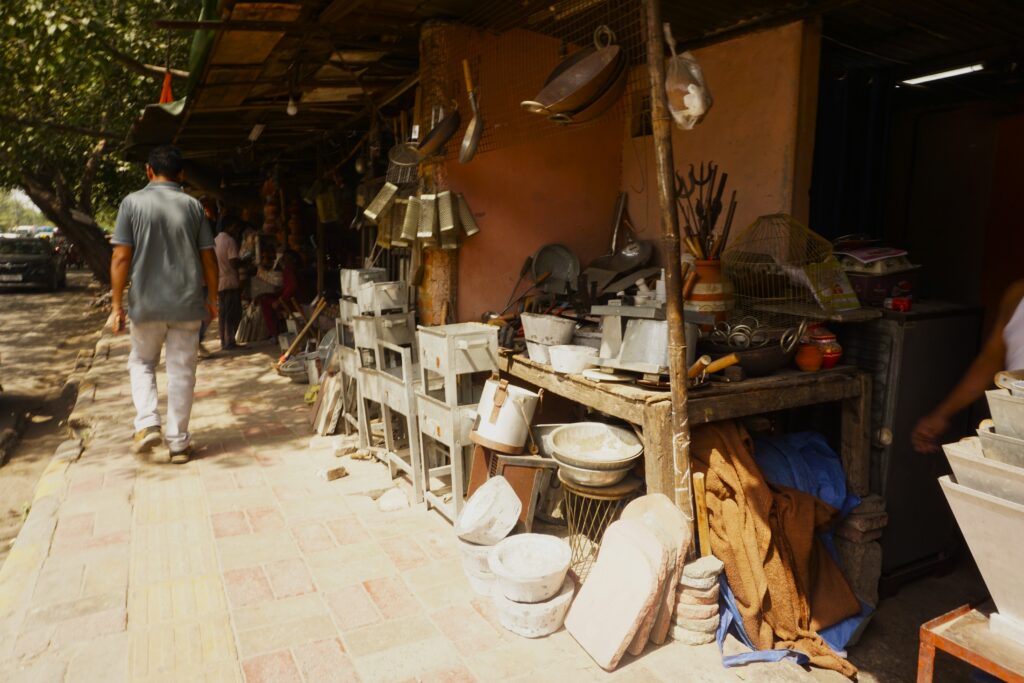
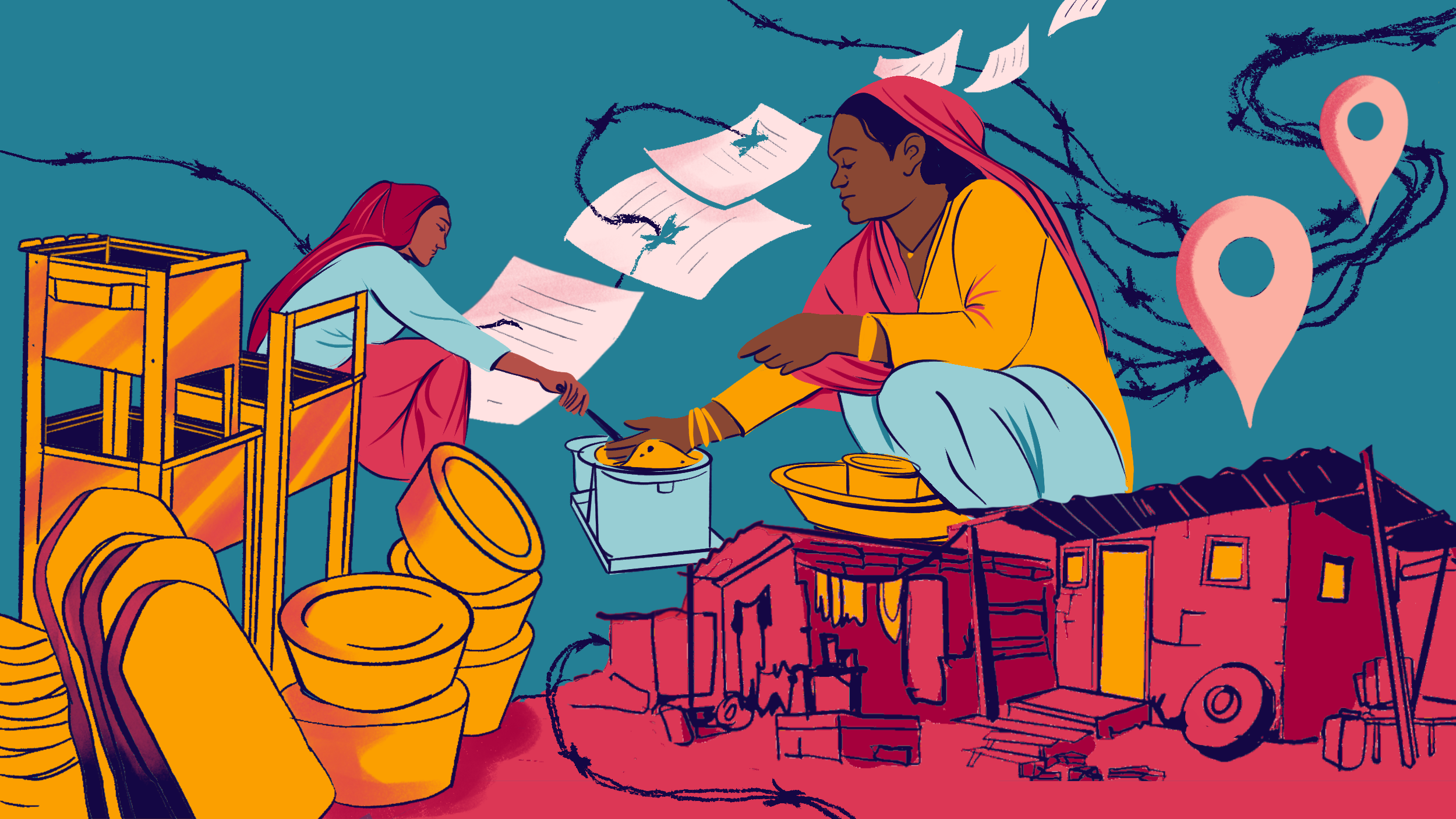
Iron tools, pots and utensils sit in a neat line along the road, glinting in the retreating rays of the October sun. Bhattis (traditional mud furnaces), used for molding hot iron, also line the same stretch. Gadia Lohars usually live and travel in their bullock carts (gadi) which serve as mobile homes and workplaces. Their work is precarious, and they are hardly able to make Rs. 10,000 in a month. 

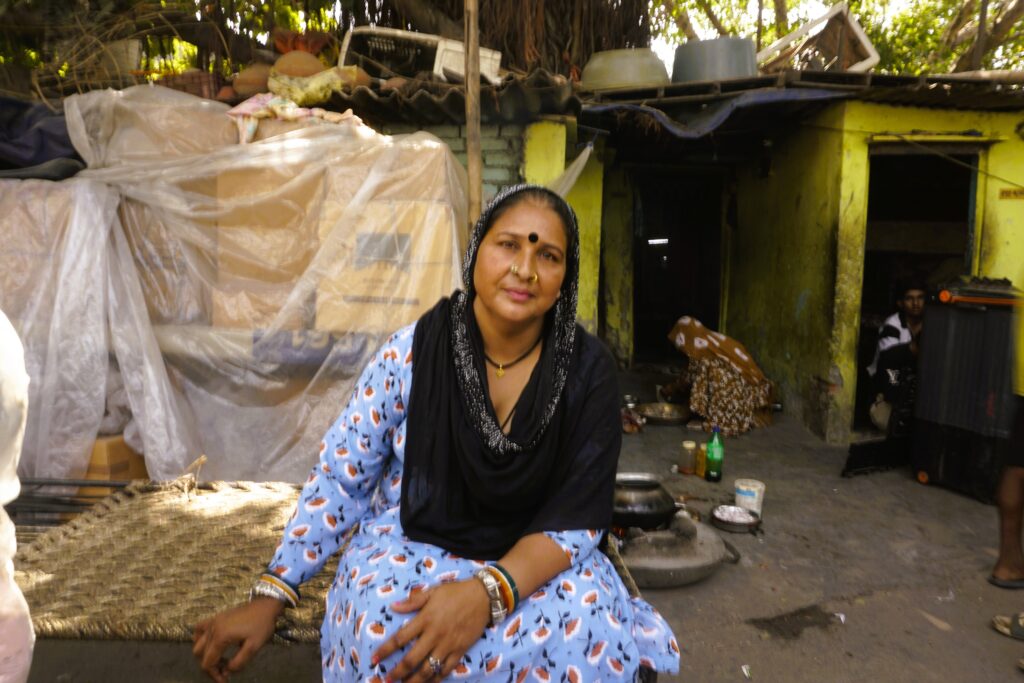
“Sadak hi hamara ghar, hamari dukaan, hamara sab kuch hai (the road is our home, our shop, our everything),” Rakhi says, crouched in front of a clay stove, her face covered with smoke. She is cooking what they call peti (goat’s intestine), a cheaper source of protein.

Rakhi sitting on a charpoy in front of her jhuggi / Samra Iqbal

Makeshift roadside tents like these are a common sight across the city, mostly inhabited by the Gadia Lohars. They trace their origins to Rajasthan – where they are listed as a Most Backward Community (MBC) – as the descendents of Maharana Pratap. In other states, such as Delhi and Haryana, they are classified as Other Backward Classes (OBCs). 

According to the Reneke Commission Report of 2008 the NT-DNT population in India totals 107 million, almost 15% of the population. Their socio-economic conditions are even worse than most of the Dalit, Bahujan and OBC communities. With no access to formal occupation and the lack of any special policy intervention by the government, those from the community that wish to take on anything other than their traditional work have to look for manual jobs, take to begging or performing acrobatics on the streets or providing door-to-door repair services. 

BehanBox spoke to the Gadia Lohars from the bastis of Patthar Market, Sagarpur in Tilak Nagar and Dwarka Sector-3 in Delhi. We found that almost all the people in these bastis have received notices under the ongoing SIR. Most of them lack the paper trail to establish their electoral legacy to the 2002 voter list, and have been marked “unmapped”. 

“Documents are a source of panic for every community, but for nomadic tribes the problem is compounded,” says Deepa Pawar, a NT-DNT activist, researcher and counsellor. “The mass exclusion of the community from the SIR is not due to the lack of documents but the government’s inability to recognise the diversity of its own citizens. We are a criminalised community, a landless community, and at the bottom of the social hierarchy who come from diverse linguistic backgrounds.” 

The State’s Long Denial

Out of those still on the draft rolls, 30% of Delhi’s voters have received notices for either of the two categories— “logical discrepancies” arising due various errors in the name or the age of the voter or parents, or being “unmapped”. As many as 13.79 lakh of these voters are flagged under the “unmapped” category.  Moreover, an analysis by Sabar Institute, a non-profit research institute, found that more notices were sent to less prosperous areas. 

A notification of the Election Commission dated September 26, has mandated that the Booth Level Officers (BLOs) will visit each and every house where notices have been served to collect the documents from the doorstep. Further, it mentioned that special camps will be set up for the assistance of the marginalised. While these efforts, meant to “ease” things for the ordinary citizens, have added to the burden of already overworked BLOs, it does little for those who cannot trace their electoral history back to 2002. 

Citing the Lal Babu Hussein v. Electoral Registration Officer (1995) judgement, civil rights activists have pointed out that the Supreme Court has maintained that if a citizen’s name is already in the immediate electoral roll, it must be presumed that all the necessary checks were undertaken before its inclusion. Thus, their presence in the 2025 electoral roll of Delhi’s Assembly Elections should be sufficient to establish their eligibility. 

But the process of SIR seems to invert this legal standard of established continuity because eligibility now requires voters to trace themselves back to the poorly digitised 2002 database, decided as the cutoff year. 

“Isme hamari kya galti hai? Hum toh bahut baar gaadi bhar bhar kar daftar gaye the pehle. Hame baar baar bol kar bhej dete the ki sadak ki ID nahi banti (how is this our fault? We went to the office many times in truck-fulls but they would send us back, saying that a voter ID cannot be made for the people on the street),” Matra recalls with a sigh.  

Sunita, echoing her neighbour’s grievances, adds: “Hum logon ko yahan rehte huye 30 saal se zyada ho gayen hai, par hum logo ko khanabadosh bolkar bhaga dete the (we have been living here for more than 30 years, but they would drive us away, calling us nomads).”  

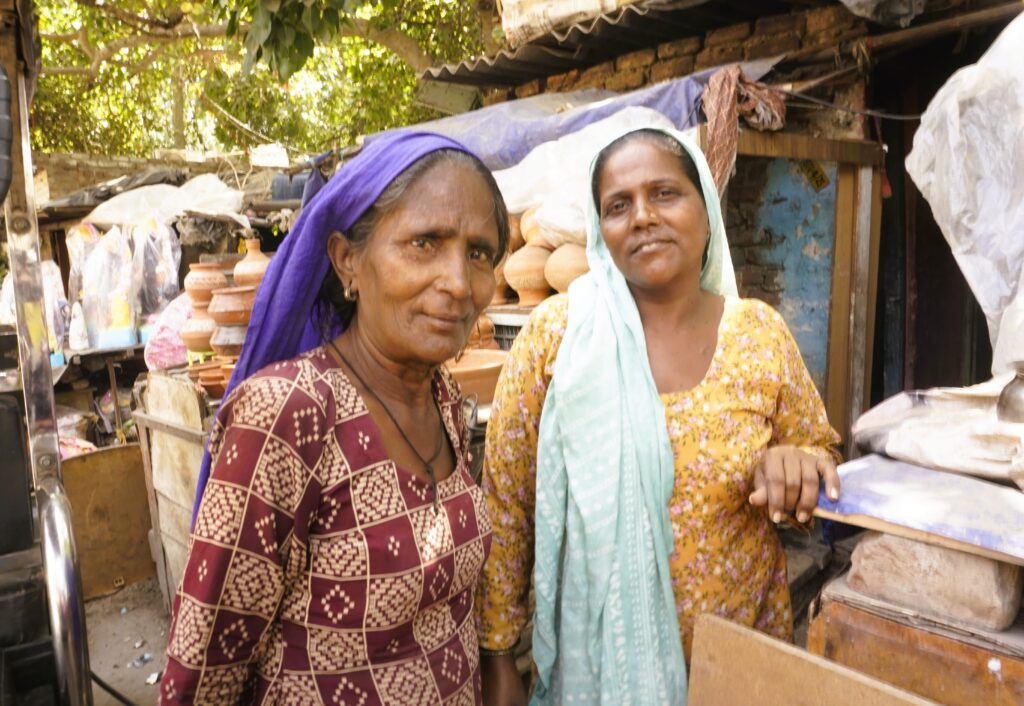
Matra and Sunita stand in front of their jhuggi in Mangolpuri / Samra Iqbal

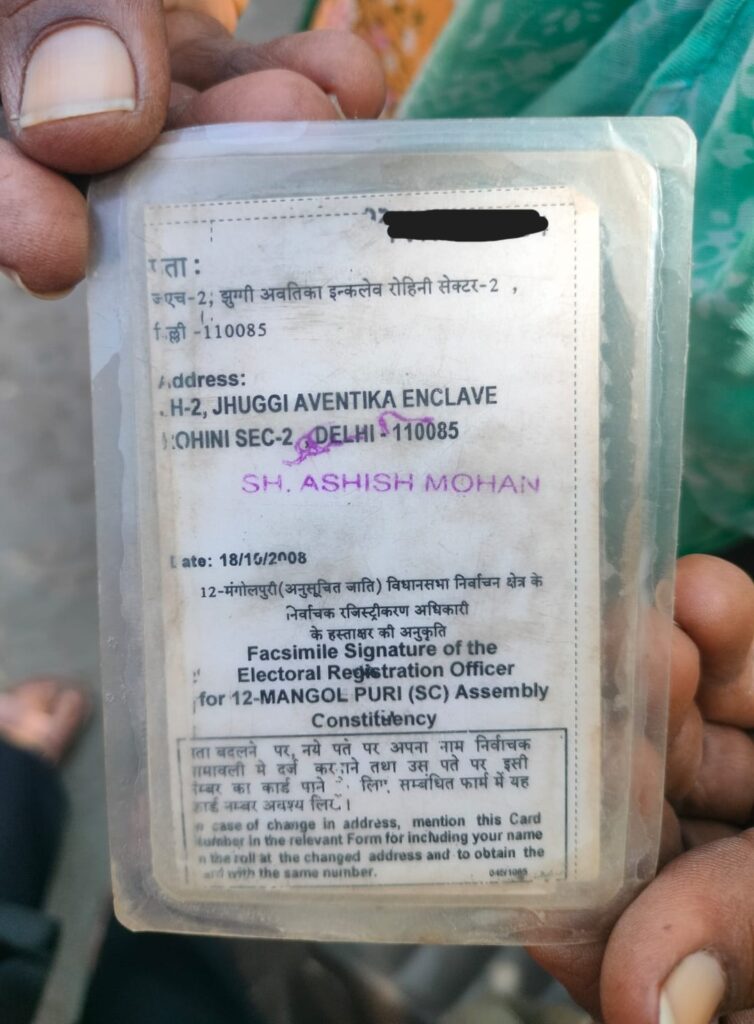
Rajesh Rathore, declared the basti ‘pradhan (leader)’ by the community, explains how with the support and political influence of someone from the adjacent Avantika Enclave Apartments, they got their voter ID cards made on their address only in 2008. Before that they had tried multiple times but were always denied the right.  

Sunita’s Voter ID issued in 2008 at Avantika Enclave address / Samra Iqbal

Deepa, has earlier written for BehanBox that despite being decriminalised, NT-DNTs continue to be seen with suspicion by both — the rest of society as well as the administration. Nomadic communities everywhere in India are vilified and marginalised because of the erstwhile “criminal” tag attached to them by the colonial government under the Criminal Tribes Act of 1871.  

Voting Rights, Then Civic Rights

Voter ID precedes every other document and civic amenities. “Pehle pehchan patr se Aadhaar card bana phir ration card bana, phir PAN card aur phir bijli lagi (first, our Voter IDs were used to get Aadhaar cards made, then ration cards, then PAN cards, and eventually, we got electricity too),” says Matra. This essentially means that while the people of the basti have no document trail to link themselves to 2002 roll, their oldest document is their voter ID card. 

Moreover, if deleted from the voter list, they fear that they will lose their jhuggies, and access to a handful of benefits they get from the government— free healthcare, ration and electricity. 

The only route back to the electoral rolls is Form-6. However, that was also silently revised and now carries an additional question to prove their parent’s presence in the last SIR of 2002. For communities like the Gadia Lohar, this leads them straight back to the same problem. 

“A permanent address is social capital in today’s political age,” says Deepa. “Nomadic communities have lived for years in jhuggis, near garbage dumps and on roadsides, yet they are denied recognition as part of their wards or jurisdiction. If their existence is denied, how will they get the documents?” 

BehanBox has earlier reported how SIR in West Bengal led to disproportionate deletions of tribal communities, especially women amongst them.  

In the next section we show how the ambiguity around the 12 “indicative” documents and the opacity of the whole system has increasingly pushed towards a greater centralisation, resulting in the rampant anxiety on the ground. 

Who Decides The 12 “Indicative” Documents?

In another basti on the roadside in Tilak Nagar’s Sagarpur area, brothers Jitender and Jagdish echo the community’s distress. They, along with another resident of the basti, are huddled together in the early hours of the day smoking hookah with a cup of chai.  

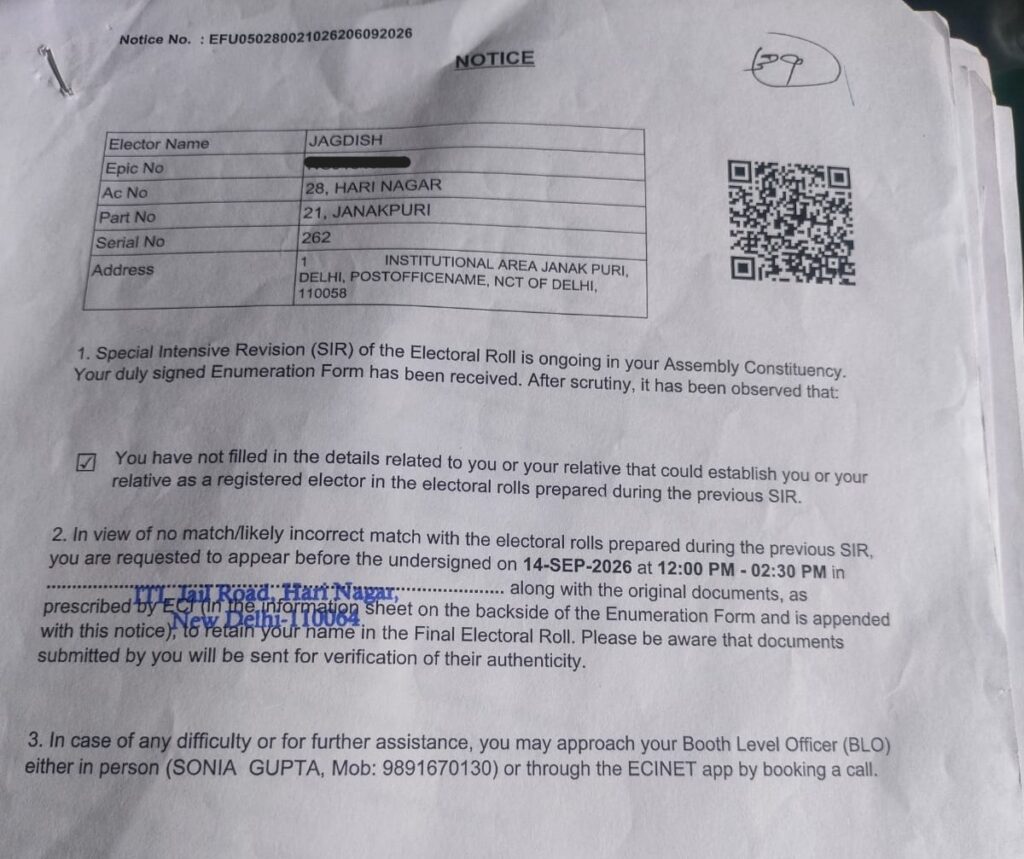
“Pachpan matdaata hai yahan, sabka notice aaya hai (there are 55 voters here, everyone has got a notice)”, says Jitender. They had all been asked to submit the documents with the BLO till September 14 when they were issued notices for being “unmapped”. 

Iron wares line the pavement outside the jhuggies in Sagarpur / Samra Iqbal

Gadia Lohars in the Sagarpur basti (Hari Nagar Constituency, booth no. 21) only got their voter IDs made in 2012. “Hum log ghumantru jaati the, ghumte rehte the toh hamare baap-dada ke kahan bante the documents. Ab yahan reh rahe hain toh hum logon ne banwaya (we are a nomadic community, so where would our ancestors have gotten documents made? Now that we are living here, we have had them made),” he explains.  

On September 14, the basti residents took bags full of documents, everything we could find from PAN cards to Aadhaar cards to ration cards and electricity bills to establish their identity. “But the BLO said they need our parents’ documents and without those our votes will inevitably be deleted,” he says.  

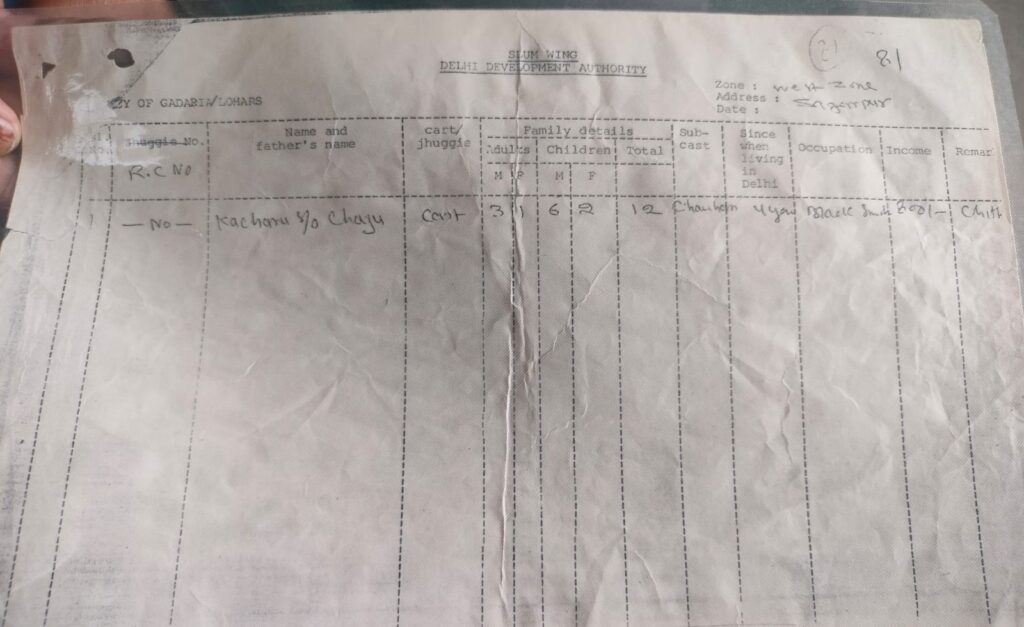
The only pre-2002 document they can still turn to is a 1990 survey of their jhuggis by the Delhi Urban Shelter Improvement Board (DUSIB), conducted for rehabilitation. While the promise of rehabilitation has not materialised, the survey document offers hope for the SIR. However, it is still not clear if the DUSIB survey will be enough to serve as a link to the 2002 electoral roll.  

Our earlier reporting from another DUSIB recognised jhugghi jhopdi (JJ) cluster in Wazirpur’s  Jailer Wala Bagh has revealed how 81.5% of the voters were arbitrarily deleted and most marked absent, despite submitting all the documents.  

“Baap ka document toh sirf ye survey hi hai (the survey is the only document I have of my father),” says Jagdish as he shows BehanBox all his documents. “Hamare baap ke document nahin hai par hamare toh hai 2002 ke baad ke hain sahi. Ye kaun sa system hai jisme baap ka hi document chahiye varna vote kaat denge (our father didn’t have any documents, but we do—even if they are from after 2002. What kind of system is this, where you need your father’s documents, or else they’ll delete your name)?”

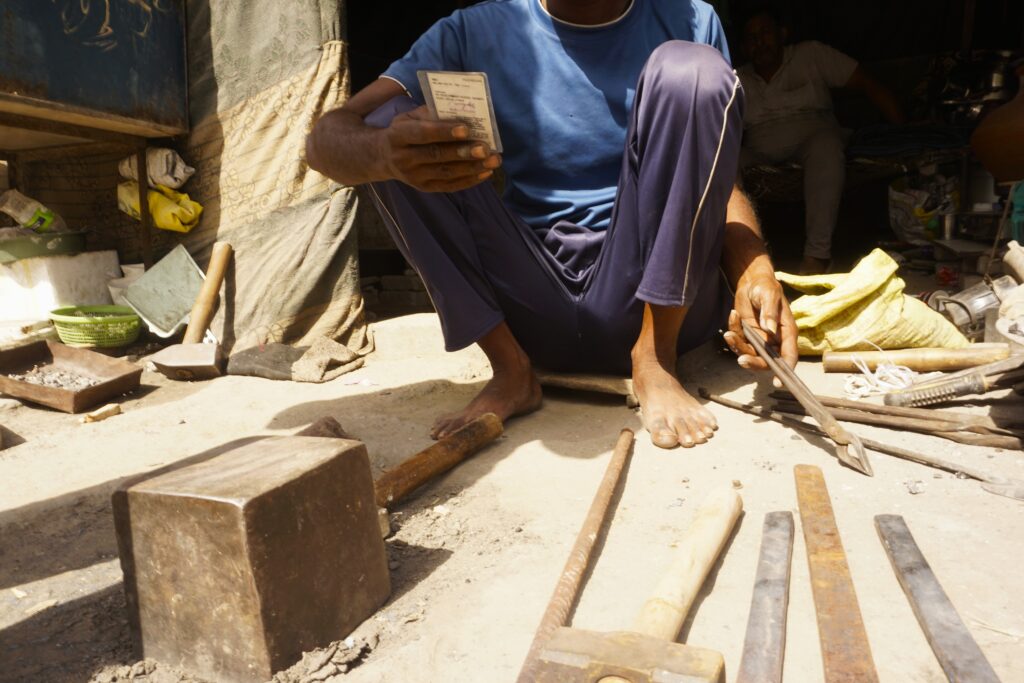
DUSIB Survey dated 1990 issued under Jagdish’s father name, Kacheru / Samra Iqbal
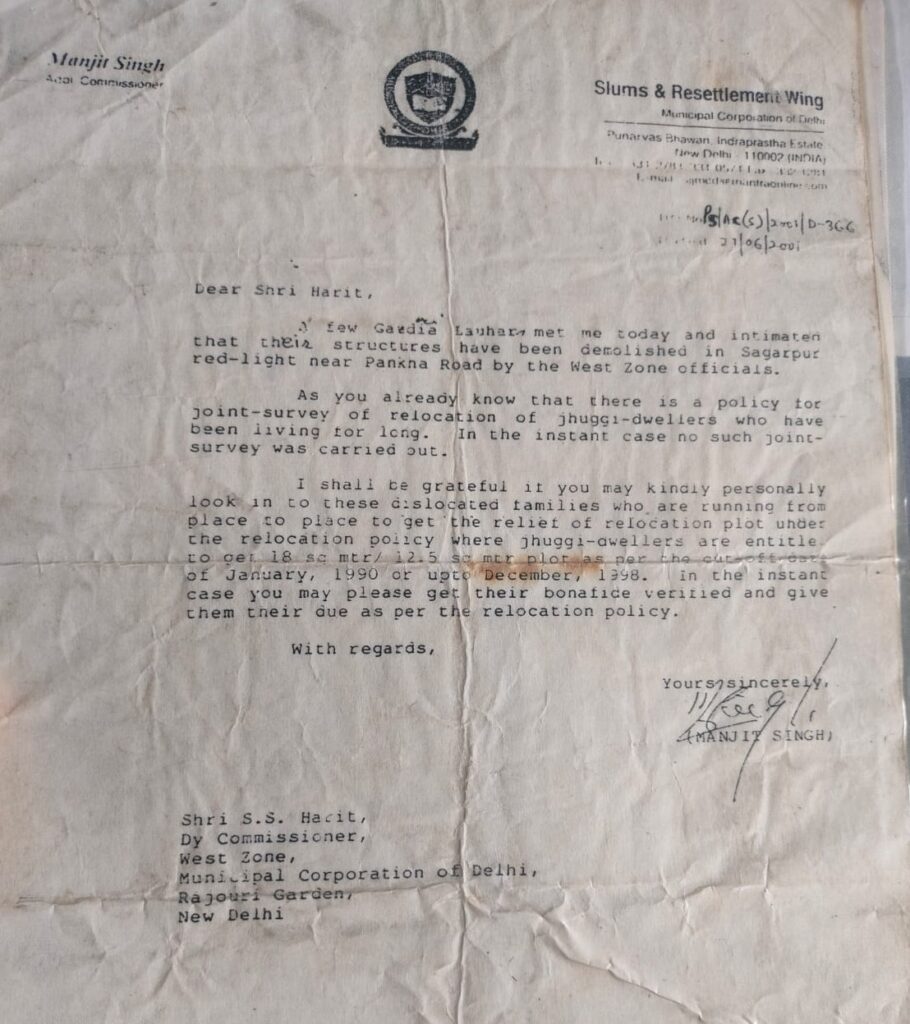
Stay order issued in 2001 / Samra Iqbal

As per the SIR rules, people who have been issued notices have to submit any one or more of the 12 documents listed in the “Indicative (Not Exhaustive) List of Documents.” A DUSIB survey document of such kind does not explicitly feature in such a list or fit broadly under any category.

“Unmapped” notice issued to Jagdish in English / Samra Iqbal

A birth certificate or Class 10 certificate might appear to be an accessible form of proof in the list of 12 documents. But, very few Gadia Lohars – who have always been kept out of the circle of civic and political benefits – possess these documents, especially pre-2002. “Pehle ghar par janam ho jaate the, janam patri kahan hai (earlier, children were born at home and there were no official birth certificates).” says Jagdish. 

A 2019 survey conducted across 58 Gadia Lohar settlements by the Housing and Land Rights Network (HLRN) and Gadia Lohar Sangharsh Samiti (GLSS), found that just 2% of the community population has a caste certificate. Up to 97% of those surveyed have an Aadhaar card which is listed among the 12 acceptable documents but is actually not accepted as standalone proof.  (The HLRN survey figures, however, just account for 58 out of the 116 settled Gadia Lohar bastis in Delhi. Many of these nomadic tribes are homeless, live on roads and have no documents whatsoever, and remain totally invisible to the system.) 

During the SIR process in Bihar last year, on September 8, the apex court had ordered the Election Commission (EC) to include Aadhaar as the 12th ‘indicative’ document for verification and a proof of identity. However, in May this year, a Supreme Court bench was quick to reverse this order stating that “Aadhaar is not a proof of citizenship or domicile and the EC is justified in not treating it as a primary document”. 

Moreover, The Reporters’ Collective found out that the BLOs who are meant to support these voters are not able to make house-to-house visits. Already drained by the enumeration phase, they are now tasked with the challenge of visiting an average of between 200 to 600 voters spread across different booths in just 60 days. 

The job of the BLOs is only limited to uploading the document on the ECINET portal for their later approval by the Electoral Registration Officers (EROs). Section 22 and 23 of The Representation of the People Act of 1950 empowers the EROs to make this decision. However, in the absence of clarity on the documents and the increasingly centralised control over the entire process as seen in other states, voting rights of many of such individuals are parked on an opaque and arbitrary digital system where only a chosen few authorities have access to and control over. 

A recent investigation by The Reporters’ Collective has now found that at least in some of the constituencies, BLOs can sign a “certificate” for the inclusion of a voter without any verification of their documents. The ambiguous and messy nature of this whole exercise once again becomes evident through these shifting rules— putting at stake the voting rights of lakhs of people. 

“Unhone bola sirf jama hoga abhi, kuch aashvasan nahi diya. Mai teen chaar baar ghuma hun. Jail Road par daftar hai (they said they would only accept the documents for now, they didn’t give us any assurance if our names will be added back. I’ve already gone three or four times to their office on Jail Road),” says Jagdish. “Ab agar vote kaat denge toh hum kiske pair padhenge (if they still delete our names off the voter list, who do we plead with?).”  

Deepa believes that inclusivity in any system should be justice-informed, and to ensure that, the government should be informed of the injustices experienced by different sections of the society. “SIR is based on a casteist framework where some people are just invisible to the system. The government cannot work with this horizontal understanding of society. DNT communities form the bottom of the hierarchies, it cannot have a framework designed from the top that only includes those at the top,” she points out.  

‘They Never Counted Us’

Depending on the state where they live, NT-DNT communities could be classified as Scheduled Caste, Scheduled Tribe or Other Backward Classes, and many appear in none of these categories. In practice, most are folded into the OBC category. The community has been demanding a separate category in the upcoming 2027 census, but there is no State response yet to the demand. 

Questioning the validity and the need for SIR, Deepa argues: “What’s the use of SIR? Who protested for the government to conduct it? We have been demanding a separate column for us in the Census for so long, but they have failed to do that.” 

This ambiguity in their caste status and the resultant lack of caste certificates, is one of the primary reasons why the Gadia Lohars are unable to avail various benefits and schemes meant for marginalised communities. “If the government never counts us, how will they know about our plight or our special requirements?” Deepa asks.

The 2019 HLRN report also found that 53% of the 58 settlements comprise structures made of mud, thatch, or other low-quality materials, the remaining 46% primarily consist of structures constructed with plastic and tarpaulin sheets.  

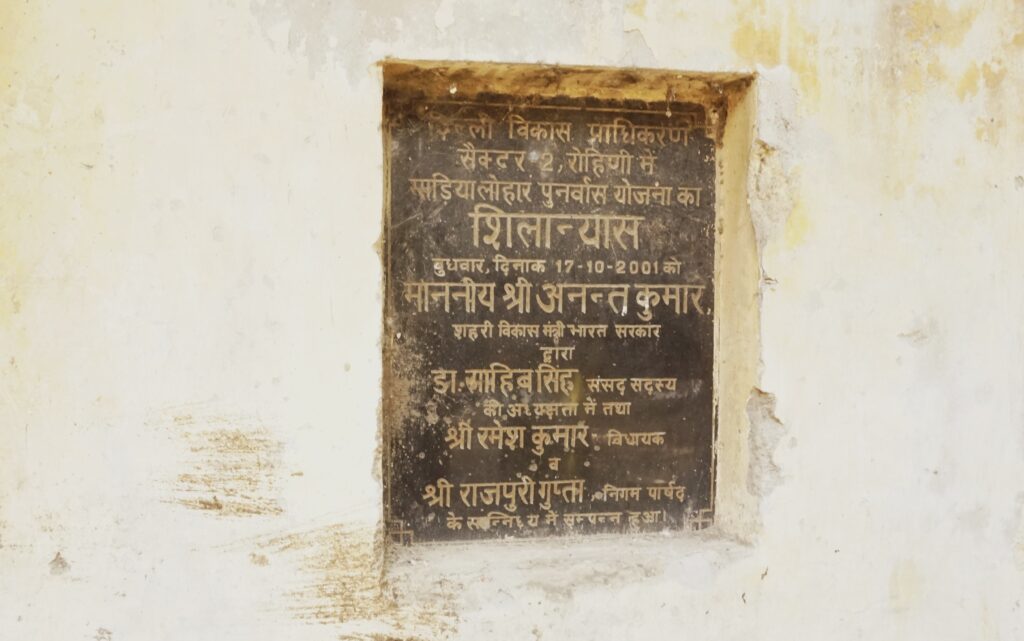
According to the report, in October 2003, shop-cum-houses for 34 Gadia Lohar families were inaugurated in Pitampura, Budh Vihar, and Mangolpuri under the ‘Gadia Lohar Rehabilitation Scheme’ by then Minister of State for Urban Development. However, these houses have still not been allotted to the beneficiaries. 

“Hum road par bas dhakke kha rahe hai 24 saal se (We’ve just been struggling on the streets for 24 years),” says Rakhi from Mangolpuri basti.

She tells us that the lack of the voter IDs in 2003 was one of the issues why these plots were never allotted, besides the change in the government over the years. 

Deepa argues that even if the nomads want to settle, the government has not taken any steps to rehabilitate them. “Are they willing to give us land rights? On one hand they have no plans and policies to settle us and on the other they cannot accept our nomadic diversity.”  

Board showing the plots meant for the rehabilitation of Gadiya Lohars / Samra Iqbal
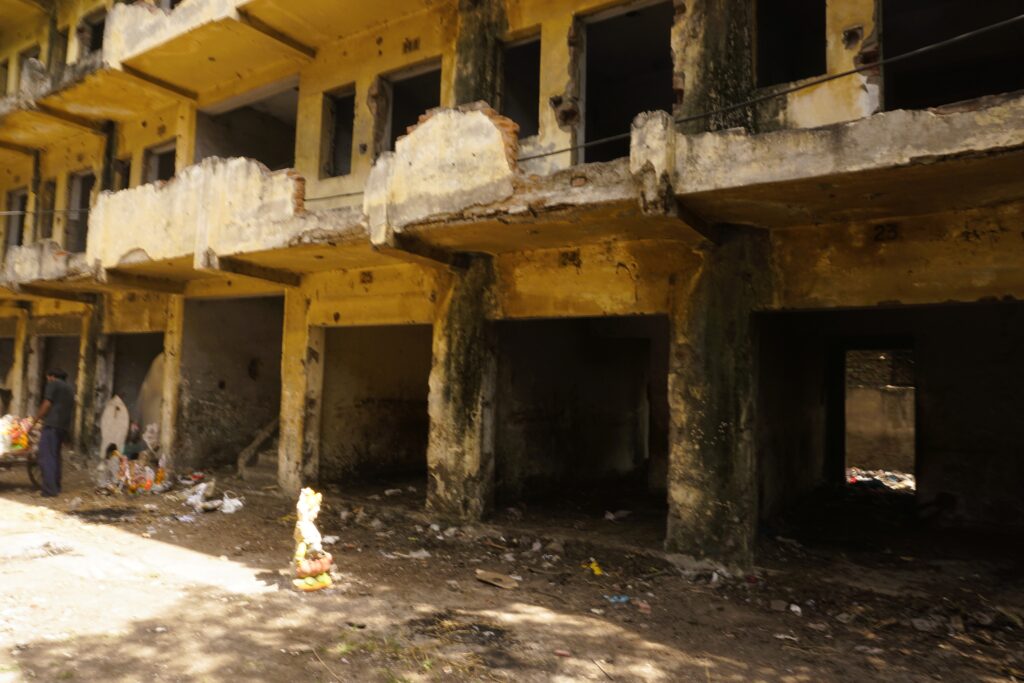
The condition of these plots after years of non-allotment / Samra Iqbal

Rakhi echoes this view: “Agar sarkaar ghar de toh kaun road par rehna chahte hai, hame bhi khatra hai bacche road par khelte hai gaadi chalti hai. MCD walon ne bahut pareshan kar rakha hai ab bola hai 12 tareekh ko tod denge jhuggi (if the government gave us homes, why would we live on the streets? We are at risk too, our children play on the road, it’s dangerous. The MCD officials have harassed us a lot, and now they have said they will demolish our huts on the 12th of this month).”  

The Gadia Lohar community has been neglected in central and state policies and has largely not been able to avail any benefits of government schemes. Women from these communities often  have to walk distances to access the public toilets or have to defecate in the open, making them prone to sexual harassment. 

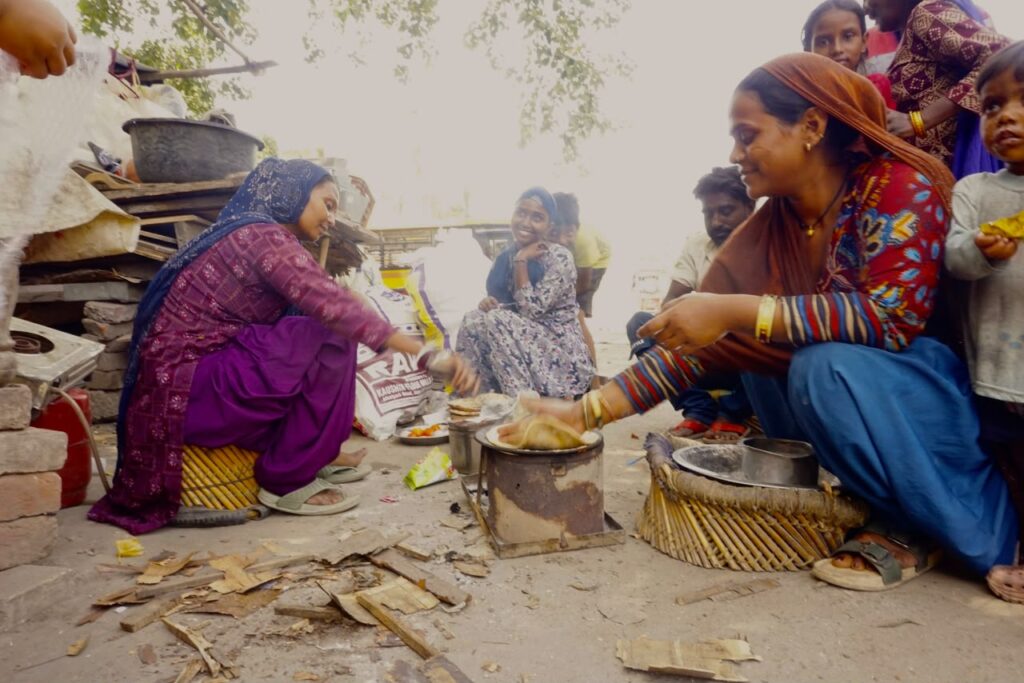
Women in Mangolpuri basti cooking food on the street over the clay stove / Samra Iqbal

Paper Citizens

In another Gadia Lohar basti in Dwarka Sector-3, adjacent to the Aakash Healthcare Superspeciality Hospital, around 20 families live on the pavement. Savitri*, an old woman in her 60s, says she has seen her jhuggi being demolished at least 50 times till now. 

She used to live in Najafgarh, in South West Delhi, where she got her first voter ID made back in 2002. “Tod phod mein voh ID gum ho gayi thi phir yahan aakar naya banwaya 2013 mein (I lost my old voter ID card during a demolition drive, then I came here and made another ID in 2013).” The last time her jhuggi was demolished was when the June enumeration phase was being carried out. She had lost her form then and could never fill in.

Anxiety regarding SIR notices in Dwarka basti / Samra Iqbal

The HLRN report pertinently noted that in many cases the government-issued identity documents do not mention the current address of the residents because they have had to relocate frequently after forced evictions. In other cases people have documents but with addresses from which they were evicted. 

“Hamare log har saal Aadhaar card banate hai, har kuch saal voter card banate hai, line me lag jaate hain. Phir aap bolte ho ki nahi ab ye sab nahi chalega, 2002 ka hi dikhao toh ye kaise possible hai (our people get Aadhaar cards made every year and voter cards every few years. We stand in lines and follow all the rules. And then you tell us that none of this will count anymore, and that we have to show documents from 2002. How is that even possible)?” says Deepa.  

Earlier we have reported how the association between residency and benefits is costing the voting rights of millions of marginalised voters.  

Another woman in the basti, busy scrubbing the utensils, asks: “Jiska 2002 se kaagaz nahi hai uska kya? (What about those who don’t have documents from 2002?).” Then another voice responds: “Uski toh baat hi nahin kehne ki, Bangladesh jayenge sab (there’s nothing left to say for them, they’ll all be sent to Bangladesh).” 

  • Samra Iqbal is a junior reporter with BehanBox. She has previously covered stories on displacement and demolitions, workers' rights,  and digital amplification of hate speech.

Malini Nair (Editor)

Malini Nair is a consulting editor with Behanbox. She is a culture writer with a keen interest in gender.

Support BehanBox

We believe everyone deserves equal access to accurate news. Support from our readers enables us to keep our journalism open and free for everyone, all over the world.

Donate Now