[Readmelater]

On The Cardamom Trail: The Invisible Women Behind A Premium Spice Trade

Men dominate the cardamom trade that is worth crores but it is women’s labour and agricultural knowledge that holds up the industry
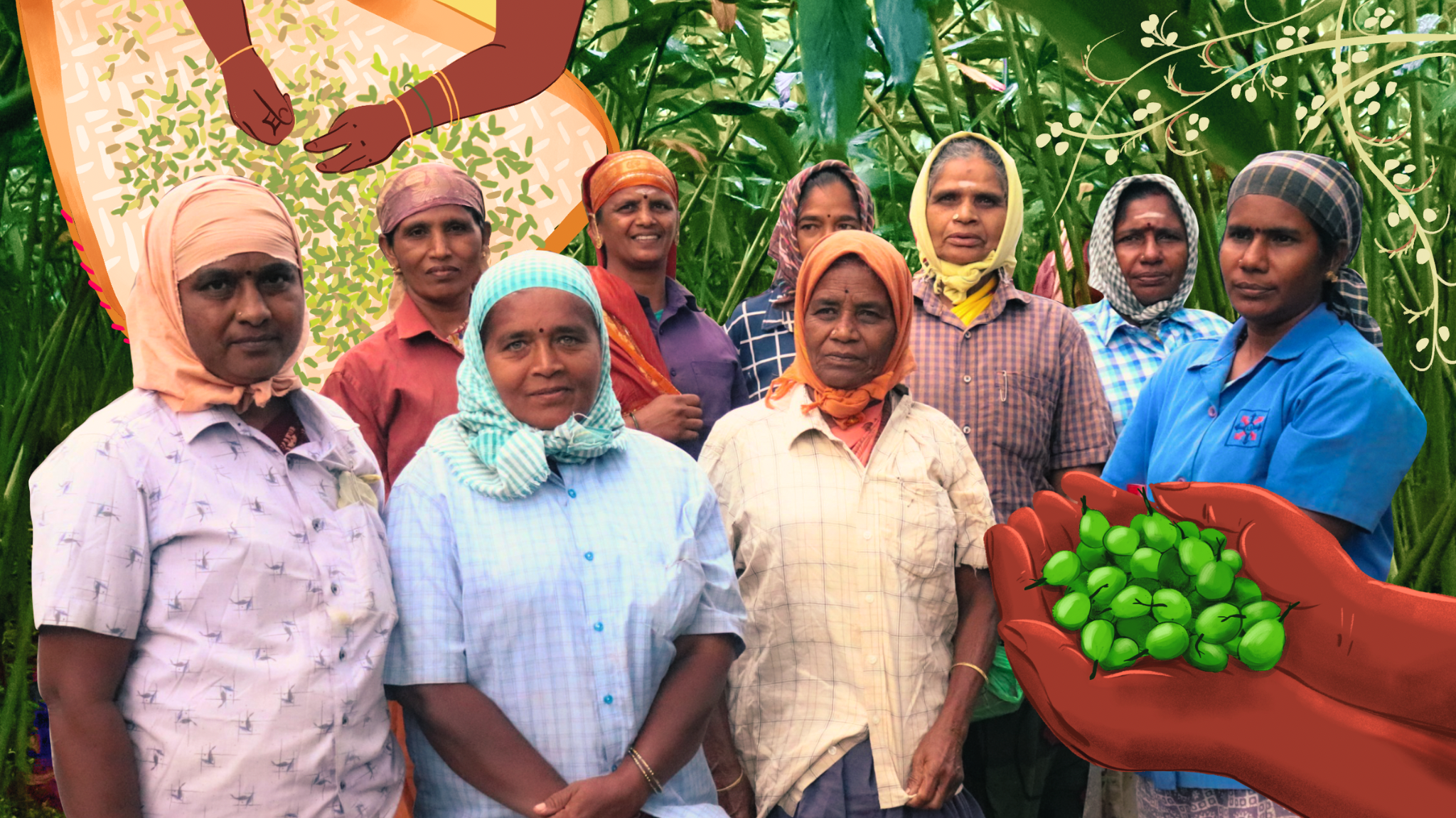
By 10 am, every weekday, the parking lot of the Spices Board of India at Bodi in Tamil Nadu’s Theni district is full of cars. Men alight in white dhotis and crisp shirts to register their names and walk towards the auction centre. In a corner sit blue and dark green bags, marked with lot numbers and emanating an unmistakable fragrance. The aroma of cardamom fills the air. 

This is the hub of the green cardamom trade. Highly valued, cardamom has an expansive  domestic and international market and netted India 413.24 million USD (over Rs 3,900 crore) in exports last year. By the end of the working day of September 15, when we witnessed the bidding, business worth Rs 60 crore had been transacted. 

However, there was not a single woman on the auction floor; men dominated every business process and ritual here – fixing prices, weighing the spice, assessing its quality and colour. 

But if you watch Theni’s roads in the early hours of the day – even the one right in front of the Spices Board – a different reality emerges. Before dawn, hundreds of Mahindra Maxx, a 10-seater wagon, zig-zag through the district’s villages, carrying thousands of women farm workers. They will cross the border into Idukki in Kerala to work at its many cardamom plantations.

A worker boarding in the Mahindra Maxx in the early morning in Dombuchery / Nithya Pandian

Contrary to their invisibility at the trading centres, it is the women who form the largest workforce at these plantations, pulling out weeds, scattering fertiliser, plucking the pods and caring for the plants. Not just that, once the bidding at the Spices Board office ends, they also perform the painstaking work of separating the pods at the sorting units in Bodi.

This is the backbreaking work that goes into readying one of the most expensive spices in the world for the market. India produces an estimated 24,715 metric tonnes (MT) of small cardamom annually, cultivated across more than 70,835 hectares of plantations.

Cardamom is the third costliest spice after saffron and vanilla. Its current price averages at Rs 2,576 a kg but this varies depending on demand.  In the retail market, 100 gms can cost anywhere between Rs 250 and Rs 500. But the women who work here make less than Rs 10,000 a month — a fraction of the spice’s market value — after working for seven hours a day.

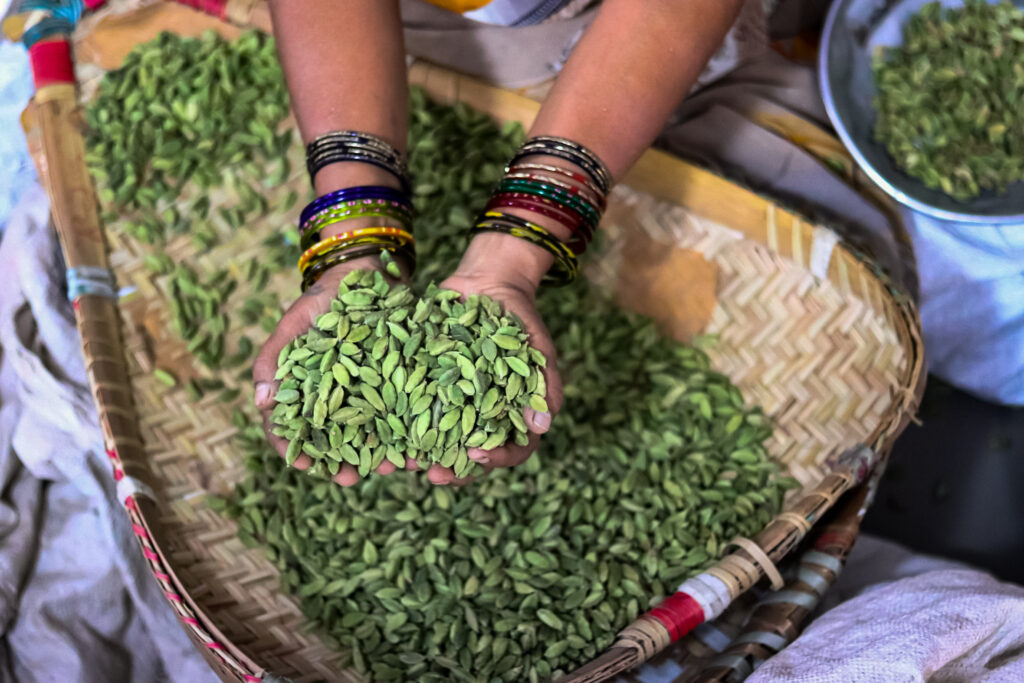
Cardamom is the third costliest spice after saffron and vanilla. Its current price averages at Rs 2,576 a kg but this varies depending on demand / Nithya Pandian

To understand this skew, BehanBox set out on the cardamom trail. We travelled with the women farm workers in the Mahindra Maxx vehicle from their homes in Tamil Nadu to the plantations in Kerala to understand the gruelling labour that brings that much valued spice into our homes. Here, we saw an exploitative agent-driver system at work that keeps the women farm workers at the edge of precarity. We attended the auction at the  yards and spent time at the manual sorting units where women earn even less for sifting through sackfuls of cardamoms and separating them by size, pod by pod, so that traders do not lose out on a single rupee. 

This is the sixth story in our series: The Full Field, The Many Faces Of Women Farmers which focuses on how women remain largely invisible in India’s official agricultural statistics despite being central to the food production systems. Across much of rural India, they sow, transplant, weed, harvest, care for livestock, and manage post-harvest tasks, yet are often recorded merely as “helpers” on family farms rather than as farmers or agricultural workers.

Crossing Borders, Twice A Day

On the morning we met her, Jyothi Karuppaiah, 45, of Dombuchery village in Theni district was readying for the two-hour commute to a cardamom plantation in Idukki . She has been up since 3 am, cooking both breakfast and lunch for her family of four. Some days, it is an elaborate meal but today she has kept it simple – rice, rasam and potato curried in coconut milk. In the kitchen, under dim yellow light, her hands moved quickly but quietly so as not to wake anyone.    

Within an hour, her tiffin box was packed and her water bottle filled. Into a plastic wire basket she tucked in an old shirt, a towel, and two different sickles – the kavvakathi used to prune branches and the kalakathi to hack weeds in the plantation. This is her morning routine everyday for 11 months a year, except May when the unbearable heat forces cardamom plantation owners to trim their workforce.

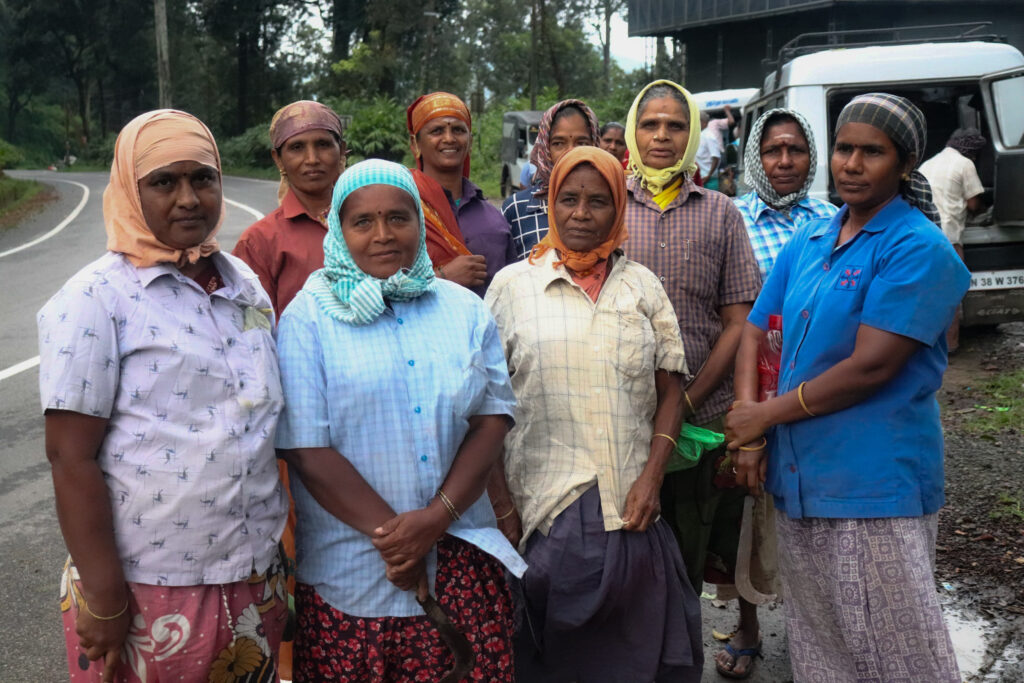
Women from Dombuchery, and neighbouring villages start their work at 7 am in the morning / Nithya Pandian

By 4:55 am, Jyothi was aboard a Mahindra Maxx, the first to be picked up that day. At Ammapatti, a neighbouring village, driver and agent Raja Ramar, 47, then picked up another worker, Thenmozhi Dhanushkodi, 56. The wagon then criss-crossed the villages of  Viswasapuram, Sillumarathupatti, and Chokkanadhapuram, collecting 14 women workers from various Tamil and Kannada speaking communities. Along with this reporter, the 10-seater vehicle was already crammed with 16 people. 

By 6 am, the vehicle reaches Munthal, a trijunction which connects Bodi to Bodimettu and Kurangani. The women engage in banter inside, in Tamil and Kannada, about issues at work, Vinayagar Chaturthi celebrations, co-workers or friends who skipped work that day, and what they cooked. Thenmozhi was looking to buy a new sickle to replace the one she had lost but was not sure where she would find a sturdy one. Someone in the back chimed in: “The quality of sickles is poor in both Theni and Bodi. Also, we should carve our names on the handles of the sickles so that we can identify ours.”

The scenic route the wagon takes attracts thousands of travellers who want to catch the sunrise against the Kolukkumalai, a popular tourist destination. But, the women had little interest, they had seen it numerous times. Instead, they grabbed a quick nap before the day unfolded.              

As dawn broke, the Idukki plantation appeared amidst the roads and trees framed against the  freshly washed western ghats from the previous day’s rain. Kerala accounts for approximately 70% of India’s small cardamom production, followed by Karnataka (20%) and Tamil Nadu (10%). 

At least 400 to 500 vehicles carrying 15 to 20 women each, reach Idukki every day, said Mariyappan S Muthu, former organiser of Driver and Labour Union for Coffee, Cardamom and Pepper. Approximately 10,000 women travel to Kerala’s cardamom plantations each day. During our  time there, we saw only three male workers. 

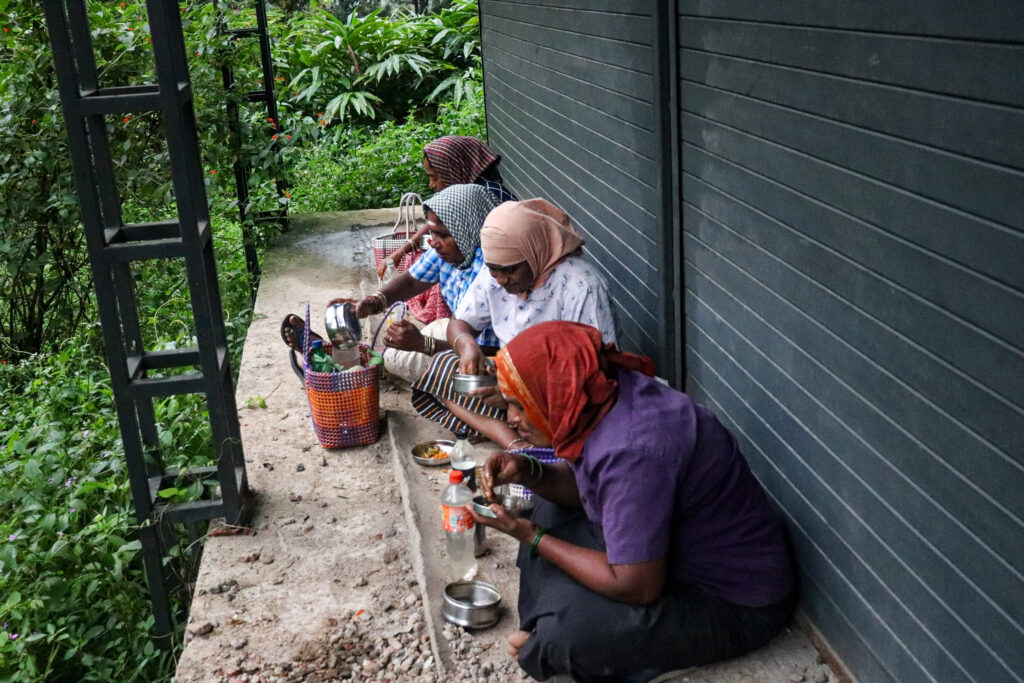
The wagon pulled over to the right of the road in Thalakulam near Poopara in Idukki district, nearly 50 km from our starting point. Women disembarked for a quick breakfast from their tiffin boxes on the roadside. This was going to be their first meal of the day. Jyothi has rice and rasam, which she packed earlier. The group then resumes its journey to the 10-acre sloping plantation.

Jyothi and her coworkers have their first meal, before their long working day begins in a cardamom plantation / Nithya Pandian

Here, each of them has been assigned a cardamom plant column. 

For the last 17 years, this has been Jyothi’s 50-km commute. Her family had once lived in a small housing unit inside the plantation in Idukki’s slopes. “We moved to Dombuchery once we built our house,” she said. As soon as she turned 18, Jyothi was married off by her parents. She returned to plantation work, ten years later, after raising two girls. It is the only work she knew.  Generations of her family had worked in plantations and with little education and fewer work opportunities, Idukki became her work destination. 

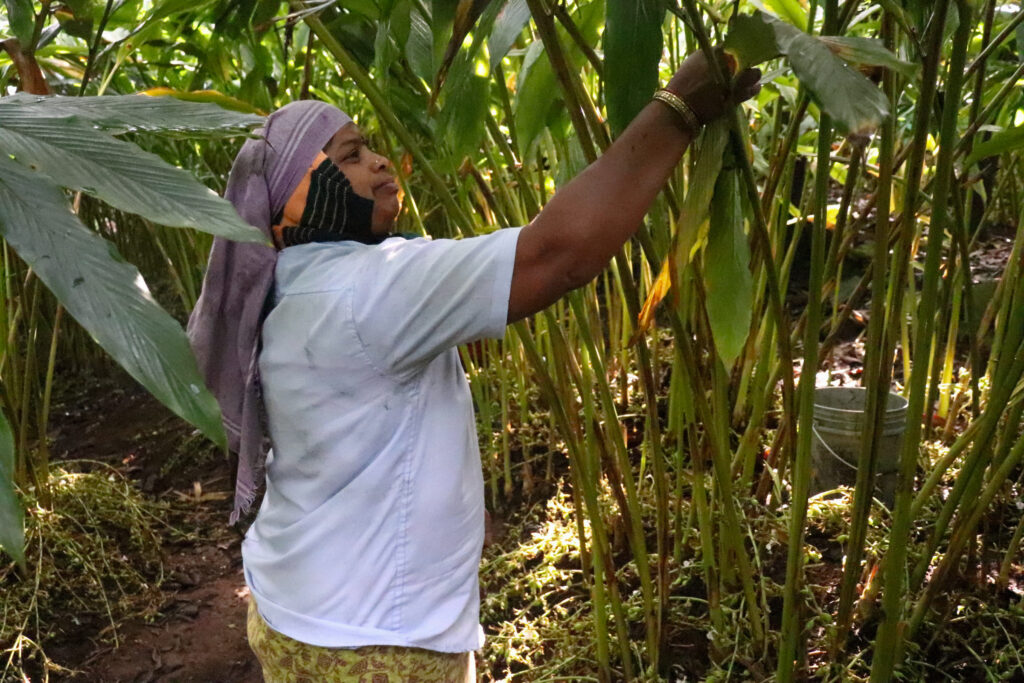
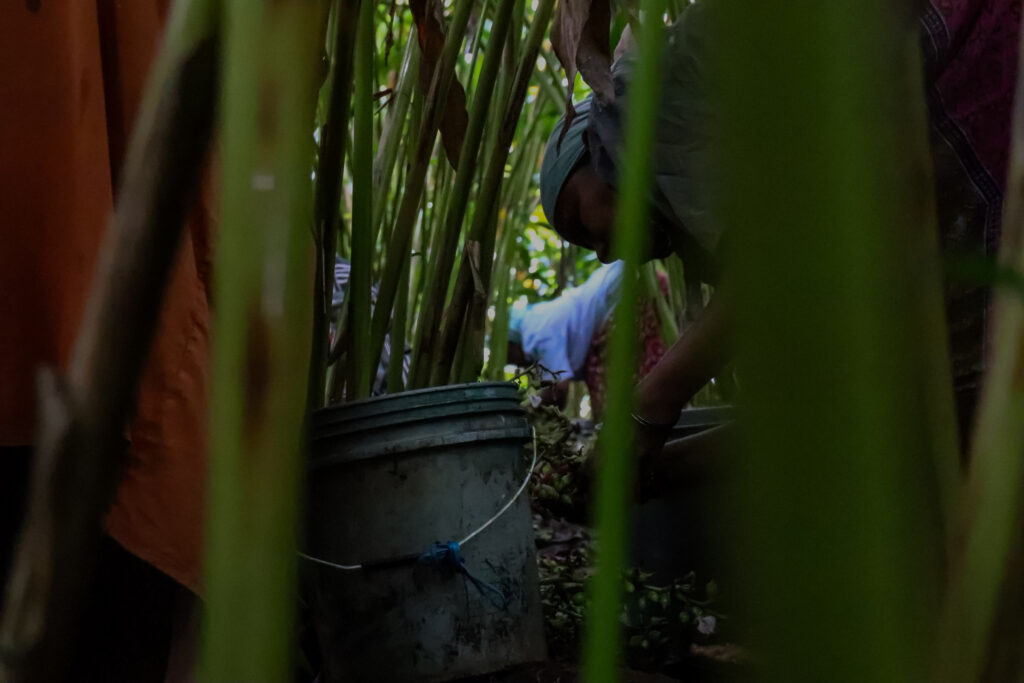
Back on the plantation, Jyothi bent forward to pluck the adikkais (mature capsules) from the panicles and popped them into a plastic bucket she carried. She must fill at least three buckets, each holding 7 kg of cardamom, before the day ends. This back-breaking work continues for the next seven hours with a 10-minute tea break. She will work on the plantation until 2 pm and then make her journey back, and reaches home by 5 pm.

Skilled Work, Paltry Wages

Cardamom is central to the Indian kitchen, used to spice tea, coffee and an array of sweets. There is a huge demand for cardamom in Kashmir, Pune, Lucknow, and Bengaluru, said Balasubramian Manoharan, manager of Narumanam Spices. It also accounts for 9% of India’s total spice export value, after chilli and cumin. The UAE and Saudi Arabia alone account for 43% of the export market followed by other countries like the USA, Kuwait, Bangladesh, Canada, Singapore, Qatar, Jordan and Malaysia. 

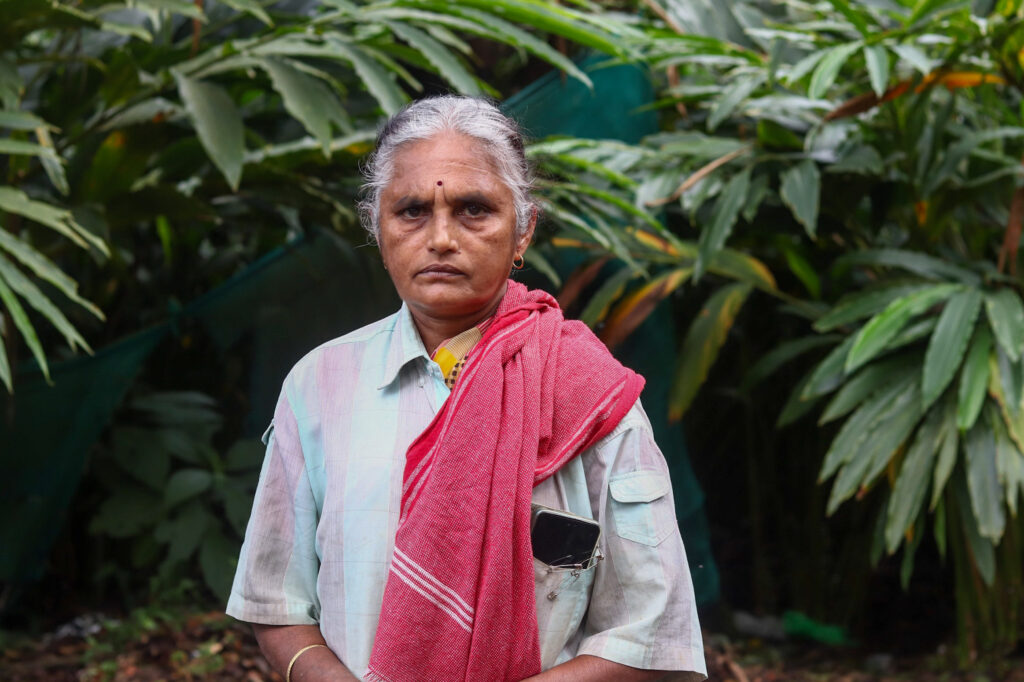
Over 17 years, Jyothi has collected a vast pool of agricultural skills in tending to this highly priced crop and knows every aspect of cardamom plantation / Nithya Pandian

It is not an easy crop to grow, prone to pesticide attacks and vagaries of climate change.  But, Jyothi knows every aspect of cardamom cultivation—from the roots to capsules to the kitchen. Over 17 years, she has collected a vast pool of agricultural skills in tending to this highly priced crop.  She knows its seasons and diseases, and can tell which plant needs immediate care. She knows precisely when the adikkai are ready for harvest by just looking at them. She knows the different varieties of cardamom – those that give good yields and those that don’t, varieties that are climate-resilient and those that make for a nightmare in the supply chain. 

But the gendered inequalities of the trade mean that in this multicrore supply chain, her monthly earnings never exceed Rs 9,600 per month even in peak yield season. 

“Our daily wage is set at Rs 600”, she tells us.  “But from this we have to pay Rs 200 to the drivers for the transportation. They act as kangaanis (agents) who are in direct touch with the landholders, and recruit us when required.” 

So, their driver-agent Raja has, by the end of the day, earned Rs 2,800 from the women workers he recruits and transports. The women themselves are left with just Rs 400 in hand. During peak season, a wagon carrying 20 workers could bring him Rs 4,000 a day. But the women, in a month of around 24 working days, earn, at the most, Rs 10,000.

This exploitative payment system is in violation of the Inter-state Migrant Workmen (Regulation of Employment and Conditions of Service) Act, 1979, says R Geetha, founder of the Unorganised Workers Federation (UWF). “Either contractors or employers should give travel allowance to the workers to cover both outward and return journeys, as per the Act. The women should get at least Rs 800 from their employers. So that they can give Rs 200 for drivers and keep the rest of the salary for them,” she said. Per the Act, women should also be paid the hours spent commuting. However, women like Jyothi have never heard of the law or its provisions.

The cardamom workers do not receive employee benefits such as paid leave, medical insurance, Provident Fund, which are largely available for tea plantation workers in Tamil Nadu. Jyothi contends that this is because of the absence of an employer-employee relationship that allows for such demands to be made.

Cardamom workers rotate between plantations. The pods mature every 60 days and workers have to wait for two months to return to the same plantation for work. In this interval, they work at other plantations. 

“We will work in Thalakulam estate for the next 10 days and move to a new one for the next few weeks. Our workforce is required on a rotation basis, across Idukki. The nature of the job itself reduces the direct connection between the workers and the landholders. This also reduces the responsibility of the landholders in case of an emergency,” she said.

The pods mature every 60 days and workers have to wait for two months to return to the same plantation for work / Nithya Pandian

But for all its precarity, Jyothi argued, her casual labour status at the cardamom plantations allowed her the flexibility. Unlike contractual workers, she is not mandated to work a fixed number of days and is free to opt out when she wants and pick up jobs closer home. In the plains of Theni, farmers do grow rice, maize, sunflower, and varieties of grains and there is work to be found there too. “We prefer to work for small landholders because they do not have strict rules. We need not work for 11 months a year. We can stay at home when there are family responsibilities or even during menstruation,” she explained. 

Dangerous Journeys, Weak Protections

There is a reason Kerala’s plantations rely on the women workers of Theni. Workers from Kerala are unionised and this gets them better wages, work conditions and bargaining power. They are entitled to bonus, increments and paid leave. They also remain employed at one estate till retirement and are paid even for the months when there is no work. Their salary is also set at Rs 600 but they have no agents to pay. 

According to Bhakiyam Thangam, 57, one of the registered union members who relocated to Kerala, plantation owners are obliged to employ one registered unionised worker per 3.5 acres of plantation. Theni’s women workers, on the other hand, are forced to work at smaller wages because no other option allows them the flexibility of sporadic plantation work. 

Many of these workers, despite decades of work experience, are not treated as farmers. The Food and Agriculture Organisation (FAO) notes that women who work in agrifood systems in different capacities across all segments of value chains, in formal and informal work, regardless of  land ownership or employment status must be considered as farmers. India’s own National Policy for Farmers, 2007, adopted a broad definition of “farmer” covering landowners, tenants, sharecroppers, agricultural labourers and others engaged in farming and allied activities.

But gender gap in wages, poor access to information, networks and capital, along with patriarchal inheritance practices limit women’s place in the value chain. 

Theni’s women workers, on the other hand, are forced to work at smaller wages because no other option allows them the flexibility of sporadic plantation work / Nithya Pandian

Selvaraj Kudalingam, who owns the land on which Jyothi works, agreed that women workers are the backbone of the cardamom economy but refused the idea that their   wages are unfair and  work conditions exploitative. He claimed that, when a worker has to deal with an emergency or accident, agents and landholders collectively take care of the expenses incurred. 

The winding roads through the ghats are prone to fatal accidents. Under Section 22 of the Motor Vehicles Act, carrying more than 12 passengers, excluding the driver, is a violation. Yet wagons ferrying women to the hills routinely exceed the limit, according to local accounts.

Ramakrishnan Azhagarsami, a Bodi-based activist,  alleges that drivers operate with the protection of officials from the RDO and the police. “There are three check-posts along these routes. The driver-agents bribe department officials or check-post staff to avoid being caught,” he said. The drivers interviewed for this story, however, denied the allegation.

Men Run Market Networks

Only 11.72% of the total agricultural area in India was operated by women operational holders, per the last Agriculture Census. But Gokila Padmanaban’s, 60, experience reveals that even land ownership does not translate into decision-making power in the market for women. 

Gokila was 15 when she married Padmanaban and moved to Poopara. Her husband owned a 12-acre cardamom plantation in Thalakulam, where they hired women from Theni to work. Gokila, too, took on the physically demanding work on the farm while her husband managed the trade. She even attended auctions a couple of times and participated in business discussions so she could understand what it took to run a plantation.  

After her husband passed away in 2024, ownership of the plantation was transferred to her. She sold 10 acres of land and retained two acres where she continues to cultivate cardamom even today. Had she registered herself with the Spices Board, we ask. “It isn’t necessary,” she said. “I want my two sons to take over the business.”

Gokila has been into cardamom farming in the last 45 years. Despite having decades of experience in the field, she largely depends on male dominated network in the crucial stages in the supply chain / Nithya Pandian

However, she supervises the workers, finds suitable curing units to dry cardamom and negotiates with customers to sell her produce. “I can read, write and negotiate  with men to set the price. But, I need to rely on the men to transport cardamom to processing units and to customers,” she said. She does not know how to use her phone to connect to the e-auction nor can she  travel to Bodi in Tamil Nadu and Puthady in Idukki – the two auction centres – on a daily basis to witness it in person. Each auction is live-telecast so that farmers, agents, and everyone involved in the business know the rate. 

Gokila plays multiple roles in cardamom production, but all these end after production. Limited access to information, digital tools and market networks leaves her dependent on men in crucial stages of the trade, with little agency to decide where, when and who to sell her produce to. 

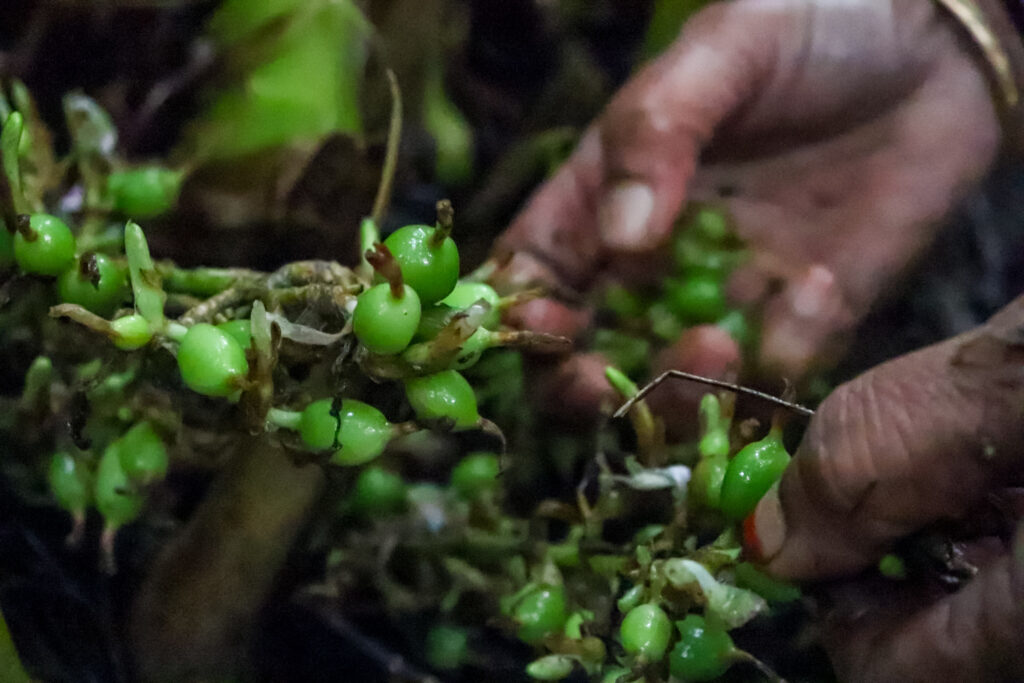
After it is harvested, raw cardamom capsules are sent to curing units in Poopara to reduce the moisture content without damaging its colour, essential oil, aroma and other properties. Bhoopathy Sangarakutti, 52, who owns a semi-mechanised curing unit, said that it takes at least 18 hours to dry the fresh cardamom. After the process, 5 kg of capsules yield 1 kg of tradable cardamom.  

Large plantation owners have traditional or mechanised curing units. However, small scale farmers like Gokila rely on men like Bhoopathy who charge up to Rs 15 per kg to dry the spice. After it is dry, plantation owners sell the cardamom to traders, who then sell it directly in the market, or auction it through the Spices Board.

After harvesting, raw cardamom capsules are sent to curing units to reduce the moisture content without damaging its colour, essential oil, aroma and other properties / Nithya Pandian

Auction Centre

Traders, mostly men, buy the cured cardamom from the planters and sell it in the local and international markets based on demand. On September 16, as bidding began, a large LCD display showed the quantity of spice available for bidding, along with the lot numbers, seller’s name, and the starting price range. Almost 24,000 kg of cardamom from the Cardamom Planters Association was scheduled for the auction at Bodi, the primary auction centre for the day. The average price for the day was Rs 2,893 per kg. 

Bags of cardamom, each weighing 1.36 kg, were opened one by one and emptied into three or four steel bowls. Distributors appointed by the seller sampled the spice and placed portions in bowls before the buyers. “We assess the colour, size, skin, moisture and weight before fixing the price,” said a trader.

Some buyers seek out low quality cardamom that cost Rs 300-500 less than the average price, while others seek superior produce. The first half of the day alone had generated business of around Rs 6 crore whereas the previous day ended with Rs 60 crore worth of business transacted.  To give a sense of the scale of trade: The Spices Board’s Annual Report (2024-2025) says that a total of 23,335 MT of green cardamoms were auctioned that year at a weighted average price of Rs 2,575.98/kg. 

grading, pod by pod

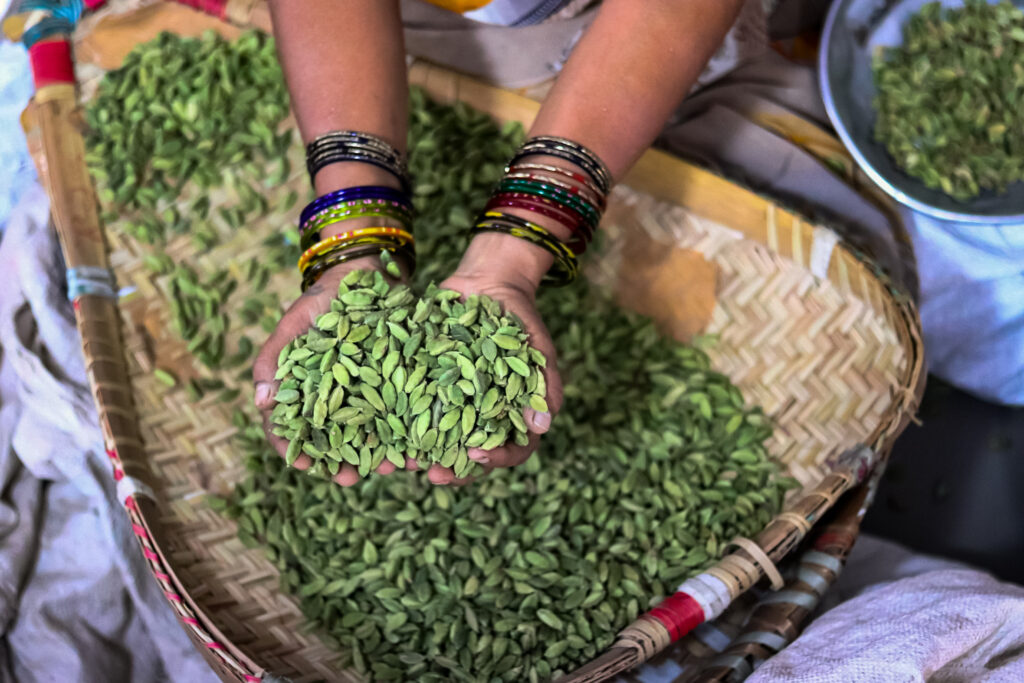
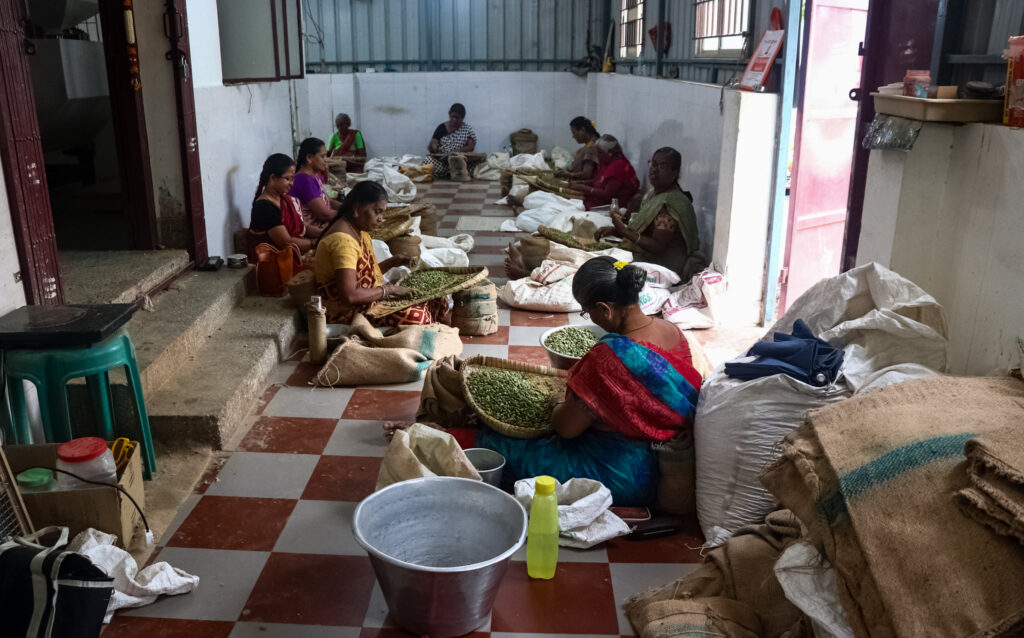
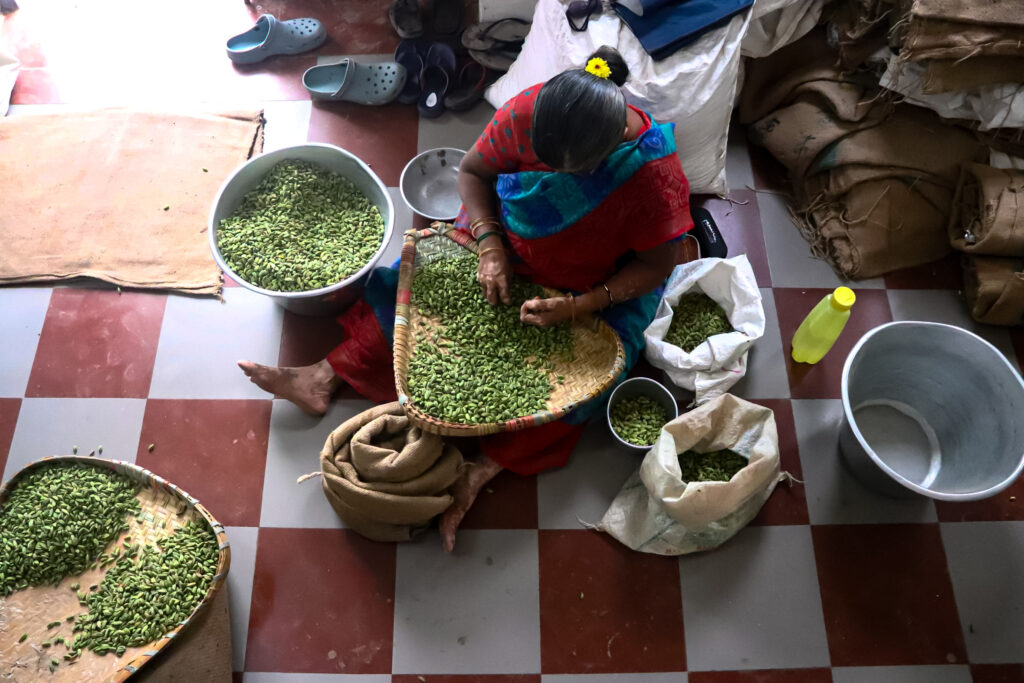
Once the bidding ends, the labour cycle returns to the women workers. Now they will segregate the cardamom pods, one by one, for grading. Larger cardamoms fetch higher prices but if they are of mixed sizes, they do not. So sorting becomes necessary for the trade.

It is the 8 mm capsules (ettu paruvattu) that are considered the highest grade in the market. On rare occasions, farmers sell gigantic 10 mm capsules, which fetch very high prices.   

There are over 50 grading units in the Bodi region which provide  employment opportunities to many women across the taluk, said Balasubramian Manoharan of Narumanam Spices. 

Women at the grading centre in Bodi. They work for 10 hours to grade the cardamom to earn just Rs 340 a day / Nithya Pandian

Jai Rubini is one such cottage unit, in Vinobaji Nagar, Bodi. On September 17, 13 women from the neighbourhood had assembled as early as 9 am to sift through the cardamoms. ‘Kothukkaramma’, as the sharp-eyed supervisor is called for the work she does, ensured that no capsule was left out.

The grading tasks may sound simple – workers are expected to separate manjal pazham (ripe, yellow cardamom fruits), from nayam (high-quality fine capsules), and kazhivu (literally ‘waste’, sold only in local markets.) 

Veeralakshmi Palsami, a worker who has been working at Jai Rubini for 15 years, reached the unit at 9 am sharp. She is given 25 kg of cardamom in polypropylene sacks. After winnowing the dust, she carefully separates the produce into three different sacks on the basis of quality. For 10 hours, she works with her back bent. 

Veeralakshmi earns Rs 340 a day, Rs 30 less than what workers at mechanical grading units earn. This unit used to have more than 30 women. Now, there are only 13, as machines replace human hands, she told us.

Veeralakhsmi has been working in the industry for 15 years and admitted that mechanized grading process replaces her job / Nithya Pandian

It was a rare day for Veeralakshmi. “Today I segregated 10 mm (patthu paruvattu) from a bag of mixed large capsules,” she said. This rare extra large variety of the cardamom fetches Rs 3,800-3,900 a kg in the market. The sack she is working on could earn the trader up to Rs 1 lakh. But, at the end of her 10-hour shift, Veeralakshmi will go home with a wage of just Rs 340 in her pocket.   

[This story is part of the series ‘The Full Field: The Many Faces of Women Farmers‘, a collaboration between Womanity and BehanBox.]

  • Nithya Pandian is an award-winning journalist who reports on gender, tribal rights, caste, and social justice issues in Tamil Nadu

Malini Nair (Editor)

Malini Nair is a consulting editor with Behanbox. She is a culture writer with a keen interest in gender.

Support BehanBox

We believe everyone deserves equal access to accurate news. Support from our readers enables us to keep our journalism open and free for everyone, all over the world.

Donate Now