The Women Who Hold Kachchh’s Pastoral World Together
As traditional pastoralism changes in Kachchh, women bear the costs of shrinking livelihoods, heavier labour and eroding freedoms

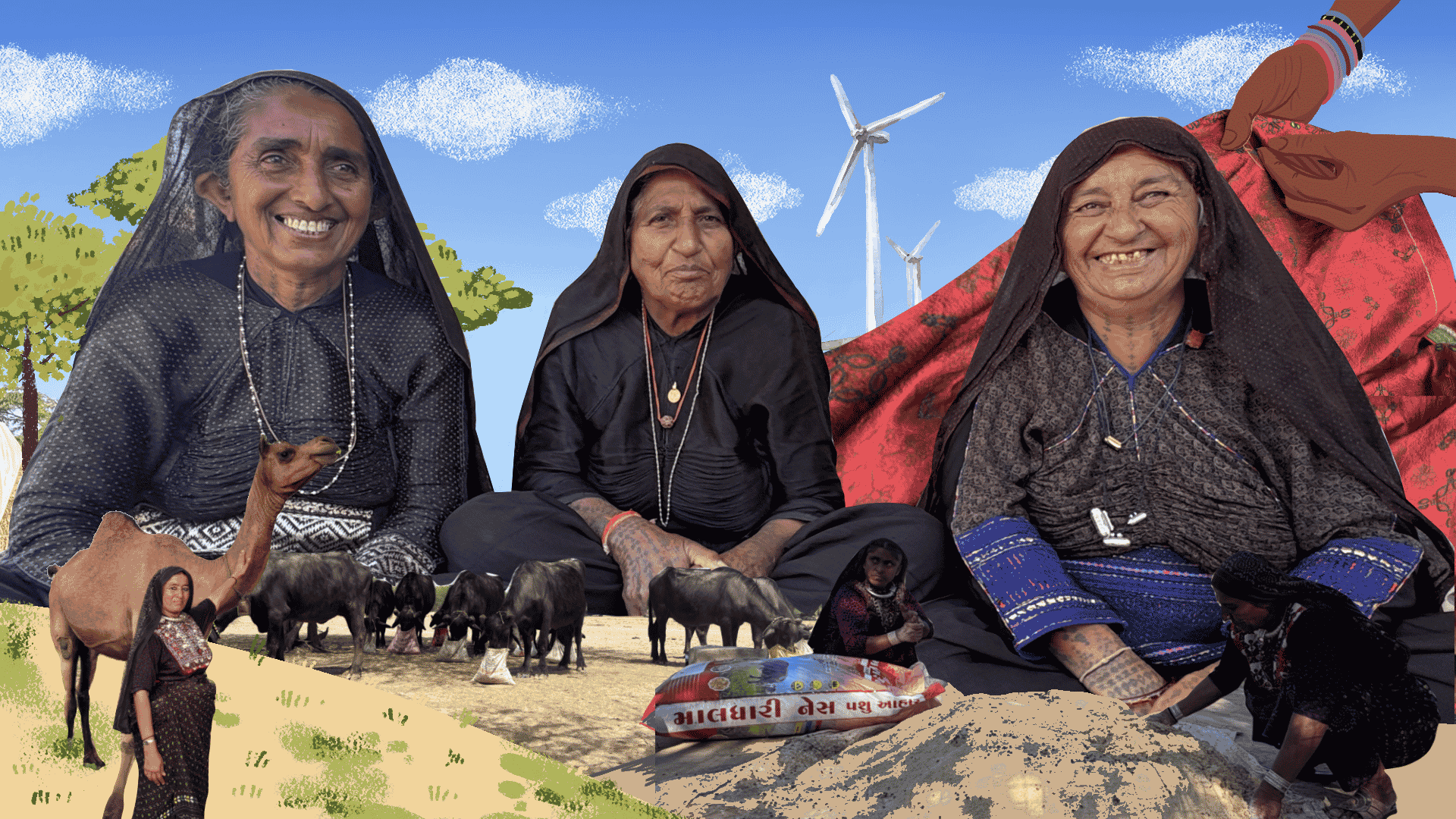
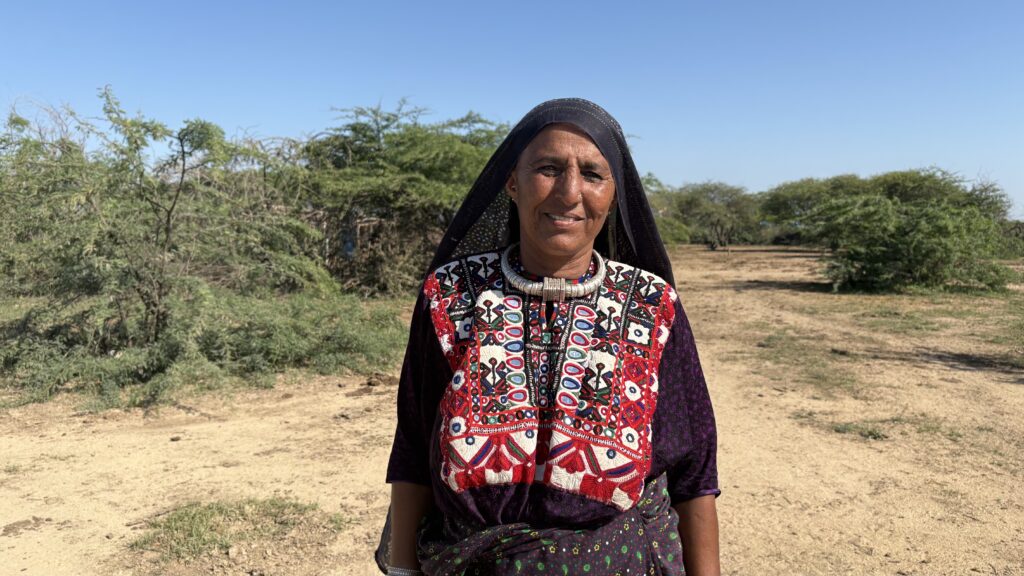
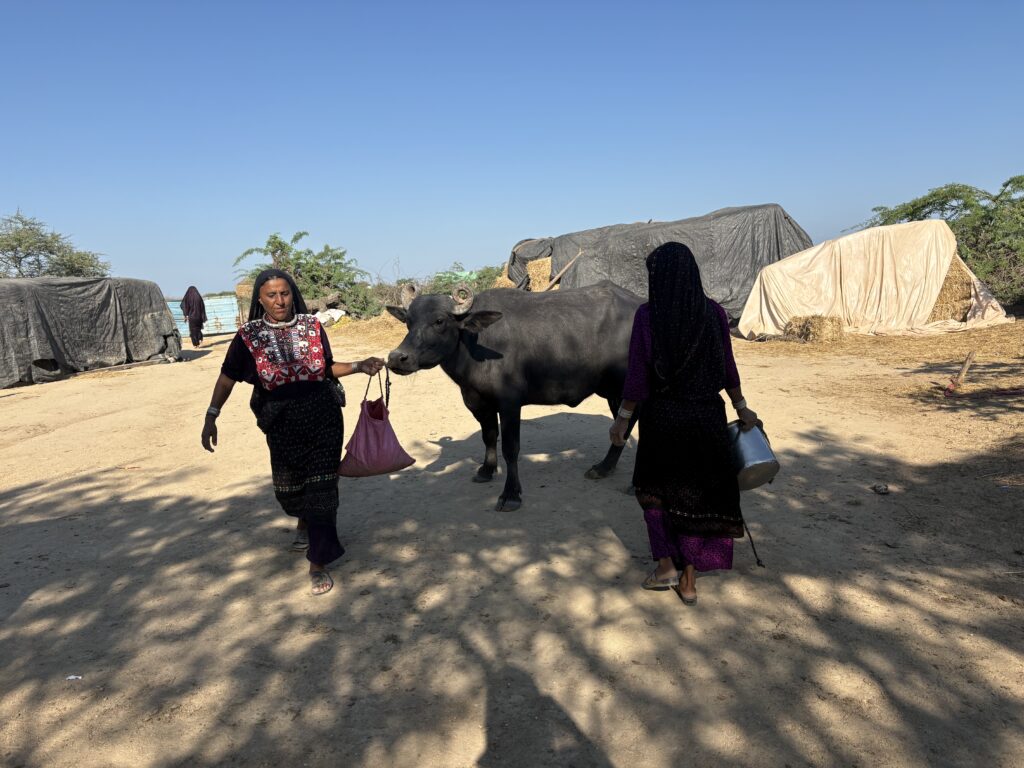
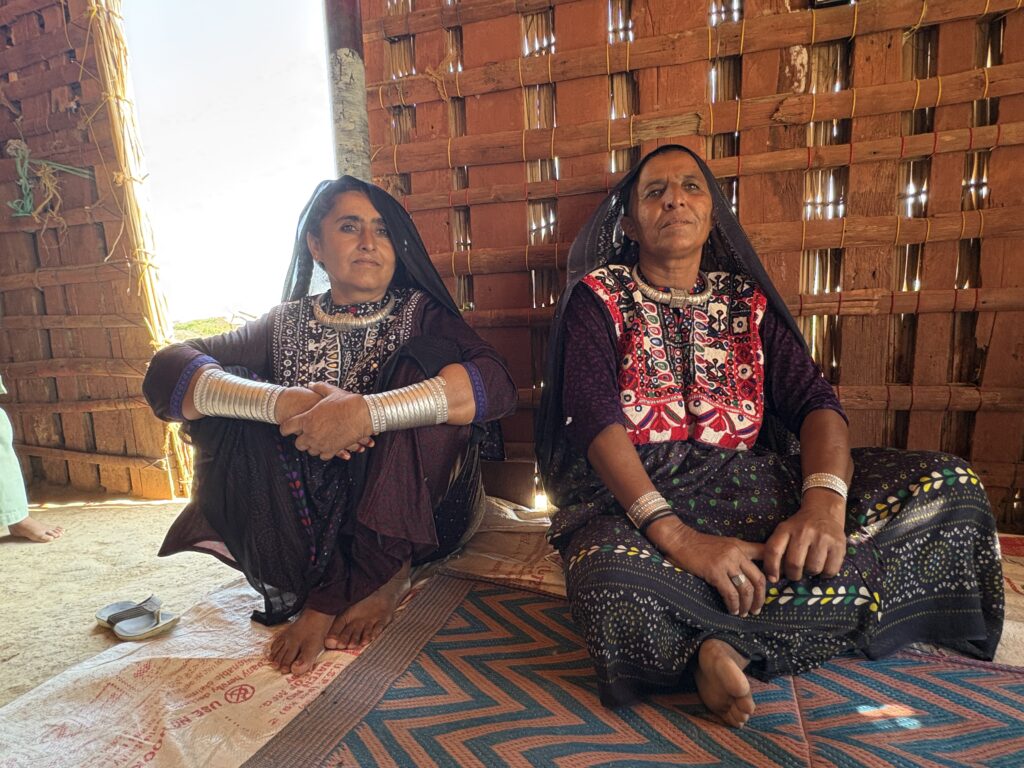
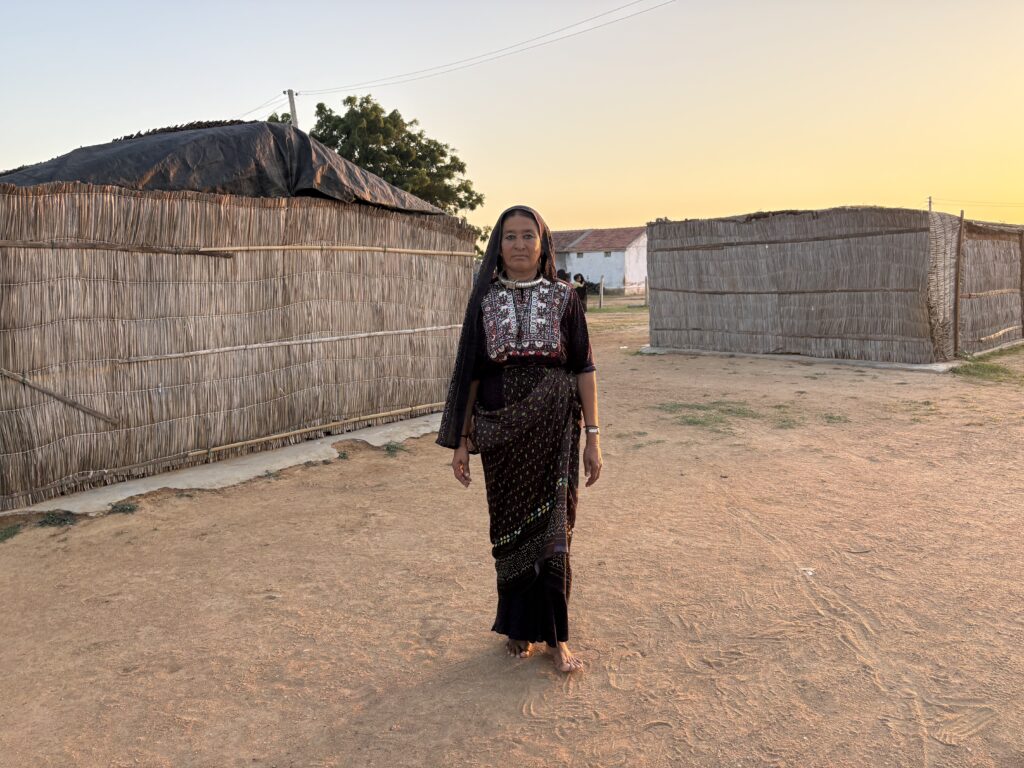
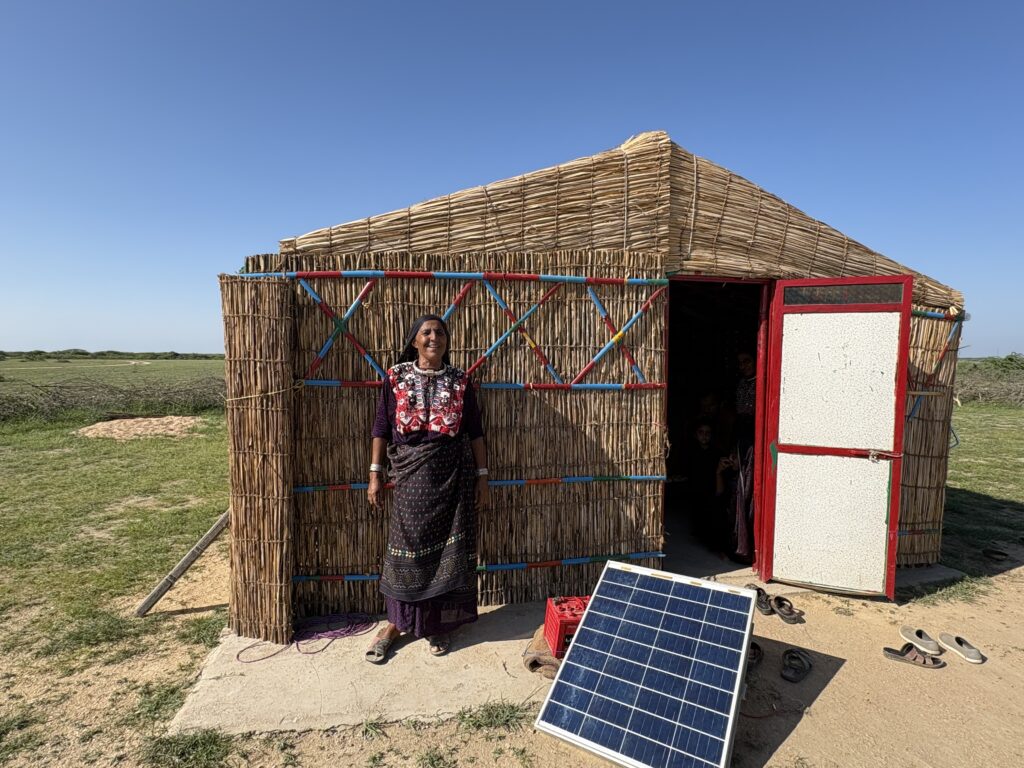
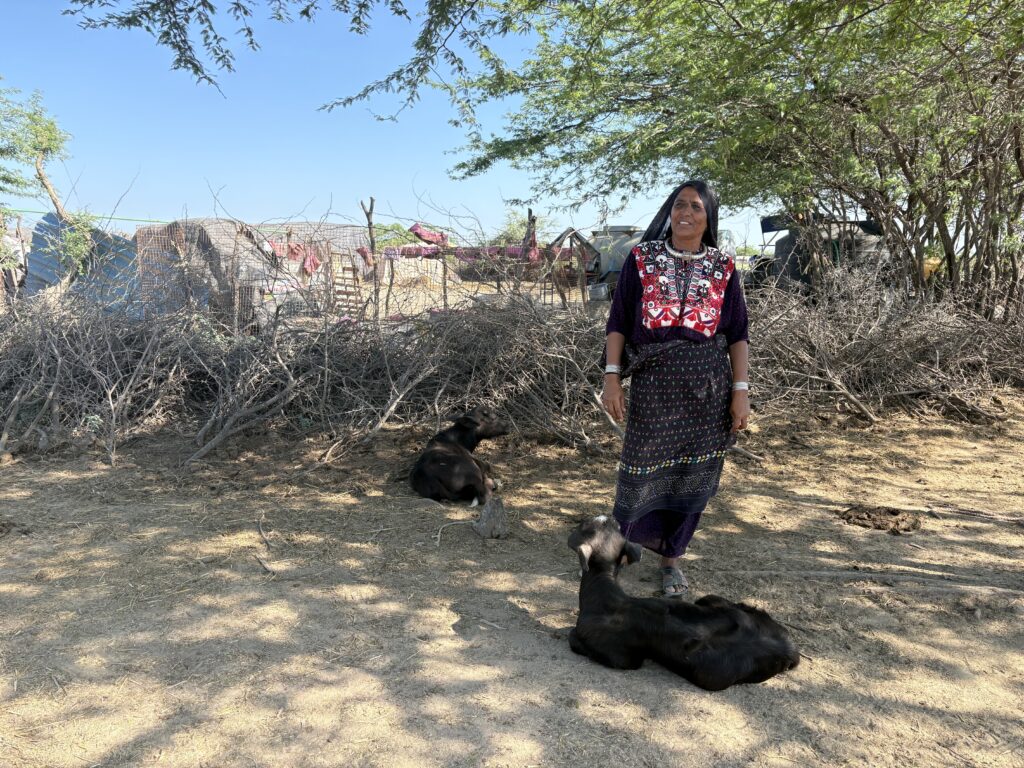
AT THE EDGE OF MORI, a coastal village in Lakhpat in Gujarat’s Kachchh district bordering Pakistan, 57-year-old Aacchat Bai Jat and the women of her vaandh (settlement) wait for their buffaloes to return. Dressed in black-and-red ghaghho embroidered with tiny glass beads and adorned with heavy silver jewellery, these women are Fakirani Jats, a nomadic pastoralist community of camel breeders.
It is 4:30 pm in early October, but the sun beats down relentlessly. A vaandh typically has 15-20 huts, but this one has just two pakkhas (traditional dwellings), which the Fakirani Jat women built from locally gathered wooden stems and grass.
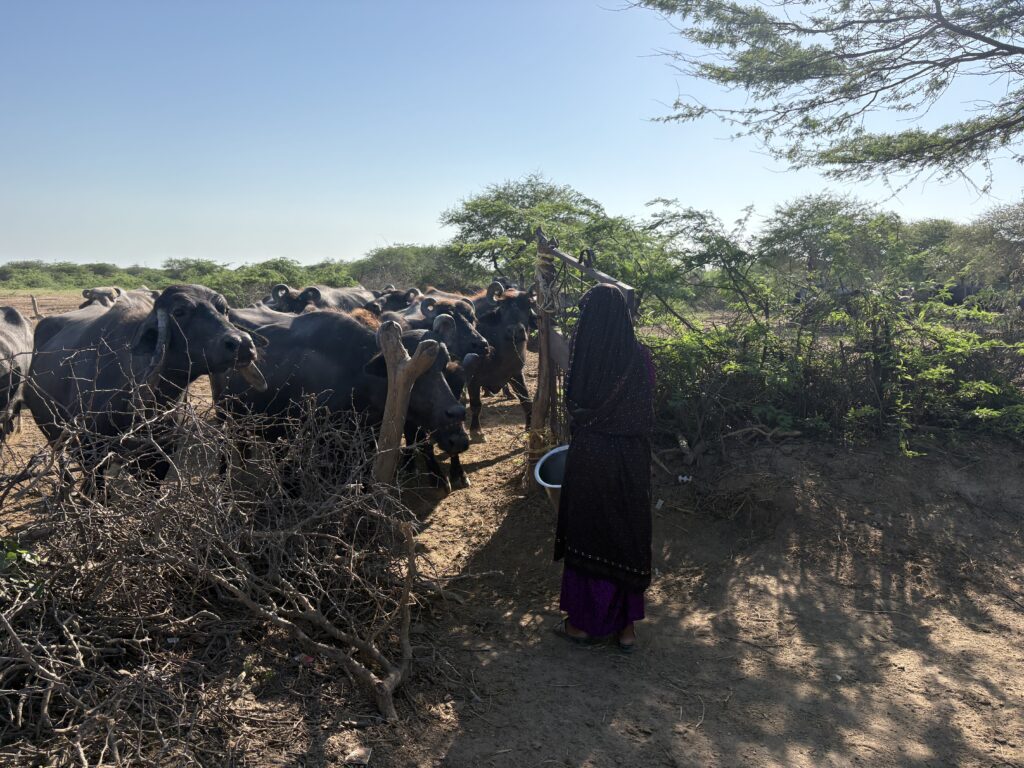
Aacchat Bai sends Fatma, 20, and Aamna, 19 – her brother’s daughters – to bring the herd home. By 5:30 pm, the lactating buffaloes have returned and gathered near the huts.
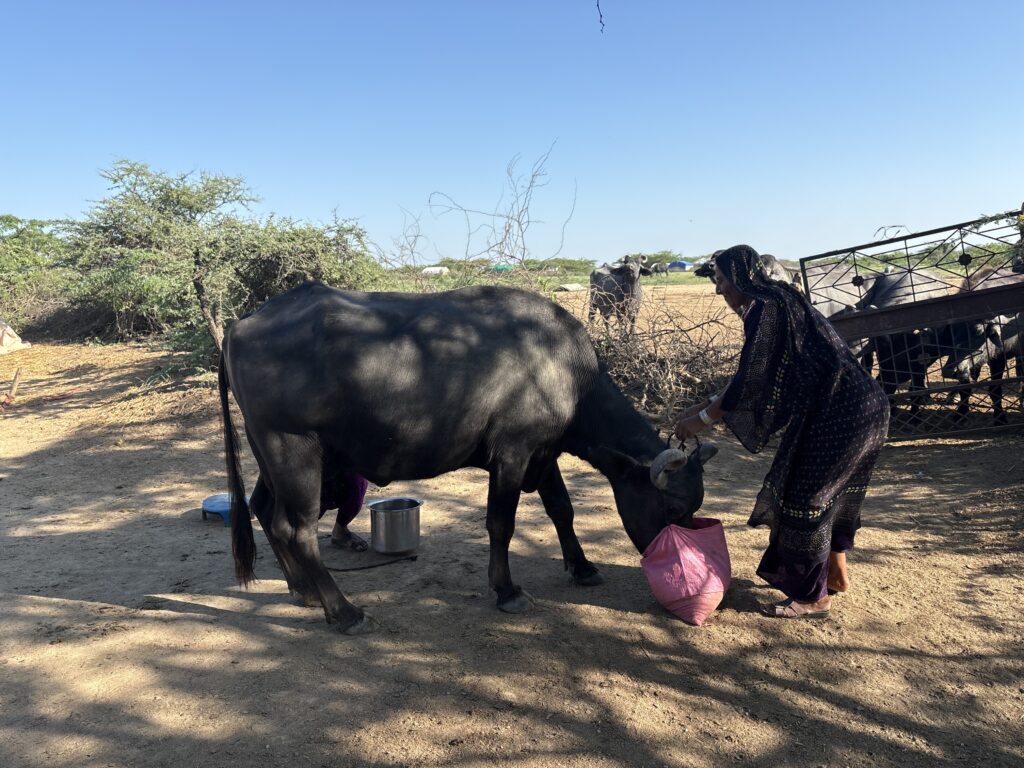
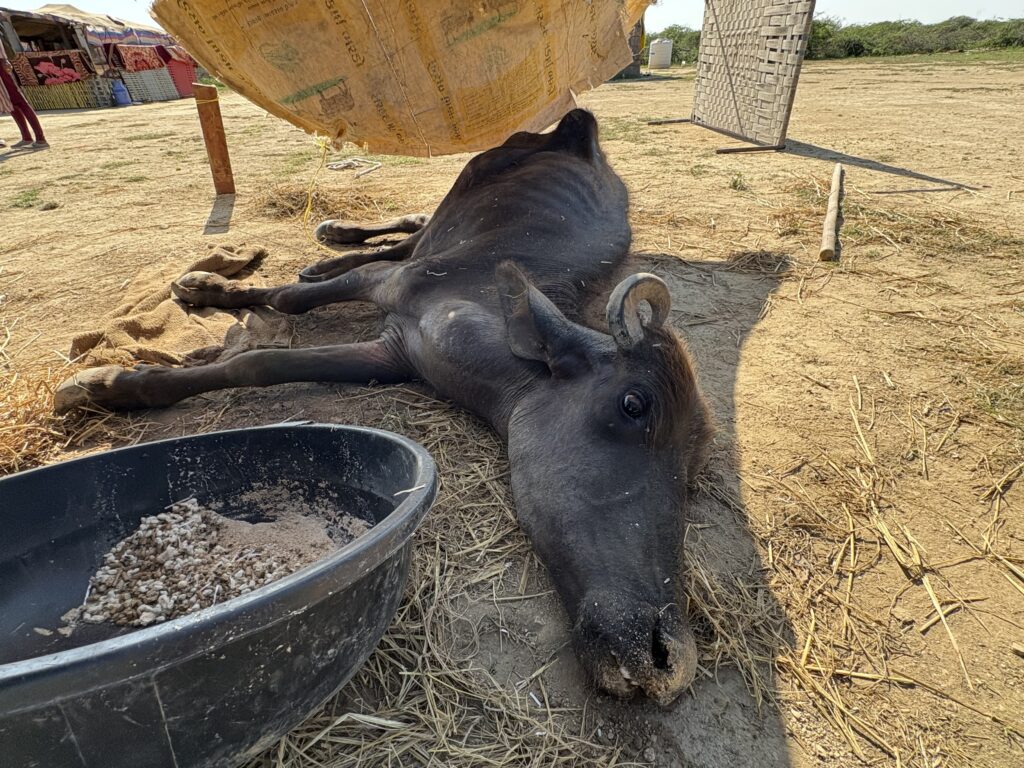
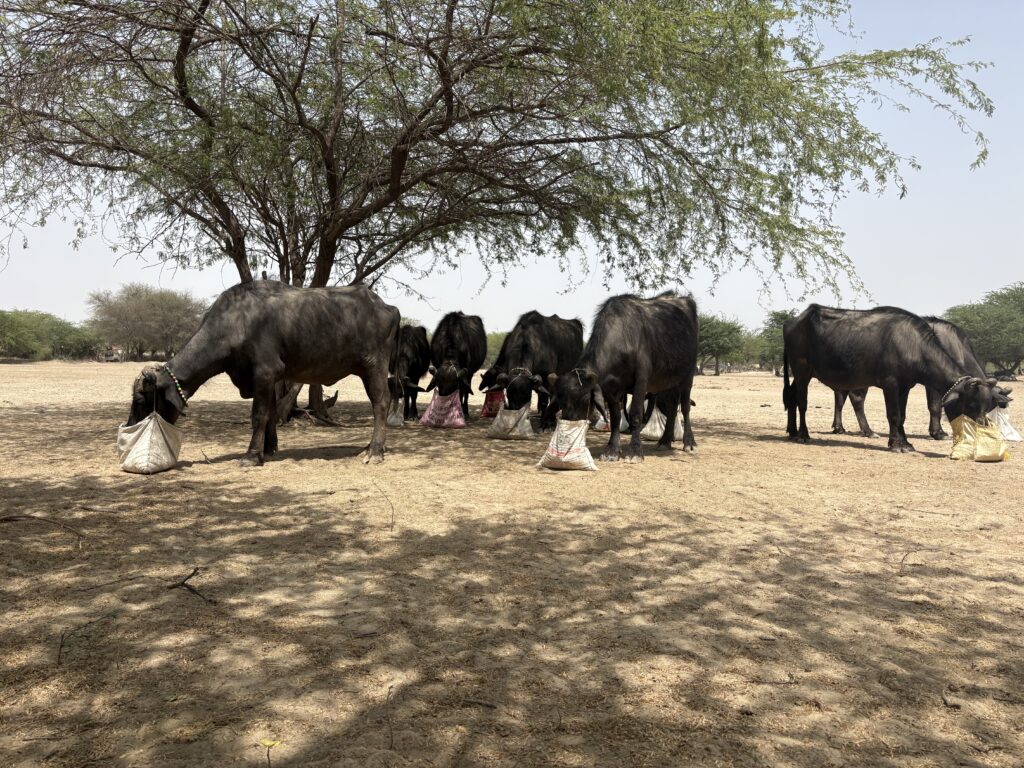
It is now time for the women to turn to the daily tasks that sustain Kachchh’s dairy economy: feeding, cleaning and milking the buffaloes, and tending to their health. For these pastoral households, the well-being of every animal is inseparable from their livelihood.
“I have never been to school. I was five when I first went grazing with my mother and other family members. At that time, my family had about 100 camels,” Aacchat Bai reminisces. “Fifty years later, I am surrounded by more than 150 buffaloes. This [work] demands rigorous labour.”
Spread across 45,000 sq km, Kachchh is India’s largest district by area, home to over 1.8 million livestock animals, including Kankrej cattle, Banni buffaloes, Kharai and Kachchhi camels, Kachch goats and Patanwadi sheep. Banni, on the southern edge of the Great Rann of Kachchh, and Lakhpat, are two distinct pastoral landscapes of the district. Together, they support a range of pastoral and nomadic communities. These include Muslim pastoral groups such as the Fakirani, Hajiyani, Dhaneta and Garasia Jats of Lakhpat, and the Mutwas, Halepotras, Raysipotras, Sumras, Khaskelis and Nodes of Banni, as well as the Hindu Rabaris of Nakhatrana, Abdasa, Anjar and Bhachau. Known collectively as Maldharis, or livestock keepers, most of these communities are classified as Other Backward Classes (OBCs).
Livestock is the only asset for the landless Maldharis of Lakhpat and Banni, and the source of their livelihood, sustenance and identity.
“Maldharis earn through daily milk sales, breeding and selling high-value animals, and milk products such as ghee and mawa. Sheep and goat herders also sell animals for meat and their dung as fertiliser to local farmers,” says Ramesh Bhatti, programme director at Kachchh-based NGO Sahjeevan, which works with pastoral communities.
Milk from Aacchat Bai’s buffaloes finds its way to Sarhad Dairy, Kachchh’s district cooperative, which collects around 5.5 lakh kg of milk a day. Across Maldhari households, women rise before dawn to feed, milk and tend to the animals that sustain this vast dairy economy. Yet the income their labour generates rarely rests in their hands.
BehanBox travelled across four areas of Kachchh—Lakhpat, Banni (Bhuj), Anjar and Nakhatrana—tracing Maldhari women’s lives and labour in the district’s pastoral economy. Some continue rearing livestock amid mounting hardships, while others have moved from pastoralism to wage work, only to slip into deeper economic precarity. Across communities, their pastoral lives are being shaped by rising temperatures, recurring droughts, water scarcity, shrinking grazing lands, industrial expansion and poor infrastructure. Nomadic mobility, compounded by poor documentation and a lack of social security, has also left many women invisible to State policies and welfare systems.
This shift from pastoralism, the women say, has also increased their workload, curbed their mobility and weakened their agency as pastoralists.
“If you ask me to write with a pen, I wouldn’t know what to write. But ask me about my animals and pastoralism, and I can tell you everything—from their grazing patterns to their breeding,” Aacchat Bai says with unmistakable pride. Her knowledge, rooted in a lifetime of pastoralism, reflects an intimate understanding of life in Kachchh’s fragile landscape.
‘None Of Us Keeps A Purse’
Aacchat Bai’s day begins at 4 am with namaz. As the family gathers to prepare tea and rotis, the household stirs to life. Breakfast is usually the previous night’s leftovers.
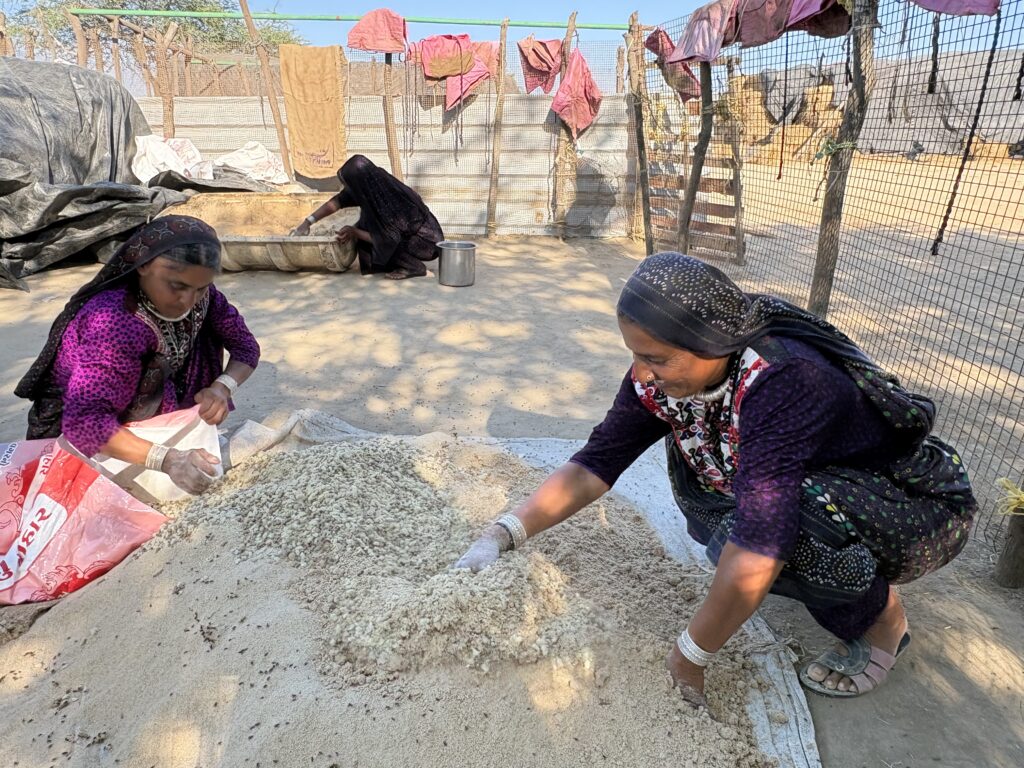
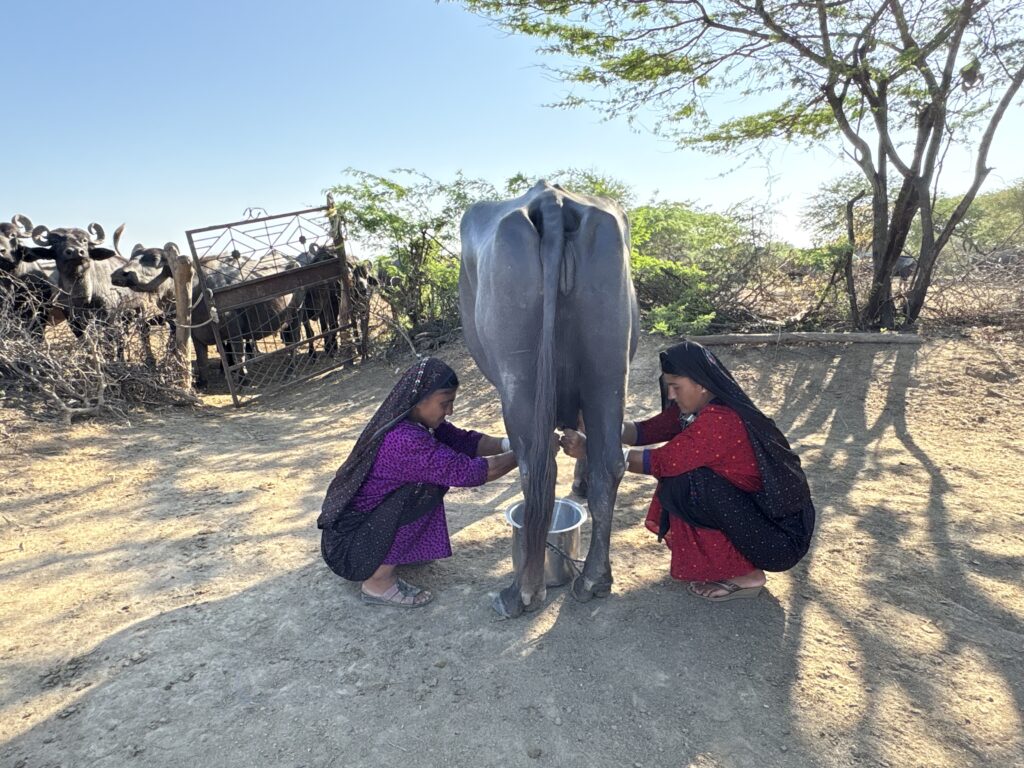
The women then head to the cattle shed. Aacchat Bai’s sister-in-law and nieces prepare daan, a nutrient-rich feed believed to boost milk quality and yield. Nearby, piles of grass await. Once the daan is ready, Aacchat Bai fills feeding bags and hangs them around the buffaloes’ necks. The calves are separated from their mothers as two women begin milking.
Of the more than 150 buffaloes the household owns, over 30 are lactating. Milk yields vary with breed, health, feed and weather. Banni buffaloes can produce, on an average, 18 litres a day, while the crossbred variety in Lakhpat yield 7-8 litres in favourable conditions. During droughts, such as the one in 2026, the yield can plunge to just 1-2 litres.
The entire herd, not just the lactating animals, demands daily care. Each round of the two daily milkings takes two hours. Once the morning round is done, the women take the herd to graze, while a male family member transports the milk to Sarhad Dairy’s collection centre, 5 km away.
Aachhat Bai knows every animal in her herd intimately and has crossed the international border to visit her sister in Karachi. Yet she does not know what happens to the milk once it leaves her home, how the dairy calculates milk prices based on fat content, or even where Sarhad Dairy’s main plant is.
“What savings are you talking about? None of us keeps a purse,” she says, holding up her brother’s phone, who is registered with the dairy. The message recording the day’s milk earnings has arrived on his number, not hers.
Kachchh’s Milk Economy
Gujarat’s dairy cooperative movement began in Anand in 1946, when farmers formed the Kaira District Cooperative Milk Producers’ Union to break a private dairy’s monopoly over milk procurement and pricing. The union evolved into Amul, whose village-level cooperative model laid the foundation for India’s White Revolution.
Kutch Dairy began procuring milk in the 1980s, but successive droughts in 1986-88 and 1991-92 forced herders to migrate, disrupting supplies. Poor roads, distant chilling centres, and according to Ramesh Bhatti, corruption further weakened the system. The local dairies around Banni and Lakhpat shut down in 1997, leaving Maldharis dependent on informal markets and private traders.
A major shift came in 2009, when the Kachchh District Producer’s union, also known as Sarhad dairy, was set up, and with its integration into the Amul network, brought pastoralists into an organised dairy economy. Sarhad now works with 900 cooperative societies and 80,000 milk producers, and has an annual turnover of over Rs 1,200 crore. Together with Maahi Dairy, located in Banni grasslands, Kachchh produces 7 lakh kg of milk daily.
The cooperative model also created opportunities for women. Sarhad Dairy now has 125 all-women cooperative societies, with over 10,000 women members across the district. Yet economic participation has not translated into equal representation. Even where women receive milk payments directly into their bank accounts, their presence in cooperative leadership, village committees and community organisations remains limited.
Rising milk prices have also pushed some households, Aacchat Bai’s included, to milk their buffaloes twice a day instead of once, adding to women’s already heavy workload. On the day of BehanBox’s visit, Aacchat Bai’s buffaloes yielded 100 litres of milk, earning the family around Rs 5,000 at Rs 45-50 a litre. During a good monsoon, daily earnings can rise to Rs 10,000. But with 2026 being an El Niño year, and the district reeling under intense drought, much of the income is being swallowed by the cost of water and fodder.
For Maldhari households, earnings are precarious, set by two forces beyond their control: the fat content of the milk, which determines the cooperative’s purchase price, and the monsoon. In October, milk yields were already below average and were expected to fall further by December 2026 as local water sources dry up.
Of the Rs 5,000 Aacchat Bai’s family earns on a day like this, around Rs 2,000 goes towards drinking water for the animals. The rest is largely spent on daan. During dry spells, the family cuts back on feed and milk yields drop with it , further squeezing already fragile incomes.
“Varsad pade ke na pade, amara hath ma paisa na made (whether it rains or not, we never have money),” Aacchat Bai says.
For her, control over household income matters less than the survival of the animals. “We are Fakirani Jats; we are Sufis. We wander without complaint and seek no luxuries,” she says. “I don’t mind the men keeping the money, as they spend it on the animals too. Pastoralism is all we know and love.”
For Maldhari women, the monsoon brings brief relief as pastures regenerate and fodder becomes easier to find. “If there were enough rain, I could sit in the pakkha and rest,” is how Aacchat Bai describes what a good monsoon means to her.
Without rain, the burden compounds. As the men leave with their animals for days or even months in search of pasture, women are left to manage the household, tend the livestock and care for children and elders.
‘Happy With My Camels’
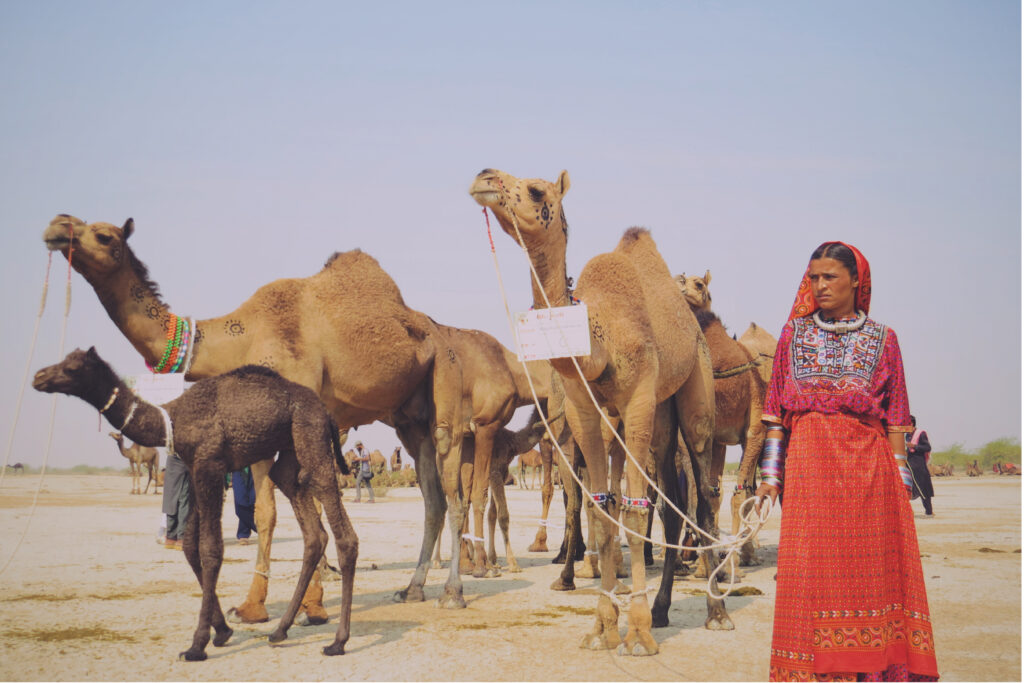
Camels are central to the identity and pastoral heritage of the Fakirani Jats. Nasibi Ben Sher Muhammad Jat, 75, and her family once owned nearly 200 Kharai camels. Today, only 50 remain, of which 12 are lactating. She keeps most of the milk for her family of more than 12 and sells 30 litres a day to Sarhad Dairy, earning Rs 1,500.
Sarhad Dairy’s camel milk plant, set up in 2019, created a formal market, procuring around 4,700 litres daily at up to Rs 50 a litre. But shrinking herds and industrial expansion continue to threaten the community’s pastoral way of life.
The Fakirani Jats rear Kharai and Kachchhi camels. Adapted to the coastal ecosystem, Kharai camels swim through seawater to graze in mangrove forests. But shrinking grazing routes and mangrove cover have pushed their numbers from over 10,000 two decades ago to around 1,000 today, according to Sahjeevan’s livestock census.
Nasibi Ben remembers a time when the family was constantly on the move.
“When we had such a large herd, none of us could sit idle in our pakkha. We split the herd and travelled with our mothers. Sometimes we walked; sometimes we rode camels. The sun was harsh, and we walked barefoot. But with the blessings of our saint, Savla Pir, we never felt tired or uncomfortable,” she says.
For the last 15 years, the family has had to trade their nomadic life for a more settled one in Dhragavandh, 4 km from Mori. “Most of our camels died because we lost access to cher (mangroves). Life on the move was better. Today, even without walking much, we feel exhausted,” she says, angry and despairing.
The sealing of the India-Pakistan border after the 1965 war curtailed their mobility further. “We belong to Balochistan. I remember crossing the sea with our herds to graze.” Nasibi Ben had crossed the border five times in the past via Jodhpur and Attari to visit her family.
Forest restrictions have added to their difficulties. “Today, forest officials treat us with suspicion and won’t let our camels into the mangroves. Where were they before the Partition?” she asks. “Aa cheriya amara ugavela che ane aaje amne j roke che (we nurtured these mangroves, and today they stop us from entering them).” The forest officials, she says, came after the 2001 earthquake that devastated Kachchh. “Now they deny us access to our own land,” she points out.
Nasibi has fought back, joining protests and travelling to Gandhinagar to demand her community’s rights.
“First, we protested against mangroves being cleared for ports. Then came the salt pans, followed by wind farms and solar plants taking over our grazing lands. What crime have we committed? Why are we being punished for keeping camels?” she asks, as she ties her granddaughter’s hair.
As camel herds shrank, many pastoral families in Mori and Mohadi shifted to buffaloes, which offer a more regular milk income. The shift began around 1990, says Ramesh, when Kachch’s fat-based pricing made buffalo milk more profitable than camel milk. Buffaloes demand far more labour, water and purchased fodder, and much of this additional work falls on women.
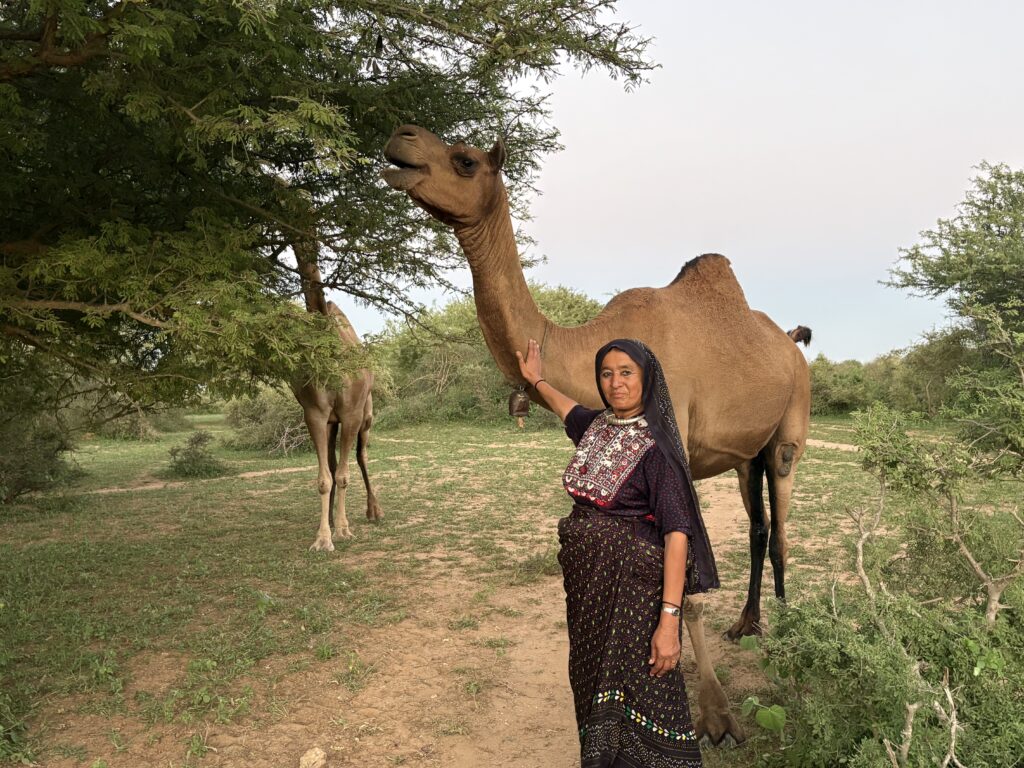
“Camel rearing is easy. You don’t have to worry about their food or how they survive the summer. These magnificent animals endure Kachchh’s extreme heat,” says Nasibi Ben. Buffaloes, she says, demand a different kind of labour. “I no longer have the strength to look after them. I am happy with my camels,” she says, as she offers us tea made with camel milk.
Suddenly, the sound of bells interrupts her. Her face lights up. “Aavya aavya jo mara unt aavya (my camels have come)!” she exclaims.
She walks towards the ovado (water trough), where the camels gather to drink. Once refreshed, they head towards the vagda (grazing land). Nasibi Ben follows with her granddaughters, gently stroking the animals.
“Whatever I am today is because of these camels,” she says.
Endless Labour, Limited Freedoms
In Gorewali village in the Banni grasslands, Gulnaz Mutwa*, 60 , stays up when a buffalo is due to calve. The newborn is treated like royalty. For the next five to six months, she feeds it milk, keeps it apart from the herd and guards it against heat and foxes, often through the night.
Covering around 2,500 sq km, Banni is one of Asia’s largest grasslands and the heart of Kachchh’s pastoral economy, known for its hardy Banni buffaloes, intricate embroidery and vibrant folk culture.
Unlike Lakhpat’s largely nomadic Maldharis, many pastoralists in Banni have become semi-nomadic, and some have diversified into industry and tourism. The gender dynamics here offer a sharp contrast with Lakhpat’s.
Here, men oversee buffalo breeding and grazing, while women handle milking and household work and are largely confined to domestic spaces. As more men take up non-pastoral jobs, women are left to shoulder both livestock and household care.
Gulnaz’s family owns 70 buffaloes, of which 12 are lactating, producing around 200-250 litres of milk a day for Maahi Dairy. “My day begins with the Fajr azaan, and from then until night, my life revolves around the calls of my buffaloes and the sound of their bells. This is my life,” she says. “I never get to rest. I dream of going to Mecca for Hajj or Umrah.”
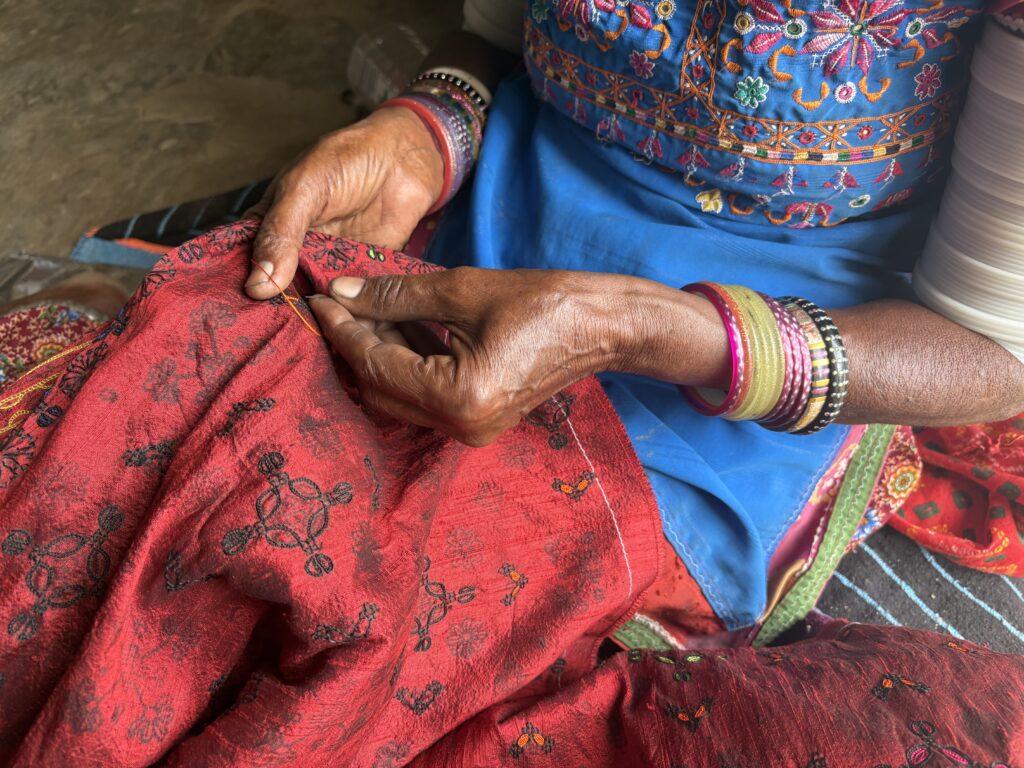
Alongside tending the herd, Gulnaz embroiders for Kachchh-based NGO, earning enough to save Rs 3,000-5,000 a month towards a pilgrimage to Mecca.
The family earns up to Rs 12,500 a day, but the payments go directly to her husband’s account, and rising costs mean that the family saves little. Gulnaz’s only independent income comes from hours of painstaking Mutwa embroidery.
Kruti Laheru, the executive director of Kutch Mahila Vikas Sangathan (KMVS), points to a deeper consequence of this transition for women’s labour and agency. “While Sarhad Dairy brought a degree of financial stability, the shift from nomadic to settled life has severely curtailed women’s autonomy,” she says. The shift has also increased women’s physical workload, she adds. While some pastoral communities share responsibilities more equally, women in others bear a disproportionate burden.
“If I had received a share of the income from our milk and breeding, I would have performed Umrah by now,” says Gulnaz, who has seen little of Kachchh beyond the hospital in Bhuj. She says she does not mind not getting a share of the milk income. What rankles her more is being tied down to Banni.
“What we want is the freedom to move, to see what lies beyond Banni. Being confined to the house year after year can feel suffocating,” she says.
‘We Were Like Free Birds’
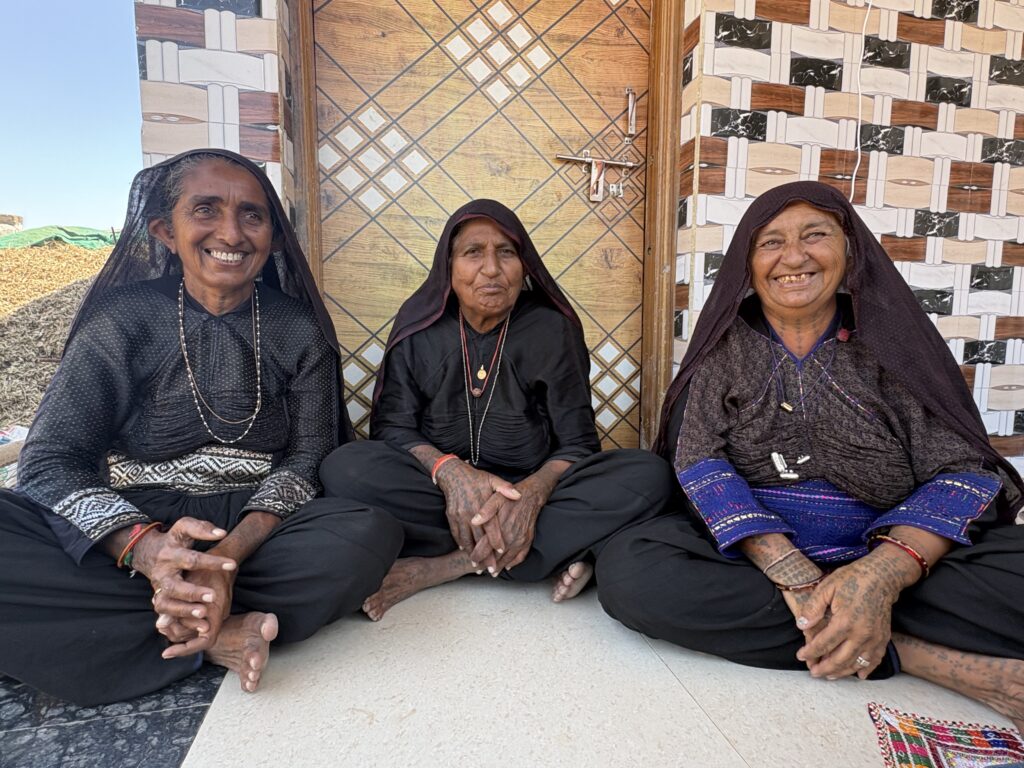
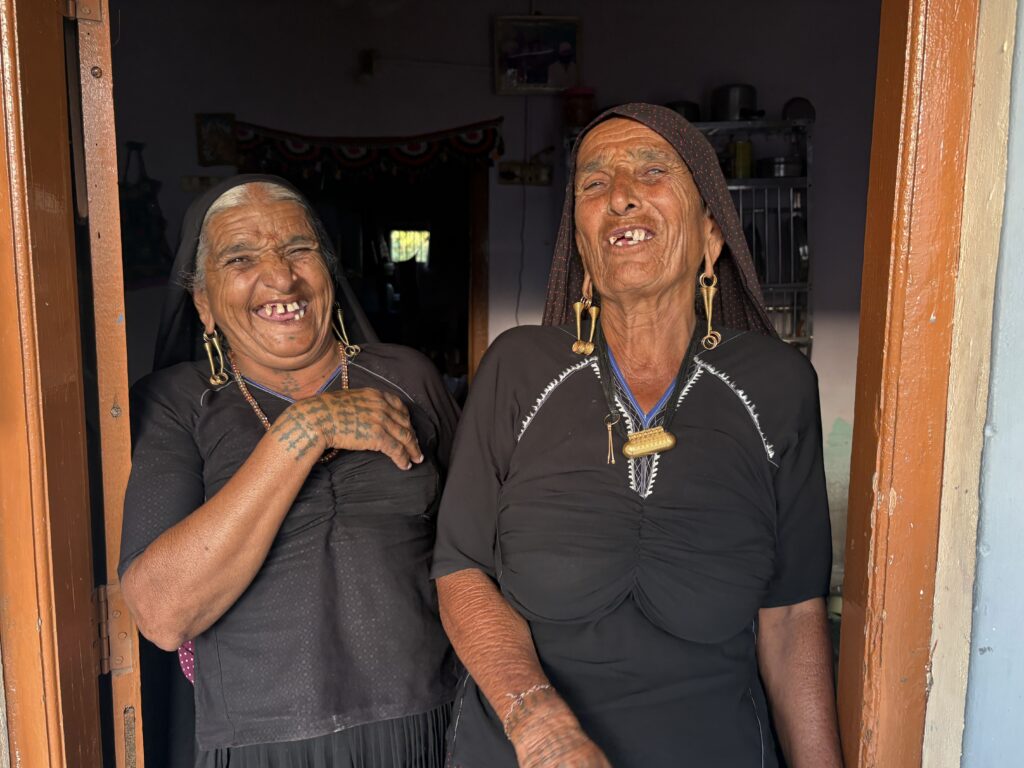
About 35 km from Bhuj, in Bhadroi village of Anjar taluka, three Dhebariya Rabari women, Jiva Ben, 75, Meghu Ben, 72, and Madhu Ben, 68, recall a more mobile pastoral life, travelling hundreds of kilometres with their sheep and goats in search of pasture. Dressed in traditional black, they wear simple lace instead of the intricate embroidery worn by married women and unmarried girls. The lace marks them as widows.
For over three decades, as the grazing lands dwindled and dried up, the Rabari pastoralists have been travelling long distances with their animals in search of fodder, going as far as Maharashtra and Chhattisgarh. They follow familiar routes in large family groups with goats, sheep and camels, often cajoling forest officials into letting their animals graze. They can stay away for several years, only occasionally returning home. Earlier, women were a part of this migration, but over the last decade, it is mostly men who travel while the women stay at home.
“We travelled as far as Chhattisgarh and Nagpur in Maharashtra [in search of pasture]. We slept under the open sky and cooked over wood fires, without worrying about electricity bills,” Jiva Ben remembers. “We were like free birds. Now, confined within four walls, we feel suffocated,” she says, as the others nod in agreement. Pastoral life had its risks: unfamiliar routes, wild animals and the chance of straying into Naxal areas. But in those years, nobody harassed them, the women say.
A typical Rabari family keeps 200-300 sheep and goats. But many of these animals have since vanished. The women sold theirs about a decade ago, as age, widowhood, illness and climate change made pastoralism unsustainable.
Access to pastures, too, has become costlier with more money being demanded by forest officials. “Thirty years ago, we paid Rs 20 per goat to graze. Today, it costs Rs 100-150,” says Madhu Ben. “With our animals, we lost our identity and our income.” Some men now earn Rs 15,000 a month in factories, while women work in bandhani tie-and-dye workshops. “As pastoralists, we could choose when to rest. Now, we are tied to rigid working hours,” rues Madhu Ben.
For Dhebariya Rabaris, pastoralism follows a different economic model. As sheep and goat keepers, they earn mainly by selling male animals, particularly when demand peaks around Bakri Eid. Female goats are retained for milk and breeding, and the milk stays home, since neither Maahi nor Sarhad Dairy procures goat milk.
“Depending on mutton prices, a one-and-a-half-year-old male goat can fetch anywhere between Rs 12,000-30,000. Selling 20-25 animals could sustain a family for a year,” says Jiva Ben. A healthy flock could earn Rs 6-7 lakh a year, depending on its size and health, far more than the Rs 15,000 a month many now earn through wage labour.
“Majboori hati ben, nahi toh koi maal veche? Dukh thay che (it hurts to sell the animals but we have no choice),” she says.
The loss of pastoralism is also visible on their bodies. Jiva Ben’s hands bear intricate tattoos of camels, tigers, stars, squares and scorpions. Girls who no longer herd animals do not get them.
“These tattoos are the identity of Rabari women. I cannot imagine my hands without them. Kevo kharab laage (how ugly they would look),” says Jiva Ben.
Changing Pastoralism
Climate change, industrialisation and invasive species are changing Kachchh’s fragile landscape and, with it, the very nature of pastoralism and pastoralists' sense of who they are. A 2019 Down To Earth report estimated that by 2105, nearly 54% of Banni’s native grasslands were overtaken by the invasive Prosopis juliflora (vilayati babool), threatening the grazing ecosystem.
For Gulnaz, protecting the grasslands matters more than milk income. “Our earnings from milk are secondary. Our grasslands must be protected at any cost,” she says. “Gando baval e amne ganda kari didha che (this mad babool has driven us crazy).”
Under the Forest Rights Act (FRA), 2006, Kachchh’s Maldharis may claim rights as Other Traditional Forest Dwellers (OTFD), subject to eligibility criteria. The Act recognises traditional grazing rights of settled and transhumant pastoralists, as well as their Community Forest Resource (CFR) rights. In Banni, 47 villages reportedly secured CFR approval in 2015, but implementation remains contested, says Ramesh who has worked with pastoralists for over three decades. Despite generations of dependence on Banni’s grasslands, Maldharis still face uncertainty over their customary land and resource rights.
Lakhpat has been officially declared drought-affected this year and several years in the past. In other years, it has faced severe water shortages. In Banni’s Chaari Dhand region, meanwhile, NTPC Renewable Energy Limited’s proposed 900 MW solar project has raised concerns over the livelihoods of nearly 6,000 pastoral families, according to information in the Narottam Ahir vs. Union of India case pending before the National Green Tribunal.
Kruti of KMVS explains how climate change is compounding these hardships for Fakirani Jats and women from other pastoralist communities. “Traditionally, migration routes and seasons were well defined and predictable. Erratic rainfall has now disrupted both,” she says. “Women are forced to take unfamiliar routes across open fields and farmlands, which pose new challenges to their safety and privacy—vulnerabilities they rarely encountered earlier.”
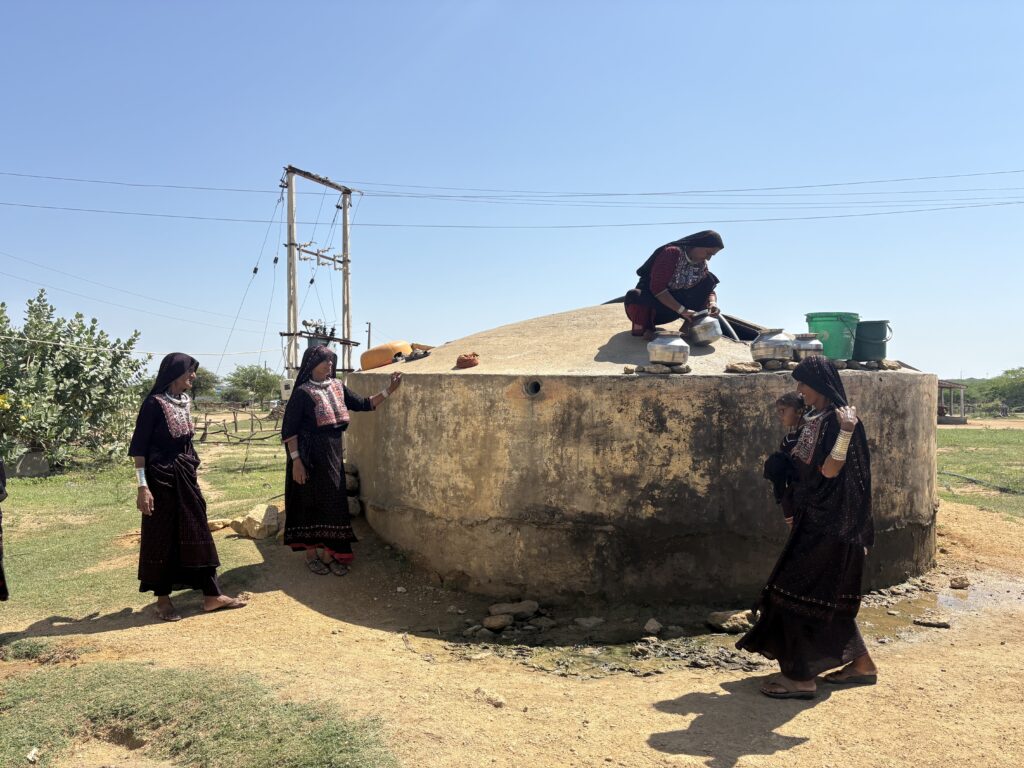
The crisis follows families home. In search of water, Aacchat Bai was forced to leave her permanent settlement in Lakki village and moved to Mori, barely 10 km away, with a few belongings. Traditional water sources have dried up, leaving households dependent on piped supplies that arrive through the Narmada canal system barely once in 10 days. Women and girls walk 5-7 km each way to fetch drinking water from the nearest well. At the time of BehanBox’s visit, Aacchat Bai’s new settlement had gone without water for nine days, leaving her anxiously waiting for the next tanker.
Yet women, whose lives and livelihoods depend on these landscapes, remain largely excluded from decisions about their future. Collective representation among Kachchh’s pastoralists remains fragmented along lines of animal, geography and gender. Collectives such as Kutch Unt Uchherak Maldhari Sangathan (KUUMS) and the Banni Pashu Uchherak Maldhari Sangathan (BPUMS) have given women pastoralists a platform while advocating for dairy infrastructure, grassland restoration and pastoral land rights.
Women’s voices, however, have remained peripheral in these collectives. Women were first enrolled in BPUMS in 2012, says Ramesh of Sahjeevan. But conservative social norms continue to restrict their participation.
“I am technically a member of BPUMS, but I have never attended a meeting at its Hodka office. The men in our families simply don’t allow us to go,” says Gulnaz.
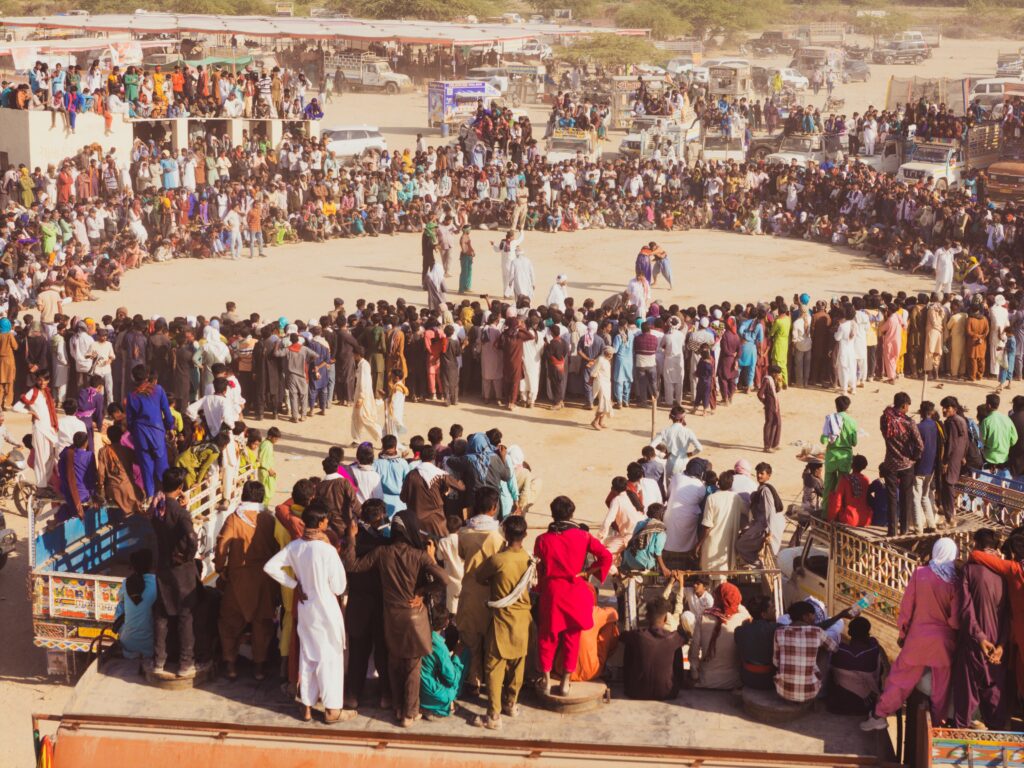
The exclusion is stark at the annual Banni Pashu Mela, Kachchh’s largest livestock fair. Thousands of men attend livestock competitions, trading and cultural events, but not a single adult woman has ever participated. They have seen their animals only in photos on phones.
“Our animals are like our children. We would love to see them compete, but we never get that chance,” says Gulnaz.
‘Out Of A Well And Into A Pit’
In Ganesh Nagar, on the outskirts of Bhuj, 82-year-old Paali Ben Penna Bhai Rabari and her 75-year-old sister, Kaamu Rabari, have earned their living as domestic workers for the last 40 years. Once pastoralists, the sisters, from the Kachchhi Rabari community of Nakhatrana taluka, sold their livestock after successive droughts, only to find themselves struggling with the costs of urban life.
The sisters work in several households for most of the month, earning around Rs 4,000. Younger women can earn Rs 10,000-12,000 a month. For Kamu Rabari, 26, who moved to Ganesh Nagar six months ago after her family sold its sheep, domestic work offers some relief from herding under the scorching sun. But even this work is physically demanding.
The shift to wage labour has brought the women little respite. “Women once had a strong say in their children’s education, marriages and other family affairs. With settlement, they became confined to domestic roles, shouldering more unpaid care work, while men took control of livestock and milk markets,” says Kruti.
While younger women have adjusted more readily to urban life, older women remain nostalgic for their villages. “Kuwa thi nikdi ne khai ma pesiya (we climbed out of a well only to fall into a pit). Had we not sold our animals, I would be resting in my village today,” says Paali Ben.
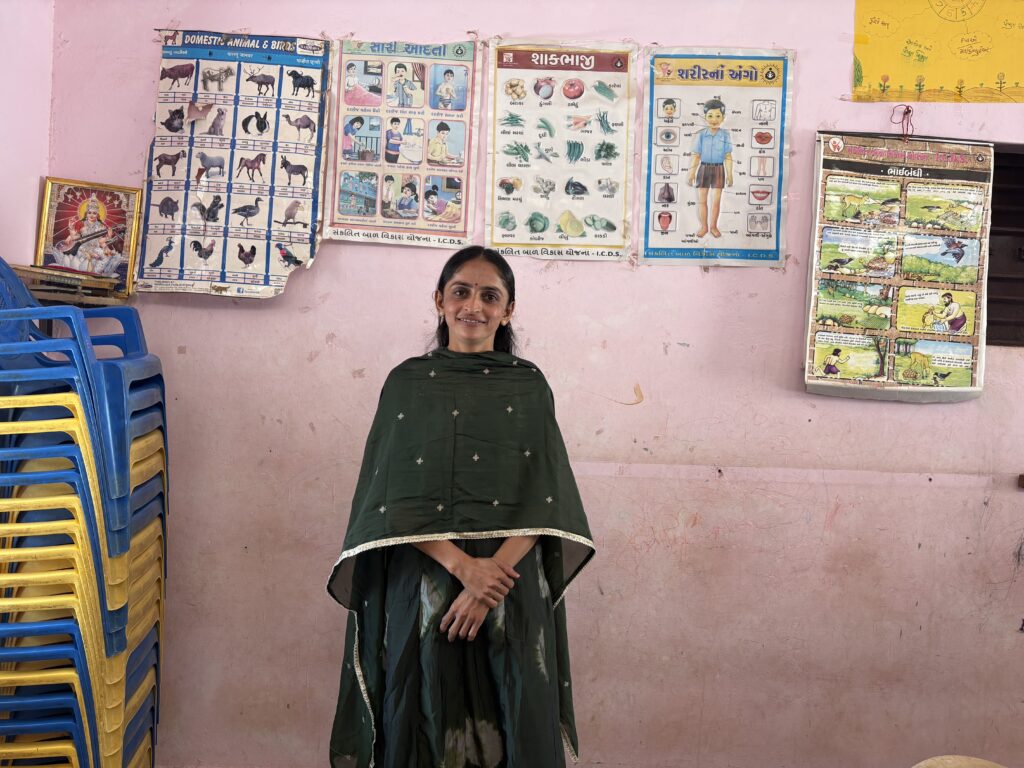
Back in Bhadroi, girls are seeking a better future through education. Girls whose schooling was interrupted by migration are returning to formal learning through distance-education programmes. Devi, 24, an Anganwadi helper, hopes to join the civil services.
“With forests disappearing, we must find other livelihoods,” she says. Recalling her years in Chhattisgarh, she adds: “We had no panchayats or groups of men monitoring our movements. We were free. Now that we are settled in one place, our movements and choices are increasingly restricted.” Devi’s sister-in-law is still in Chhattisgarh, travelling with a flock of sheep and goats.
The loss of livestock has not been offset by secure employment, pensions or reliable social support, says Kruti. Generations of seasonal migration have left many women without basic identity documents like birth certificates and Aadhaar. This gap has kept them out of reach of welfare schemes, healthcare, education and food security. For many, the only document they hold is an Animal Transportation Certificate, which protects them from police harassment and allegations of cattle theft while moving their herds. The Maldharis of Banni also lack secure land tenure and live on government land.
The women BehanBox met in Lakhpat and Bhadroi did not have National Food Security Act ration cards, which shut them out of subsidised rations. Few recalled receiving work under the Mahatma Gandhi National Rural Employment Guarantee Act (MGNREGA), since replaced by the VB-G RAM G Act.
Older women continue working because they cannot afford to retire, while younger women take low-paid jobs with few protections. Many turn to faith, finding solace at Haji Pir dargah and Aashapura Mata temple.
Aacchat Bai’s life sums up the contradictions of pastoralism today. Abandoned by her husband soon after marriage, she has found companionship in her herd. “I was born a pastoralist, and I will die a pastoralist,” she says.
*Name changed to protect identity
[This story is part of the series ‘The Full Field: The Many Faces of Women Farmers‘, a collaboration between Womanity and BehanBox.]
We believe everyone deserves equal access to accurate news. Support from our readers enables us to keep our journalism open and free for everyone, all over the world.