[Readmelater]

BehanVox: Marching Towards Erasure

This week in BehanVox: resistance against the new Trans Bill, notes from an ASHA worker in Kashmir, and more

Subscribe to our weekly newsletter that brings you top stories, gender news from the world, and our team’s reading recommendations.

Hello Behans! 

In our interconnected world, the global turmoil is now being mirrored in many pockets of India, show scattered reports.

Peeyur Timbers once used to give away firewood for free to clear its yards in Chittur, Ernakulam. But now the proprietor told New Indian Express, people are willing to pay a hefty price for it. Two tonnes of wood, normally bought only by bakeries and mills, sold out in three days to ordinary customers. Similar stories of soaring demand for firewood are being reported from across the country, indicating that decades of effort to switch the use of unsustainable and toxic traditional fuel sources in Indian kitchens is being undone

With all talk around resolution of the West Asia conflict moving one step forward and two steps back, it is difficult to summon any optimism around the energy crisis. The Indian manufacturing sector is beginning to show the signs of the strain brought by surging freight rates, stuck shipments and gas shortages, reports Indian Express. Steel, textiles, automobile, and food businesses have been hit, leading also to reverse migration. With the critical livelihood scheme – which held up the return of workers during Covid – now imperilled, it remains to be seen how the returnees will cope.

We ought to keep persisting despite everything. Our friends at Locavore are doing just that. As part of their Women farmer project– a multimedia storytelling initiative that documents and amplifies the lived experiences, knowledge systems, and everyday labour of women farmers across India’s food landscapes they are inviting applications for fellowships for women storytellers. Do check out and apply.

This week in BehanBox, we report on another geopolitical issue that has left women workers in a precarious state. And an interview with an Asha worker from Kashmir whose mission and faith keep her going despite everything.

Story So Far

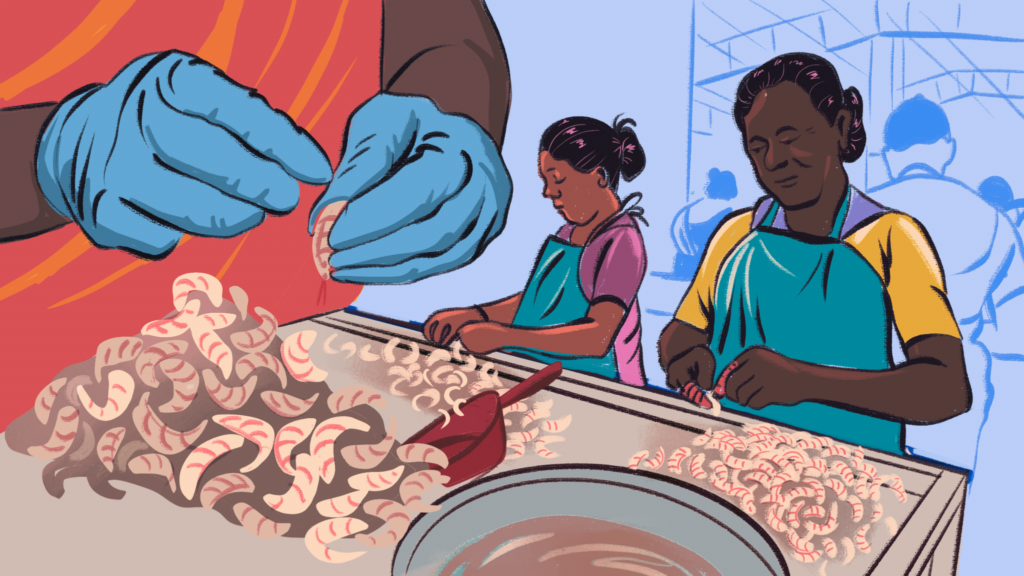
Ponds filled to the brim, lush coconut trees, and aqua farms extending to the horizon — every scenery in West Godavari’s Bhimavaram evokes prosperity. But not Durga’s 280 sq-ft home in Akividu, where the living room becomes the bedroom at night.

Durga is one of the many women employed in the shrimp factories of Bhimavaram, a critical hub for shrimp exports to the US. Here in processing and cold storage units, big and small, women like her spend hours in freezing rooms, deveining and deheading prawns that are then frozen, raw or cooked, for shipment. Andhra Pradesh contributes 80% of India’s shrimp exports and supports the livelihoods of over 2.5 lakh families, like Durga’s, and sustains nearly 3 million people directly and indirectly.

The Trump administration’s hefty tariff rate on exports out of India, including shrimp, have hit the industry hard. And despite partial rollback, the sector still cannot compete with other exporters such as Ecuador.

“In the past six months, I haven’t been getting work throughout the month and I earn only half of what I used to,” says Radha, another worker whose monthly earning of Rs 15000 has now halved. “I have to educate my eight-year-old daughter, repay loans, and manage household expenses. My husband hits me when I ask him to pitch in.” 

Radha’s earnings and work used to allow her independence and time away from home. Now she has no option but to be vulnerable to the abuse at the hands of an alchoholic husband.

Even before the current crisis, the industry was exploitative. Most workers are hired on a contractual basis so employers do not have to pay them a fixed salary and also avoid paying benefits such as health insurance, bonus, and provident fund. Although contractual workers are technically eligible for benefits such as health insurance, bonus, and provident fund, these are rarely provided in practice.

New labour laws allowed employers to demand that workers put in 8-10 workhours a day for the same pay. Now the industry slump caused by the tariff is allowing them to seek even longer hours of work or face the threat of dismissal, say workers, sometimes as much as 12 hours. 

Read our story here.

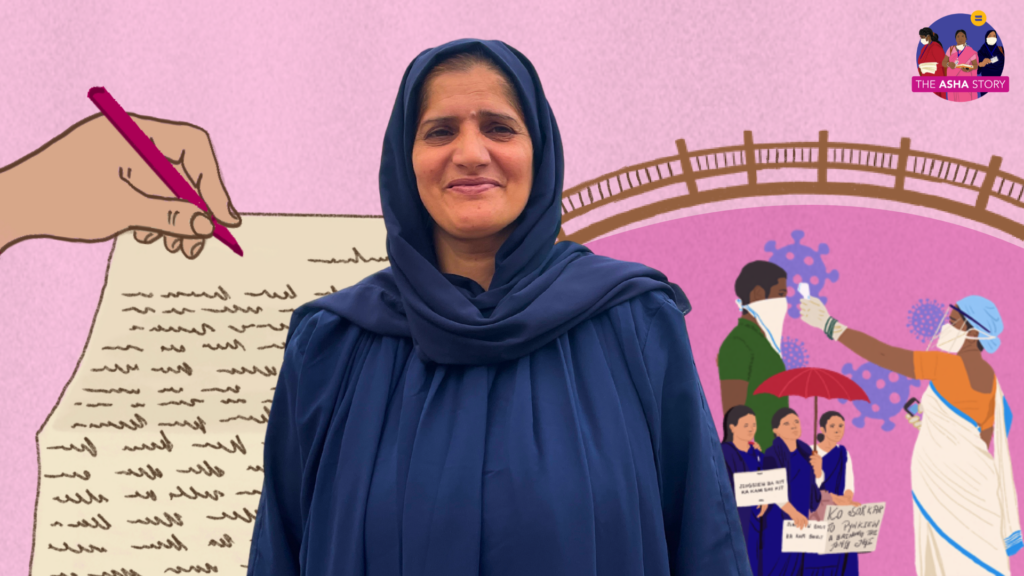
In Shaheena Bano’s life there is little room or time for bitterness or recriminations. This is despite the fact that the 42-year-old ASHA worker from Srinagar is, like others of her cadre, hugely underpaid and overworked. Apart from the unending tasks she is entrusted with, she also has to navigate political uncertainties, curbs on her mobility, public apathy, and a health department that does not dignify her work.

She works on some very basic tenets – her work is a form of long term charity that her faith values, sadaqah-e-jariya and that she and her coworkers should neither trample upon the rights of others nor stand by when others oppress them in their line of work.

“We are expected to work as full-time employees and are treated like volunteers,” she says.” There have been weeks when we have even worked on weekends. The health department is completely unaware of the scope of our work. I’ve been to the mission director, the CMO, the BMO. They expect us to be everywhere. If there is contaminated water somewhere, they put the blame on us and say, “ASHA kahan hai?” How can we be responsible for everything? Hum sipahi ki tarah humesha field mai rehte hain (we are like soldiers; always stationed in the field).” 

When recently protests against the Iran war broke out in the valley, Shaheena Bano had helped transport a pregnant woman to the hospital through the melee on the streets. She is proud of her effort and what it brought to the life of an anxious family. And her work has helped put her two children through a great education, build her home and assist her husband’s catering business.

“We are our own saviours. I have often organised protests and participated in ones which are organised by our union. I always ask my fellow ASHAs to not fear the authorities,” she says.

Read our interview here

Talking Point

Trans Bill: Despite the vociferous opposition to it, The Transgender Persons (Protection of Rights) Amendment Bill, 2026 (Bill No. 79 of 2026), has been passed by the Parliament and now awaits the Presidential stamp. The Bill makes a critical change to the 2019 Act, limiting the definition of “transgender person” to socio-cultural identities such as kinnar, hijra, aravani, jogta, eunuch, or biologically-defined intersex variations, or persons forcibly compelled into such an identity through mutilation, castration, amputation, or any surgical, chemical or hormonal procedure. This excludes those with alternative sexual orientations and gender fluid identities, doing away with the right to self-perceived gender identity. Mridula Chari had argued that this erases the very existence of an entire community. The campaign against the Bill had included not just the LGBTQ+ communities and street protests by progressive Indians but also political parties and leaders.

Women’s Seat Reservation: In the ongoing Parliament session, the government is seeking to introduce at least two bills – including constitutional amendments – over two special sessions towards reservation of one third seats for women in the next Lok Sabha poll and ensuing assembly elections. The number of seats in the Lok Sabha will at the end of this exercise rise by 50% with the increased seats being kept aside for women, Times of India reports. The Congress has criticised the move because it is being considered without the completion of the delimitation and census exercises. DMK MP Kanimozhi too has questioned the timing and haste behind the move.

Kerala Skew: Between the Left, the Congress, the BJP and the IUML Kerala’s main political parties have fielded only around 40 women candidates across its 140 constituencies. It is the first time the IUML has offered tickets to women candidates. Since the formation of the Kerala Assembly in 1957, this percentage has never crossed 10%.

Gender in Sports: The International Olympic Committee is reportedly planning to ​introduce universal genetic sex testing for women athletes and impose a ban on transgender and intersex competitors, reports Reuters. Over 80 human rights and sport advocacy groups have protested on the grounds that it would set back gender equity in sport.

BehanVox Recommends

On politics: Why you can’t change someone’s mind: If you’ve been feeling like political debate online leads nowhere, this podcast episode from London Review of Books is worth your time. Sarah Stein Lubrano challenges the idea that the “marketplace of ideas” actually works, arguing that better arguments don’t necessarily win—and may not even change minds. Instead, she explores how social ties and collective action are far more effective in shaping beliefs and driving change. It’s a sharp, thought-provoking listen that questions whether debate still serves democracy in the way we assume.

The feminist visionary who lost the plot: Elizabeth Cady Stanton believed that she was a person of “superior intelligence and courage.” This fuelled her radical politics—and her eventual descent into bigotry. Read Moira Donegan’s profile of Elizabeth in the New Yorker.

The loneliness epidemic [in data]: This intimate and data driven piece, The Pudding offers a powerful look at how we spend our time—and who we spend it with. Drawing on data from the American Time Use Survey, it follows a single day in 2021 through the lives of several people, including Martin. What emerges is something deeper than a daily routine: a portrait of growing isolation. 

Want to explore more newsletters? In Postcards, we send you missives on the places, people and ideas that brought Team BehanBox joy. Our monthly offering Postscript invites you, the reader, into our newsroom to understand how the stories you read came to be – from ideation to execution. Subscribe for more.

Support BehanBox

We believe everyone deserves equal access to accurate news. Support from our readers enables us to keep our journalism open and free for everyone, all over the world.

Donate Now