
Beaten But Unbowed: How Young Protesters Were Detained And Freed in Delhi
Delhi’s young protestors have been detained in thousands across remote holding centres but a group of citizen-led networks have worked tirelessly to free them
Here she is again, Naureen.
She has been on the streets since the beginning. She is a teacher and on some days volunteers her time at a community library. In 2024, when she was just 24, she joined the Revolutionary Workers’ Party of India (RWPI), drawn by their call to fight with and for working masses. Since then she has turned up at every flashpoint. She was in Jantar Mantar on July 20 when the student protests brought down former education minister Dharmendra Pradhan; in August she protested to demand the release of political prisoners and activists arrested in the Noida workers’ protest three months earlier. On October 2, she was there when Neha Bora of All India Students’ Association (AISA) launched Jantar Mantar 2.0 to repeal and reverse the exclusionary revision of voter rolls through the Special Intensive Revision (SIR) exercise. And on October 10, when the capital city turned into a fortress to contain protests seeking CEC Gyanesh Kumar’s ouster, she was there again.
Now she is marching to Jantar Mantar on October 13 but she will be stopped at one of the several barricaded and chained intersections. She will be told Section 163 is in effect in the area, groups of five or more people are unlawful, although there are no orders to show for it. She will cease her march and sit there, and along with three dozen people, a song in their heart and slogan in hand, staging “a civil disobedience” sit-in.
And then she was to be detained yet again, the second day in a row.
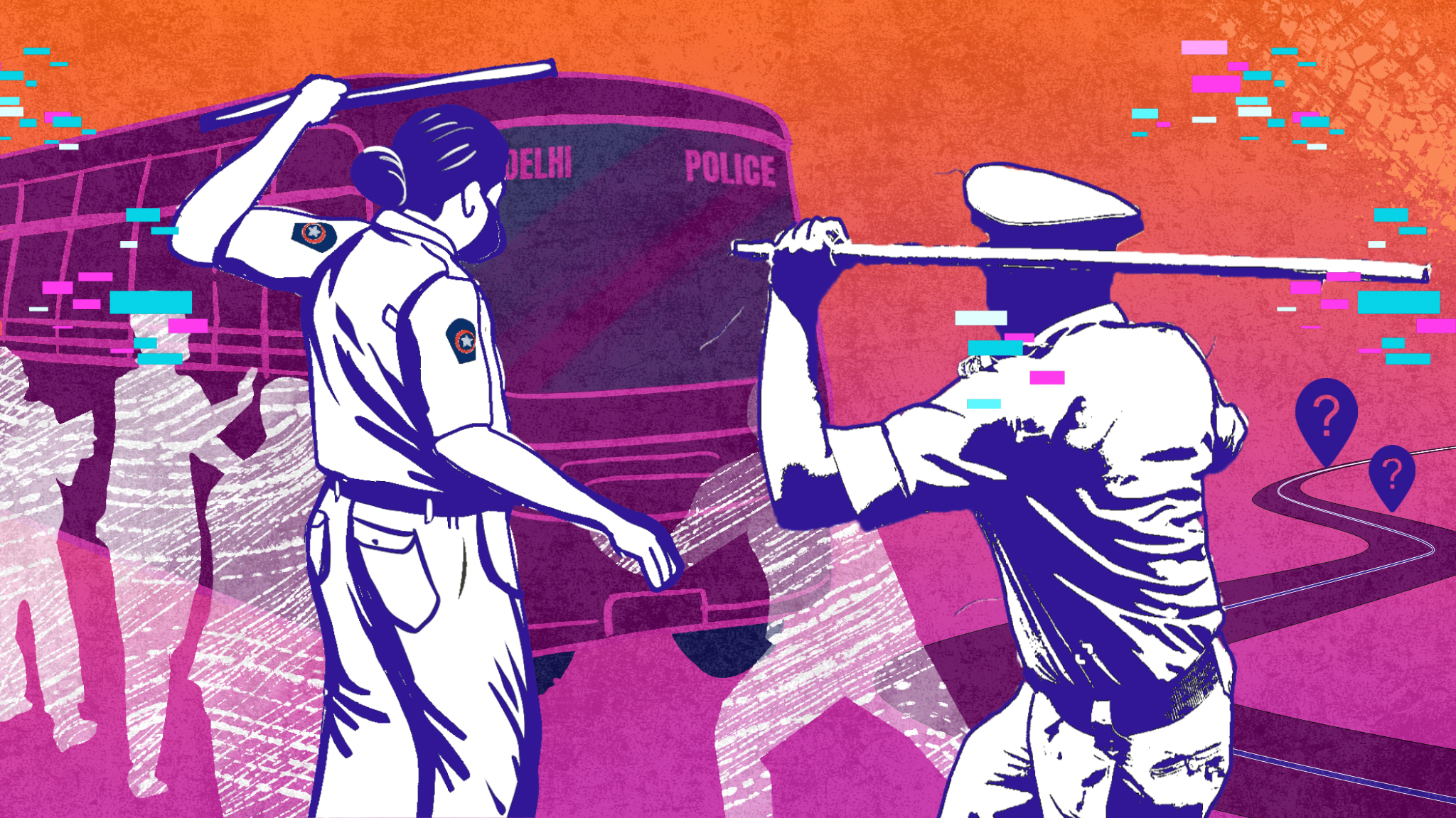
The most recent wave of mass protests challenging the SIR and calling for CEC’s exit has faced extreme police action and mass detentions in the thousands – of activists, journalists, lawyers, economists, former chief ministers, and even citizens who were passing by. Protesters are beaten and brutalised on the streets, we have found, but in many cases the violence continued, inside buses taking them to the so-called detention centres and then again inside them, some situated at the edge of the city.
Naureen says her chest still aches from the blow she took while being pushed into a detention van. Inside, an officer had slid a hand inside her shirt and pinched her. Others around her were kicked, punched, slapped, bitten, and beaten. She was driven to two different centres some 37 km from the site she sought to reclaim, offered no medical help or legal aid, and finally released at 9:30 pm, with no idea which way home lay.

Hours earlier she had sent out a distress call over WhatsApp to activists, lawyers, and citizen volunteers who are working to free protesters. One such group is The Vigil. The team dispatched four volunteers with water and food, ferried in a car that would take her to the nearest metro station 14 km away.
Between the time a protester is unlawfully and violently detained and released miles away in the night, a colossal amount of work goes into rescuing them and providing legal, medical, transport, and financial support. This work is currently being done by citizen-led networks, as we will detail later. A majority of volunteers, we found, are people who have been detained and freed themselves.
BehanBox spoke to and reviewed testimonies of eight people held between October 10 and October 13 at three detention centres located in Bawana, Pandwalan Khurd, and Daulatpur, along with the lawyers and individual volunteers who are a part of various self-organising networks. All said the police impunity this time was unprecedented. People were hauled inside detention buses “like animals”, “cherry-picked” and “systematically beaten”, and detained at these far-flung locations violating the right to legal and medical aid.
“This feels humiliating, as if we are not human …Who is pushed and beaten inside a prison van? Who is held illegally like this? They are mentally torturing us so that we never do this again,” says Naureen.
She has lost days of liberty but she is unbowed. The more brutal they are, the more strength and courage people will have to come to the streets, she says: “This is not the 15th-century where some king can cut off the heads of the commanders and the whole army will surrender. Here everyone is a leader in themselves…People will not step back, whether someone detains them or puts them in jail, or slaps [preventive laws like] the UAPA or NSA. It won’t make a difference this time.”
Why, we ask. “This is about citizenship,” she replies.
Slurs, Abuse, Blows
None of this is legal, says Vertika Mani, a criminal lawyer and People’s Union for Civil Liberties (PUCL) member who is part of legal support groups. A detained person’s protections are similar to those of someone arrested: they have the right to know grounds for detention, avail legal assistance, inform friends and family, be produced before a magistrate within 24 hours. Among these is also the right to know where you’re being taken to and to medical attention.
“Delhi is turning into a police state…The police have a free hand to commit severe violations of people's constitutional rights under the garb of administrative law and order,” Vertika says.
We will detail later the provisions under the Bharatiya Nagarik Suraksha Sanhita, 2023 (BNSS) and the Delhi Police Act that allow the police to wield disproportionate power.
A phone and access to medical aid matter much more so given how detentions happen. Arpit*, a 22-year-old freelancer and activist who requested anonymity for the fear of police retaliation, was near Patiala House on October 11 when the police approached him and asked him for his ID card. They alleged he was there to protest. More officers gathered — a collection of police and paramilitary officers — and hurled abuses at him, calling him and his friend “worms” and “cockroaches”.
They took him towards Sansad Marg, in an alley next to the Regal building, where the police had created a makeshift detention zone with barricades. Here he was made to sit in a row with everyone. They insisted he open his phone and delete all records of footage of the protest.
“Khol, khol (open),” they thundered. Arpit resisted and cited the Supreme Court published hours earlier. (In response to a plea, the Bench said internet services should function unhindered, and any detentions of peaceful protesters are unlawful.) But the police snatched his phone and deleted all media, including evidence of police brutality from the July 20 protests. The police are required to follow legal procedure – under Section 106 of the BNSS – when seizing a phone, none of which were followed.
Rajshekhar, a journalist, one of those detained, said the Police were “cherrypicking” individuals. “It’s so Nazi in its execution. The inspector was deceptively asking us to cooperate, to keep us trusting…People went inside the van trusting. And then they systematically hit people.”
Arpit recalls: “They had a code ‘Bhagat Singh’. It was a signal to the other officer inside the undertrial prison bus to hit the protester harder. You could hear the person's scream outside.” He said he suffered several blows, including on his genitals.
The ‘van’ Rajshekhar mentions is not part of the 600-fleet DTC buses the Delhi Police earmarked for protests but one used to transport undertrial prisoners. Inside were narrow corridors with cramped cabins on one side and cage-like enclosures. Several others said they felt suffocated and claustrophobic, but the police refused all pleas for water or medical help.
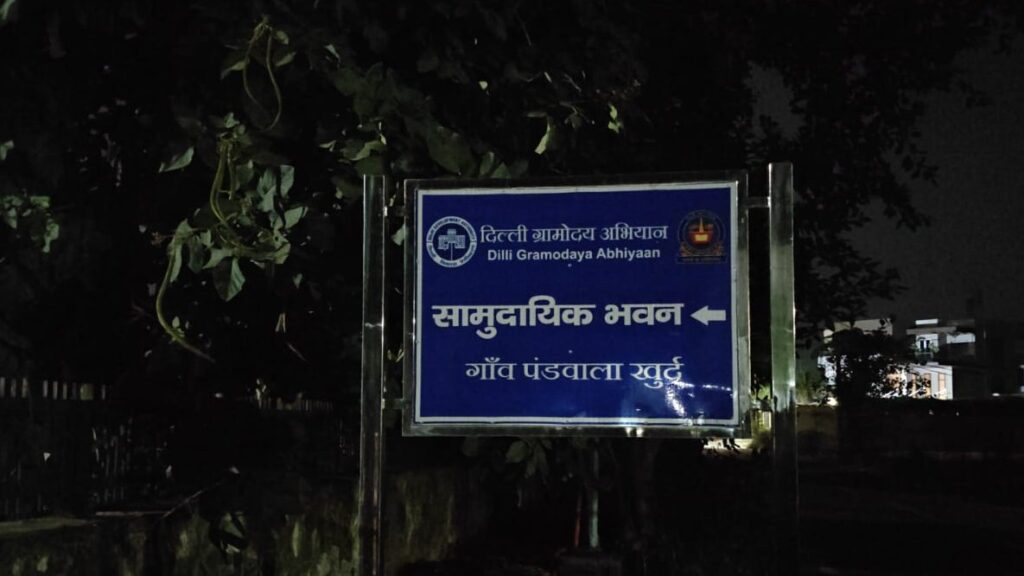
The bus, with roughly 50-60 people, including two minors and Muslim protester whose arm was fractured during the thrashing received minutes earlier, headed past Dhaula Kuan. The detainees guessed the destination to be Kapashera Police Station but just after the expressway, the vehicle took a left, inside a village, halting at the Chhawla Police Station for 10 minutes before going further west, towards a community centre in an area called Pandwalan Khurd.
No one had a phone, except for about three people who had managed to sneak it in their shoes or underwear.
Several volunteer groups received a digital SOS.
Hide and Seek
The Ministry of Home Affairs on October 9 listed at least eight spaces – sports stadiums, police stations, community centres – that would be turned into makeshift detention and holding facilities. It also ordered a suspension of internet services within 500 metres for October 10 under the Telecommunications Act, 2023 and the 2024 suspension rules. This was in addition to the 24-hour internet shutdown orders for the four kilometer radius around Jantar Mantar.
No order for the days since has surfaced.
Between October 10 and 13, at least 5,000 protesters were detained, some for hours and some overnight (several tallies run higher, Delhi Police has not released a complete list.) Apart from the eight centres in the MHA order the protesters were taken to places scattered across Delhi-NCR.
The hardest part, says Arjun Chopra, a Delhi HC advocate working with several support groups, is knowing where you are being taken. None of the protesters we spoke to were told by the police where they were being taken and on what grounds.
“The police are obliged to tell the person being detained the grounds for detainment and what jurisdiction they are being taken to,” he says.
Arjun was metres away when a protester was beaten and bundled into a bus at the INA flyover on October 10. “The first thing you do is take a picture of the bus number plate,” he says. The protester had also shared his live location with a group, which made it easier to trace the bus.
If they’re going north then it’s probably Chhatrasal Stadium and Bawana; if the movement is west the guess is Najafgarh, but it can also be Bhatti Mines.
Much of what follows is guesswork and luck thereon. You go from one police station to another, asking about detainees. At the Badarpur Police Station, police said there was no one, but he says he saw two minors being taken in at that very moment. He was told they were being moved to another centre in Pul Pehladpur, about 15 minutes away. The Juvenile Justice Act requires that a child apprehended by police be placed with a special juvenile police unit or a designated child welfare officer, produced before the Juvenile Justice Board within 24 hours, never held in a police lockup, and that the parents be informed. According to Arjun, none of this was followed.
This movement across jurisdictions without written orders is itself illegal. Often the Delhi Police are taking detainees from point A to point B without processing their detentions or making a DD entry (a daily diary recording arrivals, departures and events) at both stations. “There is no paper trail of these detentions,” says Arjun.
Under Section 65 of the Delhi Police Act, 1978, if a person resists, refuses or fails to comply with a police officer’s reasonable direction, the police may “remove” them. They must then either produce the person before a Metropolitan Magistrate or, in “trivial cases,” release them once the occasion for the removal has ceased, in all cases within 24 hours. But when does the occasion cease, is it when the detentions begin or a protest is extinguished? How much time has to pass? Which police jurisdiction does the bus have to cross?
“This is all very arbitrary,” Arjun says.
The section does not say where a person may be held during that window, or in what conditions. Section 60 of the same Act, however, makes it every officer’s duty to arrange food and shelter, get help for the wounded, and treat women and children with decency.
‘Mental Torture, No Medical Aid’
The detention centres varied and depended vastly on the conduct of the police officers posted there, its distance from the city, the hour they were taken in, and the social capital of the protester.
AISA leader Neha Bora was detained at Daulatpur on October 10 (and also on subsequent days at other locations). Luci, a 25-year-old transfemme queer individual, told us over e-mail that on the way the police struck some men in the bus but Neha intervened. “One or two of them understood that not complying with our demands would cause greater issues so they ceased hitting us. Some protesters were recording everything and then they seized our phones,” Luci says.
At Daulatpur, Luci said the women were told they could leave after 6:30 pm, in accordance with the law, but many stayed back fearing that the men would be beaten. “I wonder how much worse everything would have been had the police demanded to see my identity and decided to not afford me the same rights as other women because of my legal gender,” Luci adds.
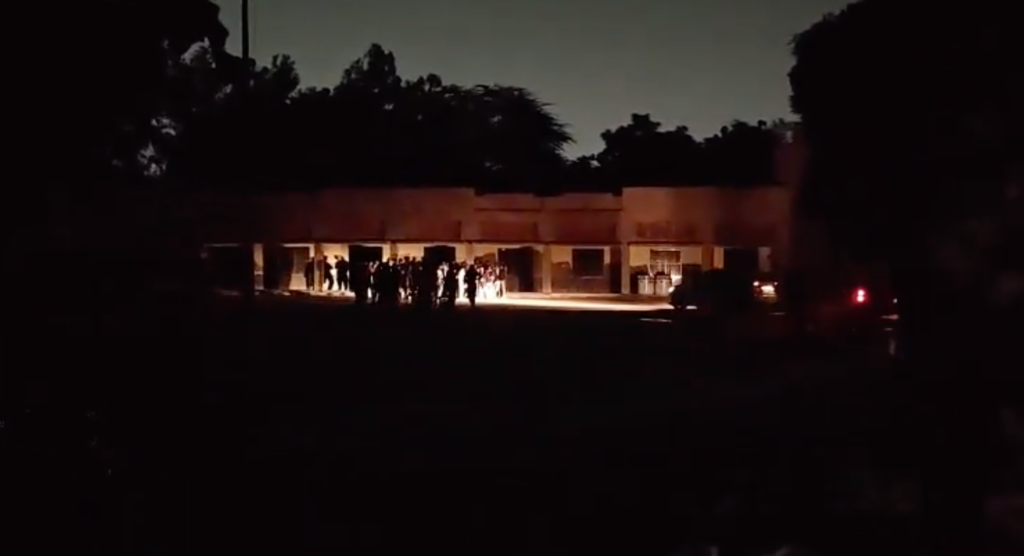
Naureen, detained three days later, was dropped off at the Daulatpur centre. The place was “full of dust, mud, and filth”, there was no electricity or washroom, and no woman officer in attendance. All through the evening there were multiple rounds of intimidation. Once when detainees were asked to show their ID or Aadhaar cards which they refused. Once when they asked to contact their lawyers which they also refused.
At around 8 pm, the protesters demanded water. Along with a water camper also came a video recorder. The officers posed with saccharine smiles as they passed along two glasses of water; then the recording stopped and the police took the camper back. “We kept shouting we need water, no one listened,” recalls Naureen.
One of the protesters had difficulty breathing after the police thrashing but Naureen alleges that the police were busy outside “watching reels, or laughing.”
All the protesters we interviewed said the police failed to provide medical support or called for it only after insistent pleas. Detainees on multiple days reported bruises and swellings on their arms, necks, throats, back; others sustained fractures and skull injuries. Some experienced breathing difficulties and panic attacks inside.
As per the law, the police is required to take any person detained or arrested for a medical examination without delay and the person has a right to the Medico-Legal Case (MLC) report. There are three copies produced – two for the police records, one at the hospital, and the detainee-patient gets a case summary and can ask the police for an MLC copy. The police refused to share these reports with several protests, a The Hindu investigation found.
MLCs document evidence that can be used to prove extrajudicial violence. In July The Hindu procured hospital records to prove, despite repeated denials, the Delhi Police used pellet guns during the student protests. This withholding of records in most cases, especially of protestor-detainees, is becoming a norm, says Vertika.

Researcher Laavanya Tamang, who was detained the day prior, showed up at Pandwalan on the same night and took her friend to get an MLC examination. AIIMS refused to do (“it isn’t under our jurisdiction”, which is in breach of court mandates and the law) and then to Safdurjung. The report confirmed scratching, bruising, and physical assault. Volunteers have forwarded it to media houses and lawyers who can use this evidence to hold the State accountable.
The Delhi Police during the 2019 anti CAA-NRC protests hindered medical examinations of dozens of detainees who they had allegedly beaten inside Jamia library resulting in head injuries and deep wounds. One bled for three hours at the police station and was close to fainting when doctors were close. He was not given an MLC.
During earlier protests – including the July 20 one – violence was more overt and visible in the form of tear gas and pellet guns; now it is more hidden and occurs unobtrusively inside detention vans and centres, says Vertika.
Around 9 pm on October 11, the police agreed to release the protesters. Per law, the police are required to escort them to the nearest metro station. They did so, but in the same cage-like detention vans which they came in.
[BehanBox has sent a questionnaire to Delhi Police about the detentions during the October protesters. We will update the story with their response.]
Citizen Vigils
From inside the courtyard of the Pandwalan community centre, detainees could hear a cluster of lawyers and activists making impassioned pleas to the police, citing the Supreme Court order.
“The pressure came from the detainees, the local magistrate, and the fact that lawyers were standing outside the gate and yelling at the cops,” says Rajshekhar. “The institutions are abdicating law and order but then you see these volunteers coming to help people they do not know.”
Every time an SOS arrives, these decentralised citizen networks activate like a well-oiled machine. The Indian Youth Congress, The Vigil, the Protest Support Initiative, along with several independent volunteers, rush to help. They get the protester’s live location, ask for an image of the bus’s number plate, details about who else is on it. Are there female constables, do they have a badge on them? Any minors? Any injuries?
“The majority we are rescuing are young people who came out to protest. Their fear of getting beaten may be gone, but the fear of detention is still there. They don’t know what happens in police custody, what their rights are, what their process is,” says the 25-year-old Rajiv Choudhary, who co-founded PSI (“the acronym is intentional”) with content creator Meghnad during the July protests.
The group has a ‘Detention Ghar Wapsi Yojana’ that uses an AI dashboard to match a detainee with nearby support nodes and drop them home. Their scouting teams supply on ground intel, say a bus is passing through Kashmere Gate, which is fed into the system where a heat map recommends possible detention centers, accessible volunteers, hospitals, and lawyers. The group of roughly 150+ volunteers has sent close to 1,800 people home since the beginning of October. Last week they launched spinoff initiatives including People Are Under Systemic Exhaustion (PAUSE) to offer psychological help to protesters and Immediate Response First Aid Network (IRFAN) for immediate medical aid.
One challenge is the information blitz, says Rajiv. SOS calls from every corner create miscommunication and amplify fear. And the other is the reliance on social media platforms that restrict and censor accounts. Two hours after our interview, Rajiv posted his Instagram reels were being taken down and his accounts frozen.
On the ground, the police have stayed out of the team’s way. “They say they are not going to do anything because we are taking people home,” says Rajiv. Sometimes they ask them to shuttle more protesters than they had planned for.
The effort is not without risk. Says Shaneel, the founder of the six-member team at Vigil: “Some people passing the detention centers threw abuse and slurs at us, calling us ‘anti-national’, desh-drohi.”
On October 11, outside the Pandwalan Khurd detention centre, Laavanya remembers that some in the crowd were sympathetic but there were also those who were hostile. The remote location, the information vacuum, all created fear and uncertainty, she says. “Kahi bhi le jayenge, kuch bhi kar lenge, aapka phone cheen lenge, maar peet karenge, kahin bhi chhod denge (they can do anything, take you anywhere, grab your phone, hit you, drop you anywhere)…. Initiatives like The Vigil are really important because there is no accountability unless you literally have a large number of people outside. They are literally saying we’re watching you,” Laavanya points out.
Unlawful Detentions
Detention of protesters and keeping them for hours without water, medical attention, legal aid, is illegal, as we said earlier. Resistance movements recognise detainments as a disciplinary tactic — it can be Adivasi communities fighting for their land, workers demanding better pay and dignified work, or parents demanding justice for children at the mercy of casteist and violent institutions.
Vertika says this time the volume of cases is extraordinary and so is the severity and display of police impunity. The scale of detentions is comparable to Haryana’s Nuh in 2023 or Uttar Pradesh’s Sambhal in 2024, but unlike regions with festering communal unrest and “pogrom-like situation”, these are happening in the capital city amidst a youth-led protest that threatens the ruling government which explains the misuse of law enforcement, she adds.
“It is like the rule of law has been suspended. The situation is so bad we’re not able to meet our clients until the peshi, when they are produced before the magistrate,” says Vertika.
What is also evident is that rather than using harsher laws like the UAPA which is used to keep students and activists like Umar Khalid behind bars, the police are taking preventive action under ‘kalandras’. Under these the person is produced before a Special Executive Magistrate, an officer of ACP rank and not a judge, who decides if the person can go free after signing a peace bond.
Under law, the detained person is required to be produced within 24 hours, and after which these detentions can be challenged in court, but up until the very last hour, “the police have a free hand, there’s not much that we can do”, notes Vertika.
She helped free Harsh Yadav, the independent journalist, who covered on Instagram the July protests. He was detained on October 10 from his hotel room under Section 126 and 170 of the BNSS, and remained in custody until the next day.
Data show demonstrations in India have risen from 10,642 in 2016 to over 18,629 till October 2, 2026, and this surge has brought increased police intervention, with over 200 demonstrations met with force in August 2026, a decade high for any single month, according to a Reuters analysis. These interventions range from everything from water cannons, tear gas, AI surveillance, and detentions.
Another tool is the frequent imposition of BNSS Section 163 (earlier CrPC Section 144) which equates the possession of banners and placards alongside firearms and swords, and by retaining colonial-era provisions, have for a century curbed dissent in the name of law and order, as lawyers have said. The police have “mischievously” failed to make these orders public, the Supreme Court remarked.
In addition to the Delhi Police Act we mentioned above, Arjun notes the BNSS section 172 also gives police the power to detain or remove any persons “resisting, refusing, ignoring, or disregarding to conform to any direction” and may either produce them before a magistrate or in “petty cases” release them before 24 hours.
These provisions are “unconstitutional”, say lawyers who have challenged this in the Supreme Court.
“Our detention, beating, phone checking, everything was illegal,” says Arpit. “I don't feel safe with Delhi Police. If something happens tomorrow and I go to file a complaint, will they take action against the criminal or me?”
‘We Are Fighting Against SIR’
Naureen says the police tried to placate the protesters by distancing themselves from the brutal crackdown. The evening after the morning of violence they had turned conciliatory. “You are like children, we don’t want to hurt you,” one of them said. When the protesters showed their injuries, some officers deflected: “Ek parivaar mein paanch log hote hain, sab alag hote hain (not everyone is the same).”
“I wanted to tell them I have no problem with any individual. My issue is with the system that lets them operate with impunity and the government that gives them orders,” says Naureen.
The 26-year-old lives in Satbadi, on the peripheries of South Delhi with a concentration of domestic workers and other daily wage workers. Hundreds of people here, she says, have been written off voter lists.
“Unka ya toh naam kaat gaya hai ya phir BLO ka form nahi aaya (either their names have been deleted or the BLO never arrived with the form)…Without their name they will lose their houses, ration cards, whatever little government support they got would be nullified. They are scared future generations will also suffer,” she says.
Her demand is that the SIR be repealed. Now she says there is an additional fight to have Jantar Mantar restored as a protest site. “The places being given to us, whether it is Burari or Ramleela Maidan, you will go there and shout and die, no one will listen to you,” she says.
That’s why she was marching again on October 14 to reclaim Delhi’s epicentre of dissent. “All parties and student organisations, all citizenry need to gather at a common space, find a common idiom, and fight against this government.”
We messaged her in the evening: Are you safe?
“Abhi release kiya hain Dwarka Police Station se (just been released from Dwarka police station),” she replied around 9:30 pm, with a halo sign hovering over a smiling emoji.
This story was produced with support from Report for the World, a global media service strengthening local independent journalism.

We believe everyone deserves equal access to accurate news. Support from our readers enables us to keep our journalism open and free for everyone, all over the world.
