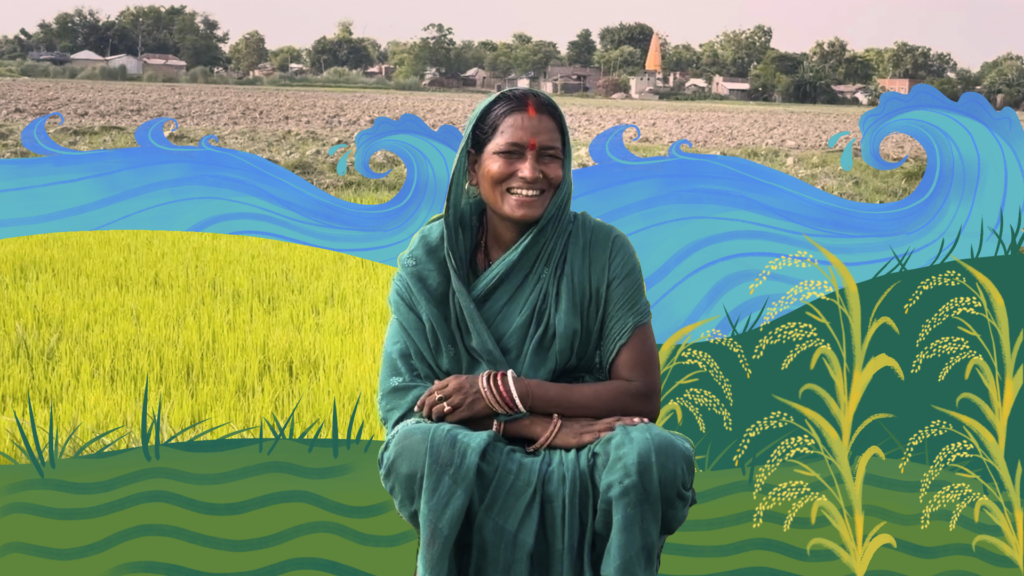
Fulo’s story has to be heard to be believed. A child bride from an utterly impoverished Dalit family from one riverine village she arrives in another, Alani, that sits on the banks of the flood-prone Kosi. She was already used to labour – at age 8 she had started working in the fields of her natal village, picking vegetables. So she never complained about working in Alani’s rice fields for Rs 30 a day. Her husband was rarely home, migrating where work took him – Delhi, Rajasthan or Punjab. She raised three children through terrible precarity, having to borrow even Rs 100 to get her sick child medicines.
Today, at 39, Fulo is mobilising force for the women of her village. Each Friday afternoon, she goes door to door, summoning women from their homes. Most of the 15 women in the group are left-behind wives of migrant workers. Over the next two hours, the mud courtyard they sit in becomes a sort of microfinance office.
Together, they are JEEViKA didis, members of one the 12 SHGs in Alani, and also one among the 12 lakh self‑help groups across Bihar. They are a part of Bihar’s Rural Livelihoods Promotion Society or JEEViKA, a programme that encourages women like Fulo to save money, and helps them access low-cost bank loans, and run non-farm micro-enterprises, livestock, or farm-based work.
Alani’s story is one of neglect. No buses run here, public or private, and there are no railway lines within a radius of 10 km. There are only steamer boats, teen pahiya (three wheelers), and bikes. Nobody owns a char‑chakka gaadi (a car) in the village, and only a few well‑off families can afford to rear buffaloes; the rest own goats and cows.
But Fulo and her group are an island of growing self-reliance in the midst of this. Fulo leads the group as its adhyaksh (president); Phool is sachiv (secretary) and Parmila is koshadhyaksh (treasurer). Khushboo Kumari, 28, is the master book keeper for Alani and two neighbouring panchayats.
Fulo exhorts them to save just Rs 10 a week. It is how she now owns a quarter acre of farmland on which she grows rice and maize. She had started small – borrowing for a goat, a sewing machine and a kirana kiosk before she found the capital to become a farmer with her own land.
Jyoti Yadav writes about Fulo and how she navigated poverty and marginality to propel herself into a place of strength.
Read our story here.