
‘They’re Calling It Digital Census But Asking For Manual Data’
A Census enumerator from Maharashtra tells us about the unyielding work load, safety concerns, and community anxieties shaping up their work
This article is part of our Census 2027 coverage. You can read other stories here. For sharing leads, suggestions, and questions, write to us at editor@behanbox.com.
Counting over a billion people — their houses, livelihoods, identities — is an exercise of cosmic proportions, one requiring a labour force ever so careful and conscientious at each step. A house missed, or a detail misinterpreted, can distort the picture and derail the outcome of one of the largest data collection exercises in the world.
India is conducting its official Census after a delay of six years. Behind the country’s first digital Census is a labour force of 33 lakh enumerators — government school teachers, Anganwadi workers, local officials, contractual hires — tasked and trained to collect, record, process data of about 1.47 billion people.
The two-phased Census 2027 began in April. In the first phase, scheduled to go on till October, enumerators are collecting on the house listing operations app (HLO) details about conditions and amenities — the make of the roof, the cooking fuel used, access to internet and vehicles and other assets. Phase two will kick off next year, where questions of caste and identity will be recorded for the first time. Census, this year, introduced the channel of self enumeration — residents can feed their personal details on the digital portal before an enumerator verifies said information in person. But self enumeration is optional; an enumerator still has to pay a physical visit to the house.
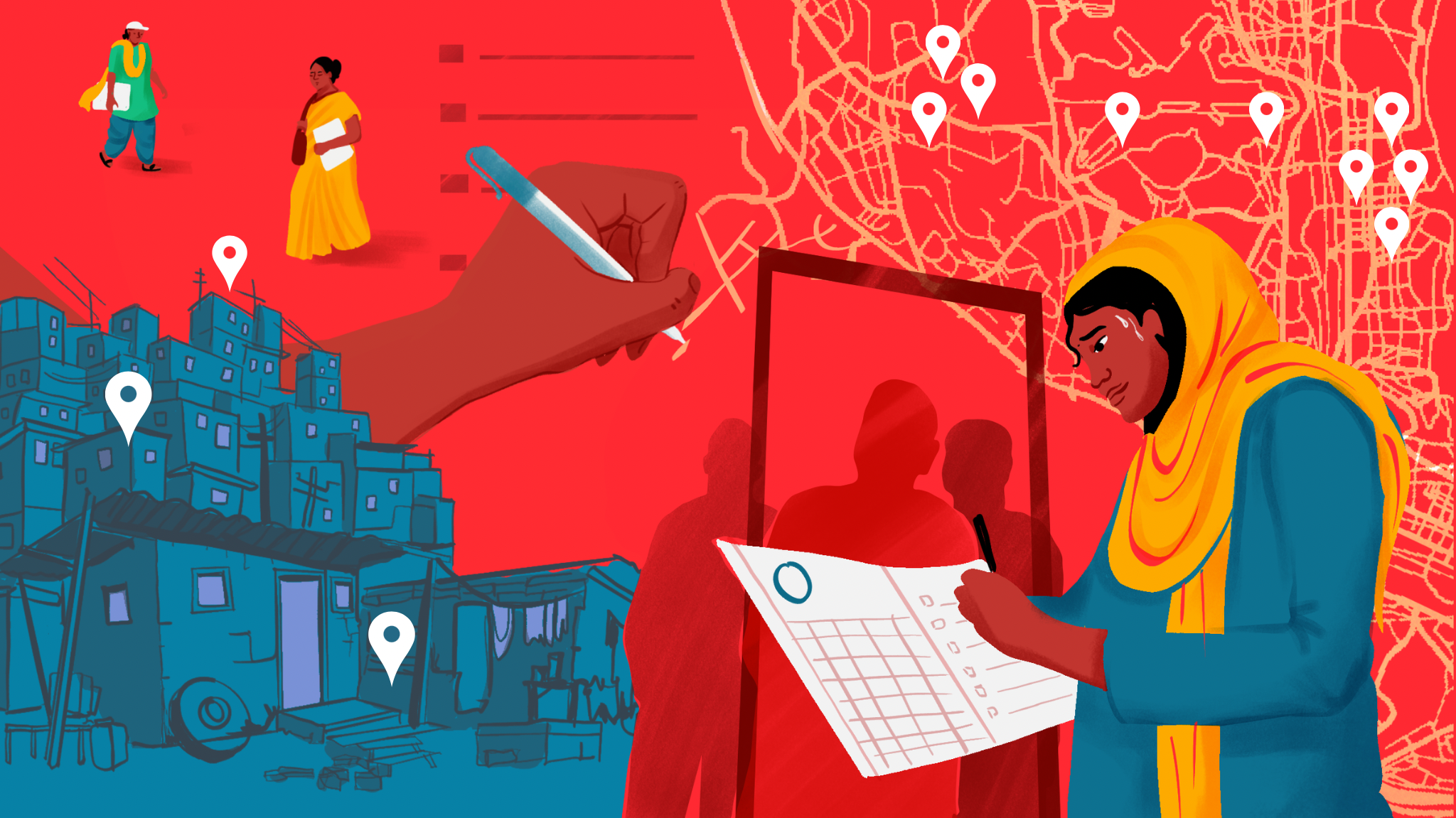
Saumya Kalia spoke to Garima*, a teacher from Maharashtra, about her duties and dilemmas over the last month. Most of Garima’s days unfolded under the scorching sun. She covered her area on foot, visiting close to 300 houses, each requiring at least three visits, entering people’s data into an app and answering questions. Added to this was the task of drawing, by hand, maps of the area. She showed us intricately sketched maps annotated with house numbers, roads, other landmarks, with guiding arrows to help her navigate the field. These hand-drawn sketches, which will be verified later using geo-tagging, have to be submitted as hard copies for her work to be considered complete.
“It’s funny they are calling this a digital Census,” she says, given the disproportionate amount of time being spent on manual work.
Census enumerators are under the jurisdiction of the Directorate of Census Operations in respective states. Workers in states have raised concerns about unsustainable work loads, coercive environments, and the pressure to manipulate data. At least two teachers reportedly died in Odisha in April due to the heat; others are facing connectivity issues on apps and resistance from residents on ground.
In this first-person essay, Garima talks about the unyielding work load, safety concerns, and community anxieties shaping up their work. All identifying details — name, age, area of residence — are withheld to protect the enumerator’s anonymity.
Edited excerpts below.
THE WORK STARTED on May 15. Prior to that there was a three-day training session where everything was laid out. We were told to draw maps of allotted areas, and trained on the houselisting operations app [the official tool for houselisting and population data collection in Census 2027’s first phase]. My HLO app wasn’t operational at that time,so I took dummy information from a friend’s app to learn the ropes. My app started working later when the proper Census work began.
Initially we were told each person would get to enumerate nearly 150-200 census houses. But by the time we covered half the area and mapped it on paper, the total number of homes was almost double and even three times the original count. If there are 15 flats [in one building], they’re counted separately, and altogether it amounted to about 600 houses.
We — me and two other enumerators — visited the local ward office for five days. The local officials kept saying there’s nothing they can do. In the meantime, the work continued. We numbered the remaining houses and charted a rough sketch of the area. Then we went back to the first area and conducted house visits to collect information.
The officials eventually suggested a solution: other enumerators, when done with their houses, will assist with our extra load. But those enumerators refused. “We won’t take your area, we’ll just walk around with you. At best, if you ask questions, we can feed it in the app,” they said. There was a supervisor meeting with an official from Delhi soon after. He agreed to reduce the house count of enumerators who had lodged complaints about the work load.
One problem finally got solved! Until then it felt like nobody on the other side understood that covering 600 houses was a daunting task. I’m glad we went. It benefited us, but sadly, not everyone spoke up, not everyone’s situation was remedied.
I DIDN’T HAVE a fixed daily routine. The thing is, women find it easy to do this work when there’s someone to accompany them. We came up with arrangements: either two women plan to go together, or else a family member comes along. For the first three days, my supervisor ma’am accompanied me. Her schedule was a bit hectic. We headed out only around 10:30-11 am, once she finished her household work. On those days we worked till 4:30, sometimes till 6 pm. Other times I took my husband, who is not an official enumerator. His company made me feel while covering so many houses, some located in secluded areas. With him, we left at 9 in the morning and worked till 2-2:30 pm. At least ek time toh dhup mein kaam karna compulsory tha hi (Working in the heat at least once a day was unavoidable).
The male staff, on the other hand, would make a start at about 7 am to escape the heat, but that doesn’t work for women, does it? We have to make food, send children to school, and finish household chores.
One day, I went with my husband in the evening, between 6 pm to 8:30 pm. That was easier — a much-needed respite from the heat. It also helped that people were returning from work by then, so we could finally catch the ones we had missed in the afternoon.
We took other precautions for the heat. We wore caps and carried snacks. Each of us had two bottles of water, and we made stops on the way to buy juice, lassi or something cold (we paid for this ourselves, hoping we might get reimbursed later). Lekin fir bhi takleef toh hui. It was still challenging. Some people were kind and offered us things along the way but we didn’t accept too much – all the talking and stopping would only waste time.
TO DRAW THE MAP, in the beginning we surveyed the area for three days. On the fourth day, we sketched the map while walking — counted houses, drew lanes, numbered the boxes, labelled if a building has five flats and mentioned other details. For instance, if a building had 15 flats, we annotated 15 in brackets on the map. That took about two-and-a-half days. Then we took that map along and labelled each house with the same number. That took another day or so, and finally, we went house to house to enter information on the phone. The app generated an alphabetic number and a central house number.
We fed basic information based on observation — the flooring of the house, the construction of walls, access to toilets. We asked about solar energy usage, whether they benefit from it, but such houses were rare.
About 90% of people seemed willing to share information, some were even curious. Others displayed pangs of annoyance. “Is it really necessary?”, they asked. We told them this is for the Census – to check the progress of the country.
We faced issues in say one out of 10 houses. People were wary and less responsive. They were also afraid of fraud in the area. Something also happened in Solapur, where about 10 people impersonating enumerators and asking for OTPs were caught. We tried to win their confidence – explain our work to them, show them our ID card, tell them about the school we work at. Sometimes the kids in the house who go to the same school recognised us, making it easier.
In some areas, like a slum I visited, two women were hesitant to share details because they were worried the government will misuse this information, or that money under the Laadki Bahin scheme [which gives monthly cash transfers of Rs 1,500 to women] will cease to come. Vo darr bhi logo ke mann mein hain (that fear lingers). Some people asked us about future schemes. I told them I don’t know, that is for the government to decide.
The issue is the booth level officers (BLO) are also in the field and there are others collecting information for the Special Intensive Revision (SIR) exercise, now we’re the third group on ground. People are getting confused and suspicious about how the information will be used.
IN THE 34 QUESTIONS, there was one column to record the name of the “head of family”, no other family member’s details were needed. The caste category listed SC, ST, and “Other” as options; everything else fell under the “Other” category. People asked whether their caste details will be taken and we told them that the caste census will happen next year. Another person asked why we didn’t inquire about their language and we said that even that was not needed right now — all granular information will be taken in phase 2 next year.
Some people had entered their details themselves through the self-enumeration process. We had to verify their information on these visits. For some people it matched but for others it didn’t, so we had to re-enter information from scratch into the HLO app. There was no written paper work involved.
Finishing this work – canvassing the area, drawing maps, entering data – took three to four visits per house on average. For the locked houses, the numbers climbed to six or more visits; some residents didn’t answer calls no matter how many times we called.
I always carried a power bank with me. Initially we asked officials to give us tablets [which would be more efficient]. I already had a decent phone but others had to buy new ones to do this.
We called the field trainer if we ran into issues. They helped a lot. Enumerators also communicated with each other and offered support. “Are you facing any problem?” We guided each other.
I’M A TEACHER. We’re in the midst of summer holidays right now so I was able to complete the work on time. Earlier they said June 14 would be the last day but they brought it forward to June 5. It has added a lot of pressure. I had to be more active in the field – covering 10 houses on one day, 25 on others – under the harsh sun.
The heat has caused diarrhea. I took one day off but began carrying ORS and a water bottle with me. I also eat a little something before going so that the stomach isn’t empty. There’s a lot of walking throughout.
An enumerator died in this region. They finished work, went home, drank water, and within 10 minutes, they suffered a heart attack. All the other enumerators went to the Municipal Commissioner, demanding that the family be compensated. They’ve agreed to give Rs 5 lakh but I’m not sure if the family has received it. There’s also a demand that each enumerator and supervisor should get an LIC insurance. I don’t know if that will happen.
MY WORK UP TO June 5 is done, even the locked houses. Making hand drawn maps is the only task that remains. For the map, they gave us a satellite image, which we fed into ChatGPT to get a rough layout. But it wasn’t rendering accurate results. Some landmarks kept shifting positions, which affected the overall precision. While it did help to some extent, the results were still noticeably off in terms of accuracy.
So then I drew them by hand. It took a couple of renditions. Earlier they asked us to draw it with pencil but now they’re asking us to use a black pen so it scans clearly, and to make it exactly as shown in the training. I made some changes on my own to make it look better. We were taught how to draw maps during the training but since my area was large, it was difficult to fit it onto an A3 sheet without making the layout seem too congested and confusing.
I am happy to redraw it if they are not happy. It’s funny that they are calling this a digital Census but asking for a hand-drawn layout, so that nothing gets left out. It’s not difficult exactly, but frustrating.
They said we’ll be paid Rs 9,000 for the first stage of the census and Rs 16,000 for the second phase in February, totaling Rs 25,000. They are yet to take a photocopy of our passbook; we have been told that this will happen after directives come from relevant authorities. Separately I have heard in some quarters that the full payment will come only after February 2027 when all the Census exercise is complete. Of course, it’s not ideal but we’ll wait and do whatever work comes our way.
One concern we had already raised was the timing. In February, teachers involved in Classes 10–12 board examinations are occupied with conducting exams, invigilation duties, and paper evaluation. At the same time, regular classes must continue, and the syllabus for other grades needs to be completed before their examinations. Teachers also have ongoing responsibilities such as assignments, homework, and project assessments.
What will happen then? After discussing these challenges, the officials agreed that we could complete the training in February and conduct the actual data collection in April instead.
We could manage this round of data collection due to school holidays. But even now, some schools have summoned teachers from June 1. These teachers had to put in hours at school between 9 am to 11 am and then report for the Census work. Some teachers are doing this alongside preparing for the Maharashtra Public Service Commission (MPSC) exams.
A LOT OF PEOPLE have tried to wriggle out of Census duty and produced medical certificates to show that they are indisposed. It is difficult to establish the genuinity of everyone’s claims. Those who wanted to opt out have been asked to find a replacement. Cancelling is also tiresome. I don’t want to give fake certificates. Some say you can pay some money but I never went down that path. In the end, the honest ones suffer. I had to shoulder extra house count because of the people who cancelled.
The first phase had just 34 questions. After the next training we’ll have a better sense of the scope of the next phase and how much time it’ll take per family member, how many days in total. I hope what they did this time — preponing the date from June 14 to June 5 — doesn’t happen. It will create a myriad of obstacles.
They should also plan this training during the Diwali holidays or a similar downtime period. It will allow us to escape the heat and balance both Census and school work. I have to keep working here until retirement, so I can’t afford to neglect this.
Honestly, I don’t mind the work, it’s important and I’m committed to doing it. But officials should plan ahead and allocate work reasonably. It’s the least they can do.
As told to Saumya Kalia


We believe everyone deserves equal access to accurate news. Support from our readers enables us to keep our journalism open and free for everyone, all over the world.
