
‘The Intention Is Questionable, The Means Do Not Inspire Trust’: GN Devy On Census 2027
The long-delayed exercise is not inclusive, transparent, or accountable. The government has undermined the promise and possibilities of a Census, says the scholar
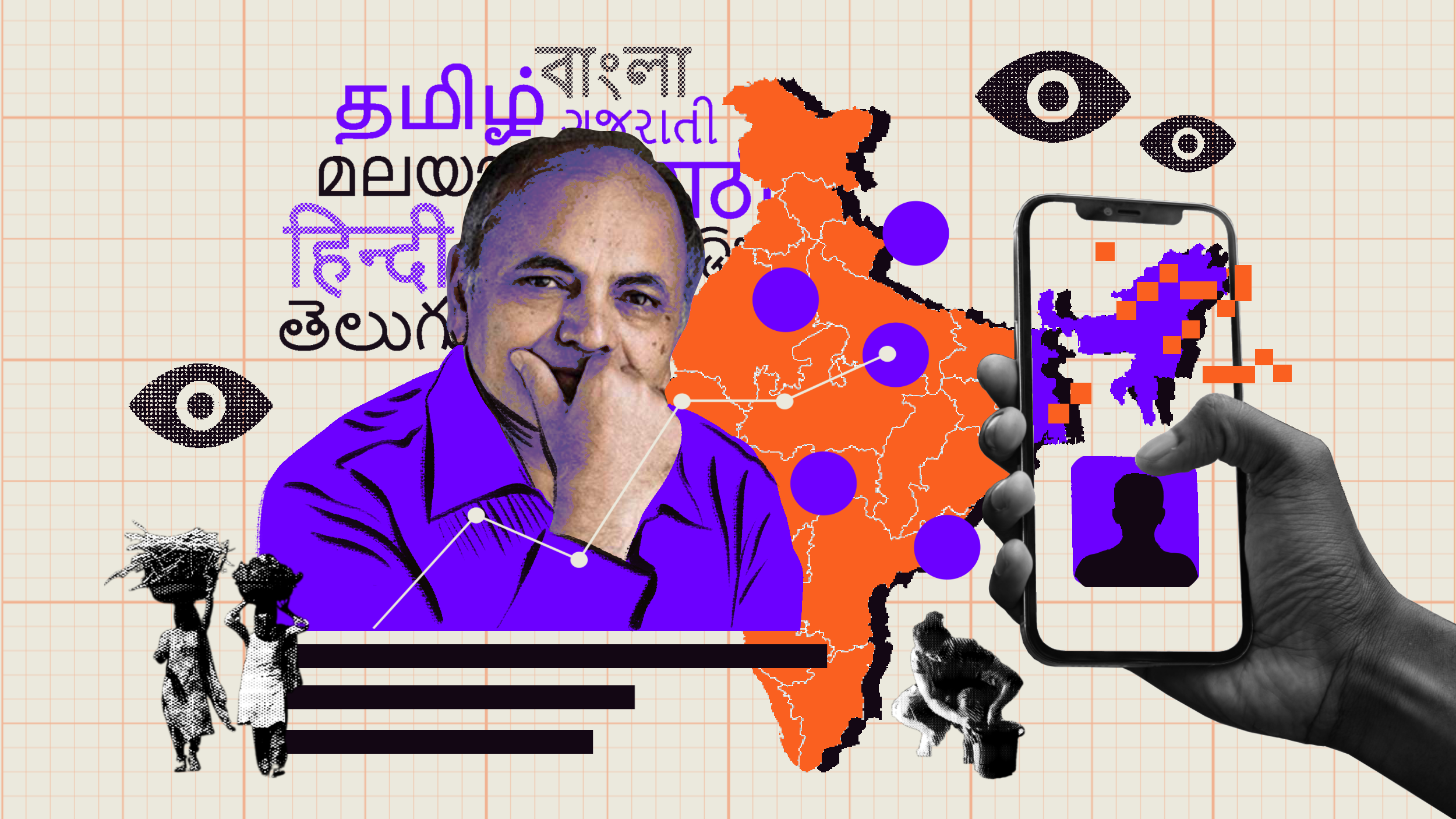
In 2013, a People’s Linguistic Survey of India – almost 50 volumes of 35,000 printed pages – was published as a record of India’s languages and by extension, its people. Linguist and culture scholar GN Devy led the exercise. The survey found 780 languages while the government officially recognises only 22. To Devy, the privileged elite had sidelined languages over decades, disempowering identities and destroying whole knowledge systems. The same story – of dominance and exclusion – is now playing out with the Census in India, he says.
“The Census has to give a complete photographic image of the nation… but this Census is trying to doctor the photograph even before the exercise started,” Devy says.
Deliberate delays, opaque processes, and a lack of accountability define the 2027 Census saga. Some fears are new: India’s first digital Census brings with it worries about data security, data hygiene, and misuse in a country where digital preparedness is low and cybercrime has almost doubled between 2022 and 2024. India in 2024 was the second-most targeted nation for cybercrime. A 2023 ICMR data breach resulted in Aadhaar and passport details of 81 crore Indians being sold on the dark web, the same year the CoWIN vaccine data portal was breached. All countries are vulnerable – when Australia attempted its first digital Census in 2016 it saw cyberattacks and a systems crash. Cyber fraudsters are already targeting people with fake mobile applications in Gujarat, while the Rajasthan government has put out an advisory about rising scams.
There are old faultlines too – the Census has historically failed to count migration statistics, tribal and marginalised communities, and languages that are predominantly spoken by women. This Census was an opportunity to correct historic wrongs, he says.
“Census 2027 is an oddity,” says Devy, for it will produce incomparable data which will be of little value for social justice and welfare schemes. “It appears to have been launched to serve the political ambitions of the regime.” Edited excerpts below.
How is Census 2027 different from the previous ones? Has something shifted socially, economically over the last 15 years?
The Census goes back to the colonial era – Lord Mayo designed the first Census in 1871. Since then, the Census is always carried out in the zero year [in decennial cycles] and the results published in the first or second year. This is the only Census in the history of Indian Censuses which was not carried out in 2021. Now the reason given by the government was Covid-19. But worth noting here is India is a participant in an international understanding – called the Norms and Principles of Census – overseen by the United Nations. All other participant countries carried out their Census in 2023. We did not. We deliberately delayed it even though we were ready. The preparation of the Census begins nearly three to four years before it is conducted, so we were ready for Census 2021 from the year of 2018. And even if Covid-19 was a barrier, we could have still carried it out in 2023. But we didn’t do it.
The government wanted to first complete the delimitation process. Delimitation is the exercise of redrawing geographical boundaries of voter constituencies, and in the case of the next delimitation, it will increase the numbers of representatives of people in Lok Sabha and Assemblies. The number [of MPs and MLAs] continued to increase from Independence till the 1970s but in 1975 it stopped because of uneven growth of population in different states. The delimitation for increasing the numbers was pushed to 2001 when, again, it was thought best to further freeze the seats for 25 years. In 2002, since population growth levels had still not evened out across states, it was decided that delimitation would be carried out after any Census post 2026. For such a delimitation exercise, the Census after 2026 was necessary, and, therefore, the government chose to do it in 2026-27 and not to wait for the 2031 Census.
There’s also a whole gender dynamic here. One thing is that the population growth in different states is directly related to education and health access for women, which the state governments haven’t been able to provide sufficiently and equitably across the country. The second is the women’s reservation, which was passed in the parliament in 2023, and easily could have been implemented without any delimitation process since that was a matter of proportionate seats and not dependent on how many MPs are in the Parliament or Assemblies. One-third can be of anything – of 30 or 300 or 3000. But this government was cynical about women’s reservation. There was no need to tie it up with the Census or the delimitation.
This particular Census is unusual because it really shows the desire of the present government to perpetuate the regime and push its Hindutva agenda – which has nothing to do with Hinduism – which seeks to legitimise the domination of a majoritarian society, in effect, rendering persons from other religions as secondary citizens. This Census appears to be playing a part in that entire politics.
So in this exercise – meant to document the nation, its people and their identities – the intent is not neutral.
Absolutely, I have no hesitation in saying that. We need comparable data for planning, for providing access to social welfare [like ration and gas]. How can anyone gainfully compare the data of 2027 with data of 2001 or 2011 and subsequently, of 2031, 2041, 2051? This choice of year stands out as an oddity. You cannot compare a seventh standard student with a first standard student; this Census is of no use as far as data for planning is concerned. The data will be collected, but it cannot be properly used in planning and providing access to social welfare and justice, which are the primary objectives of the Census. This Census appears to have been launched primarily to serve political ambitions of the regime.
Also, if the government knew the Census was going to happen, there was no need for the Special Intensive Revision (SIR) exercise. The SIR has started a process of exclusion, and the Census is under pressure to match a lot of population profiles with the conclusions drawn in the SIR. The citizens have no way of verifying if the Census data is accurate as the Census process is not transparent. The Census is non-justiciable; it cannot be asked questions in any law court, the Census officer is not answerable even to the Parliament. It is an opaque exercise lacking the expected degree of transparency. Since it appears to primarily have political objectives of a single party, it is a very unusual Census.
Etymologically, the term Census in Latin was associated with the term censēre (meaning censorship and surveillance). These two meanings were separated in British English in the 18th century. Census was for spreading knowledge and for achieving equality; and censor was to spread fear and intimidation. In this particular Census, the two meanings of the world seem to have come together again.
You’ve written about the distortion of language data which has disempowered identities and destroyed whole knowledge systems. Has this politics played out in Census collection also? What do we count, who is excluded?
I’ll give you three instances. One, the Census is not measuring interstate migration levels, and this migration has really increased. Evidence – both from international and national reports – tell us that more than 35% Indian citizens have migrated for employment purposes out of their own states. If we imagine our population is at 140 crore, 35% would be close to 50 crore. Half a billion people have migrated, but their migration is not taken into account in the Census.
Two, the Census has played an active role in eliminating women’s languages. In 1961 the Census recorded 1,652 mother tongues. In the 2011 Census, we recorded 1,369. In 50 years’ time, 283 languages were erased. These are not languages of livelihood, incomes, schooling, offices, courts, marketplaces; these are primarily spoken by women, they hold women’s memories. It is a very large number by any global standard. This Census is not ready to change its earlier methodology where it gathers the names of mother tongues and regroups them into linguistic categories [what is called ‘rationalisation’]. For instance, the 1,369 mother tongues in the last Census were regrouped into 121 language categories. But this is completely unscientific.
The rationale [after the 1971 Census] was that if less than 10,000 speakers speak a language, it is not a language. But for a language to be a language, even if there are only two people, that is enough. Because a language is vocabulary, it’s memory, it’s an ability to convey meaning; and for that, you don’t need a fixed number of minimum people. It can be two, 20, it can be 100, one million or billion. This is pointed out through scientific literature after 2011. The People’s Linguistic Survey of India came up with 50 substantial volumes recording 780 living languages. The Census is unwilling to take into account that scientific development; they are still sticking to their old method.
The Constitution, which used to be respected at one time, gives people a fundamental right to express oneself. For expression one needs language, and therefore implicit in that right is the right to use any language that one wants to use. But the Census is denying that fundamental right by wiping out language names. It is more inclined towards highlighting homogeneity than our great diversity.
The third thing is about fairly counting communities. While they’re conducting a caste Census this time – and hopefully they will – there is a need for counting special category castes. In 1871, the British created an act called the Criminal Tribes Act under which many innocent communities were branded as criminals; their number kept on multiplying until 1952. When this notification was withdrawn, they became Denotified. Now we call them Denotified Tribes. These communities are diverse; some are put under the ST category, some under SC and some are found nowhere. Their life experience is not just about poverty and and lack of access to natural resources. It is more about harassment by police and violence they face – through mob lynching in villages or in cities where they are hounded out of gated urban localities. These communities number over 300 and their approximate population may be about 10 to 12 crore or even more. A commission appointed by the UPA government [in 2008] recommended the Census of the NT-DNT people had to be carried out. A second commission appointed by the NDA government made a similar recommendation. I also headed a Technical Advisory Group on the DNTs and made the recommendation. My argument was that only when we know what their number is will the country be able to make provisions and rescue them from this long stigma and harassment they have faced for more than a century. Despite this series of recommendations, the Census has not put an independent question to count them.
Thus, the Census will come up with the exact number of SCs and STs, but it will not be able to tell the country the exact number of the DNTs among them.
What challenges hinder the counting of marginalised communities?
They are mainly political. If DNTs are counted independently, the government fears, perhaps, that they might ask for political representation. There’s apprehension, but I think the Census cannot take a political stand. The Census has to give a complete photographic image of the demography of the nation. When you take a photograph, you don’t dictate to the person being photographed that their nose should be longer or their ear shorter. For the Census, the nation is a person, and the Census is a photograph. It takes a snapshot of the entire society on a given day, called the reference date, and with reference to that date, the country must know – it has a right to know – what India is like, socially, economically, in terms of number of villages and cities, number of houses and vehicles, age, groups, etc. That photograph has to be pure, it cannot be doctored. This Census is trying to doctor the photograph even before the exercise has started.
Arguably Census and surveys are never neutral counts – biases creep into the design of questions and how technology is used to document data. Have errors cropped up in earlier Census exercises?
There have been errors, statistical errors, and errors of judgment, but I have not come across a doctored Census since I started looking at data from the 1960s. In 2001, there was an unnatural inflation of population figures in a couple of states, in Gujarat, Uttar Pradesh, and Haryana. At that time, both Gujarat and UP had a BJP government – Haryana had Chautala’s government under NDA rule. But otherwise, I have not come across errors. The Census is a time-respected, time-tested device which is useful for strengthening the people, the democracy, and the nation. No government, unless it’s genuinely short-sighted, will try to bend the Census exercise to suit its immediate political goals.
Unfortunately this present government is extremely fond of presenting only likeable data. The country has become richer they say; but what is not said is more people have become poorer and only very few have accumulated said wealth. This government says our country has more universities than before, but omits the fact our universities are ranked very low in all global university rankings. This government likes to present to the believing people very nice data. They call it positivity. But the number of pavement dwellers, people without homes, people without jobs, elderly people who are without pension or denied pension, farmers’ suicides – all the numbers have increased.
The NCRB report last year showed Maharashtra alone recorded more than 10,000 farmer suicides; but we don’t have data about what happened to their wives or daughters. Did they get access to any schooling or health facility? Or any employment scheme meant specifically for them? Are they left with the same burden of indebtedness due to which the men hung themselves? Has that loan been written off or does the family have to inherit it? The Census should ideally capture all this. The Census should not worry about the ugliness of data, but must pick all of this and only then can the country really plan its macro-economics and make local governance meaningful.
Our village panchayats, zilla panchayats, assemblies and Parliament have been creating policies for nearly a decade without knowing the exact numbers for whom these schemes are made. It is like throwing our precious national wealth blindly into darkness.
This is the first time in a century India is collecting caste data. Has the government made available its methodology or suggested how it will use the data? Is there transparency?
You said it yourself. The Census can be a sturdy, robust exercise if it agrees to be transparent and allows citizens to ask questions and answer those questions. But the Census officers have closed the doors for questions. They don’t answer any questions even when people have sent right to information queries, or have written letters to the ORGI. [The government in April refused to make public the deliberations and inputs feeding into the caste Census.]
That is worrisome. It is okay in dictatorial countries like Russia or Korea; but we, at least for the sake of appearance, are still democratic. The UN Principles and Norms say a Census has to be transparent, accountable, and useful. This Census is not going to be useful, it is not accountable to anybody, and it is not transparent, and therefore, it’s a mockery of a Census. To say that it is not transparent is an understatement; it is deliberately opaque, it has stonewalled some vitally important information.
Is there any learning from your experience of counting languages that we can apply here? How would you conduct a caste Census?
We can follow a simple method. During the last 200 years, several gazetters, scholars, even the governments’ own Anthropological Survey of India, have classified castes. The names of castes exist; a scholar just has to sit in a library and collate a list of caste names. It is possible to create this last. There will be jaatis and upjaatis (sub-castes), and there might be errors and duplication. But the Census office has a list of castes which it can match against the inputs that come from people. There is also data from the Mandal committee report. The list of castes is there, available scholarship should be used to match the inflow of data and the one which does not match properly can be left open for scrutiny without closing the question. The government can take time and revisit some of those cases…That will reduce the margin of error quite significantly.
If with languages they could not do it, with DNTs they could not do it, then with caste, it is anyone’s guess that there would be a lot of mix-up and errors creeping into the published information. It will cause a lot of anxiety and turmoil and unease among people belonging to those communities. Some specific communities like Asur in Bengal and Jharkhand, for instance, may not be a large population but for them belonging to that community matters. Their social economy and financial security are dependent on belonging to their caste or tribe. They have to marry their children within that community, they have to become each other’s support systems. Their caste or tribe identity matters to them. You can’t just count major castes and allow them to get a major share of power like Marathas and Jatts and Patels do. The desired aim of any Census, by all international standards, is to bridge divides, to bring social justice to deprived people. The regime fails to understand this.
Is the digitisation of this Census likely to exacerbate existing inequities and anxieties?
The United Nations normally helps every national government in determining the cleanliness of the technology used [in a Census] – whether it is sound and robust, whether enumerators have been trained and made sufficiently aware of the complexities involved. Sending messages only on WhatsApp, as it happened with the Election Commission and the SIR, won’t work here.
With the Census, the United Nations and other agencies were kept out of this exercise, and this makes this Census more opaque than previous years. Similarly, we don’t know what kind of technology is being used to capture this data of 1.5 billion people. On Earth, there are about 8 billion people; this Census will collect data of nearly one-fifth of humanity. This is untold data-wealth. We need data hygiene, data security, and for that the technology used has to be robust. If the government cannot even hold NEET exams properly, I feel worried about the fate of the Census.
What do you make of the self-enumeration exercise? Who can realistically participate, given digital preparedness is low – especially among migrant workers, women, elderly, disabled communities? Do you foresee a risk of fraud?
The risk is for DNTs, Muslims, and many other communities. People will try to terrify them when data collection happens. We always have these people – when any calamity happens, they try to profit from people’s misery. They collect documents and start privately selling the collected data. If that happens, as has happened in the past, there will be exploitation of the poorest of the poor by anybody who is slightly higher in this social hierarchy. Low levels of bureaucracy do not have a record of non-corrupt practices; when we go to any government offices, a bribe is a must. When you add digital intermediaries, the Census will become a muddied field where people will get exploited.
Even the educated people – say a college-educated housewife – may not know how to handle this technology. Some enumerator comes in and starts asking questions and asking her to press a button, she is likely to make mistakes. Moreover, people will be asked to put in sensitive data, such as fertility details, so data privacy and security are big concerns.
The results of this Census are going to be declared by December 2027, which is the shortest ever time in history. Normally it has been three-four years in all past Census cycles. So there is a risk of the data analysis being flawed. Data security, hygiene, and analysis are issues raising concern. The technology used is another issue. Besides, the intention itself is questionable, and the means being used are not trust inspiring. I want a good, robust Census; I want to know about India, but what is happening before us is not my idea of a Census.
This story was produced with support from Report for the World, a global media service strengthening local independent journalism.



We believe everyone deserves equal access to accurate news. Support from our readers enables us to keep our journalism open and free for everyone, all over the world.
