‘We Saw The Biases In The SIR Process But Were Too Overwhelmed To Do Anything About It’
A BLO from West Bengal talks about the confusion around the ever-changing rules of the SIR process, the relentless work pressure and voter anxiety that shaped their work for six long months
- Aditi*
This article is part of our SIR coverage. You can read other stories here. For sharing leads, suggestions, and questions, write to us at editor@behanbox.com.
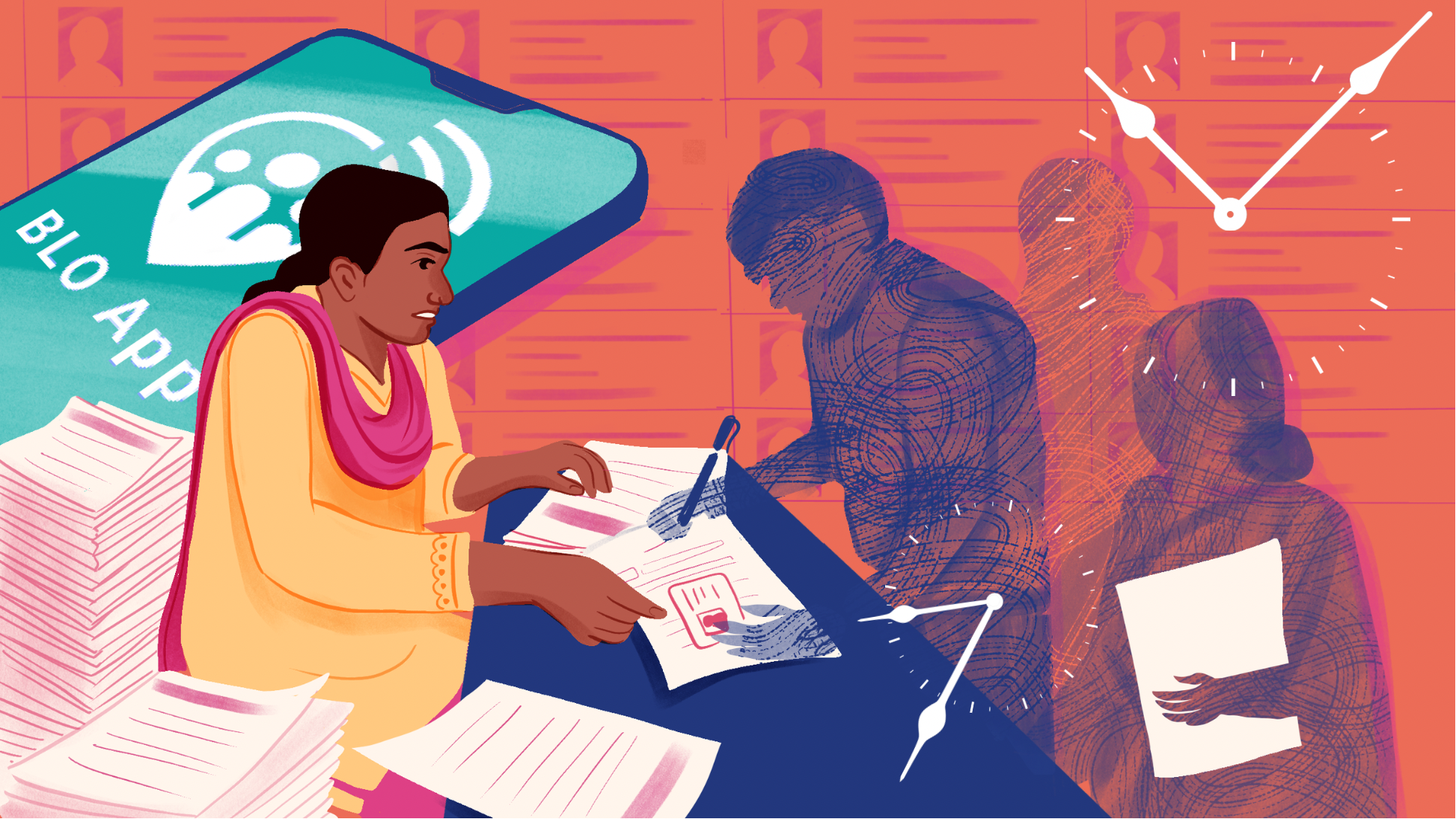
BLOs (Booth Level Officers) have been lauded as the “foundational pillars of India’s democracy” by the Election Commission of India. The most visible official face of the ongoing and chaotic exercise of Special Intensive Revision (SIR), they are mostly government employees, school teachers, ASHA and Anganwadi workers tasked with distributing the enumeration forms, collecting them, digitising them, giving notices and appearing for the hearings as well as helping out with the election duty.
The SIR process in West Bengal was distinct on many counts. Guided by the policy of “Detect, Delete and Deport” “illegal infiltrators”, it was criticised for deliberately excluding certain sections of the population. It resulted in the deletion of 90.82 lakh voters, with around 27 lakh voters placed “under adjudication”. This, researchers and journalists noted, happened significantly in Muslim-majority districts. Nearly four months after the Bengal elections, the SIR’s appellate tribunal has now reinstated the voting rights of 91% of the people who appealed.
BLOs working in West Bengal were caught between confused and angry voters and an apathetic official machinery that offered no clarity on guidelines. Samra Iqbal spoke to BLO Aditi* who described the months she worked on the SIR as the “worst time of my life”. Most of her workdays unfolded after sleepless nights, and were spent travelling door-to-door on an experiment that was clearly falling apart.
The system that was supposed to decide the voting rights of 7.6 crore voters in Bengal, was itself marred by a plethora of ambiguities and new guidelines mostly communicated through informal channels like WhatsApp and phone calls, with no record of written notice. BLOs across states raised concerns about unrealistic timelines and workload, the need to constantly juggle duties, non-payment of compensation, faulty technology and the adversarial nature of the exercise. At least 30-40 officials have reportedly died during this exercise, most of them by suicide.
In this first-person account of her workdays as a BLO for six months, Aditi* talks about the frustration of dealing with an opaque process, helplessness at the inability to calm people’s anxieties and fears for her own privacy. All identifying details — name, age, occupation— have been withheld to protect the BLO’s anonymity.
Edited excerpts below.
THE FIRST PHASE OF ENUMERATION — also called mapping— began on November 4, 2025 in Bengal. A few days before that we were exposed to just a one-day training session, lasting from 9am to 5pm. We were shown presentations in different languages but the instructor was barely audible. We also didn’t get any time to clear our doubts because of paucity of time. Since there was no precedent to this exercise, there were no YouTube tutorials or Google links to help us. There were just no answers available anywhere.
The training session turned out to be entirely useless because we were trained on a prototype of the BLO App that was still being developed. The app that we actually had to work with finally was completely different from the one on which we had been trained. I still have the app, since I am a local BLO now, and till this date it is updated and changed every two days.
I was asked to enumerate 1,350 people. Some BLOs had to enumerate more than 2,000 people. For this work – which included mapping, digitising, giving notices for hearing, appearing for the hearing and helping out with the election duty – we were promised a compensation of Rs. 22,000. In the end we were paid only Rs 12,000. The whole process required a lot of paperwork at every step, and I’m certain I ended up spending more from my own pocket than what I was eventually paid. Besides, our daily travel expenses were never compensated for. My home was just 7 km away from my ward but there were others who travelled from as far as 50-60 km everyday.
I USED TO REACH my ward, Tollygunge, in south Kolkata, around 8:30 am everyday. I would start the day distributing forms to people, explaining to them how to fill it, collecting the forms that were distributed the previous day and also mapping the houses. Sometimes the houses were more than 1 km apart and I had to walk the distance. But this was only half of my day’s work. After returning home around 7 pm, I had to digitise at least 50-60 forms everyday for a system that was marred by constant lags and crashes.
My typing speed is fine, so I could digitise 50-60 forms in 3-4 hours, but in practice it would take me 6-7 hours because the app would crash regularly, for 2-3 hours. I ended up working till 2 am on most days, only to wake up after a few hours to repeat the whole hectic schedule, all over again. For the process of digitisation, I had to upload the front side and the back side of the form along with a passport-sized photograph of the voter; sometimes the portal failed to recognise the image I would upload because of a wrong angle or bad lighting and I would have to start filling in the details from scratch.
This was the hardest time of my life. I didn’t even sleep or eat properly on days. There were no holidays, no life, nothing.
We were asked to categorise the voters into two categories: self-mapping and progeny mapping. If someone had been a voter in 2002 and they are tracing themselves to that electoral roll, it is self mapping, but if someone is mapping themself in relation to their parents, that is progeny mapping. The progeny voters were conventionally asked more questions in the hearings, asked to submit more documents if marked “under adjudication”, and they were the ones we were told to scrutinise at least five times.
The most frustrating part of all of this was that there were no clear rules. On some days I was asked to categorise data according to gender and on others, according to age. Every other day, something new would come up that I was not prepared for.
Once we digitised the forms, our supervisors and Returning Officers had to digitise them from their end before the publication of final electoral rolls on the Election Commission of India (ECI) portal. But they failed to do this. And this was true for not just my ward, but also several other wards. We were given slots to digitise it from their computers. My headquarter was in Alipore Treasury, so I had to go there.
OUR NAMES AND NUMBERS were printed on every form, made available on everyone’s app without our consent. A lot of women I know got prank calls and creepy messages from strangers. Because there was this atmosphere of utter confusion and panic, voters used to call me at even 2 am sometimes. I get their anxiety, but at least our supervisors should have let us know that our numbers would be shared? I would have personally got a new SIM card.
THE DRAFT LIST was supposed to be out on December 9, but then it was postponed by a week. The voters who had to appear for the hearings were marked in the draft list. The first hearings, called “quasi hearings”, happened in local schools. These consisted of me as the BLO representing the voters, my supervisor, the Electoral Registration Officer (ERO), and a micro-observer who is supposed to be neutral. There was also a photographer who was taking pictures of everyone present.
People came for the hearing, they answered the questions but were not given any confirmation about their names appearing in the final voter list. This caused enormous anxiety amongst voters who submitted all the documents from birth certificate and Aadhaar card to school certificate and passports – and everything else they could possibly furnish. Some people were called for a second and third hearing too. People called for these hearings were of two kinds: the ones who didn’t have the required documents, and those whose applications had “logical discrepancy”. Most people in my constituency under this category of “logical discrepancy” were Muslims.
Tollygunge is a relatively posh area. Most Muslims living there are well off, and politically aware. They knew how to map themselves and what documents were required at the hearings. Most of them had everything in place, and they brought newspaper clippings of their name changes. Some also produced valid passports, yet were simply not believed. They were given all kinds of absurd reasons like: “Your photo doesn’t exactly match across documents” or simply: “Why should we believe you?” Thankfully most of the names made it to the final list but this was the general trend. Logic never existed in this system, my supervisors didn’t know most of the things and I was equally unaware.
Up to 200 people were called from my ward for the hearings. In other wards, this number went up to nearly 800 people. The hearings only happened for 23-24 days and the BLOs were often seen fighting with the EROs on the day of hearing so that their voters could get a chance.
I DON’T KNOW WHAT ORDERS WE WERE FOLLOWING. On my first hearing, which was supposed to be on January 13, I got a call from the authorities that the hearing had been postponed to January 21. There was no written notice — nothing aside from a phone call. How am I supposed to inform so many people that their hearing is not happening tomorrow? Most of them refused to believe me and turned up for hearing the next day. This created distrust between the BLOs and the voters. The system was set up to fail, it was designed in a way that ensured that voters could never trust us, no matter how much we tried.
ONE DAY THE “EDIT” OPTION just vanished from our systems and we weren’t even informed of it. Initially, we were told that it is okay to make mistakes, and that the target should be to digitise 50-60 forms each day. The idea was that we could correct these mistakes later when we had more time, but were given just two days in the end to make all the edits. After that the option never reappeared.
There were also instances where people had filled the forms wrong — for instance, a wrong spelling, or naming one’s husband instead of father. We used to get a lot of panicked calls from people asking us to edit these mistakes. But we could not do much about it after a point.
Our supervisors often said that the process wouldn’t affect anyone in the long run, and that it’s just a “routine”. We used to parrot these reassurances to panicked voters, but now, unfortunately, they are left with no recourse. Even their ration cards are being suspended. Frankly, I made many mistakes because of the enormous work pressure I had to deal with every day. Sometimes voters would fill the forms in Bengali and it would be hard to ascertain how the details should be spelt in English. Even if the mistakes were mine, it was the voters who were called in for hearings unfortunately. I would have helped so many people, but I had been under the impression that this is a routine procedure that is repeated every five years. It was careless of our supervisors to trivialise the matter.
The app was in a process of constant back-end development. Those who were not tech savvy used to bear the biggest brunt of this. We were told that we would be aided in our work by data-entry officers. Ironically, they ended up making so many mistakes, which put so many people’s voting rights on the line, as well as made the BLOs accountable for something they were not even responsible for in the first place. All of us understood the biases, as well as how the elimination worked but we were just too overworked and overburdened to do anything about it collectively.
THE FINAL ROLL was out on February 28. In the final list some people were under adjudication, which means they had to appear before the tribunal and submit their documents. This time we did not have to be present. Everybody thought that the tribunal hearings would be done before the elections, but when the list came out, the names were still under adjudication. Some of the names were just deleted from the list and we still do not know the reason for it.
Some of the names were deleted because the applicants didn’t show up for the hearings. But many who did and furnished many documents, also found their names deleted. Before the final list was released we were told of the number of people who would be deleted from our areas. But we realised that many more names had been deleted than had been communicated earlier.
Moreover, the whole process was riddled with biases. Thumbprints were not considered valid, and even with birth certificates, EROs made absurd claims, asking how could the voter be certain it was their thumbprint and not someone else’s. In many ways, those who did not know how the system worked, especially the working class and the poor, were exploited. They were deliberately kept from any sort of clarity and were often dismissed, or shooed away.
I AM STILL A LOCAL BLO and will have to collect all Forms 6 and Forms 8 for voter inclusion or correction in their details. I have to collect these forms at least twice in a month and I know I will have to again look in the eye of so many people whose names had been deleted from the electoral list and ask them to fill out more forms for the government.
Apart from working at my government job, I am also a census enumerator and a BLO. I think our duties should have been made clear, and the work divided, so that we wouldn’t have to juggle so much.
The most stressful part about the SIR was that no one really knew much about what was going on. I can tell you the technical details and the workplan, but the ground reality was so different.
This was unprecedented, and unplanned. Beyond anything, I feel like they owe all voters a proper explanation about the process, to begin with, taking into account the ambiguities, the confusion, and the overt biases.
As told to Samra Iqbal

We believe everyone deserves equal access to accurate news. Support from our readers enables us to keep our journalism open and free for everyone, all over the world.
