
Why The SIR Is Like A Video Game, Where New Obstacles Come Up At Every Level
SIR has become an existential test where clerical errors from two decades ago and technological failures may put both your right to vote and citizenship under threat, says an SIR helpline volunteer
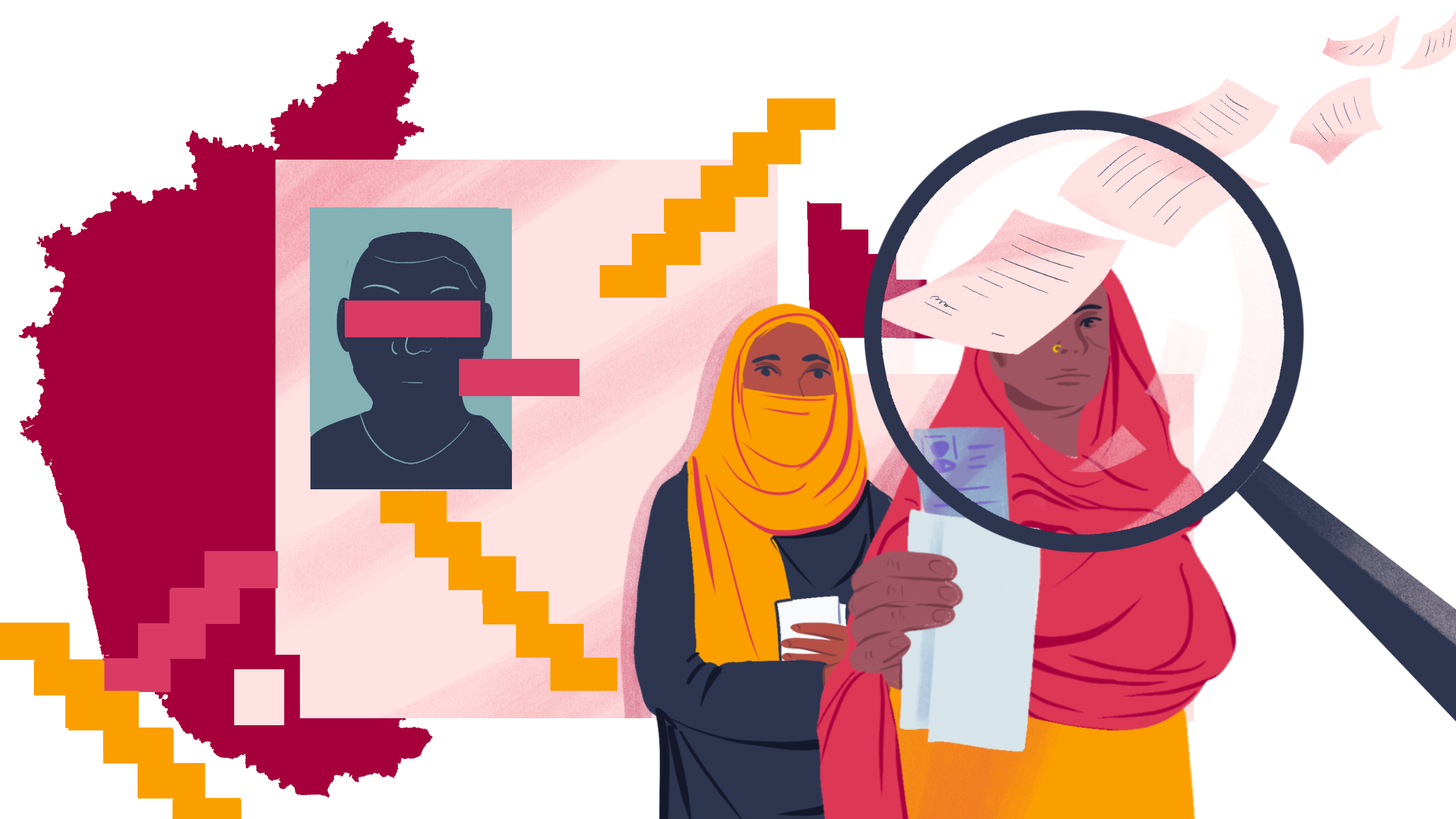
Bibi Fathima* from somewhere in Karnataka had called in with a question: “In my mother’s 2002 voter information, her husband’s name has been wrongly recorded as her father’s. When I am filling out her enumeration form, what should I do? Should I change it to ‘husband’?”
It was late evening on a Friday in July and I was volunteering to manage the Special Intensive Revision (SIR) helpline set up by My Vote, My Right Karnataka (MVMR-K), a coalition of civil society groups. Karnataka is one of 19 states and union territories where the Election Commission of India is carrying out the third phase of the SIR.
Since the first phase in Bihar in June last year, nearly 6 crore voters across India have found their names deleted from the electoral rolls. Seeing how the process played out elsewhere, the MVMR-K coalition prepared by training volunteers like myself to run a helpline and help desks, particularly for communities at greater risk of being disenfranchised—migrants, slum dwellers, trans people, Muslims, Dalits, and Adivasis.
Though it’s a ‘revision’ in name, the process requires every registered voter to submit an enumeration form. Failure to submit will lead to deletion from the rolls and the voter will have to register once again, now with far stricter documentation than before.
According to the ECI, the purpose of the exercise is to maintain the integrity of electoral rolls by deleting dead, shifted, and duplicate voters. This, they say, will ensure that ineligible voters, i.e. non-citizens, are not on the voter list. To this end, since the second phase, the ECI requires every voter to map themselves, or a parent or grandparent, to the previous such exercise, conducted across India between 2002 and 2004. Karnataka’s Chief Electoral Officer, V Anbukumar told the press that mapping is how the ECI is establishing a voter’s citizenship. If a voter cannot map themselves to the previous SIR, the next step is to produce one of 11 documents for themselves and, depending on when they were born, for their parents.
I have spent several weeks now fielding questions from anxious voters in Karnataka, trying to navigate the labyrinth of ECI’s many websites to track down 2002 voter information from electoral rolls that are poorly digitised and riddled with errors. Having witnessed the chaos on the ground, I am in disbelief that our right to vote, the most basic element of a democracy, now depends on a process with no clear instructions, opaque ever-changing rules, and an assumption of a perfectly digitised and documented administrative Utopia.
ECI’s inquiry into citizenship—a power that the Supreme Court of India upheld in limited scope in its May judgement—has turned the SIR into an existential test where clerical errors from two decades ago and technological failures may put both your right to vote and your status as a citizen under threat.
In its judgement about the validity of the SIR, the Supreme Court ruled that the exercise was “proportional”, that the potential hardship caused by it had been mitigated with safeguards, and that the ECI had addressed all concerns about transparency and documentation. Perhaps in theory, from within the court halls, it would seem so. But I would invite anyone who argues that the SIR is fair and transparent to spend just an hour on a helpline, answering questions from voters like Bibi Fathima.
I had no official answer from the ECI to offer Fathima. Officers on ground were giving contradictory answers about even basic aspects of the form such as the progeny mapping section. So, as volunteers, we are forced to guess what logic the ECI might use to flag a voter for further scrutiny. “Retain the mistake so that it matches the 2002 rolls,” I told Fathima.
“And what about the second part of the form where we give current information? Should I describe her husband as ‘husband’ here, or as her ‘father’?”
I was stumped. First Fathima, then I broke into laughter at the absurdity of the situation, a rare moment of humour among a volley of stressful calls. After checking with the more experienced people leading the coalition’s work, I got back to her. “Write it as ‘husband’.”
Unforgiving of Lived Realities
“I think I voted in 2002 but I don’t remember. How will I remember which booth, which constituency?”
Sumitra, a domestic worker, was one of the first people to approach our help desk, a bench set up in a narrow lane in Thayagrajanagar in south Bengaluru. MVMR-K was running several help desks simultaneously across the city that Sunday, and four of us had volunteered in this neighbourhood on the request of Stree Jagruti Samiti, a domestic workers union. Women from around the locality were coming to us, forms in hand, along with every ID document they could scramble.
In the enumeration phase, our most critical task as volunteers was to help voters with the 2002 mapping. Three key details from 2002 were essential to completing the form: the assembly constituency number, the polling booth or part number, and the serial number of their name on the voter list. For this, the ECI has set up a webpage meant to search through digitised voter rolls from that period.
During the volunteer workshop, this search page appeared straightforward. Enter state, district, assembly constituency. Enter the polling booth number if you have it. Enter the voter’s name. Enter voter’s relative’s name as recorded in 2002. Hit search and look through the results until you find the right one. But the first help desk made the challenges very clear to me.
Sumitra didn’t know her polling booth or even the constituency name. Assembly constituencies in Karnataka were redrawn in 2008; how do we figure out which constituency this neighbourhood came under in 2002? The Chief Electoral Officer had not provided a ready list we could refer to. An internet search and a discussion with the people gathered there led us to two possibilities, Uttarahalli and Basavanagudi. I searched her name and together we went through all the options that turned up. She didn’t recognise any of the corresponding relative names so we don’t have a match.
“What about your husband, did he vote in 2002?” I asked.
“He is no more. He used to get drunk and lie around. I don’t even know if he voted in 2002,” she responded.
I tried another track. “What about your parents?”
“They were in my village. How will I remember if they voted or where they voted?” Sumitra asked.
She was hardly the only voter who could not recall the details necessary to search the 2002 lists. The SIR process is unforgiving of a voter’s lived realities. People move. A volunteer recounted how residents of a slum in Bengaluru laughed at her when she asked them to remember their whereabouts from 24 years ago.
People forget. At another help desk, a woman told us they couldn’t map her husband to his parents because the family had cut off ties with them and refused to help.
People die. On the helpline, a caller named Meena told me only her father was registered in 2002 but they lived in a different part of the city back then. He is now dead so she cannot ask about the exact area or the polling booth. Meena wasn’t even sure if her father’s name might be registered as Dandapani, his official name, or Raju, the name he usually went by.
In May, before SIR began in Karnataka, MVMR-K conducted a survey with 74 transgender and intersex people in and around Bengaluru. The majority of them said they would not be able to map themselves to 2002 because they were cut off from their families. The survey also found that most respondents did not have any of the 11 documents a voter should produce if they failed to map themselves. Even when they did, the documents did not uniformly reflect their names and identified gender.
It took me over a week and the pooled knowledge of volunteers to learn my way around the ECIs websites. But there were still too many people I could not map, the fate of their voting rights remains lodged as a niggling worry in the back of my mind.
Looking For Creative Solutions
“I am trying to submit the form online but the website is not working. Why is the website like this? Why are they giving so much trouble to voters, not giving us enough time to complete this process?”
Another evening on the SIR helpline. The caller was Ramappa, an accountant in his 70s who worked in a textile shop in Bengaluru. The form had been delivered to his home in Gadag but he couldn’t go back now so he wanted to submit the form online. Sensing his frustration, I launched into my practised explanation: we are only citizen volunteers with no connection to the official ECI. It was not the first time that volunteers were at the receiving end of a voter’s anger against the election authority.
Having clarified my position, I told Ramappa to try the ECINet mobile app. The website had been down for a few days, and we too were struggling to help voters with mapping. Around the same time, on July 20, we discovered that the website of the Chief Election Officer of Karnataka had made it harder for us to download the booth list PDFs, requiring us to enter the voter’s details instead of only the constituency name and booth number.
It felt like we were in a video game where new obstacles came up at every level and we had to find creative ways to get past them. One volunteer found a website where we could download booth lists without having to jump through the new hoops and captchas. My husband Ronak, also a volunteer, used AI to create a spreadsheet that mapped present-day assembly constituencies to the likely 2002 constituencies. On our WhatsApp group, volunteers pooled FAQs on the variety of issues faced by voters and legal experts in the team drafted responses so we had a ready reference when working the helpline.
That’s how I knew to check with Ramappa, “Does your name on your Aadhaar card exactly match your name on your voter ID? If it doesn’t, you will not be able to submit the form online.” I don’t know if Ramappa was successful in his attempt; if he was, he would be among only 1.26% of the state’s electorate who submitted the form online.
‘I Hope This Will Be Okay’
“I was born here. My family has been voting in the same polling booth every election. But still our names are not on the list.”
I was on the phone with Shivakumar, a voter in Binnypet, Bengaluru, who knew the exact name of his polling booth but the lists didn’t seem to remember him. The Booth Level Officer told him their names may have been mixed up. He found potential matches for himself and his family members scattered across two other booths in the area. He asked me: “How do I know for sure that these are the right ones?”
This was a problem I had encountered before. Often when the search turned up a matching name, other details such as the age or relative’s name were not as expected. The method developed and passed around by volunteers was to find the PDF of the booth list, locate the potential match, and read out to the voter the names appearing above and below their own. Maybe they would recognise a neighbour or relative who lived in their area, confirming that this Periyammal who voted in Melmalayanur in 2002 is indeed the mother of Vidya in Subhash Nagar, Bengaluru.
But this method too failed in the face of Manjunath’s problem of mixed-up lists.
That evening, another caller, Asad Rahman, had a similar issue of his name not being listed in the expected polling booth. His BLO told him that a few booths had been merged, so his name might be in a different list. Asad asked me: “Can you help me find my name?”
In theory, a wider constituency search should have turned up Asad’s name, regardless of which list it had ended up in. But the reliability of the search function is questionable. The other volunteers and I had noticed something odd: the results never showed more than 100 entries. Were there more matches the system was not showing us?
Over two days, I looked for Asad’s name and the names of his family members in breaks between work. Another tactic I learned from fellow volunteers was to do the searches in Kannada. So I used a combination of Google translate and the English-to-Kannada keyboard on my smartphone to type out their names. Different variations of their names, in fact, because we quickly realised that the 2002 lists were replete with spelling errors. So it could be that a man whose old voter ID showed his name as Gnana Shekhar in English could be recorded as Gnana Shekar or Jnana Shekhar or Jnanasekar in Kannada.
There were many Asads in the Uttarahalli constituency but none with the exact name as my caller. Maybe the PDF with his name had not been digitised correctly so it was not searchable. Other volunteers had come across cases where the search didn’t produce a result but the PDF list had the voter’s name. Then again some PDFs, typed in Kannada, had so many Unicode rendering errors that they were simply not searchable. Many booth lists had not even been uploaded weeks into the enumeration phase.
Defeated, I had to tell Asad I couldn’t map him. The only thing to do was to check if he had any of the 11 documents.
Producing one of 11 documents sounds like a reasonable ask until you start going through the list with the callers to the helpline: an ID card or pension payment order from the central or state government or a PSU; an ID card from before 1987; forest rights certificate; a land or house allotment certificate from the government; a family register. None of the voters I spoke to had one of these, very few had passports. The more likely options were birth certificate, education certificate, or caste certificate.
“Do you have a birth certificate?” I asked Asad. Unsurprisingly, the answer was no. Only in 2024 did India achieve 99% registration of births and deaths as per official data; until 2000, only 56% of births were being registered so older voters were less likely to possess a certificate.
Thankfully, Asad had an SSLC certificate. With a sigh of relief I told him: “Keep it safe and ready. When the draft voter list is published, you may get a notice, and you will need to produce this certificate.“ Asad then asked me about his daughter who had only recently registered as a voter. Voters born after 1987 have a higher burden of proof. In addition to a document to establish their own date and place of birth, those born after 1987 but before 2004 must produce a document for any one parent, while those born after 2004 must produce documents for both parents.
“Thank you for helping me. I hope it will be okay,” Asad said.
Fear Of Being Flagged
Some days, we got more calls than we could answer. The beep-beep of one incoming call would sound even as we were speaking to an earlier caller.
On one such day, Ziaullah Khan called me from Shivajinagar. He said: “We found our family’s information and we have completed the forms. Before submitting, I just wanted to double check something. Seven of us have mapped to our grandfather. Is that okay?”
Ziaullah was right to be concerned. In West Bengal, in phase two of the SIR, the ECI introduced a new category of exclusion called ‘logical discrepancy’. The category does not appear to have any basis in existing election laws. In this step, voters are flagged for further scrutiny if there is a mismatch in their data such as: less than nine months age gap between siblings; improbable age gap between parent and child; change in the relative name between the 2002 list and recent voter rolls; more than six children linked to a parent. Over 1.2 crore voters were flagged for scrutiny because of ‘logical discrepancies’ in West Bengal.
Will these exclusions apply in Karnataka? We don’t know yet. The CEO Karnataka told the media it would be clear only after the draft roll is prepared. But news reports indicate that people submitting forms online were shown notifications about anomalies, and the Greater Bengaluru Authority (GBA) disclosed 6.41 lakh ‘logical discrepancies’ in its jurisdiction as of July 24. Unnamed officials also confirmed to The Hindu that an AI software tool was being used for the process.
I would be hard-pressed to name a single voter I spoke to whose voter ID information in 2002 exactly matched their present details. Women are especially at risk of being flagged since they change their surnames, sometimes even their first names, after marriage. An analysis by BehanBox and Kolkata-based Sabar Institute found that 61.8% of the deleted voters in West Bengal were women, with the effect concentrated in constituencies with large populations of Muslims, Scheduled Tribes, and Matuas. Sabar Institute’s analysis also suggests that Muslims were disproportionately flagged under logical discrepancies in West Bengal.
Was Ziaullah at risk of being flagged for scrutiny? He may not be, since the rule of six should only apply to children, not grandchildren. But it was better to err on the side of caution.
“You said you have the 2002 details for someone else in your family, right? Change any one form that can be mapped to that relative. Just to be safe,” I told him. The part I did not say out loud was: “Because you are Muslim.”
Absent, Shifted, Dead, Duplicate, and Other
On August 4, CEO Karnataka started publishing the list of voters marked Absent, Shifted, Dead, Duplicate, and Other (ASDDO). People on this list are to be deleted and their names will not appear on the draft electoral roll. Two days later, I received a panicked call on my personal phone from Pamela D’Crasta, an 86-year-old woman living alone in Bengaluru.
“My name is not on the list, please help me. What should I do? This is such a headache. They’re troubling old people like me,” she said.
I reassured her that not being on the ASDDO list was a good thing.
I had been in touch with Pamela since she first contacted the SIR helpline asking for help with mapping. I was inundated with calls that day, and since she seemed like a well-off, college-educated person, I didn’t think she was a high-risk voter. So I took the work home to search in my own time.
On WhatsApp, Pamela sent me pictures of every single voter ID she has held since 1995. In spite of this, I could not find her when I searched her 2002 constituency in Mumbai. I used all my usual tactics and tried repeatedly over two weeks, hoping a fluke spelling mistake would turn up the right result. Maybe because she was an old woman living alone, or because I saw her date of birth and realised she was older than the country itself, I found myself unable to let go.
Finally, Pamela gave up and submitted her form without the mapping information. At least she has a passport and education certificates to respond to the notice when it arrives, I told her.
“Okay, will you still be there when it happens? I don’t know what to do.”
“Yes, the helpline will still be there. I will still be here and you can call me anytime.”
Readying For Final List
As of August 7, nearly 1.1 crore of Karnataka’s 5.54 crore voters, or 19.81% of its electorate, were marked as ASDDO. In the densely-populated capital, nearly half of all voters were in the ASDDO list. Under pressure from civil society groups including MVMR-K, the CEO Karnataka made the lists public and extended the timelines by one week. Already, reports suggest that the ASDDO list has shrunken by 3 lakh after voters flagged incorrect classifications. The SIR booklet states that no eligible voter should be deleted without a fair opportunity to be heard. But if the deletions are in lakhs, will the ECI be able to manage it fairly? In West Bengal, the Calcutta High Court observed that SIR tribunals in the state would take 21 years to dispose of all appeals at its current pace.
For us volunteers, the work is far from done. We’re preparing for August 24, when the draft roll will be published and the claims and objections phase will begin. All of us, taking time off from our busy lives to mitigate what I can only describe as an administrative theft of the right to vote.
On paper, it makes sense. Of course, only citizens must vote and surely there are errors in the existing list. But if a revision flags nearly a fifth of the electorate for deletion, shouldn’t it raise concerns about the design of the process itself?
Couched in the rational-sounding language of bureaucracy is a new reality for our democracy where the burden of proof has shifted to the individual; where the rules to become a voter are being silently rewritten; where the state’s own records are messy but it expects its people to have perfect documents; and where these ever-changing rules now hang like like a threat over one’s status as a citizen of this country.
Meanwhile, as I switch from one ECI webpage to the other, its motto stares back at me: No voter to be left behind.

We believe everyone deserves equal access to accurate news. Support from our readers enables us to keep our journalism open and free for everyone, all over the world.
