[Readmelater]

Women Sustain Andhra’s Fish Trade But Are Absent From State Schemes

In Vishakhapatnam, at the harbour, in the market and on streets, women fishers are visible in large numbers but the state simply does not count them as part of the industry

THE COAST ALONG THE Visakhapatnam-Bheemili Road in Andhra Pradesh was silent at midday, except for the cawing of crows and the waves crashing against the shore. Fishing nets lay scattered across the sand, while boats lay anchored facing the sea. On the road leading to the coast, around a dozen women gathered in the shade of a small temple at Thimmapuram village, seeking respite from the summer season’s hottest days during a power outage.

Among them were women from fishing communities, the Vada Balijas, classified as Other Backward Classes (OBCs). They are discussing the upcoming annual festivities at the temple the following day– the Ernimamba, Poleramma, and Pothuraju festival–honouring folk deities during the fishing ban months. 

The two-month annual marine fishing ban mandated by the Union government from 15 April to 14 June on the east coast (on the west coast, it applies from June to July) to conserve fish stocks and promote the regeneration of marine resources. Fishers say that in the lean months, these festivities regenerate their sense of belonging and community.

Dooda Dhana Lakshmi, 46, was counting down the days until the fishing ban ended and she could return to her dry fish business. As did the  164 women of the Visakhapatnam Town Fisher Women Dry Fish Cooperative Society, founded in 1981. Named after the port city of Visakhapatnam—home to one of India’s largest fishing harbours and Andhra Pradesh’s biggest fish landing centre—the cooperative has long sustained generations of women fish workers.

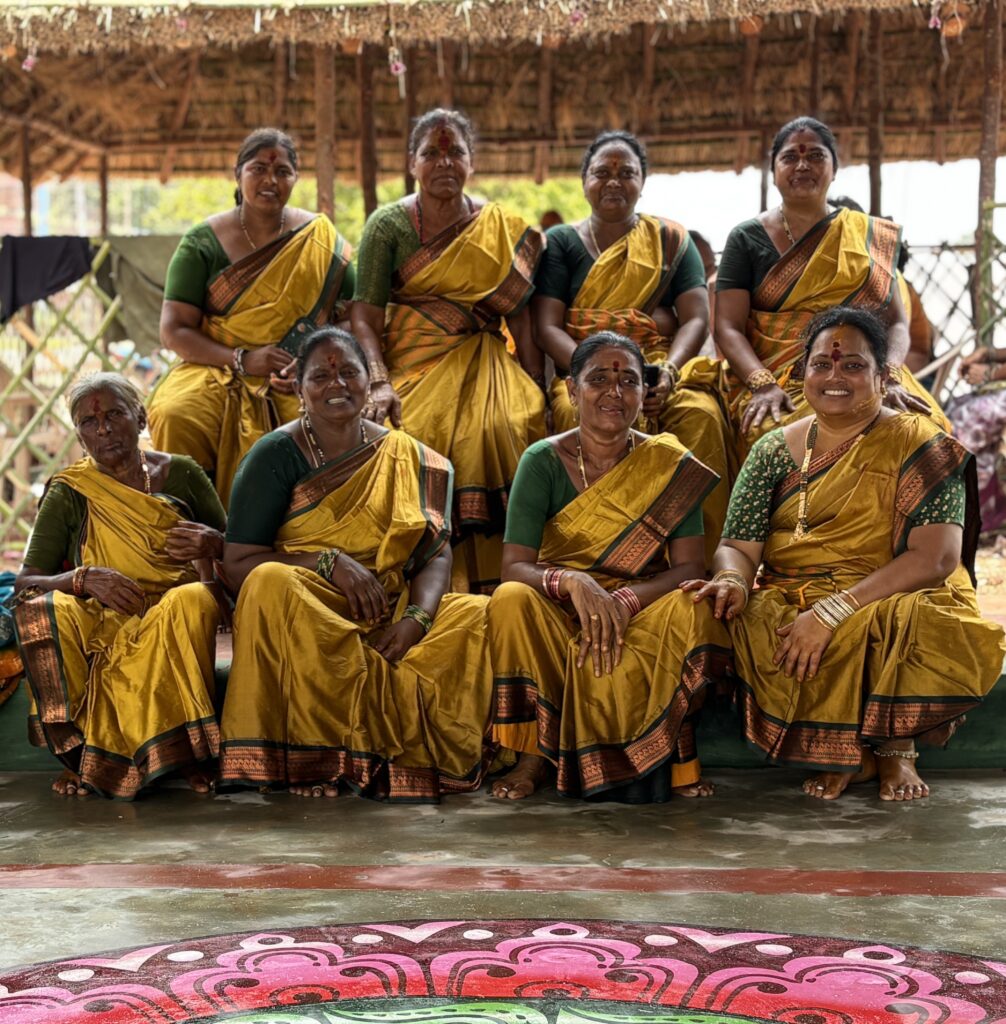
Smiles and matching attire mark the village folk deities festival as members of the Visakhapatnam Town Fisher Women Dry Fish Cooperative Society gather in Chepala Thimmapuram, Visakhapatnam / Photo: Bhaskar Basava

For generations, these women have depended on Gangamma, as they lovingly call the sea goddess, for their livelihood. Their work begins when the catch is brought ashore by fishermen, often their own husbands and relatives. They clean, dry, and market the fish, adding value before selling both dried and fresh fish across the region. The State Fisheries Department in Visakhapatnam estimates that at least 30% of fish landed at the harbour is diverted for drying, a trade largely sustained by women.

The two-month fishing ban pushes many women into financial strain. Lakshmi must pay nearly Rs 20,000 every month in loan installments and DWCRA self-help group contributions. Once fishing resumes, she will need another Rs 50,000 in working capital to restart her business. The constant cycle of borrowing, repayments, and fresh debt is what worries her the most.

During the ban months, the state offers some financial assistance – the Andhra Pradesh Matsyakara Sevalo Scheme provides Rs 20,000, to which the Centre contributes Rs 1,500 under the Livelihood and Nutritional Support component of the Pradhan Mantri Matsya Sampada Yojana (PMMSY). But this help is only extended to fishermen who venture out to sea. Of the 9 lakh fishers in the state, only 1.3 lakh (about 14%)  are eligible for the assistance because, according to a state fisheries official, it does not apply to those who avail other state welfare schemes.

Marupilli Parvathamma, 70, president of the women collective, questions this gendered definition of a fisher. “The government has nothing for us during this period even though we keep the fish economy running. There is no recognition of our work or our identity,” she says.

This assistance is intended as livelihood support for the families of fishermen who go to sea, counters B Suresh Kumar, assistant director of the Fisheries Department, Visakhapatnam: “It should not be seen as an individual entitlement. It covers up to 10 crew members per registered vessel, depending on the category of the boat.” In Visakhapatnam district alone, around 13,500 fishermen are beneficiaries of the scheme, accounting for about 10% of the state’s total beneficiaries. 

Andhra Pradesh produced about 40% of India’s fish in 2023, with fisheries contributing nearly 7% of the state’s GDP. Women are central to this economy, sustaining the fish value chain from harbour landings to consumer tables. And despite women’s central role in this economy, their work remains invisibilised. While the national and state policies acknowledge the role of women fishers in the value chain, schemes are not designed around women fishers.

The marine fisher population in India is estimated at 3.77 million, of which 0.93 million are active fishers, estimates the Draft National Fisheries Policy, 2020 . The policy also acknowledges that fishers include not just who venture out to the sea but also those engaged in allied activities. It estimates that women constitute 69% of such fishing workforce and in the area of fish marketing, women fishers constitute 86% of the workforce.  

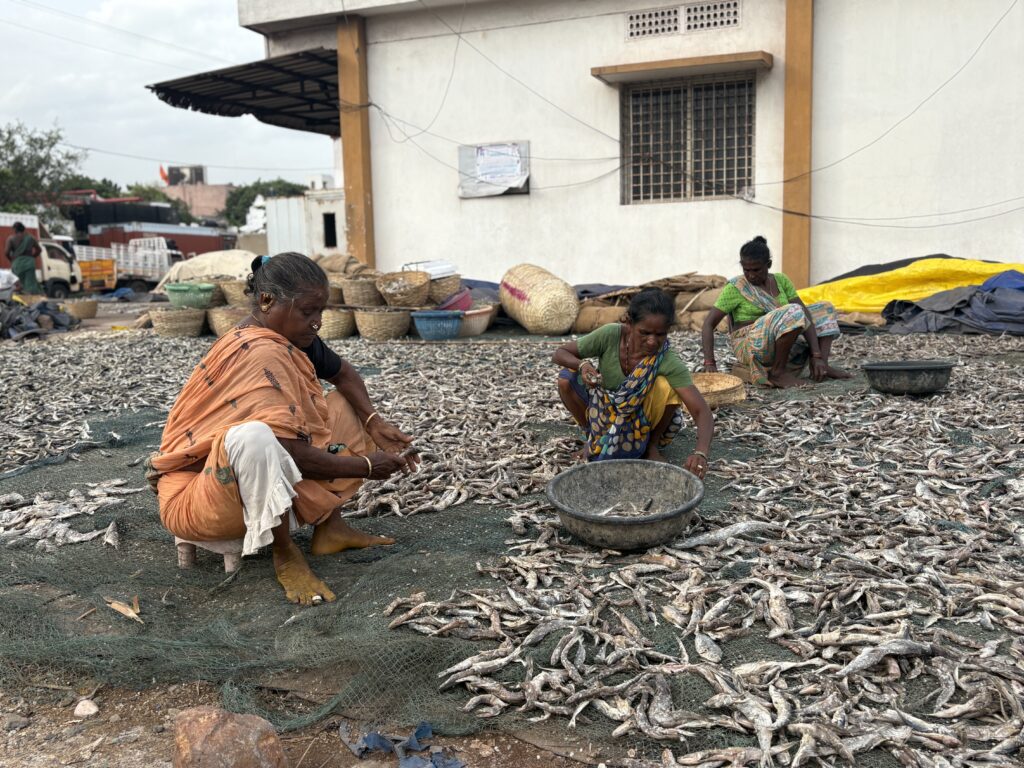
To understand what this labour entails, we followed two women fishers—Dooda Dhana Lakshmi at the Vishakhapatnam fishing harbour and Dooda Devi, a fish vendor in local markets. We found that their work is conducted in hard conditions – hours of enduring stench, labouring in scorching heat with poor sanitation facilities, and an inadequate market infrastructure. 

Forging the Collective

“In times like these, when the system fails us, it is the women’s collective that keeps us going,” says Parvathamma. The collective’s resilience was forged decades ago. Four years after it was formed, the women found themselves fighting displacement.

Before the Visakhapatnam Fishing Harbour was built in the 1970s, fishers ventured into the sea on theppas—small wooden boats. The harbour ushered in mechanised fishing vessels, drawing fishing families from across the district to settle in makeshift shelters nearby. While the men went to sea, the women processed and sold the catch. Much of it was salted and sun-dried, making it possible to transport fish to tribal and other inland regions where fresh fish was scarce, providing an affordable source of protein.

In 1985, the Visakhapatnam Port Authority proposed development works that threatened to displace these families. The women responded with a protest, deliberately keeping the men out of the campaign. “The men had to go to sea, and they were more likely to be arrested,” Parvathamma explains. “Even when the police resorted to lathi charges, we refused to back down.”

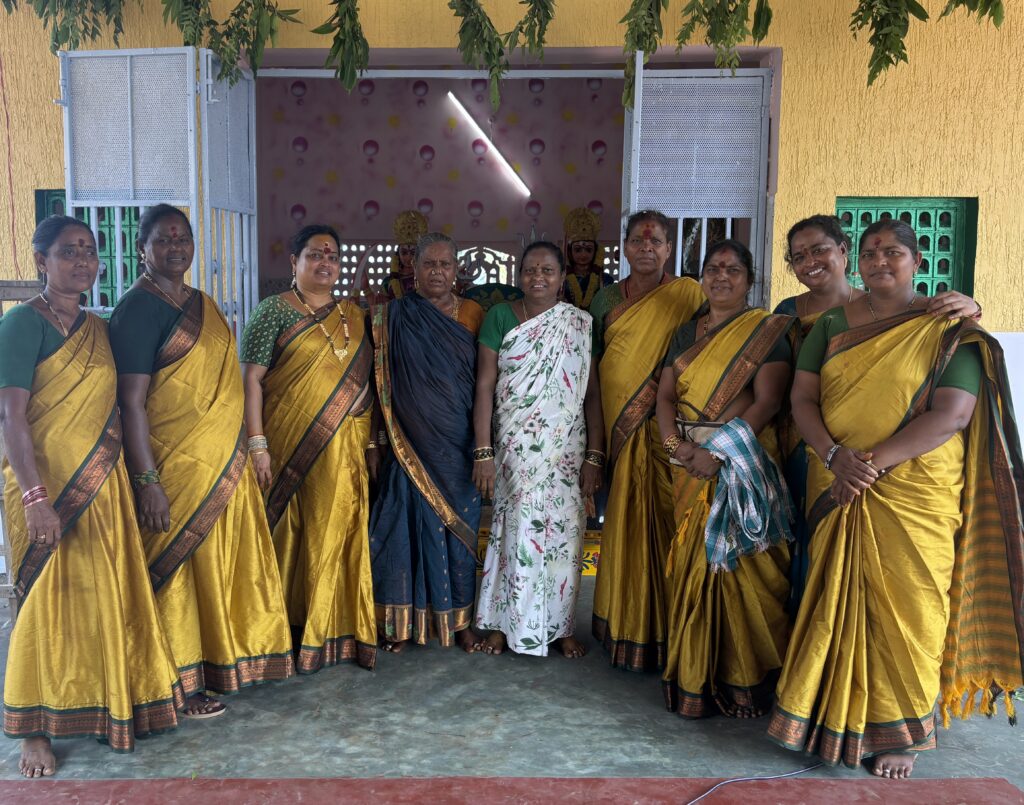
Members of the Visakhapatnam Town Fisher Women Dry Fish Cooperative Society participate in celebrations at the local folk deity temple in Chepala Thimmapuram village / Photo: Bhaskar Basava

The struggle reached the Andhra Pradesh High Court in 1987. The outcome secured 10 acres of land for 164 women about 20 km from the harbour, where they built their homes, reserving five acres for drying fish. The settlement came to be known as Chepala (Fish) Thimmapuram.

Nearly four decades later, the collective remains the backbone of the community. When a member dies, a family member involved in—or willing to take up—the fish trade takes her place. “That is how the collective has survived,” says Parvathamma. Around one in 10 members, she adds, have lost their husbands at sea.

When the Boats Returned

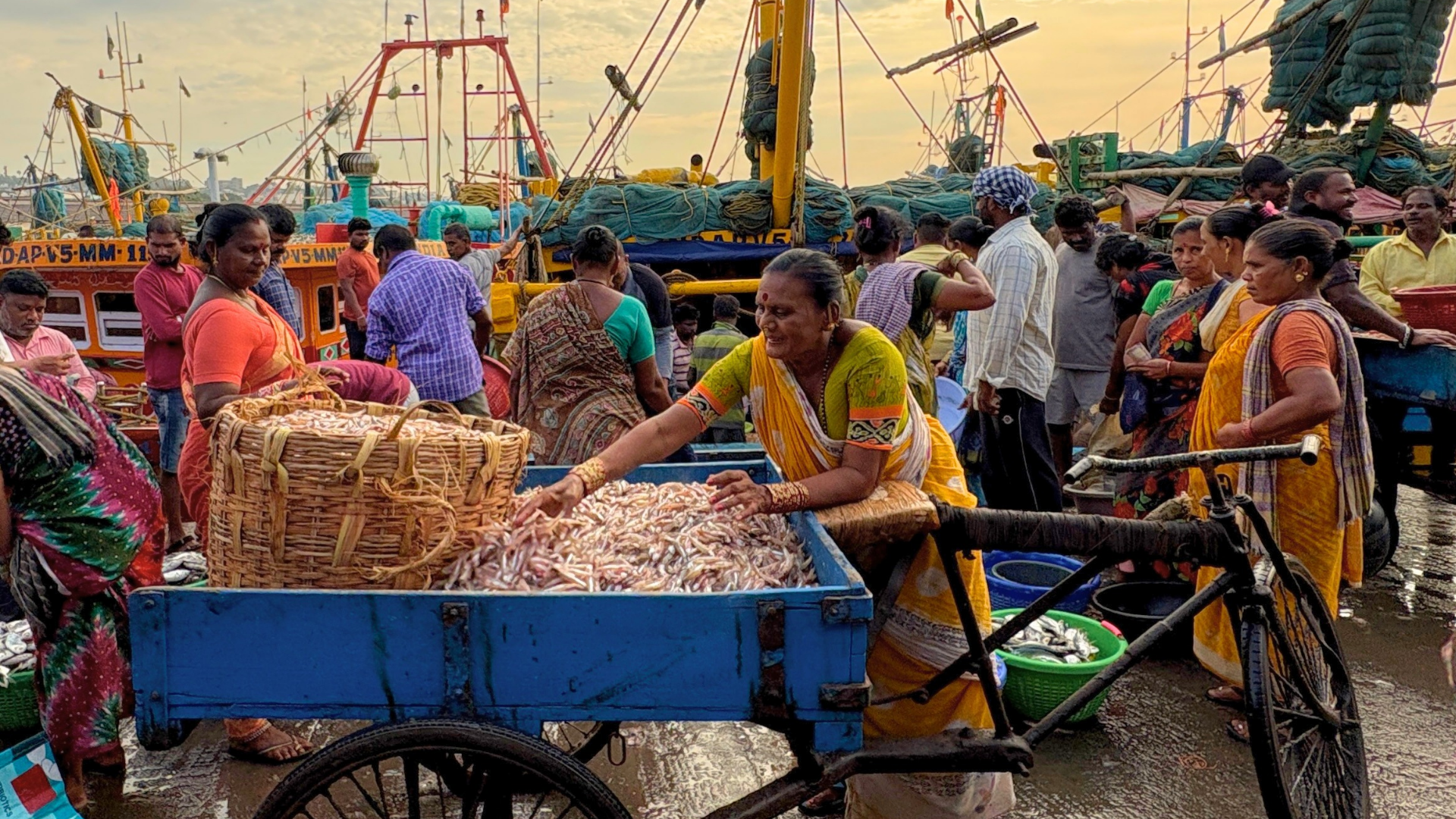
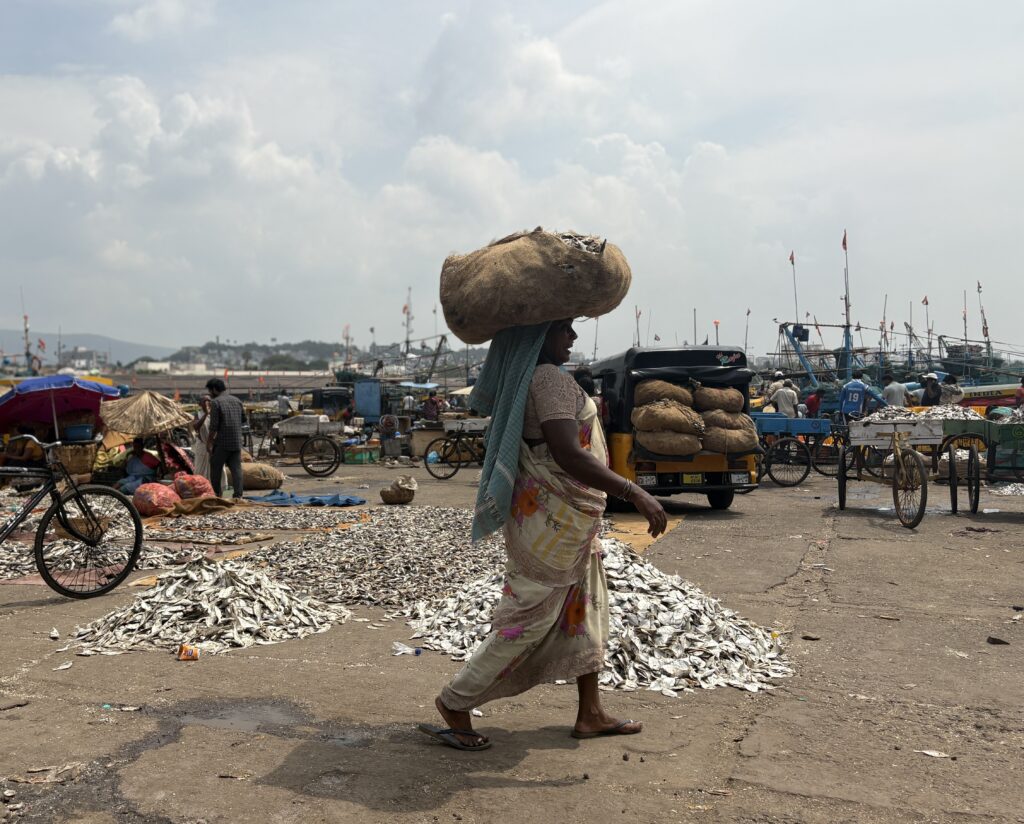
It is 6 am on June 25. Ten days have passed since the fishing ban ended. The first catch begins arriving at the harbour. Lakshmi is already on her way, joining the many women opening stalls and preparing their workspaces.

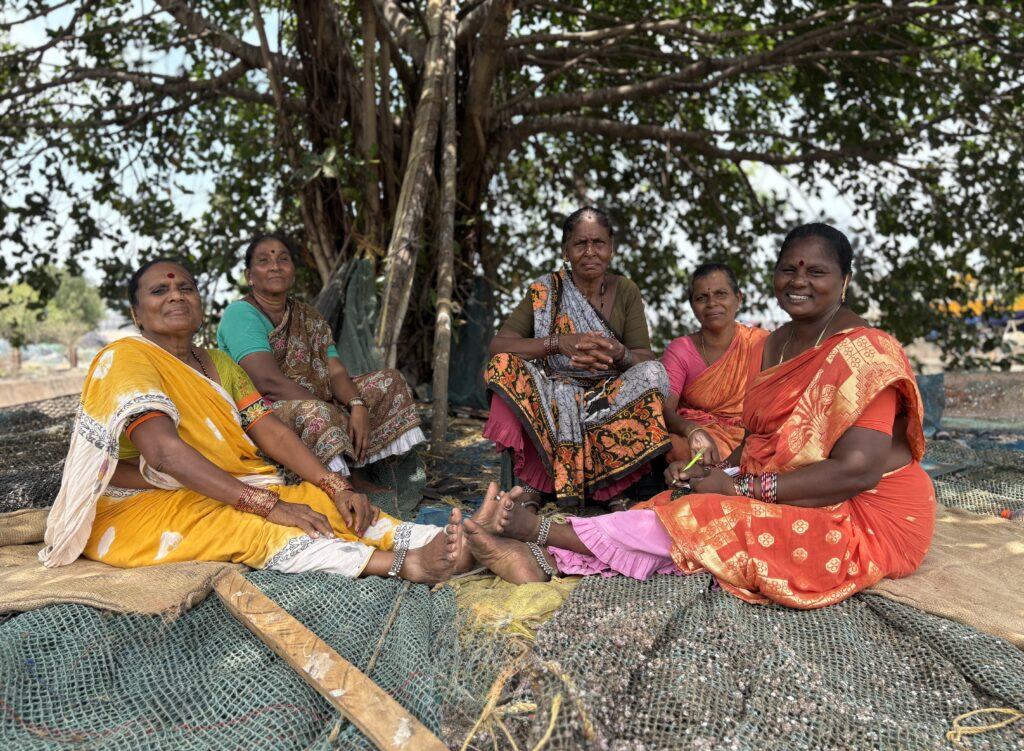
Soon, four other members of the collective—Alipilli Tandelamma, Sipilli Eramma, Pukkala Ellayamma, and Vasupalli Sathyavathi—join her. The 164-member collective often works in smaller groups, pooling money to buy fish when prices are high, sharing labour, and dividing profits.

That morning, Tandelamma is unhappy with the price of a butta—a basket holding about 7 kg of fish. Auctioneers on boats in the harbour called out prices based on the catch. A basket of nethallu (white anchovy) opened at around Rs 1,200.

“What is this? ₹1,200? That is far too much,” Tandelamma exclaims. Lakshmi consoles her: “Don’t worry, the price will come down. Wait before buying.” 

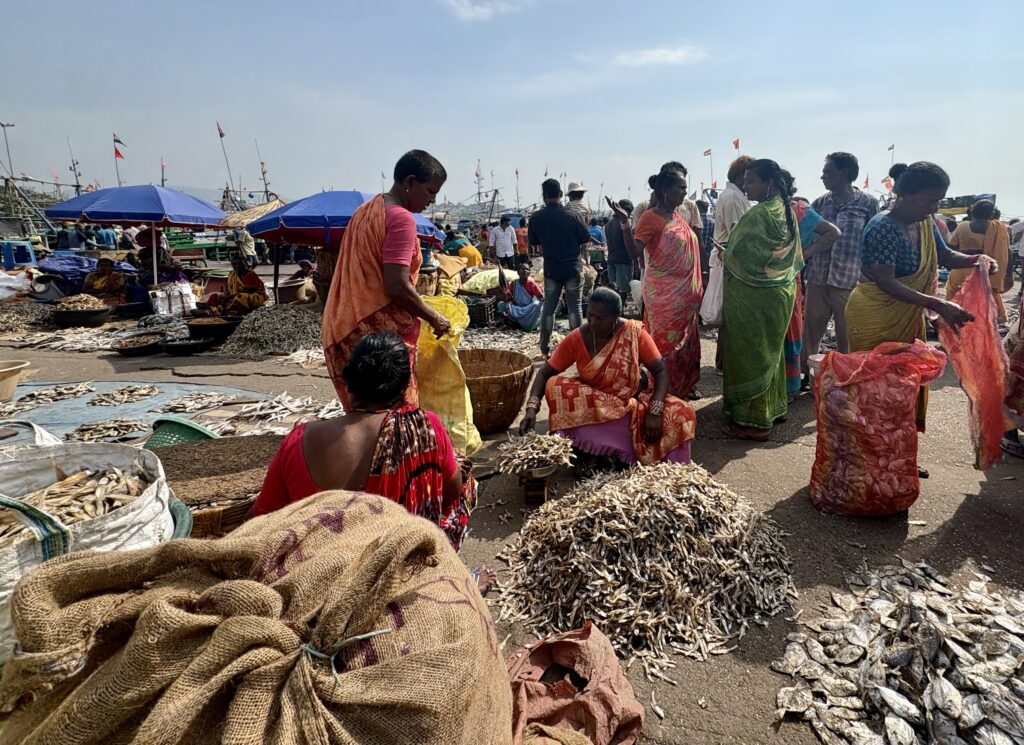
Lakshmi has been coming to the harbour as a little girl with her mother and grandmother. Women like her are everywhere—negotiating price, examining the catch, and making quick decisions on what to buy. They talk in raised voices above the harbour’s constant noise. This noise and bustle of fishing harbours is the subject of social prejudices in many languages including Telugu.  Consider this: “Chepala bazaru laaga (like a fish market).”

Tandelamma arranges the fish on a rickshaw while, behind her, Dhana Lakshmi counts the baskets being loaded onto it in the Visakhapatnam Fishing Harbour / Photo: Bhaskar Basava

Lakshmi walks up to the boat, then turns to the other women and jokes in the Srikakulam dialect of Telugu that a guntadu (young boy) was driving up the price unnecessarily. “No one will buy fish at that rate,” she tells the auctioneer.

Lakshmi says anchovy catches have declined sharply due to climate change. Two decades ago, they were available for nearly six months a year. Today, the season lasts barely two months. Yet demand remains strong. 

The Fisheries Department acknowledges a decline in the catch of several fish species: annual landings at the harbour have also fallen, from rough estimates of around 90,000 tonnes in 2019 to 80,000 tonnes in 2025.

Lakshmi says this crisis is worsened by rising competition from exporters and hotels. “They make deals directly with boats, and much of the catch never reaches the auction,” she says.

Labour, In Gruelling Heat

Lakshmi’s husband is a fisherman but she never buys from his boat. “If I bargain, his crewmates will say they had to sell good fish cheap because of me,” she says. An hour later, as the basket price of anchovy falls from Rs 1,200 to Rs 850, she buys 40 baskets from a single boat.

Their work is collaborative. Tandelamma hires a cycle rickshaw to take her to Fishing Harbour Dry Dock for Rs 200. As she leaves, Tandelamma asks Lakshmi to count the baskets as they are loaded. Sathyavathi searches for more catch, while Eramma and Ellayamma begin drying the fish.

By midday, the heat is relentless. Hours pass as the women load and unload fish without stopping for food, water, or shade. They say they limit their water intake because the only nearby toilet is unusable.

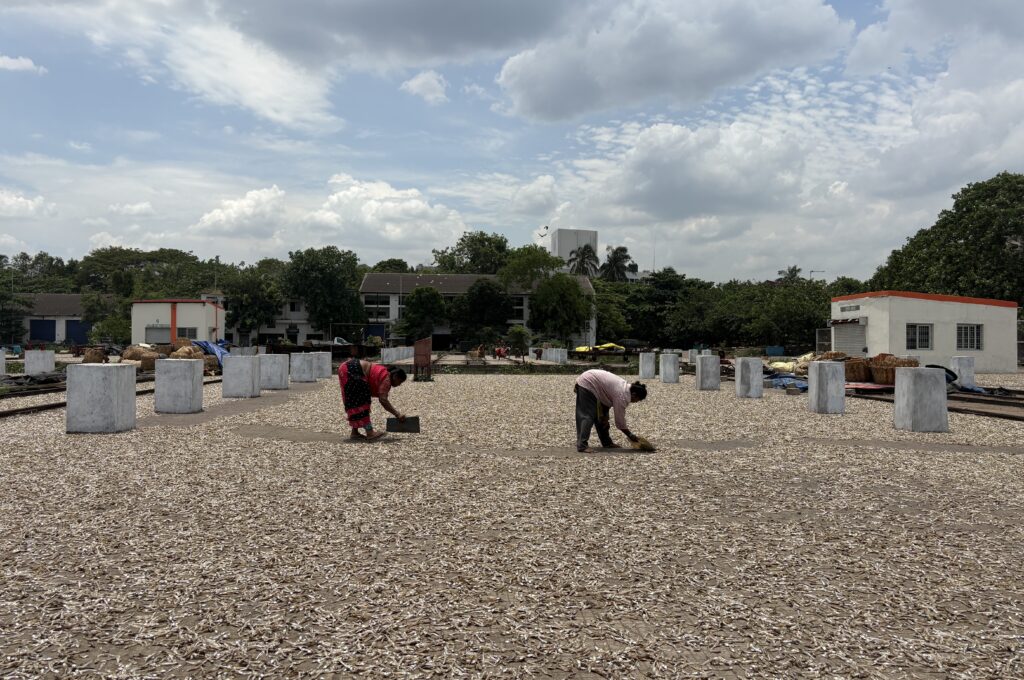
Women dry and arrange fish under the open sky at the Visakhapatnam Fishing Harbour Dry Dock / Photo: Bhaskar Basava

By the end of the auction, the group had bought 130 baskets from four boats. The catch is moved to the drying yard, a kilometre from the harbour, where a 7 kg basket of fresh anchovies eventually shrinks to about 3 kg after drying. Solar dryers, experts say, can reduce wastage and improve quality by keeping sand away. But the women say the technology cannot match their scale. The collective dries 8–16 tonnes of fish daily, while a solar dryer handles only 500–1,000 kg at a time.

The fish will take a day or two to dry if the days are sunny.

The Credit Gap

Lakshmi’s purchases that day cost nearly Rs 1.10 lakh, but she paid only about 40% upfront to the four boat owners. The rest came through credit, backed by her three decades of relationships at the harbour. Her working capital came from the women’s collective, which lends members money from a Rs 20 lakh corpus fund at 1–2% monthly interest. Lakshmi had borrowed about Rs 1 lakh.

She must repay boat owners before buying again from them or before their next fishing trip. She constantly juggles balancing repayments, sales, and fresh purchases. Without the collective’s support, she says, she would have been forced to turn to private lenders.

The collective began with a seed fund of Rs 18,000, raised through Rs 110 contributions from each member, says Parvathamma. Over the years, the corpus has grown as women contribute 10% of group business profits, funding a community hall, school renovations, a wedding hall, and three temples. Now in its fourth decade, apart from an initial Rs 3,000 loan from a private bank during relocation, the society has received no loans from the government or banks.

The women say access to credit remains one of their biggest challenges. Banks often encourage them to apply for loans, only to reject their applications later. 

Fisheries officials say the PMMSY offers women up to 60% financial support for fisheries-related SHGs and activities. But none of the women interviewed had accessed the scheme, largely due to lack of awareness, and officials confirmed that no women from Thimmapuram had received assistance.

The women say their biggest need is not subsidies but working capital to buy fish daily. Fisheries officials said that women in fisheries and allied activities were eligible under the Kisan Credit Card scheme, with collateral-free loans of up to Rs 2 lakh for working capital needs. However, K Lakshmi of the Andhra Pradesh Traditional Fish Workers Union (TWFU) says access remains difficult because banks are reluctant to lend.

Sathyavathi holds a bag while Dhanalakshmi weighs, counts, and packs the dried fish for wholesale / Photo: Bhaskar Basava

Arjilli Dasu, general secretary of the Federation of Indian Fishermen Organisations (FIFO), says that access to microfinance remains one of the biggest unmet needs for women, despite the scale of the business they handle. “They have viable businesses and can repay loans, but the system does not recognise the nature of their work,” he says.

He rejects the idea that women are poor borrowers. He cites a collateral-free lending programme run by the Institute for Motivating Self-Employment, Kolkata, with his Small Scale Fishers Fish Producer Organisation, through which about 300 women from Visakhapatnam have received loans of up to Rs 20,000. The loans are repaid over 11 months, including 1% monthly interest.

From Shore To Market

The next day, Lakshmi and her partners buy 240 baskets of anchovies at Rs 750 each, spending a total of Rs 1.8 lakh. She takes charge of selling the dried fish, setting the price at Rs 400 a kg after factoring in purchase costs, labour, transport, and the partners’ share.

Customers arrive one after another, and Lakshmi finds herself on the other side of a tough bargain. Many bulk buyers, known locally as sahukars (traders), purchase dried fish to resell in retail markets. Some of them buy on credit, while others pay part upfront. One offers Lakshmi Rs 250 per kg for 50 kg of fish which she refuses, challenging him to get the same price from the boats that sold to her. After several rounds of bargaining, they settled at Rs 340 per kg. 

When the buyer asks for a few extra fish, as customers often do, Lakshmi retorts: “Take it or leave it.” She records every sale, credit, and expense in a small notebook, with the other women helping her calculate the accounts. At the end of each day, the partners sit together to reconcile their earnings, never needing a calculator.

Members of a five-woman subgroup of the Visakhapatnam Town Fisher Women Dry Fish Cooperative Society, led by Dodda Lakshmi. From left_ Tandelamma, Eramma, Ellayamma, Sathyavathi, and Dhana Lakshmi / Photo: Bhaskar Basava

Over two days, the business earns a profit of about Rs 28,000, including the value of labour. Each partner takes home Rs 5,600. On an average each partner is able to earn up to Rs 10,000 from each purchase. But if the market price falls after they buy the fish, the women are forced to sell at little or no profit. Then, sales can take up to four days or more, not two.

After the fishing ban, comes the monsoon.

In late June, as monsoon clouds gather, nearly 1,600 kg of anchovies can be at risk in the open drying yard. With no official weather alerts beyond cyclones and severe events, the women rely on experience—reading the sky, dark clouds, and cool winds—to protect their catch. At the first sign of rain, they cover the fish with tarpaulins and resume drying the next day. They say the harbour has no storage facilities.

occupying Market Squares

Unlike Lakshmi, Parvathamma travels to larger wholesale markets such as Nakkapalle, about 90 km from Visakhapatnam, where a weekly dried fish market draws vendors from across the region, including Odisha. The turnover here ranges anywhere between Rs 50 lakh to around Rs 1 crore, says Arjilli Dasu.

Every Thursday night at 9 pm, she boards a bus with her dried fish. The journey takes about two and a half hours. Under the State’s Stree Shakti scheme, she now travels free. After arriving early Friday, she rests in temporary sheds until trading begins. When her consignment is large, Parvathamma hires a van.  Otherwise, she shares one with other women, splitting transport and handling costs. A van typically costs around Rs 5,000.

Marupilli Parvathamma, 70, president of the Visakhapatnam Town Fisherwomen Dry Fish Cooperative Society, collects fish after a day of sun-drying them in the open at the Visakhapatnam Fishing Harbour / Photo: Bhaskar Basava

At Nakkapalle, she spends Fridays by the roadside waiting for buyers. She usually brings about a tonne of dried fish worth around Rs 1 lakh. The panchayat-appointed contractor collects an aasilu (market fee) of Rs 30 per bag for maintenance and sanitation. On average, Parvathamma says, she earns between Rs 10,000 and Rs 20,000 from a week’s sales.

Despite the scale of the trade, Parvathamma says basic facilities remain inadequate. The market lacks toilets, proper accommodation and sheltered spaces where traders can rest or protect themselves from the harsh sun and rain. 

Meanwhile, some women set up roadside stalls in nearby towns and villages, others sell door to door in apartment complexes. 

Selling on the Streets

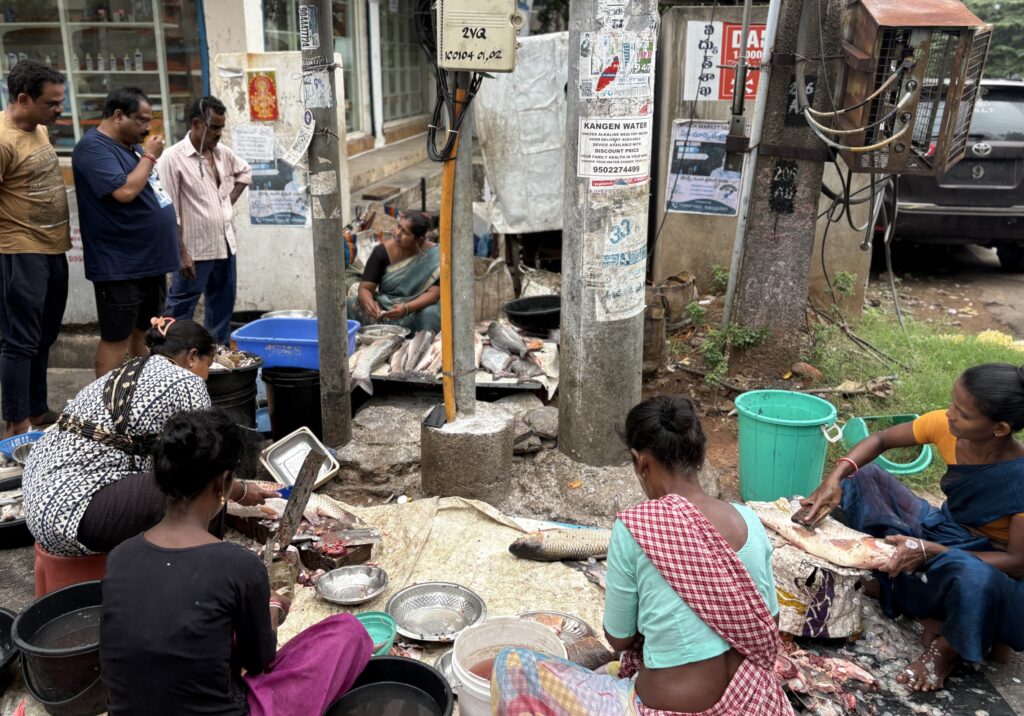
Dooda Devi buys seafish from the harbour and river fish from Visakhapatnam’s Poorna market at 5 am, before heading to Madhurawada to sell her stock worth around Rs 60,000.

She entered the trade in 2016, in search of financial independence. After her mother-in-law’s death, Devi took her place in the women’s collective. Her husband Nookaraju initially opposed this, fearing that selling fish in local markets would undermine their family’s middle-class standing despite his own roots in the fishing community. 

Within a month, Devi raised her initial capital by selling puppies born of her pet pug. With Rs 30,000, she began selling fish from a roadside spot suggested by a well-wisher. She now runs her business three days a week—Sunday, Tuesday, and Wednesday—when salaried families are most likely to buy fish.

Over the years, Devi has built a loyal customer base. In 2021, she spent Rs 20,000 to build a roadside stall, but municipal authorities later demolished it as an unauthorised structure. She continues to sell from the same spot, now working under an umbrella. The heat takes a toll on Devi’s health, but she says she has little choice. 

On the day we met her, she sold fish worth around Rs 70,000. After paying for transport and wages to the four workers who cleaned the fish, she had earned around Rs 6,000. Her husband now works alongside her—he buys the catch from the harbour for Devi to sell. 

Doda Devi sells fish in Madhavadhara, a suburb of Visakhapatnam, after procuring the day's catch / Photo: Bhaskar Basava

But, she is worried about declining fish catch. That day, at least 10 customers asked for sea prawns but she couldn’t find them.  

Women like Devudamma, who sell fish door to door, are slowly disappearing from neighbourhoods. Walking through Arilova calling, “Chepalamma, chepallu!” (“Fresh fish, madam!”), she sells about Rs 1,500 worth of fish to regular customers and earns around Rs 1,000 in profit on a good day.

Both Devi and Devudamma work without access to cold storage. Fisheries department officials say there are no government-run cold storage facilities at the Visakhapatnam Fishing Harbour or elsewhere in the district, though some private units operate in the region. Around 20 chill rooms are currently under construction at the harbour.

A woman carries a bag of fish on her head after purchasing it at the Visakhapatnam Fishing Harbour / Photo: Bhaskar Basava

Until then, women like Devi and Devudamma depend on private ice vendors. A 150 kg block costs around Rs 250, but supply often falls short and ice melts quickly in summer heat.

Devi often sells the unsold fish at a loss, while Devudamma salts and dries it for later sale, although there is limited demand in her area. 

K Lakshmi of TWFU says rising temperatures have made the fish trade increasingly difficult. Women selling fresh fish struggle to keep their catch from spoiling, pushing many to leave the trade for other low-paid work, including cooking and domestic labour. She adds that women fish vendors also face discrimination while travelling, with some being denied access to public and private transport because of the smell of fish they carry.

Toll on Their Health

While fish odour is often a source of stigma in public spaces, health experts warn that prolonged occupational exposure during dried fish processing may also carry health risks.

Vinod Kumar Manthini, district epidemiologist, Parvathipuram Manyam, and P. Sridhar, district surveillance officer and epidemiologist, Vizianagaram, explain that when fish proteins break down due to bacterial activity they release compounds such as trimethylamine (TMA), ammonia, and volatile sulphur compounds. For women who spend years handling and drying fish, repeated exposure to these may cause irritation of the eyes, nose, and throat.

”Over time, many workers undergo what is known as olfactory adaptation, in which the brain becomes less sensitive to persistent odours. But becoming accustomed to the smell does not reduce other occupational risks associated with the work”, Sridhar says

Six to ten hours of outdoor work in direct sunlight exposes fisherwomen to heat stress and UV radiation, while prolonged physical labour contributes to musculoskeletal problems, including back, neck, knee, shoulder, and heel pain.

Despite these health risks, none of the women interviewed reported having access to regular health check-ups or protective equipment. For Lakshmi, Parvathamma, Devi, and hundreds of women along the coast, the dangers of the trade are accepted as a part of worklife. Instead, they place their faith in Gangamma, the sea goddess. Each fishing season, they return to the harbour carrying the same faith. And as the monsoon arrives, bringing fewer drying days and slower sales, they simply carry on.

This story is part of the series ‘The Full Field: The Many Faces of Women Farmers’, a collaboration between Womanity and BehanBox.

  • Bhaskar Basava is an independent journalist from the Telugu states who covers human rights, gender, caste, education and the environment.

Malini Nair (Editor)

Malini Nair is a consulting editor with Behanbox. She is a culture writer with a keen interest in gender.

Support BehanBox

We believe everyone deserves equal access to accurate news. Support from our readers enables us to keep our journalism open and free for everyone, all over the world.

Donate Now