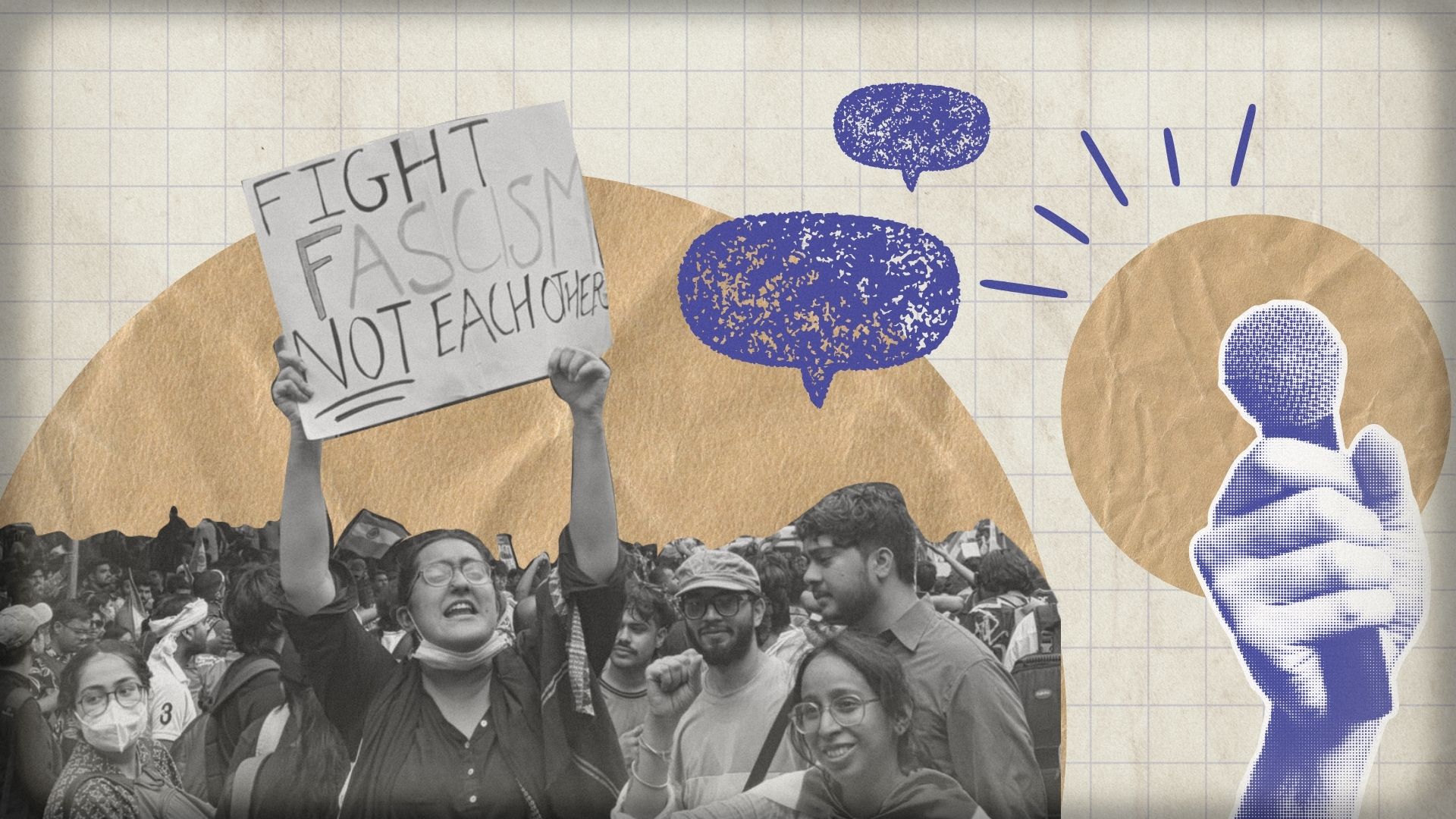
The air is thick with chants of change and hope. Across India, young people are gathering in streets, district headquarters, university campuses and village squares. There was a fast. Then came the furious.
They are demanding resignations and answers over exam leaks also that which has felt increasingly absent from public life: accountability.
This is the first pan India protest since the 2019–20 anti-CAA movement which, with Shaheen Bagh as its centre, spread far and wide and became an expression of resistance around constitutional rights, citizenship and state power.
Over the past year, as youth-led movements in Bangladesh and Nepal unsettled governments in very different ways, a familiar question surfaced in Indian conversations: Where is India’s Gen Z? They were there all along – in Rohith Vemula’s own resistance against the casteist educational system and the subsequent movements led by BAPSA that followed after his death; in the voice of Anitha, the Dalit student who mounted and a legal challenge against NEET, the very issue at the heart of these protests; in the progressive student politics in universities challenging neo-liberal and casteist policies among others.
It is also evident in the youth who, failed by the system, became gig workers to fund their education and life choices. The resistance is offered everyday by Shanti Sharma and Tanu Duhan and the many young women in Haryana who failed by the recruitment system on the one hand and the pressure of marriage on the other, sit in public libraries everyday in the hope of writing that one exam that would land them in a government job.
Today, they have coalesced in Jantar Mantar, and in adjoining parts of central Delhi, and also started their own ones on the streets of Patna and Katehar and villages such as Artiya Kurd in Jodhpur district.
The forms of protest are unmistakably Gen Z – memes, reels, ironic placards and livestreams but it would be amiss to contain it or define it as just that. What these young protesters are reviving is an older political language, that of citizenship as a relationship of rights and accountability, of the social contract between the state and its citizens. This is remarkable at a time after years in which public debate has been dominated by identity, nationalism and polarisation. The spell is broken. One only has to spend 10 minutes at a protest site or march around the digital alleys to glimpse this reckoning. Sample these: “Modi hatao, India bachao” or “Modi jab jab darta hain, Hindu-Muslim karta hain”.
This praxis of resistance and citizenship is also embodied in the labour of the protestors and sanitation workers who are cleaning up the sites, in the gig workers who are braving through the barricades and possibly potential time losses to reach food and supplies, in the transport workers who are ferrying the protestors, sometimes free of cost, in mobilisers who are ensuring people are fed and cared for and erecting Walls of Shame to hold the police accountable. It is rooted in the care of those who cannot be present by sending them food and water and other essentials.
That language is especially significant today. At a moment when citizenship itself is being contested through exercises such as the Special Intensive Revision of electoral rolls, and after more than a decade of deeply divisive politics, these protests signal an assertion of substantive citizenship. The demands extend beyond examinations to questions of unemployment, informalisation of labour, shrinking social protections, rising living costs, corruption, and the erosion of public institutions.
A New Public Sphere
This moment carries a significance that extends far beyond what was immediately visible. Beyond the police violence unleashed on peaceful protesters, the state’s deployment of surveillance technologies, and the abdication – often outright collaboration – of much of the television media, the protests revealed something else. They marked the emergence of a new public sphere. In the vacuum left by institutions whose responsibility it was to bear witness, independent media platforms such as Peek TV, The Polis Project, The Caravan, Scroll, etc, alongside countless independent journalists from English and regional language media and citizen journalists, stepped in to investigate and archive the moment to be seen, remembered, and contested.
The protests also belong to a generation that challenged the prevailing culture of fear and political conformity through their irreverence in the face of authoritarianism of the Modi government forcing the Prime Minister to address them, in a vertical camera angle – breaking a decade and a half practice of never responding to public questioning.
Above all, however, this is a moment of profound political education and consciousness, carrying forward the moral and political vision articulated by Dr. BR Ambedkar: Educate, Agitate, Organise. It is evident in a class 9 student who asked why, when her civics text book mentions that democratic government is a more accountable form of government, is the government not doing its job.
From Centre to Margins
The work, then, is not just to resist the temptation of making it the Delhi story or about the leadership of the Cockroach Janta Party, but to understand the significance of the moment as a much longer continuum of resistance – one that is shaped as much by students on university campuses as by the women in Ramabai Nagar in Mumbai resisting their evictions, workers in Patna’s neighbourhoods, Adivasi communities resisting land acquisition, or families demanding accountability after custodial deaths. These struggles may not look identical, but they are connected by the structures. As Audre Lorde reminded us “There is no such thing as a single-issue struggle because we do not live single-issue lives.”
How do moments such as protests become movements? Arguably movements are built through organisation, relationships and infrastructures that endure after the headlines fade. If this mobilisation is reviving the language of accountability and rights, its future depends on whether that language can travel beyond examination failures to encompass the right to education, dignified work, social security, public institutions and democratic accountability. That, in turn, demands alliances across student groups, workers, farmers, women’s organisations, disability rights advocates, anti-caste movements, environmental struggles and communities resisting displacement. These are not separate constituencies but people confronting different expressions of the same unequal distribution of power.
Such solidarities require confronting the fractures of caste, class, gender, religion, region and language – and recognising how these shape both political priorities and access to the state.
Looking at them together also changes the questions we ask. Instead of asking whether one protest matters more than another, the more pertinent question is why our information ecosystem compels these false choices. Why do we treat each protest as an isolated eruption instead of recognising the cumulative force of interconnected struggles against exclusion, dispossession, caste, patriarchy, surveillance and state violence?
For journalism, this means sustained shining the spotlight on the structures that exclude, the capital that drives the state’s logic of dispossession, and the policies that aid this precarity. This means showing how when a domestic worker has to work harder to earn enough to send her child to a private school with few chances in a shrinking job market, the interconnectedness of rollback of public education and increased privatisation are deeply linked with questions of labour rights.
Our job is also to spotlight the organising that continues in bastis, campuses and small towns; the solidarities that travel across movements; and the ways the state hardens its responses through surveillance, retaliation and increasingly predictive forms of policing that will inevitably fall hardest on already marginalised communities for whom these are everyday.
If these protests are a sum of many struggles rather than a single event, then our reporting must also learn to hold that sum together – to see continuity where news cycles see fragments, and to recognise that today’s mobilisation is inseparable from the many unfinished fights that made it possible.