
Postcards #15: Gold And Gardenia
This month in Postcards: the sweet Mallika, books and bees, charnel houses, and more

Younger me gobbled up books at lightning speed but somewhere along the way, I stopped reading. It was replaced by friends, sleep, academic submissions, and a neverending pile of to-dos.
So you can imagine my joy when I stumbled upon a treasure trove of my childhood favorites!
Hidden underneath a pile I found The Why Why Girl, a playful picture book my father read to me as a child. The story is about a girl who questions everything around her, never leaving any stone unturned. Pointing to the book, papa would tell me, “Remember to always ask why. Never assume things are as they are. Be curious about the world and about yourself.” I hold his words and this book – which taught me to explore and question without fear – close to my heart even today.
The second book my eyes drifted to was My Side of the Mountain. It is a story about a boy who runs away from his city home to survive in a nearby forest and through the year, he learns to carve a house inside a tree, make jams and pickles, befriend hawks. He realises, over time, he never wants to leave his mountain – it is where he belongs. The ways of the city now seem foreign to him. Flipping through it, I found myself back in the jungle where I grew up, with only the sound of chirping cicadas and the flowing river.
I smiled, and placed the book aside. Suddenly, my eyes caught a glimmer of gold – it was a copy of The Secret Life of Bees, a book that has gotten me through thick and thin. The story is set just after the civil war in the US and follows a white girl who runs away from her house and lands up in the home of three black sisters and beekeepers. It is here that she learns how to forgive, how to stand up with courage, how to love, and how to mend and build community that transcends the artificial boundaries of this world. She learns that sometimes, the hardest thing on earth is choosing what matters.
These books bring me back to myself, reminding me to love, to question and be gentle even when everything feels like it’s falling apart. In the words of August Boatwright, “Send the bees love. Every little thing in this world deserves to be loved.”
Anjali

Trudging up the steep slopes of Hallstatt, the postcard-perfect UNESCO village tucked into the Austrian Alps, I found myself at the Beinhaus – the Bone House. “A must visit,” declared the Lonely Planet. Every instinct in me resisted the idea. Displays of skulls and bones had never fascinated me – not as memorials to past horrors, or as relics of history. What, after all, is the pleasure in staring death in the face?
But I had an entire day to spare, and the salt mines, the real reason I had come to Hallstatt for, were closed for renovation. So, reluctantly, I wandered in.
The first thing I encountered were the graves outside: beautifully tended, nothing like the cold slabs of stone that crowd cemeteries elsewhere. These were wooden graves with little canopies, with beds of flowers. Spring was in full bloom, and the place felt like a scene from a Hans Christian Andersen tale.
Inside, skulduggery took on an entirely different meaning.
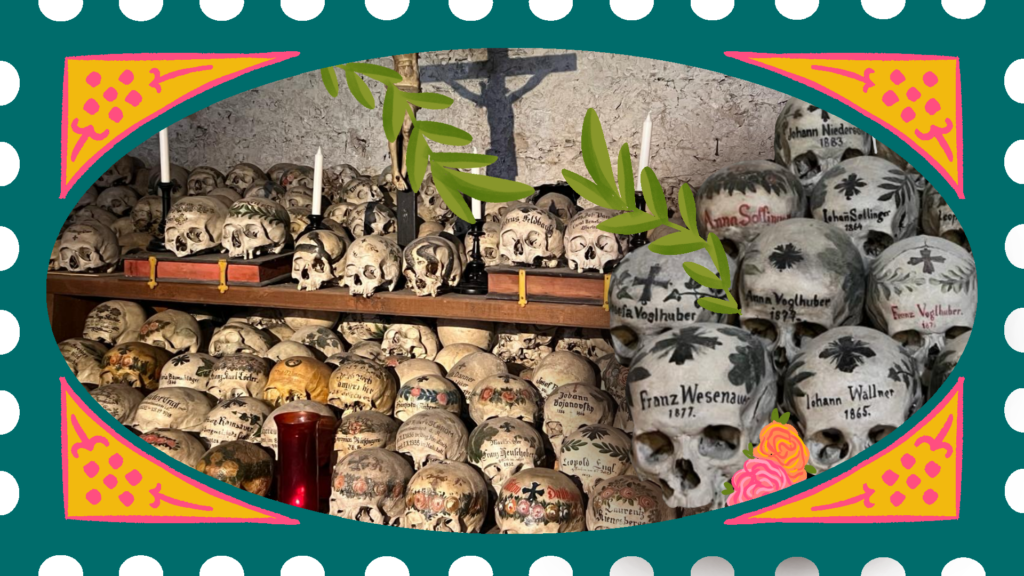
The charnel house – its name derived from the Latin carnes, meaning flesh – held rows upon rows of painted skulls, carefully arranged on wooden racks. Beneath them lay stacks of bones, neatly ordered. The room whispered love and care.
In a town where space was scarce, the practice began in the 18th century. Families would bury their dead, and after fifteen years exhume the remains. The bones were cleaned, the skulls painted with flowers and vines with Latin inscriptions – sometimes chosen by the deceased, sometimes by those who loved them – and then placed reverently in the Beinhaus. The most recent skull belonged to an elderly resident of Hallstatt who had wished to join the others after her death. She had a gold tooth, which gleams proudly among the painted petals.
This act of remembrance was shaped equally by necessity, sustainability, and love. In making space for the dead, the living also made space for one another. Here, there is no permanent resting place. Land and memory are shared. In a world obsessed with private property, legacy, permanence, and accumulation, the Bone House offers another imagination of community – one where faith sits comfortably with practicality.
And strangely, that brought joy!
Bhanupriya Rao
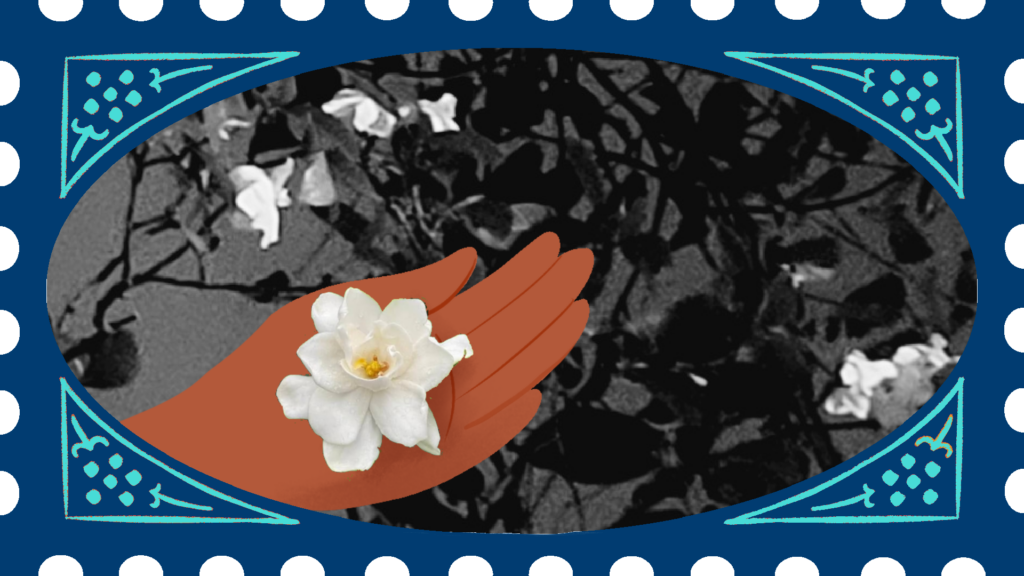
Against all climate odds, the sole gardenia (called a more lyrical ‘gondhoraj’ in Bengali) that stands in my balcony has decided to flower. The spring that arrived in Delhi two months ago seemed like summer. And briefly a weird Delhi summer was here with rains, cool breeze and mellow temperatures, it was sprouting buds and flowers, throwing itself out of the railings in its display of enthusiasm.
The gardenia came to me around 15 years ago. A friend was leaving Bangalore for foreign shores and some dozen plants were going to be orphaned. He offered to truck them to Delhi and I welcomed them home after three days of exhausting road travel, looking quite frazzled. These were once shiny Bangalore-happy plants, used to balmy sunshine and drizzles. Their new moorings were hellish – either freezing cold winters or searing hot summers. About half of them perished in the first year.
But you have to hand it to the tenacity of those that survived. I did not know that the gardenia was, well, a gardenia. It was just another Bangalore import, rather non-descript and it never flowered for about 12 years. Then sometime during the pandemic, it revealed its first blossom, creamy white and many layered. Google Lens told me it is gardenia, which I thought only grows in the gardens of honeysuckle cottages in the west.
It was incredibly, headily fragrant, bruised easily and had a very fleeting lifespan – a day, at most two. Since then it has flowered once a year – sometimes twice if it is in the mood – scattering the balcony wall with its short-lived effulgence especially at night. I keep a hawk eye on its precious comings and goings. Neighbours passing down the lane remark on its arrival. A friend who is superstitious tells me I should hang a nazar battu on it and I might just.
Malini Nair

The Prime Minister this week asked Indians to refrain from buying gold for a year. Did you know the Sun cannot make gold? Most stars cannot. Fusion inside stars builds up lighter elements – hydrogen into helium, helium into carbon, carbon into oxygen – and runs out of energy long before reaching anything as heavy as gold.
Gold requires two neutron stars to collide.
A neutron star is what remains after a massive star dies – a city-sized object so dense that a teaspoon of it would weigh more than a billion tonnes! When two of them spiral into each other, which happens in a galaxy our size about once every hundred thousand years, they detonate in a brief and very specific kind of fire. Astronomers call it a kilonova. A single one can forge ten Earth-masses of gold in a few seconds.
In 2017, humans watched this happen for the first time. Two neutron stars 130 million light-years away sent a ripple through spacetime that arrived on Earth as a hundred-second chirp in a gravitational wave detector. Telescopes around the world swung to the spot in the sky and found the afterglow of a fresh batch of gold, platinum, uranium, and iodine drifting out into the galaxy.
This cosmic fire forges most of the universe’s gold. Every gold ornament we have ever held was made this way: in the collision of dead stars billions of years before Earth existed. Most of the gold that arrived with our young planet sank into its molten core, out of reach forever. The gold we mine today reached us later, carried by asteroids that rained down on the cooling crust long after it had hardened.
All this to say, I am finding the news more tolerable from thirteen billion years away.
Pallavi Prasad

As a child, I thought all mangoes came from Raigad. Every summer vacation our family would get free petis of Raigad Hapus from relatives living in Konkan. Those boxes would arrive packed with hay and the whole house would slowly start smelling like mangoes before we even opened them properly. Honestly, Hapus was the only mango I knew. I thought that’s just what mangoes were supposed to taste like. Summer felt incomplete without it.
Then slowly the excitement disappeared.
The petis became fewer. Some years they didn’t come at all when relatives faced losses. Hapus also became expensive, and oddly unreliable. So many times the mangoes we bought looked perfect outside but were spoiled on the inside. We still bought them out of habit at that point, but the fun was gone. Mongabay reported last year about this, about what’s happening to Konkan Alphonsos. Heatwaves, unseasonal rain, and unstable temperatures are hurting flowering and fruit development. Farmers are seeing early fruit drop, lower yields, and inconsistent quality even when trees flower normally.
It was last week when out of curiosity I stopped near this wholesaler selling mangoes in a temporary roadside setup. Big piles of mangoes laid over hay under a blue tarp. Banganapalli, Dasheri, all kinds. The place smelled insanely sweet. I was standing there, confused, and suddenly there were too many mangoes. But I noticed people repeatedly going back to one pile. It was the pile of Mallika, a variety that is a hybrid of Neelum and Dasheri. I bought some too. And honestly, I haven’t recovered since.
Mallika tastes absurdly good. It’s as sweet as honey but also so juicy and citrusy. It is deep orange on the inside exactly like the mangoes I used to draw as a kid with crayons. And it’s cheap too. I’ve gone back three times already which is very unlike me, and I’ve been eating two mangoes a day. I think I’ve accidentally become a Mallika fan now.
Urvi Sawant




We believe everyone deserves equal access to accurate news. Support from our readers enables us to keep our journalism open and free for everyone, all over the world.
