
Postcards #14: Playlists And Photo Albums
This month in Postcards: Asha Bhonsle serenades, Hans Zimmer soars, and more
Dear reader, we write to you about the people, places, and ideas that brought team BehanBox joy. This month: a selection of audio and visual keepsakes from our playlists and photo galleries that provided relief in the tempestuous month of April. We hope they stir and soothe you too.


Koorni, a white-and-brown cat with a small face but large eyes, lives in a dusty teashop in Chenoli, Kozhikode, surrounded by old men who feed her ayala and mathi. Perhaps the highlight of her day is the evening arrival of the local fisherman, who drives a noisy rickshaw that is heard
30 seconds before it is seen. Almost instantly, Koorni is in and around the legs of the people gathering around the fisherman, before leaping to grab the fish thrown at her. Of late she is not as acrobatic since she is expecting (her third pregnancy in the last eight months!).
I like to think that a second, though lesser highlight of Koorni’s day is my arrival at the teashop. Sometimes, she will rub her sides against the spokes of my bicycle wheel, let me pat her a few times, and listen to me talking in my made-up cat language.
Then she goes back into the refuge of the teashop.
Ananya Das

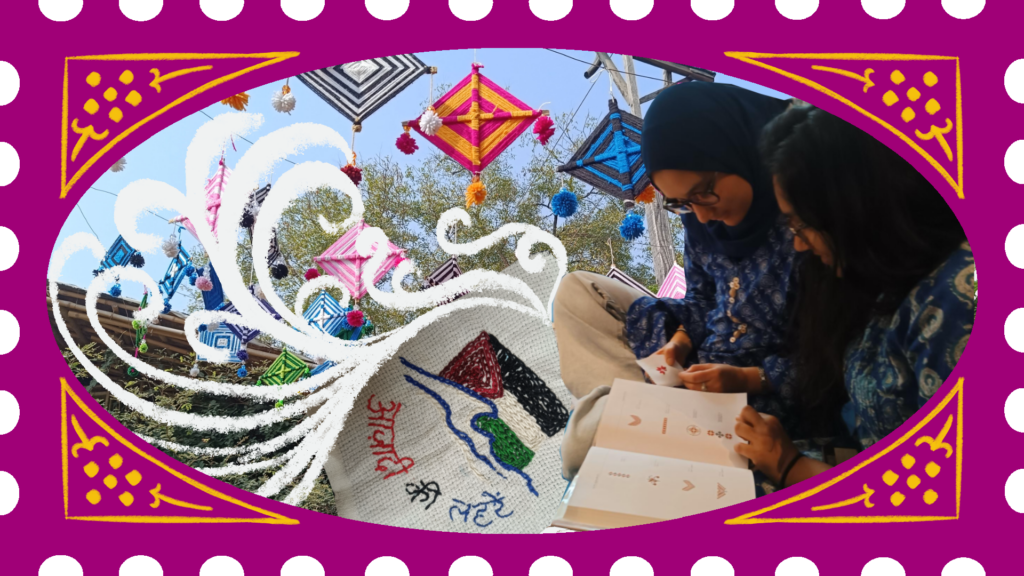
In and out, in and out, cross over the top… my fingers worked slowly but surely to guide the twice-looped, crimson thread through the checkered fabric. Around me, an exciting hum of crickets, children playing badminton, and juicy gossip flooded my ears while the sky turned a stunning shade of salmon pink and yellow between the trees in Munirka park. It was the perfect place to stitch together a reminder of love, possibilities and freedom for a dear friend.
Working with my hands has always made me feel calm and most at home with myself. Growing up, I picked-up a new craft every few months – origami, crochet, quilling, patchwork, papier-mache, pottery, carpentry, oil painting… But somewhere along the way, I stopped giving time to my hands. My world began revolving around screens and books.
Then, two years ago, during my Masters, I stumbled across embroidery again – this time, inside our student encampment for Palestine. A Palestinian organisation came down to the camp to teach us tatreez – a form of cross-stitch embroidery that weaves together stories of the Palestinian land, people, martyrs and memories. I spent the day ruminating over intricate pieces woven by Palestinian women to document memories of their families and of freedom, as they waited for their loved ones to return from prison.
The next day, I sat with some felt, thread, and a needle, and stitched together a piece for my grandmother with the tatreez techniques I learnt. Using my hands again was cathartic. I could feel my emotions, thoughts, and the heaviness of the world flow through my fingers. The fog in my mind cleared and the cloth in front of me transformed into a story.
A year later, I felt this again when I visited my school in Pune. The children had hung beautiful hand-made thread decorations around the school, creating a colourful mosaic of shapes and patterns in between the green mango leaves. I sat on the swing under the trees for hours as I made my own decoration. In that moment, everything was still, and anything was possible.
Stumbling upon these pictures in my gallery, this year I have promised myself that I will breathe life back into my hands.
Anjali

The first time I heard the song, I was hunched over on my hostel bed, racing to finish an already late assignment. A wistful alaap, followed by those ordinary words: “Mera kuchh saaman tumhare paas pada hai.” What followed was extraordinary.
My roommate Vandana had a ritual. Every evening, between eight and nine, she would tune in to All India Radio. We both loved old Hindi film music, and though she owned a Walkman, this shared listening to of melodies became ours.
“Is it Gulzar?” I remember asking, newly enchanted by his ability to turn the most ordinary objects into feelings and poetry.
“Saawan ke kuchh bheege bheege din rakhe hain,
Aur mere ek khat mein lipti raat padi hai…
Woh raat bujha do, mera woh saaman lauta do.”
It slowly revealed itself as a song of heartbreak, of longing, of memories. Years later, when I finally watched Ijaazat, also directed by Gulzar, and understood the context, the song only grew more luminous. It was Asha Bhosle’s voice.
In the film, Maya writes to her former lover, now married, after receiving a parcel of her old belongings. The letter becomes the song. Can memories of a shared past ever be packed and returned? Are there perfect closures? Maya does not accuse, resent or demand. She just asks.
“Geela mann shayad bistar ke paas pada ho
Woh bhijwa do… mera woh saaman lauta do.”
There’s a story about when Gulzar first showed these lyrics to RD Burman, he scoffed. “Where is the meter in this? Tomorrow you’ll bring me a news item from The Times of India and ask me to compose it.”
But then Asha began to hum, “woh bhijwa do…”and suddenly, the song found its shape, its pulse, its soul.
This weekend, with the news of her passing, I found myself returning to this song again and again. To define Asha Bhosle by any one song, genre or moment is impossible; her voice traveled across decades, moods, and styles with effortless grace.
And yet, for me, it always comes back to this song. This perfect confluence of poetry, composition, and voice.
Bhanupriya Rao

It was early spring but the landscape of Tilonia in Rajasthan had already turned drab and colourless under the searing sun – full of baked clay, scrub brown and dry sage. Till the ajrakh arrived on the scene that is, in a riot of earth colours – fuschia, ink purple, blue, maroon, dust red, washed greens and teal, brown and beige and in geometric motifs — draped with careless swagger across the shoulders of Langa and Manganiyar musicians.
I was there for the remarkable Lok Utsav folk festival held by the Barefoot College which brings Rajasthan’s musicians together to perform, talk and demonstrate their art. And I spent as much time soaking in the music as gawping at the ajrakh drapery the men sported.
I have been a handloom nut since high school when my friend Sirisha introduced me to the joys of shopping for yardage at the state emporiums. Back in the 1980s — when large chunks of the emporia had not been given away to private players — they held delightful treasure troves for those who love loom work. There was Lepakshi with its gorgeous Pochampallis, Poompuhar with Chettinads, and of course Gurjari with its Kutchhi embroidery work that, along with the jhola, was the staple collegewear for many women then.
I discovered the incredible gorgeousness of ajrakh later in life, and though it is now ubiquitous, I still gasp at its colours and motifs and how much they mirror the Islamic art work on the splendid Mughal structures that dot Delhi. Take a look at the roof of the Jamali-Kamali tomb in the Mehrauli archaeological park for instance. It makes you wonder – did the Khatri craftsmen draw inspiration from this architecture or did the architects recreate the patterns of this unique dyeing technique common to both Sindh and Kutch?
One bright morning I ran into a group of Langa musicians slowly making their way down the bouganvillea-dotted campus, in starched whites with swathes of ajrakh fabric flowing off their shoulders. It was almost like a tableau set for a photo shoot. And I must admit I had a hard time resisting the urge to grab those ajrakh stoles and run home.
Malini Nair
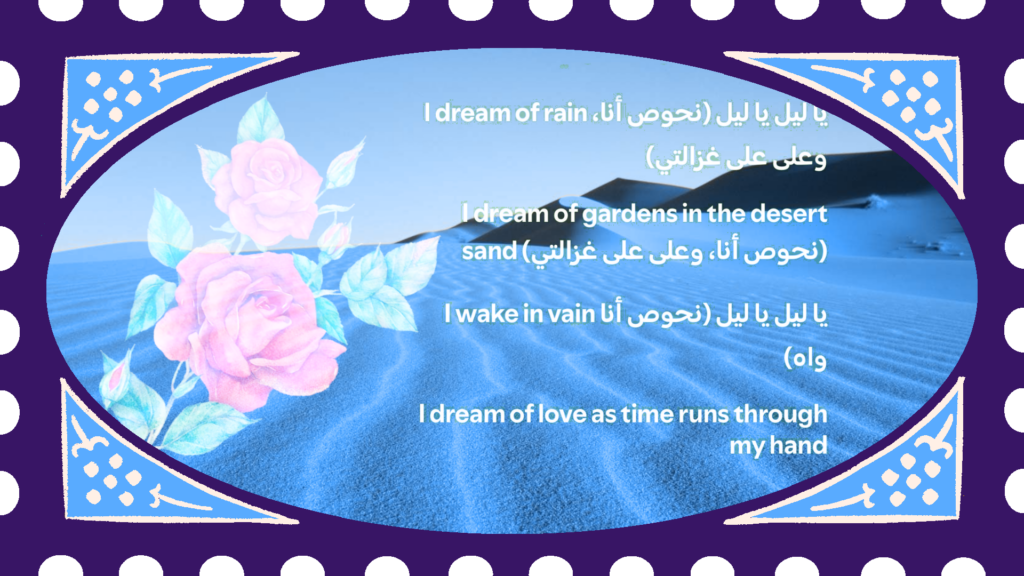
I don’t know when ‘Desert Rose’ became a song I return to rather than a song I just like. No decision was made. Some phases of restlessness have a soundtrack and this one keeps showing up, in autorickshaws, on late walks, and in that 1am window where the day’s work is done and my brain isn’t ready to stop yet (last night).
Cheb Mami’s voice is most of it. He does the thing the best ghazal singers do where you can’t tell whether the feeling is sacred or romantic and it doesn’t matter. I know that register from somewhere older than pop music. My body recognises it before my brain catches up. The Arabic lines aren’t subtitled or footnoted. You either feel them or you don’t. I do.
Then there’s what Sting is actually saying. I dream of rain, I dream of gardens in the desert sand. He’s dreaming of rain; not just the garden – the precondition. The thing that has to happen before anything can grow. That’s the kind of want where you know you are several steps away from the thing you are reaching for and you haven’t taken the first one and you are still reaching. The song never gets past it. This desert rose, each of her veils a secret promise. This desert flower. No sweet perfume ever tortured me more than this. He keeps circling the image without holding it. I have listened to this song maybe four hundred times. It has never once resolved; I have never once minded.
Zimmer’s ‘A Time of Quiet Between the Storms’ from Dune: Part Two is perhaps the only other piece of music that lives in the same place for me. It plays over the part of the film I rewatch most: the desert is just the desert, Chani is teaching Paul to walk without rhythm, they share water, the light is absurd. Both pieces of music seem to know the same thing. ‘Desert Rose’ knows the garden isn’t coming. Zimmer’s track knows the war is. And neither lets that knowledge cheapen what’s here right now.
I have tried, many times, to find other songs that do what these two do. Nothing comes close because most music that soars is trying to arrive somewhere, and these two just soar. They make the wanting itself soar. The ache, instead of closing down as it often does, opens up. Mami’s voice climbs, Zimmer’s woodwinds swell, and for a few minutes the distance between where I am and where I want to be is not a problem to solve. It’s the whole sky.
Pallavi Prasad

It’s the sort of song that you see before you hear. Somewhere in Paris, some 20 years ago. The Norwegian acoustic duo Erlend Øye and Eirik Glambek Bøe are on stage in a soft glow. Fingers snap to give a rhythmic texture, chords strum delicately, and intimate, whispered voices rise in classic Bossa Nova fashion. They reach the chorus, and ufff. The audience’s shouts and murmurs give it away. The singer Feist comes jaunting, finishing the chorus, her voice adding a spirituality quality to the melody.
Oh, what is there to know / Oh, this is what it is / Oh, you and me alone / Sheer simplicity.
A smile builds up on my face. And everyone else’s.
‘Know How’ is not Kings of Convenience’s best song, or even the one I’ve listened to the most. I found it a decade ago, maybe earlier? But that’s of little relevance, because it is the one that has lingered most faithfully in memory.
It feels like a hug from an old friend, the sun on a spring morning, like coming back home after a vacation. It sounds the same every time I return to it, evoking the familiar warm, fuzzy feeling at the precise moment, when Feist pops in the frame. The spring in her step, the joy in their voice, life feels just a little sweeter. The heart knows what to anticipate: when to leap and how to mellow down. It is life in a minute.
Then you go to YouTube comments and see others have sought this warmth too, so many times over the last decade. “This video is like my home on YouTube”, one says; “I come here so often, please never delete this,” followed by another.
A song has so many lives, doesn’t it? One of those times one feels grateful for the internet. Sheer simplicity.
Saumya Kalia
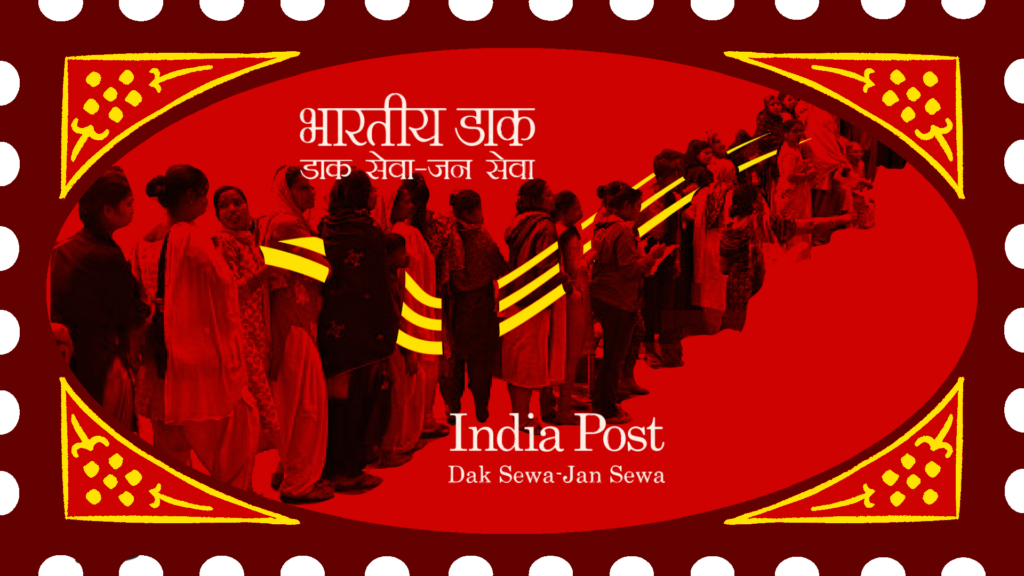
My dad and I reached the JK Gram Post Office by 10am to withdraw money. It was a once-in-five-year visit and my first time accompanying him there. After wandering around a bit, we finally found the small, worn-down building tucked behind a mall, which also doubled up as a BJP karyalay. As we walked down a slope lined with big, flashy Raymond ads, the old post office slowly came into view, sitting right beside a garbage dump.
We stood outside waiting for our agent, Jayu Kaki, without whom getting any work done here felt impossible.
Inside, the post office was packed. Mostly older grandparents, daily wage labourers, ASHA workers, and women managing their household expenses stood in long, unmoving lines. In the Mumbai summer heat, everyone seemed to have already accepted that this would take at least three hours. Still, in between the waiting, people helped each other fill forms and passed around pens.
Just then, an old couple walked out, mid argument with an agent explaining a senior citizen scheme. “Never depend on your children, we can only take care of ourselves. You tell me the scheme after lunch on the phone,” the man said, clearly irritated.
By then, Jayu Kaki had arrived. As she helped me fill my form and guided me into the withdrawal line, she stopped to greet a domestic worker. The woman had come to withdraw what seemed like her last savings. “I am leaving this man. He took loans in my name to open a tea stall and ran away with that woman. Why should I waste more money? Always on his phone, how will he run a business like this?” she said.
“Aye baba, if you are leaving, do a proper divorce and free yourself. Why should you give up on alimony? That is your right. I will talk to a lawyer for you,” Jayu Kaki replied, without missing a beat.
We were interrupted by an ASHA worker who had rushed in from a school to send her daughter money for college. We let her go ahead, and she thanked us quickly before stepping into the line.
Time moved slowly. After about twenty minutes, the line shifted a little. I watched Jayu Kaki move constantly, from one counter to another, helping people fill forms, speaking to staff, negotiating small but important things on their behalf. Around her, other women agents did the same. If one was busy, another stepped in without hesitation.
“If I point out their mistake, she doesn’t like it,” Jayu Kaki said, laughing, after a quick exchange with the strict post office madam.
I just stood there, watching her, a little in awe of how she managed to stay both kind and firm through all of this. When I asked her how she does it every day, she laughed. “Ek kana ne aikaycha, dusrya kana ne sodun dyaycha. Manala lagun kahi nahi ghaycha (You hear from one ear and let it go from the other) Never take it to heart. It’s been 25 years working with government employees, I am used to it now.”
Even after she said it so casually, I kept thinking about it. About how she, and so many other women like her, negotiate with the system every day. The long lines, the sharp tones, the small humiliations, and still they keep things moving.
With more waiting, some complaining, a bit of banter, and Jayu Kaki slipping in life advice about becoming financially independent, we finally managed to finish the one task I had come for.
Urvi Sawant



We believe everyone deserves equal access to accurate news. Support from our readers enables us to keep our journalism open and free for everyone, all over the world.
