
Precarity, Pain, Protest: In West Bengal, Muslim Women’s Citizenship And Identity Are On Trial
Women lose out on wages and political identity as they navigate a Kafkaesque, patriarchal SIR process in West Bengal
- Sanhati Banerjee
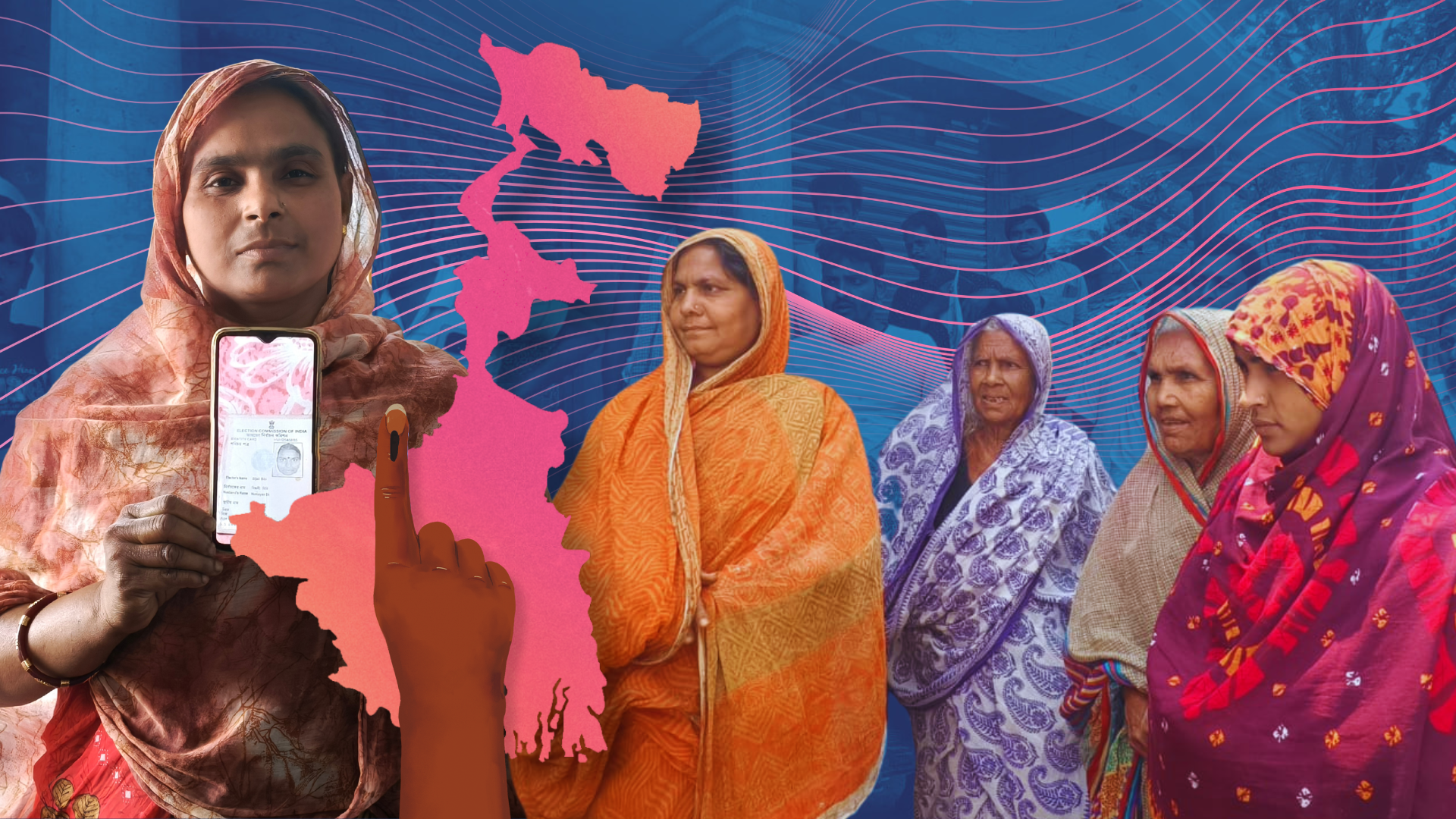
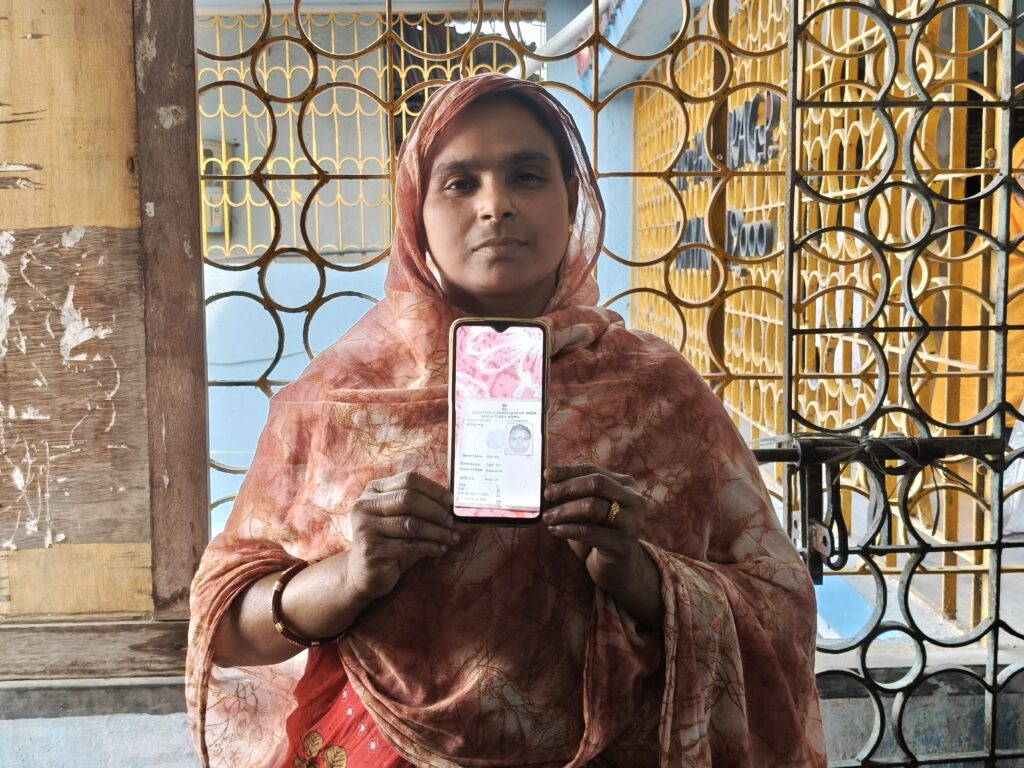
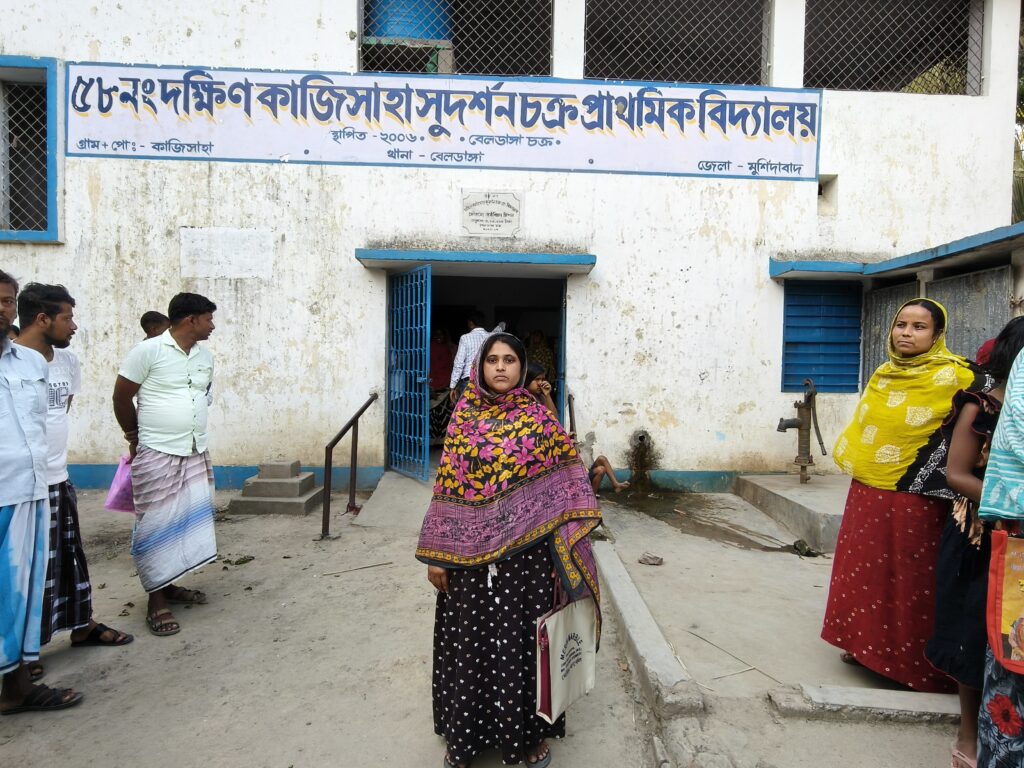
AGAINST THE APRIL SUN, with dusk impending, Selina Bibi sits restless, tired of proving that she belongs. She clutches her documents inside the Kazisaha Primary School in Beldanga, about 40km from Berhampore, the administrative headquarters of Murshidabad. Alongside her are hundreds of women, mostly overworked and underpaid bidi labourers who have taken time that they cannot afford, off work.
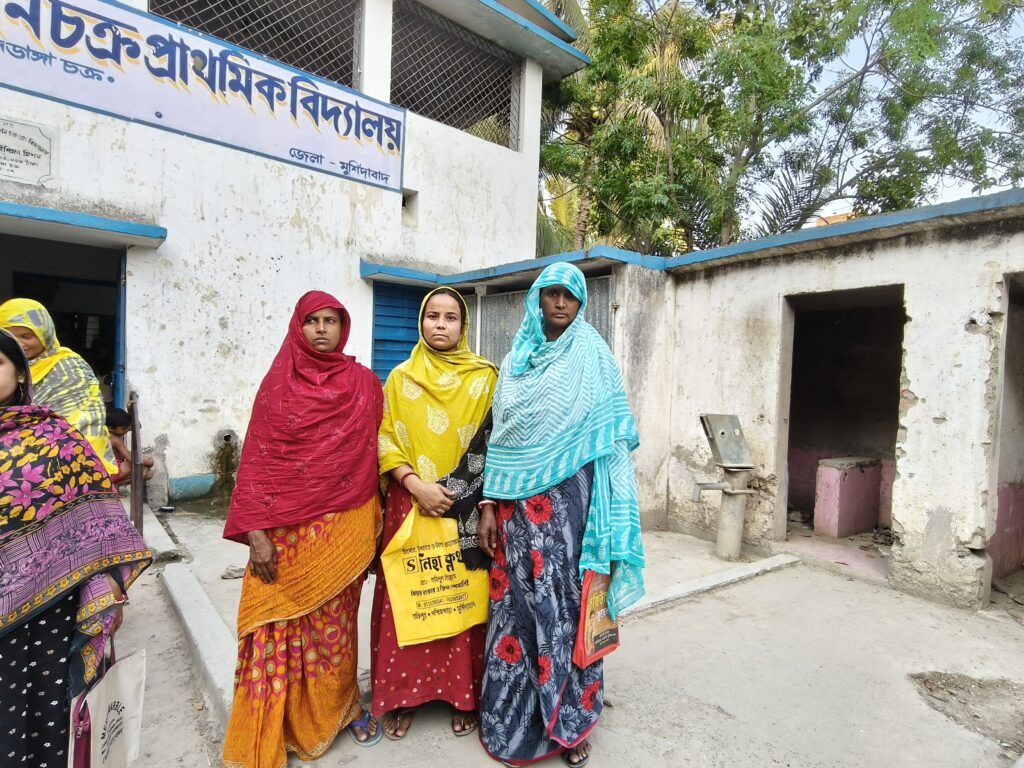
They are all at the government school to contest the deletion of their names from the voter list in West Bengal during the Special Intensive Revision (SIR) – a process that was drawn over five months as we wrote here.
“How many times should we prove that we are from here? Tell me that first. We submitted our papers three times. Still nothing has happened. If I keep running from work like this, how will we eat?” asked Selina Bibi. She earns around Rs 400 a week, in three instalments, and has to support her family of five, including her husband who does household work and fishing.
This is her third visit to deal with the electoral roll crisis. First in December 2025, when the ECI published the draft electoral roll’s initial deleted voters list where nearly 58 lakhs were struck off, and her name was missing; second, when the Booth-Level Officer (BLO) collected her documents again; and third in early February at a designated hearing where she was asked to re-submit documents once more The opaque, prolonged process over five months is part of the SIR exercise, conducted by the Election Commission of India (ECI) and meant to correct duplication and errors. On the ground, it has pushed thousands into a grey zone where their status as voters is in a democratic limbo.
Across West Bengal, nearly 91 lakh voters have been deleted (or under adjudication), with 27 lakhs permanently deleted from the electoral rolls in the run up to the April elections. While Muslims constitute around 27% of West Bengal’s population, according to the 2011 Census, the second-largest Muslim population state in India after Uttar Pradesh, they represent more than a third of those deleted. Murshidabad, with 66% Muslim population, alone accounts for over 4.5 lakh deletions.
Almost 61.8% of voters who were deleted or are under adjudication are women, according to data released by the Kolkata-based non-profit Sabar Institute, which works on public-interest data analysis.
Muslim women in the state are navigating an alienating process amidst a larger alienation that the community faces across India. In West Bengal, which shares the border and language with Bangladesh, the alienation is built around ‘illegal infiltration’. The Union Home Minister Amit Shah pledged that after the Bharatiya Janata Party’s victory in Bengal, the first task would be to ‘drive away the illegal infiltrators using the “Detect, Delete, Deport” formula. Prime Minister Narendra Modi at a rally in Birbhum in April 2026 declared it his “demographic mission” to weed out “ghuspaithiye” or ‘infiltrators’– referring to the citizenship of Bengali-speaking Muslims.
The SIR in Bengal is tied to its unique history of Partition in 1947, which unfolded differently from Punjab, explained Anwesha Sengupta, Assistant Professor, Institute of Development Studies Kolkata. The overlapping waves of migration across porous borders – for food, work, survival, and a shared language and culture – was the norm rather than the exception. “For a long time, the border functioned less as a rigid divide and more as a socio-cultural and economic zone,” she said. “What was once a fluid history of movement and belonging is now being reframed through policy in ways that can exclude.”
Why is this mobility being problematised now? The partition as a political tool, said Anwesha, has legitimised the ‘infiltrator’ narrative, allowing it to shift from mere rhetoric into formal administrative processes such as the SIR where they acquire material consequences.
From Kazisaha Primary School’s stifling classroom in Beldanga, BehanBox travelled to Taranagar on the Padma riverbank, Lalbagh near Ranjit Para’s Darul Huda Madrasah, and Samsherganj roads, and spoke to more than 30 women – including bidi labourers, mothers of migrant sons, and those whose homes are frequently swallowed by the Padma.
The SIR has unfolded, in this context, as an administrative exercise that is patriarchal and exclusionary, demanding time, presence, and documentation – all resources rarely available to women – as we explain later. In our interviews, we found pain and precarity, fear and fatigue, as Muslim women navigate the burden of proving citizenship amidst the BJP promise of a Hindu Rashtra. Women must prove they belong to a country whose climate stress is displacing them, whose extractive economy has failed to generate formal jobs, and whose politics is shrinking the definition of who counts as a citizen.
As West Bengal heads to the second and last phase of its assembly elections this week, another bidi labourer, Parbina Bibi, raised a question: “If our votes built governments, why are we being pushed out now?
Gender Bias In SIR
Beldanga sits at the heart of Murshidabad’s electoral battleground. Last December, suspended Trinamool Congress (TMC) MLA Humayun Kabir proposed a Babri Masjid-style replica mosque at Rejinagar, laying the groundwork for what has been called the “Bharatpur-Rejinagar-Beldanga arc” that created fears of the Muslim votes being fragmented. But amidst these unfolding party politics trends, women at the Kazisaha Primary School describe SIR as the most alienating political arc of their lives in present-day West Bengal.
While women make up more than half of the deleted voters in over 88% of the constituencies, the deletions are concentrated among women in constituencies with large populations of marginalised communities, including Muslims, Scheduled Tribes, and Matuas, per the data. Murshidabad (with six constituencies) and Malda (with four constituencies) – both Muslim majority border districts – alone accounted for the highest number of women voters removed, with a combined total of 4,61,257 deletions.
“Ami ei gramer i beti [I am the daughter of this village],” said Nayantara Bibi, who works as a bidi labourer in Beldanga. “My family has lived here for seven generations. If my name is not recognised, what will happen to my children?”
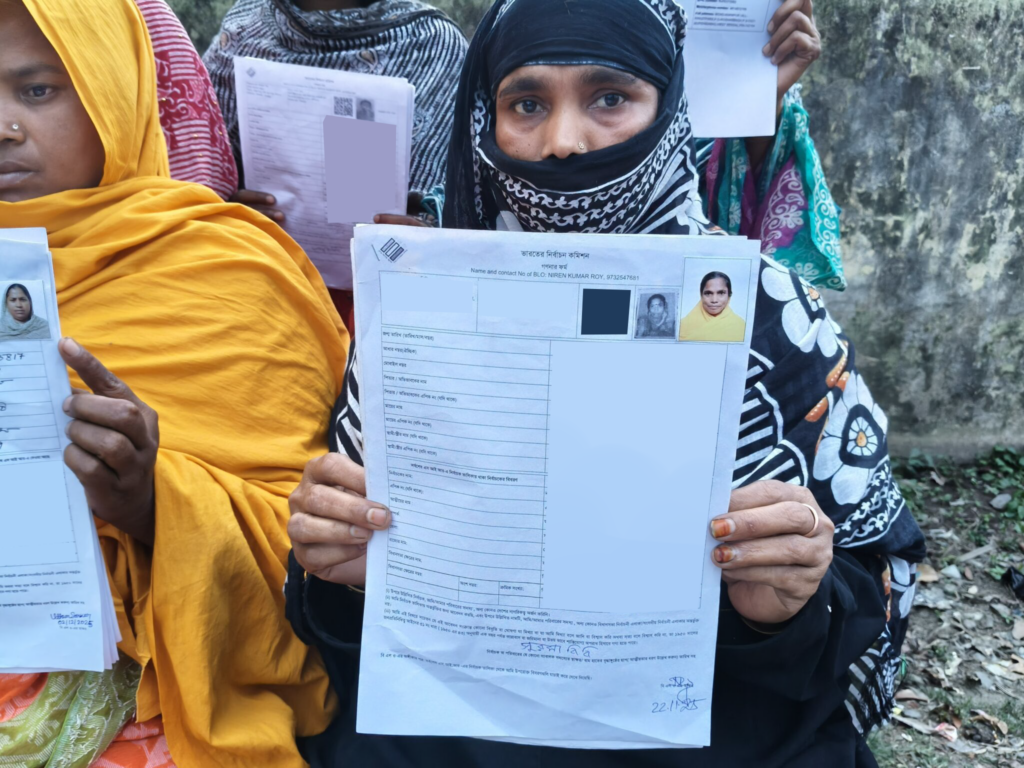
The SIR relies on the presentation of documents and legacy linkage, proofs women often lack due to early marriage, migration, lower levels of education, and divorce. In Beldanga, Nasira Khatun who works as a bidi labourer and also takes on informal artificial hair industry jobs, found her rejection notices flagged discrepancies between ‘Khatun’ and ‘Bibi’ titles – these refer to a Muslim woman’s status before and after marriage, respectively.
In many such cases, women are deprived of voting rights despite having documents. The gender disaggregated data on deletion shows that Metiabruz, a Muslim-majority neighbourhood in Kolkata, has emerged as an urban outlier, reporting 31,20,834 Absent, Shifted, Dead, or Deleted (ASDD) female count despite strong documentation. Here, women’s names were removed even while that of the men in their family remained.
Farhana Khatun, who holds an Indian passport cannot understand why she was rejected in the process even as others from her family made the cut. Her daughter, a Class 12 student, said it is hard to trust a government that can deprive citizens of their voting rights despite documentary credentials.
Wage Loss, Climate Burden
At Beldanga, Parbina Bibi, 28, tells BehanBox that the SIR process has taken over her work and life. The message that she had a hearing the next morning at Berhampore came at 11 pm the previous night. By dawn she had finished her cooking and headed to the designated centre. There, she submitted her documents again. She was asked to return after two days and check if the correction was made on the electoral list. “If not, come again,” he said.
In Lalgola and surrounding areas, such hearings are typically held at block-level administrative centres or designated institutions, where voters flagged during the draft stage are asked to appear with supporting documents. Officials – often linked to the local election office – review papers, identify inconsistencies, and frequently ask applicants to return with additional proof.
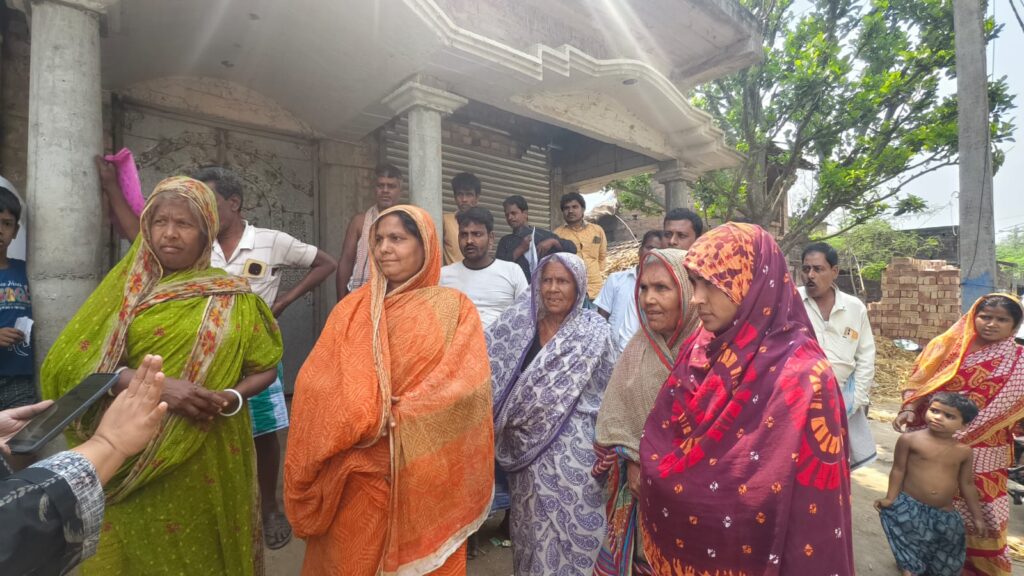
Bidi labourers like Noor Bibi, at Taranagar, on the eroding banks of river Padma, were forced to abandon work – their husbands’ field labour is also stalled because of the river having eaten their land – only to chase documents across block officers. “We are spending money we don’t have to do all this,” said Noor Bibi.
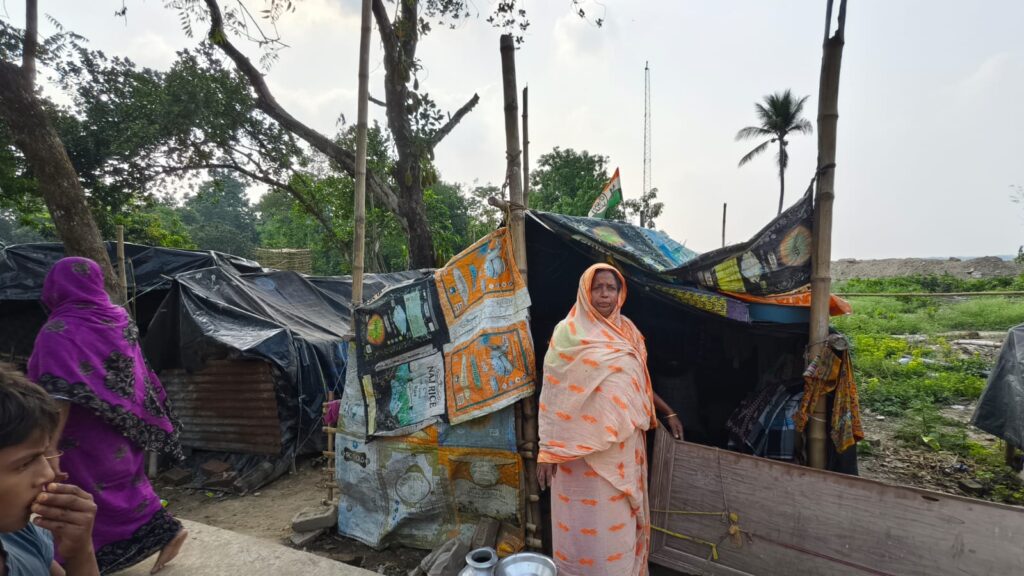
For families with migrant members, the burden is even more onerous. Mothers spoke to us of sons working in Kerala, Chennai, and Punjab who had to return repeatedly for hearings. On Lalgola’s roads, Sahera Bibi from Chandipur, whose sons have all migrated for work, said the names of her three sons were deleted from the voter rolls. At the hearing, officials told her that the issue would be fixed. But, soon after, an issue was flagged with their Aadhaar. One son, who works as a mason in Chennai, returned thrice. “We spent above Rs 5,000 and lost almost a month of work,” said Sahera Bibi.
Her family lives in poverty, with no access to welfare schemes, not even one that promises a toilet for every home, she said. The endless paper trail and time spent in procuring and submitting documents, online and offline, with no clarity on what works and what doesn’t, puts a strain on her meagre weekly earning of Rs 400. Nayantara Bibi put a number to this loss. “More than Rs 2,000 has gone in one month,” she said, on travel, photocopies, and mobile recharges.
In Taranagar, Selima Khatun has lived in Saklipur school for the last eight months since the river Padma deluged her home. She sees her family’s names vanish from the electoral rolls just as the land vanishes from underneath her feet. “Do we fix voter documents, arrange food, or find a place to live?” she asked. “This tension has exhausted us and we can’t even see a doctor.”
Ayesha Begum from Taranagar too lost her home and documents in floods.. The state government-run scheme for women, Lakshmir Bhandar, a direct benefit transfer scheme with a monthly allowance of Rs 1,500-1,700, reaches her, but the SIR confusion puts a question mark over their home and stability.
Jahanara, living under plastic sheets with her disabled kin after months of relentless storms, talks about not getting any guidance from the state. “No one has told us what to do, where to go for hearings,” said Jahanara. Food aid stopped after two months. “We survive only on people’s help.”
Calcutta High Court advocate Tarique Quasimuddin, whose chamber has been running legal aid camps to assist applicants, said the confusion is systemic. “The ECI is responsible for disseminating and informing the people and publicising the right way to submit required documents,” he said. On January 19, 2026, the Supreme Court issued critical directions to the ECI, to circulate proper instructions and information on the SIR process. But this did not happen.
“Booth-level officers are not well-trained. The common public can’t be expected to visit the ECI office, it is only natural that they will line up in front of the BLOs with questions,” he pointed out. Tarique and his team have encountered people, who have been instructed by BLOs to fill up and submit Form 6, but Form 6 is only applicable to register a new voter. For others, the only option is to submit their claims at tribunals.
Tribunals And Hearings: A Kafkaesque Process
The functioning of the tribunal framework is shrouded in mystery and confusion. There are 19 appellate tribunals, all in Kolkata, housed within the Dr Syama Prasad Mookerjee Institute of Water and Sanitation. “There is confusion over who constitutes these tribunals – whether it is under the Chief Justice of India (CJI) or the state – and many are staffed by retired High Court judges given additional responsibilities,” said Tarique.
For those whose names remain unresolved after hearings, the next step is the appellate process, where cases move beyond local verification into a quasi-judicial framework. On paper, this is where correction should happen but in practice, the process has failed due to a stretched system and lack of transparency, we found in conversations with applicants.
Once an appeal is filed, applicants are left in the dark. In Murshidabad, women spoke of holding on to appeal numbers with an almost spiritual fervour, hoping against hope. “What will happen with it, no one tells us,” one woman told BehanBox. It is a nightmare to travel to Kolkata from distant districts like Murshidabad.
In some cases, families are spending whatever little they have, even selling chicken and goats, to attend hearings.
Advocate Tarique explains that even after the appeal moves to a judicial framework involving state-appointed officers, there is chaos and confusion. “In some instances, civil judges or magistrates are disposing of 100 to 150 cases in a single day,” he said, pointing to the room for error this leaves.
Moreover, many affected individuals are not given a meaningful opportunity to present their case. While the Supreme Court has directed that tribunal orders be routed back to the ECI or the EROs, the burden of navigating this process remains on applicants, often without guidance.
“There is a structural issue with how appeals are being filed,” he added. “In some cases, political parties have submitted bulk petitions – covering up to 150 individuals at once, with each person’s grounds of rejection compressed into a 1,000-character limit, as per the provision. That undermines the basic principles of natural justice, where every individual case should be heard and assessed on its own merits.”
‘Not enough Support from Mamata’
The SIR has directly hit two of chief minister Mamata Banerjee’s strongest vote banks – women and Muslims. Her appeal among women, nearly half the state’s electorate and one of its most decisive voting blocs, has been increasingly led through women-centric welfare schemes such as Lakshmir Bhandar. In her rallies she used familiar and familial idioms with the states’ women – repeatedly calling to “ma bonera [mothers and sisters]” and as she did in the run-up to the 2021 assembly elections, asking them to confront BJP cadres, with the “hata khunti”, the everyday ladle and spatula, collapsing the distance between the language of the home and that of the State. Back then, Mamata described BJP cadres as “bohiragoto” or outsiders, another recurring theme in West Bengal 2026 election campaign.
In her political rallies, Mamata Banerjee has repeatedly invoked the exclusions driven by the SIR process and even went to the Supreme Court with her appeal. While she directed her party workers to help them file appeals for re-inclusion, women we interviewed said they got no ground-level SIR support from the TMC
Several women we met at the Darul Huda Madrasah question why the state police, along with the armed central forces, censured their anti-SIR protest following the arrest of lawyer and politician Moffakerul Islam in the adjacent Malda district and placed restrictions on assembly or more than four people.
Fear, Anxiety, And Surveillance
The acute anxiety over inclusion in the electoral rolls festers into other fears. Across villages, rumours circulate via social media and whisper networks that those marked for deletion would be taken to detention camps.
Women in rural Bengal are accustomed to the presence of armed central forces and their male gaze during elections. “But with SIR, that familiar presence has taken on a different meaning, with some women fearing that the central forces will take them away after elections,” Jinat Rehana Islam, a Murshidabad-based women’s rights activist, and founder of Feminism.com, explains.
Islam recounted the case of Nazira Khatun, a 43-year-old woman with a mental disability. “What will happen to women with mental health vulnerabilities and without family and societal support?” she asked. “She dresses up, wears alta and mehendi, eats and moves through daily life, but what will happen to someone like her in this process?” Women are increasingly restless, moving between home and outside spaces in a state of constant anxiety, she added. "Some say, ‘We are not even going to the pond or public spaces now; we are busy submitting papers.’”
Across Murshidabad, women fear whether loss of voting rights might also mean losing access to women centric schemes such as Lakshmir Bhandar, Kanyashree, and Swasthya Sathi, even though there is no official directive from the state government.
On the streets of Samsherganj, a volatile area under the watch of state police and BSF security personnel, Rozina Bibi, whose documents were flagged for PAN mismatch despite voting for years, asked: “Will I now lose access to government schemes? Ration? Lakshmir Bhandar? My citizenship?”
The monthly Rs 1,500 under the Laskhmir Bhandar scheme sustains households and anchors women’s political relationship with the government. The loss of benefits seems less damaging than the loss of citizenship, some women said, because it is the end of many more privileges.
“If voting rights go, then other rights also go: land rights, school admissions, medical treatment, access to schemes,” said Farhana.
Shades Of Resistance
Muslim women have been at the forefront of recent resistance movements, especially on questions of citizenship. In 2019, from Delhi’s Shaheen Bagh” to Kolkata’s Park Circus and several districts of Bengal, Muslim women mobilised against the Citizenship Amendment Act (CAA).
But this mobilisation is invisible as SIR. The activist Jinat Rehana Islam explained why.
“In Murshidabad, there is effectively no category of working women—sromojibi nari bole kono nari nei. Women who roll bidis do not see themselves as workers with labour rights. Many migrate for survival—going from Hariharpara to places such as Ludhiana in Punjab just to cook rice and earn a living—but there is no organised struggle around labour rights or wages for these women. So when it comes to the SIR process, expecting them to mobilise, demand inclusion, or build pressure on the government was never realistic,” Jinat said.
Occasionally, articulating this marginalisation becomes an act of resistance. Regina Khatun, a bidi worker with an eight-year-old son, is among the 90-100 bidi workers in Jagannathpur of Berhampore block. Many are divorced, barely educated, and lack stable family support. Regina, whose father sells bangles at village fairs, told Islam bluntly: “Didi, they will not keep us. Because I am a Muslim woman.”
There is a long history of communalising politics in Bengal dating back to the partition of Bengal in 1905. Historian Irfan Habib says that this was resisted during the Left front rule in the state but has found new currency in recent times. “The strategy is to detach Muslim citizens from a shared sense of nationalism by linking them instead to Bangladesh,” he said, adding that it becomes easier to question their belonging once the association is made.
Historian Aditya Mukherjee also pointed out that the selective political use of the memory of Partition by the BJP leaders such as Narendra Modi generates a broader anti-Muslim sentiment and a “narrative of permanent antagonism”, sidelining the state's powerful histories of coexistence.
'I can't be punished like this'
Feminist historian Uma Chakravarti, called the SIR an attempt to render Muslims illegitimate through administrative means. “The regime asks, ‘Where are your papers?’, much like Nazi Germany,” she said.
Muslim women’s claim to citizenship coexists with the fight against communal rhetoric that is deepening divisions rather than healing them. Inside Kazisaha’s classroom, Nasira Khatun challenged the so-called “population jihad” theory.
“How many children I have is my personal matter, or that of my family’s. That cannot be decided by the nation…If I have 10 children, will the government feed them? My husband will; my family will,” she asserted. “But they are saying “too many children,” so names are being sent back. Why? I cannot be punished for that.”

We believe everyone deserves equal access to accurate news. Support from our readers enables us to keep our journalism open and free for everyone, all over the world.
