[Readmelater]

Numbers Without Influence: Women And Power in West Bengal’s Assembly

Despite visible gains in representation, women in West Bengal’s Assembly remain sidelined from real power—underrepresented in key committees, excluded from leadership roles, and further marginalised by caste and community divides.
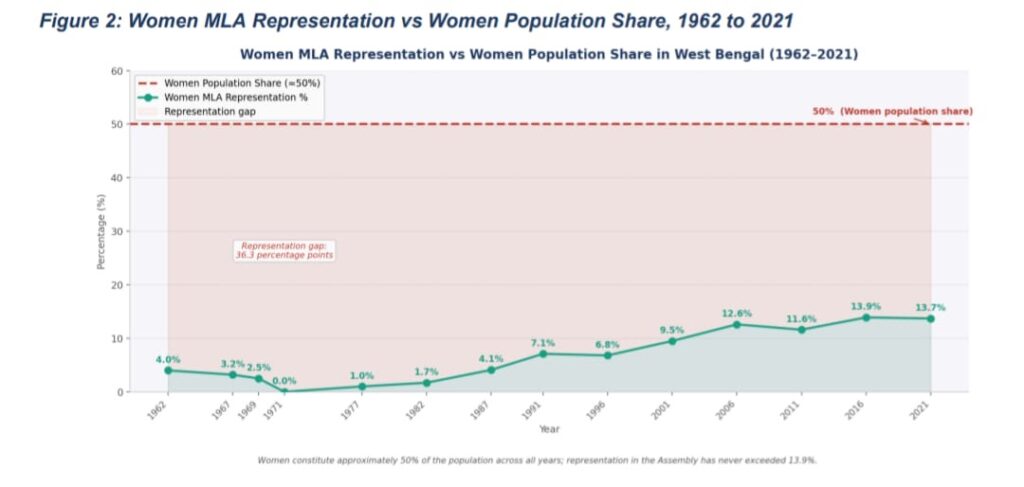
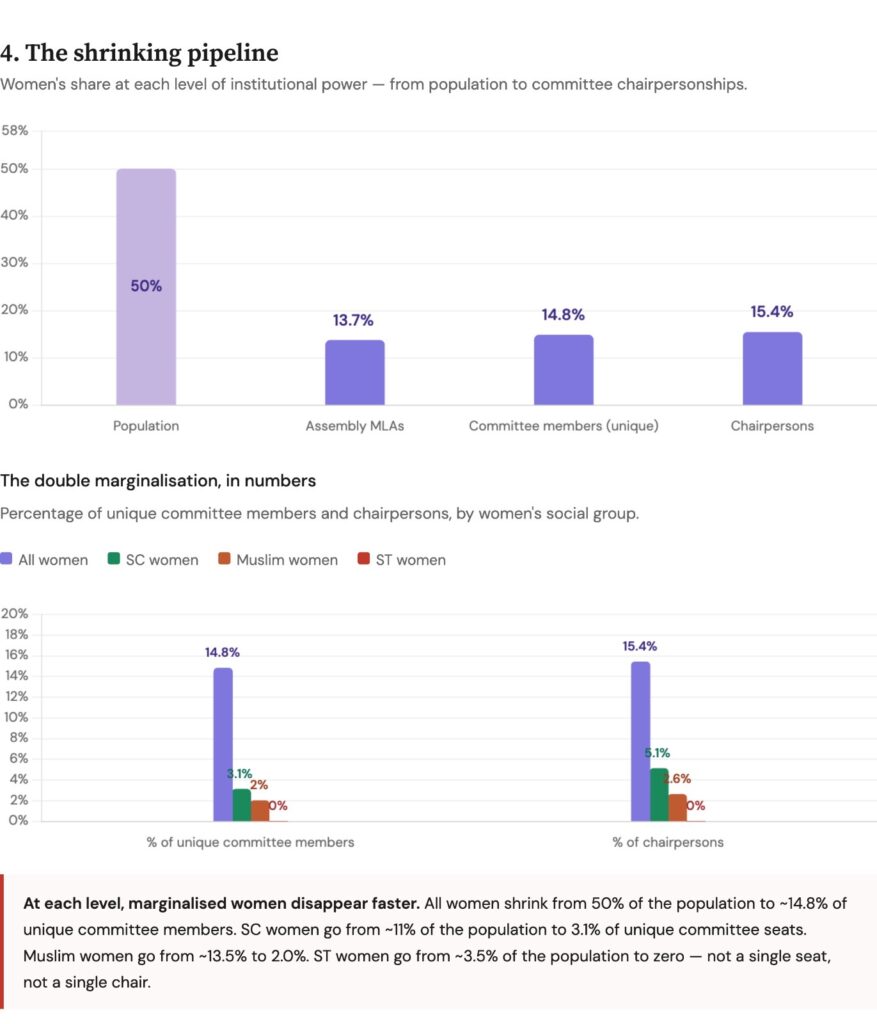
West Bengal has the unique distinction of being led by a woman Chief Minister for three consecutive terms since 2011. The Trinamool Congress (TMC) also boasts the highest proportion (38% of their total MPS) of women Members of Parliament. Yet, within the state’s legislative structures, gender representation remains far from equitable. In the outgoing Legislative Assembly, women constitute only 13.7% of the total Members of the Legislative Assembly (MLAs), and this proportion has never exceeded 13.9%.

A closer examination of the Seventeenth West Bengal Legislative Assembly reveals a more concerning pattern: women are significantly underrepresented in Standing and Select Committees—the key decision-making bodies within the Assembly. Women account for just 14.3% of committee members and are largely concentrated in committees dealing with issues traditionally associated with women. Leadership representation is even more limited, with only 13.2% of committee chairpersons being women.

Trajectory of women's representation in West Bengal Assembly

Intersectional disparities further compound this imbalance. Among the women who do hold positions, the majority are from general caste backgrounds, while those from Scheduled Castes, Scheduled Tribes, and Muslim communities remain inadequately represented in positions of influence.

Notably, this data is not available in the public domain nor proactively disclosed by the West Bengal Legislative Assembly. It was obtained through a Right to Information (RTI) request in 2025.

Seats without Power

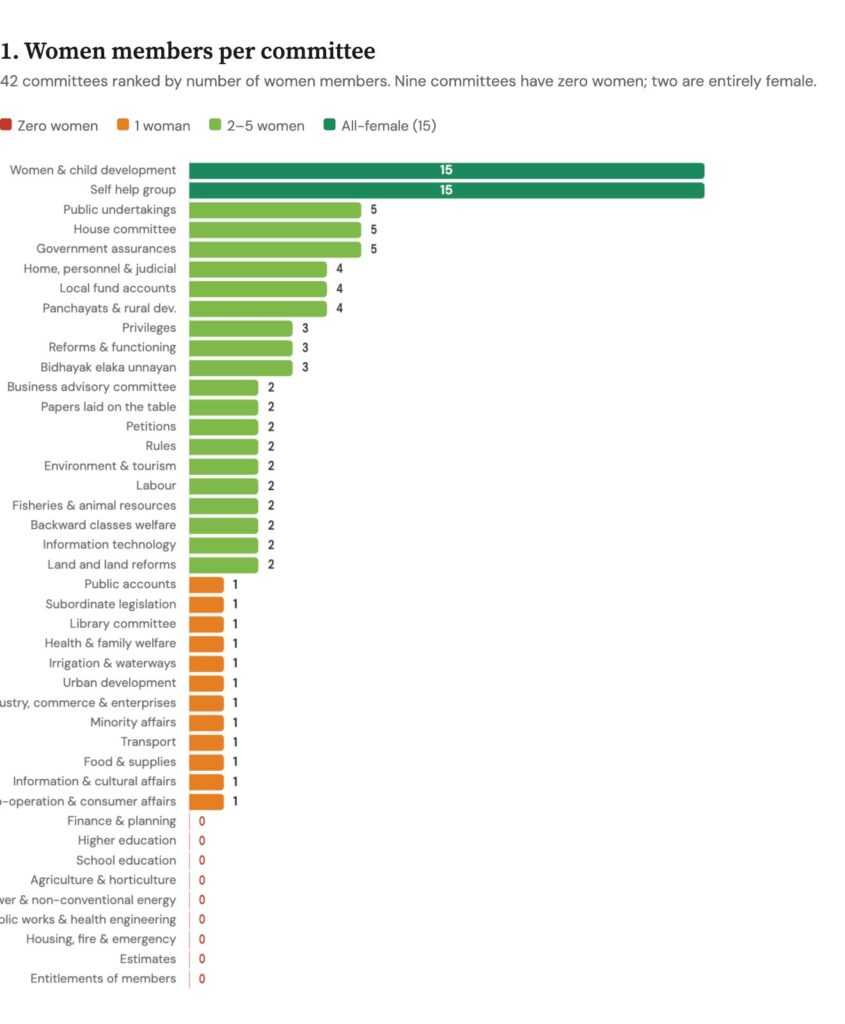
The outgoing Assembly constituted 42 Standing and Select Committees, with 694 MLAs serving across them. Of these, only 99 were women—just 14.3% of the total. While this is marginally higher than their share in the House, a closer examination of the roles they occupy and the social composition of these committees reveals a far less encouraging picture.

Nearly one-third of all women members are concentrated in just two committees. The Standing Committee on Women and Child Development and Social Welfare is composed entirely of women, with 15 members. Similarly, the Standing Committee on Self-Help Groups and Self-Employment is also exclusively female. Across the remaining 40 committees, men outnumber women in every case.

In contrast, committees that shape core areas of governance—finance, infrastructure, and education—show a stark absence of women. The Standing Committee on Finance and Planning (14 members) and the Standing Committee on Higher Education (15 members) have no women at all. The Standing Committee on School Education, which influences the lives of millions of children across the state, also has 14 members—all men.

Where do women find a seat at the table?

This pattern extends to other critical sectors. The Standing Committee on Agriculture, overseeing a sector that sustains millions across Bengal’s rural districts, comprises 15 male members. The Standing Committee on Power and Non-Conventional Energy Sources, responsible for the state’s energy policy, has 14 members—again, none of them women. Similarly, the Standing Committees on Public Works and Public Health Engineering, as well as on Housing, Fire, and Emergency Services, include no women.

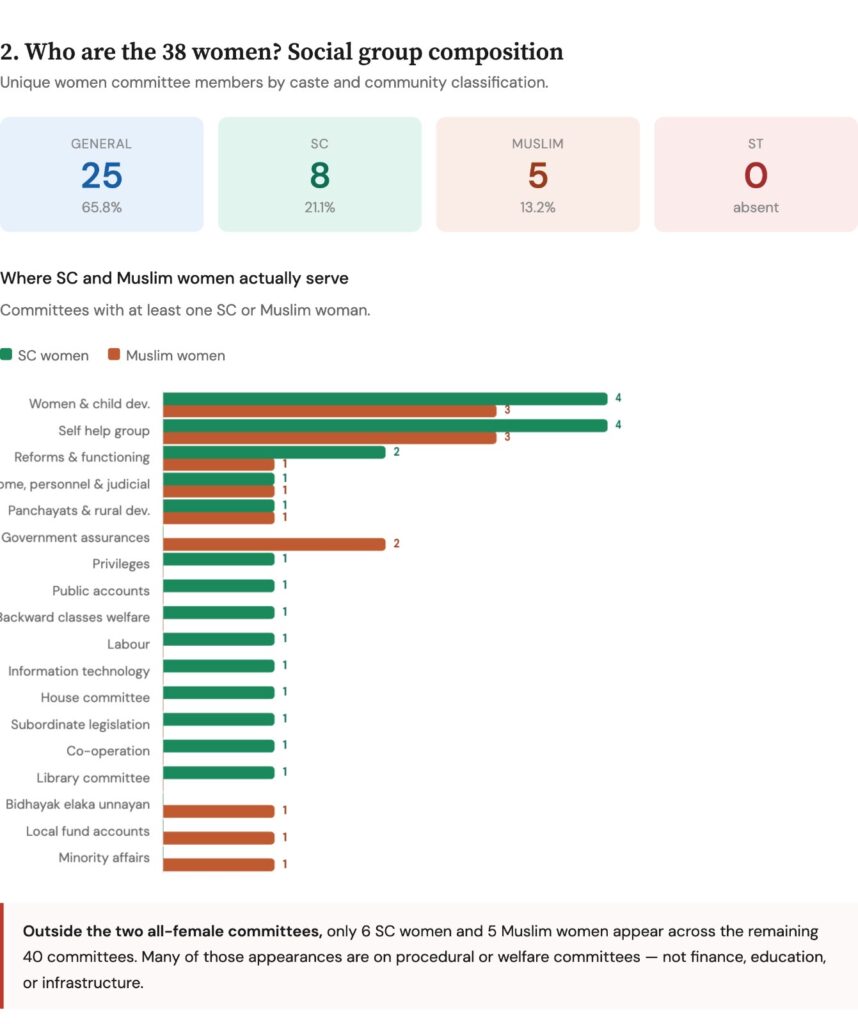
Social composition of women in Committees

The pattern is difficult to ignore. Women are overwhelmingly assigned to committees associated with welfare, self-employment, and family-related issues, while their presence in committees that shape fiscal policy, infrastructure, and formal education remains minimal or entirely absent.

Chairpersons

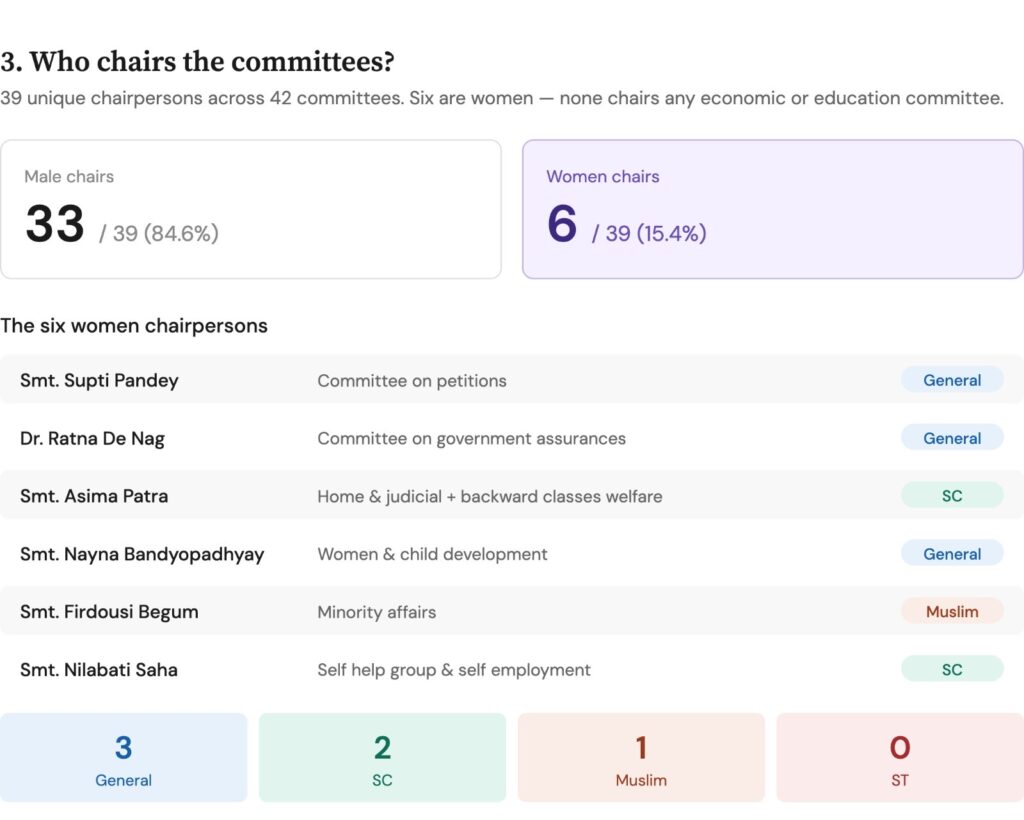
At the level of committee leadership, the imbalance is even more pronounced. The Assembly has 42 committees but only 39 chairpersons, as a few individuals head more than one committee. Of these, just six—13.2%—are women.

The six women who chair committees are largely concentrated in specific domains: Smt. Nilabati Saha (Self-Help Groups), Smt. Supti Pandey (Petitions), Dr. Ratna De Nag (Government Assurances), Smt. Asima Patra (Home and Administrative Reforms, and Backward Classes Welfare), Smt. Nayna Bandyopadhyay (Women and Child Development and Social Welfare), and Smt. Firdousi Begum (Minority Affairs).

Who chairs the committees?

In contrast, committees that shape the state’s economic and educational priorities are led exclusively by men. Shri Debabrata Mazumdar chairs the Finance and Planning Committee, Shri Rafikul Islam Mondal heads Higher Education, Shri Kalipada Mandal oversees School Education, and Shri Dinen Roy leads Agriculture. Notably, in the Seventeenth West Bengal Legislative Assembly, not a single woman chairs a standing committee focused on economic policy or education.

The pattern demonstrates that even where women are present within the committee system, their access to leadership—particularly in influential policy domains—remains sharply constrained.

Double Marginalisation: Caste, Community and Committees

Among women serving on committees in the West Bengal Legislative Assembly, representation varies sharply across social groups. Of the 38 women members, 25—65.8%—are from general caste backgrounds. Scheduled Caste women account for only 8 members (21.1%), while Muslim women number just 5 (13.2%), despite both groups constituting a significant share of the state’s population. Most strikingly, there is not a single Scheduled Tribe woman represented across any of the 42 committees.

This imbalance is further reflected in the distribution of roles. Scheduled Caste and Muslim women are largely concentrated in the Standing Committees on Women and Child Development and on Self-Help Groups—forums that focus primarily on gender and welfare concerns. Their presence in key committees dealing with finance, education, health, and land governance is minimal to non-existent.

A similar pattern emerges at the leadership level. Of the 39 committee chairpersons, only six are women (around 15%). Among them, three are from general caste backgrounds, two are Scheduled Caste women, and just one is a Muslim woman. Notably, the sole Muslim woman chair heads the Minority Affairs Committee—an assignment that appears less a marker of inclusion and more a reflection of institutional compartmentalisation. Scheduled Tribe women hold no chairperson positions.

Taken together, the data points to a layered form of exclusion. Women from Scheduled Caste, Scheduled Tribe, and Muslim communities face a dual marginalisation: first as women in a male-dominated legislature, and again as members of historically underrepresented communities.

Support BehanBox

We believe everyone deserves equal access to accurate news. Support from our readers enables us to keep our journalism open and free for everyone, all over the world.

Donate Now