
How Caring For Mental Illness In The Family Consumes Women’s Lives
Despite chronic stress, fatigue and loss of livelihood women have no choice but live up to the expectations of caring for family members with mental health issues
Trigger Warning: Mention of suicide and IPV
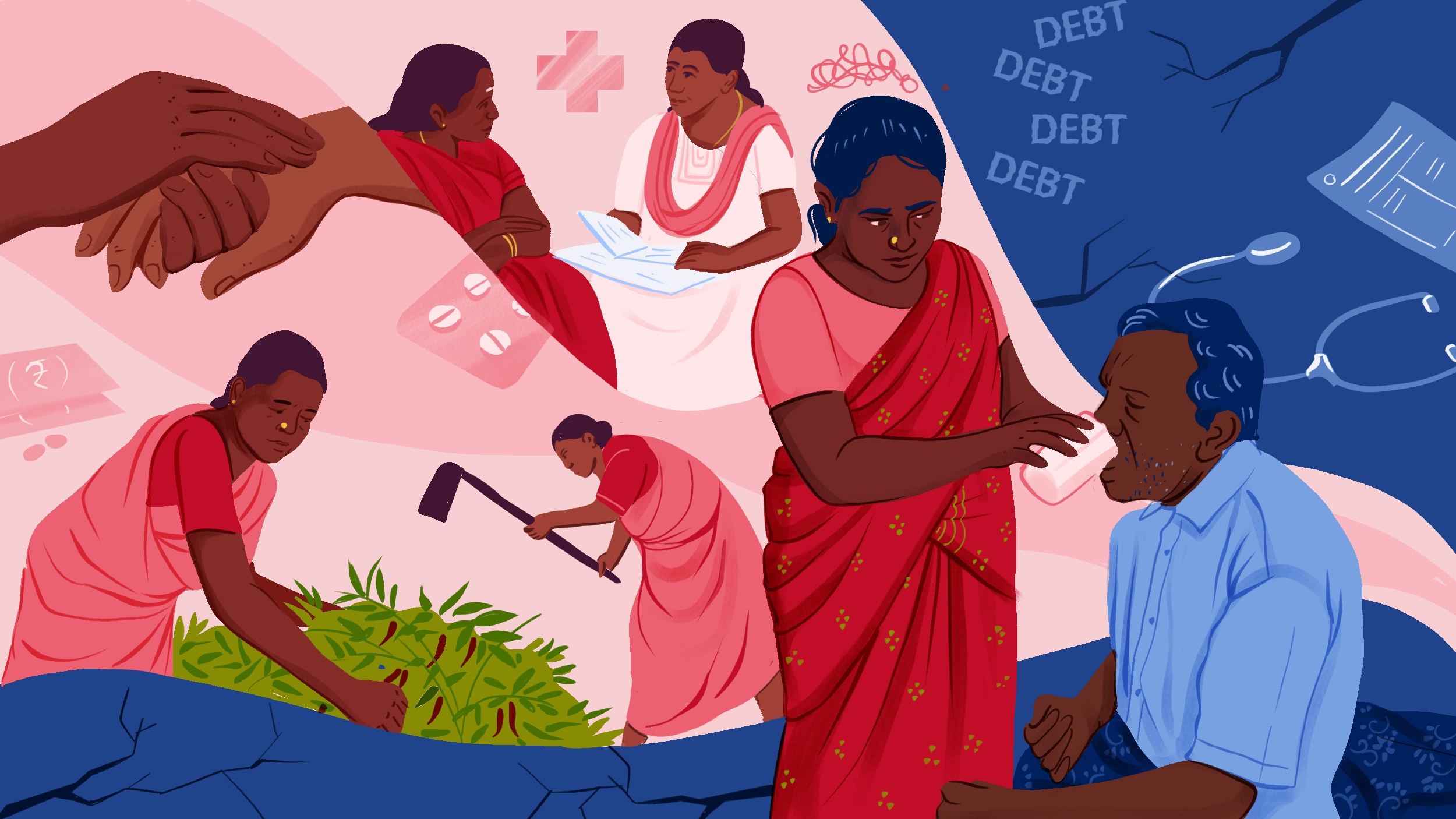
IN THE MIDDLE OF JUNE HEAT, Nallammal Thamizhselvan, 40, was getting ready for farm work. Her days usually start much before everyone else in her family wakes up. She has to be on the farm by 6 am and all the household chores have to be done before that.
Every day, before she sets off, she leaves one instruction with her two daughters: “Appavukku edhavadhuna udanea phone pannunga (call me immediately if anything happens to your dad).” Her husband, Thamizhselvan, has been living for decades with schizophrenia and is also prone to epileptic seizures.
This constant fear of a crisis means that Nallammal has to be available at all times to deal with medical emergencies. She routinely turns down any farm work that needs her to travel more than 3 km. In the 17 years of their marriage, she has been his only caregiver and she is exhausted by the responsibility.
“I can’t leave him. But, I need to sleep at least one night peacefully in my life without anxieties,” she says.
She is the primary earner in her family but there are few jobs for her in her village, Kothakottai, situated in Alangudi Taluk of Tamil Nadu’s Pudukottai district. It is an arid region where agriculture depends largely on rainfall. This means that farm work is erratic – one day, Nallammal would be cleaning the field, the next she would be plucking chillies or pounding tamarind, sometimes she reaps greens.
Eight hours of hard work earns her just Rs 170. Women farm workers earn no more than Rs 200 in this region, half what the men can demand. If Thamizhselvan needs hospitalisation or medicines, she has to borrow from her neighbours. This has left her family in a state of constant precarity. The family also bears the stigma of mental illness and the isolation this brings, as we detail later.
The caregiver burden for mental health is all consuming – it is physical, psychological, emotional, social, and financial, show our interviews with women. Chronic stress, declining personal well-being, exhaustion, and low energy experienced by spouses are often referred to as spousal caregiver fatigue. And this fatigue can last years given the failure of early detection of mental illness.
Till three years ago, Nallammal had no help from any quarter, not even from her own or her husband’s family. Nallammal’s entire life is planned around Thamizhselvan’s needs – adapting, calculating, overextended, overexploited, and of course, uncompensated because carework is assumed of a wife. Seventeen years of marriage have deepened Nallammal’s time poverty.
It was her encounter with WORD (Women’s Organisation and Rural Development), an NGO that works in partnership with Carers Worldwide India to support unpaid carers, that lifted her and her family out of precarity. WORD has been working in around 80 villages of Pudukottai district spread over Thiruvarangulam and Pudukottai to provide support to carers of persons with mental health issues. It offers monetary support to carers and also guides them on how they can access mental health care at government hospitals.
When Nallammal became a part of the network, she got a loan of Rs 5000 to buy goats for her husband to rear. The network of support also gave her the courage to take on better-paying work as a catering assistant at weddings outside the village.
We found in our interviews with women across Pudukottai that carework was not just physically and emotionally exhausting but it also drained families of precious resources. They have to pay for medicines, transportation and hospitalisation costs. This often meant the loss of a month’s salary leading to a debt trap.
The crisis we found is worsened by inadequacy of the public mental healthcare network. Carers complained about the frequent shortages of medicines and psychiatrists at government hospitals that force them to seek out expensive alternatives. The one disability scheme the government runs has been digitised and it now faces access and awareness issues. We discuss these issues in detail later in this article.
double whammy
According to the United Nations Development Programme (UNDP), Indian women spend 301 minutes or five hours a day on unpaid work in their homes. The Time Use Survey (TUS), conducted in 2024, revealed that 41% of women aged 15-59 years participated in caregiving for their household members, while with men the participation was 21.4%. Women, as per a 2021 study Caregiver Burden Among Working Women and Homemakers Taking Care of Psychiatric Patients, are twice as likely to become caregivers than men – 55% of the caregivers surveyed were mothers and 31% were wives.
As per a 2015-16 National Mental Health Survey (NMHS) study by the National Institute of Mental Health and Neurosciences (NIMHANS), 10.6% of Indian adults, roughly 11 of every 100, were living with a diagnosable mental health disorder.
These studies read together would indicate that women are also the primary caregivers for persons with mental health issues. Take the case of Nallammal. With only primary education, she was forced to marry Thamizhselvan when she turned 23 though her family knew that he needed special care and she could not get any support for this.
“I’m the third of five children. My younger brother got married before me and thinking that this would affect my matrimonial prospects, my parents married me off to Thamizhselvan. I did not know him and I did not have any idea about his life,” she recalls.
The stigma around epilepsy and mental health meant that her husband would not find many job opportunities. It fell upon Nallammal to run the family, make ends meet, plan for her daughters' future, and ensure regular health checks and medicines for Thamizhselvan and nurse him to health when he was hospitalised. Through all this, she also had to deal with spousal violence.
“My parents and siblings promised to help me during medical emergencies but every emergency taught me that their promises were empty,” she says. “Earlier, I thought faith healers, temples and dargahs could cure him. But nothing helped. Now, with medical care, and growing awareness over time, I learnt how to manage.”
Now, her teen daughters take turns to look after him while Nallammal takes on contract employment in neighbouring districts as a catering assistant. In the last three years, she has been to Trichy, Karaikudi, Chennai and Coimbatore on work. Employers provide accommodation, food and cover transportation costs. These assignments get her between Rs 1000 to Rs 1500 for two days. “This is handy in managing our expenses,” she says.
However, travel comes with the added anxiety – what if there is an emergency and her children cannot cope?
Living Upto Social Expectations
Nallamma’s example shows how caregiving not only impacts women’s employment opportunities and financial stability, but also affects every aspect of their life, including leisure. “I could not recall a night when I slept peacefully. I stopped attending family functions. With this marriage, my autonomy was taken away from me to honour my family,” she says.
Indian women are expected to unquestioningly care for family members, especially elderly in-laws, apart from handling domestic chores like cooking and cleaning. It is not unusual in families for women to quit work to care for the elderly.
“Caring for someone with mental illness takes up a lot of energy, but it is a socially reinforced responsibility, and it is expected of women,” says Rakshana, senior resident psychiatrist, who practises at a private hospital in Vellore.
For the last seven years, Fathima Abbas, 38, of Vallathirakottai has been caring for her sister-in-law Mehernisha, 50, who is schizophrenic. Thilagavathi Murugesan, 40, of Koozhayan Kaadu village takes her 16-year-old daughter with an intellectual disability wherever she goes.
“As medical advances continue to raise the life expectancy of patients living with chronic disabling conditions, it is apparent that the “second victim” in this scenario is the caregiver,” says this research paper, The Cost of Compassion: Caregiver Fatigue Associated with Caring for Persons with Disability in a Rural Population in India.
WORD traced 700 persons with mental illness and their carers in Thiruvarangulam and Pudukottai blocks of the district. Among them, including Nallammal, Fathima, Thilagavathi, 620 are women and 80 are men, emphasising the gendered nature of the caregiving role. Schizophrenia, bipolar disorder, depression, anxiety and obsessive-compulsive disorder (OCD) are some of the more common mental illnesses reported among the people who live in the two blocks of Pudukottai.
There are men caregivers too in the region but how they approach their work and time is different. The ones we interviewed say they assign caregiving responsibilities to their children if they need to travel, go on a pilgrimage or simply catch up with friends. Women in similar situations only travel for work.
Community Support
For three years in the blocks of Thiruvarangulam and Pudukottai, WORD’s mental health campaign has centred around financially empowering women carers.
To trace persons with mental illness and their carers in these blocks, WORD hired 10 volunteers (9 of them women) to spread out in 49 panchayats in Thiruvarangulam and 28 in Pudukottai. Once the carers were identified, WORD created 50 self-help carer groups and provided loans of Rs 5,000 to 104 of them.
The beneficiaries invest this money to build something – some purchased sewing machines, some started petty shops, others started vending vegetables and a few returned to cultivation.
Nallammal now has four goats. Thamizhselvan, in his free time, herds them. “We purchased baby goats for Rs 1,000, and we sell them once they reach adulthood to the butcher shop. We get up to Rs 10,000 per goat,” she says.
The monetary support has given them a sense of purpose and a sense that they are not alone, says RK Doss, executive director of WORD. “It made them feel seen and heard,” he notes.
What started as an NGO in 1992 for the development of women and children in the region later focused on community-based support for persons with mental illness and their carers.
WORD faced hardships in the early 2000s when it organised medical camps for people with mental illness. Doss says that, like most parts of rural India, Pudukottai too was ignorant about mental health, and people’s first and last resort was faith healing. “People did not let us enter their homes. In villages, those labelled as persons with mental illness carried the label to their grave. People did not know that there was a cure for many conditions,” he says.
The shift happened only after they actually witnessed someone’s life change with medical care. Sethu Arumugam lives with schizophrenia but he is also now a volunteer with WORD. “The constant care helped me return back to my social life. When I visit villages, I tell my own story to people to convince them to get medical treatment,” he says.
WORD also makes an effort to reduce the burden of carers. Its volunteers identified persons with mental illness and their carers being treated at private hospitals and redirected them to Government Hospitals and the District Mental Health Programme (DMHP), where treatment and medicines are provided free of cost. This has helped carers save up to Rs 3,000 on their monthly medical expenses.
Importance of Support For Carers
Yogarani, 52, from Kothakottai has been caring for her 29-year-old son Prakash, who has been diagnosed with BPAD (Bipolar Affective Disorder) since his teens. “Initially, we shared our responsibilities of taking care of him, visiting hospitals and getting all the necessary treatment. But over time, as a mother, I was expected to carry this work. My husband is in his 70s, and he cannot go to work. I take care of family responsibilities, work as an agricultural labourer and take care of my son,” she says.
WORD’s volunteer from Kothakottai, Rajakumari Muthappan, 43, said that Yogarani had been coping with multiple tragedies in the family. Prakash’s twin sister who was married 10 years ago had died by suicide. “Providing care to one child with mental illness alone was very difficult and energy-consuming. The death of her daughter took a mental toll on Yogarani,” she says.
But Yogarani carried on with her caregiving tasks with no support from mental health professionals. “Women carers have no leisure, no recreational space and no support system. I think this is high time for the government to think about hiring more mental health professionals at Primary Health Centres,” she says.
The WORD team requested the DMK government then in power to build a counselling centre for carers in Kepparai locality in Pudukottai to specifically address their distress, says Doss. He plans now to reinforce the request with the Tamilaga Vettri Kazhagam (TVK) government.
Carers identified by WORD meet once every two months to share their hardships and discuss both good and bad news. “These meetings have become significant to them as [an alternative to] a social life,” Doss says.
Rakshna says they keep an eye on carers when they take their loved ones to hospital for consultation. “Especially when we see significant distress, we also offer patient attendants separate appointments for counselling,” she says.
In urban circles, there are support groups for caregivers, especially those who care for children with autism. Al-Anon and Alateen groups work around the world to help adults and teens, respectively, who are affected by alcoholism. But this kind of community bonding is absent when it comes to those who look after family members with mental health issues.
“Helplines and digital platforms for caregivers in distress are great resources but they require certain digital literacy and accessibility. This is not something rural people have. We need to study the issue of access to mental health services with multiple rural variables to understand how we can support them,” Rakshana says.
The Trouble With Public Schemes
WORD has also been urging the state government to hike the maintenance allowance, on par with Andhra Pradesh’s NTR Bharosa Pension Scheme, which provides Rs 6,000 to vulnerable people from different walks of life – the elderly, widows, toddy tappers, weavers, single women, fishermen, those living with HIV, cobblers and persons with disabilities. As per government norms, disabilities also include mental illness and intellectual disabilities.
The Union Government issues a Unique Disability Identity Card (UDID) through government hospitals and it covers not just those who have mental health issues but also those who care for them. Under the scheme, Rs 1,500 is given to card holders as a monthly allowance but this fund is usually managed by their caregivers. The card also promises subsidies for education, self employment loans from nationalised banks, travel concessions in public transportation, and self employment training programmes.
Carers also want the government to ease up the procedures to procure UDID cards. To get one, doctors have to assess a person’s mental illness using a comprehensive clinical process called the Indian Disability Evaluation and Assessment Scale (IDEAS). If the measure is up to 40%, the beneficiary can apply for a UDID card that facilitates a maintenance allowance and subsidies in government schemes. Despite 700 persons with mental illness being identified, by WORD, fewer than 150 got UDID cards.
To get the card, the applicant has to go to camps conducted by the Department of Welfare of Differently Abled Persons. But ever since the process was digitised, there is uncertainty around how it works. Earlier, right after the IDEAS assessment, hospitals would issue a letter with which the applicant goes to the camps held by welfare departments to obtain a UDID card. Now, applicants need to apply their personal details on the Swavlambancard (or the UDID card) website and they need to wait for their applications to be processed before getting a hospital assessment. However, in many rural areas, digital penetration and awareness is poor. Many do not know where and how to apply.
WORD has also been demanding the availability of scheduled drugs for mental illness at PHCs because they are only available at district headquarters or taluk level centers located in Alangudi, Thiruvarangulam, Keeramangalam, Iluppur and Thirumayam. This means travel expenses and critical time lost, especially for the carer.
Staff, Resource Shortages
India has only 0.75 psychiatrists per 1,00,000 people which is less than the World Health Organisation’s (WHO) recommendation of three per 1,00,000. And this shortage is worse in villages and small towns.
Radhakrishnan, the Joint Director of Health Services In-Charge for Pudukottai district, says that psychiatrists should be hired at PHCs to prescribe Scheduled Drugs to the patients. “We have only five psychiatrists for the entire district and they visit all Government Hospitals and PHCs at regular intervals," he explains.
While describing the work nature of the team, Radhakrishnan notes that two psychiatrists have been appointed to the District Mental Health Programme (DMHP), two psychiatrists work at the Emergency Care Recovery Centre (ECRC) and one works as a satellite psychiatrist [who is involved in outreach programmes].
“We make 38 visits to the Government Hospitals and PHCs to treat patients with mental illness. The visits are dependent upon the hospital bed-capacity. For the hospitals with more than 100 beds, our doctors make two visits per month while for the hospitals with less than 50 beds make one visit per month. Besides, we conduct Mananala Viyazhan (mental-wellbeing Thursday) campaign programme across the district on Thursdays to create awareness in public spaces such as educational institutions,” says Radhakrishnan.
Naveen Selvam, National Health Mission (NHM) Coordinator for Pudukottai district, says that people could use the 108 helpline for ambulance services. There is also a Mobile Medical Unit (MMU) for those who need immediate care. On the drug shortage at hospitals and DMHP, he points out that it is due to variations in supply. “Hospital in-charges and medical officers can always raise a request to Tamil Nadu Medical Services Corporation (TNMSC) to make prescribed drugs available at the hospitals,” he says.
Need For Better Health Literacy
As we said, there is still a lot of stigma around mental health issues and these still dictate how families are seen by communities. WORD has changed some of this for the residents of Tiruvarangulam and Pudukottai blocks. “Talking about mental health is normal here,” he says, citing the 20 years of groundwork reflected in conversations. “In recent years, no one is visiting dargahs for a solution. They reach out to volunteers for help.”
But even here, families hesitate to associate with those who have mental illness, especially through marriage. “Prospective in-laws tend to calculate the dowry, wedding expenses, and sacrifices they would incur if they married into such families,” Doss says.
Yogarani would like to get Prakash married some day but she knows the problem with that. “I cannot let another woman carry the burden of care,” she points out.
Rakshana emphasises the importance of early detection which defines everything, including the amount of time spent on treatment, resources, and care. “The care and treatment costs are expensive for mental illnesses such as schizophrenia and bipolar affective disorder. The state of being unhealthy for a prolonged period, or morbidity, is high with decreased access to mental health services,” she says. High morbidity needs longer and more intense care.
Community participation in mental health services is also important, she notes. Since the implementation of the National Mental Health Programme (NMHP) (1982), integration of community participation and mental health services has been one of the main challenges.
“Health literacy is not widespread, so the immediate response to signs of mental illness is to seek out faith healers. To increase community participation, mental health workers should go to the community and involve the healers and administrators of religious sites who are in the pathway to care,” she said.
In 2008, Mira Datar Dargah in Gujarat came up with an innovative concept of dawa-dua that combines both prayer and medicine. Persons with mental illness who visited the dargah were referred to the psychiatric unit, which was opened to treat them. They received both faith-healing and evidence-based psychiatric treatment. Six years later, the concept was implemented by the Tamil Nadu government in Erwadi Dargah in the name of markkam and maruthuvam (faith and medicine). A DMHP team and clinic with 50 beds has been set up inside the premises of the dargah, where patients are referred for diagnosis and treatment.

We believe everyone deserves equal access to accurate news. Support from our readers enables us to keep our journalism open and free for everyone, all over the world.
