
Postscript #13: Doing Democracy, The Feminist Way
In Postscript, we reflect on the editorial choices we make and abandon. Plus all things behind the scenes. This week: inside our Feminist Election Newsroom
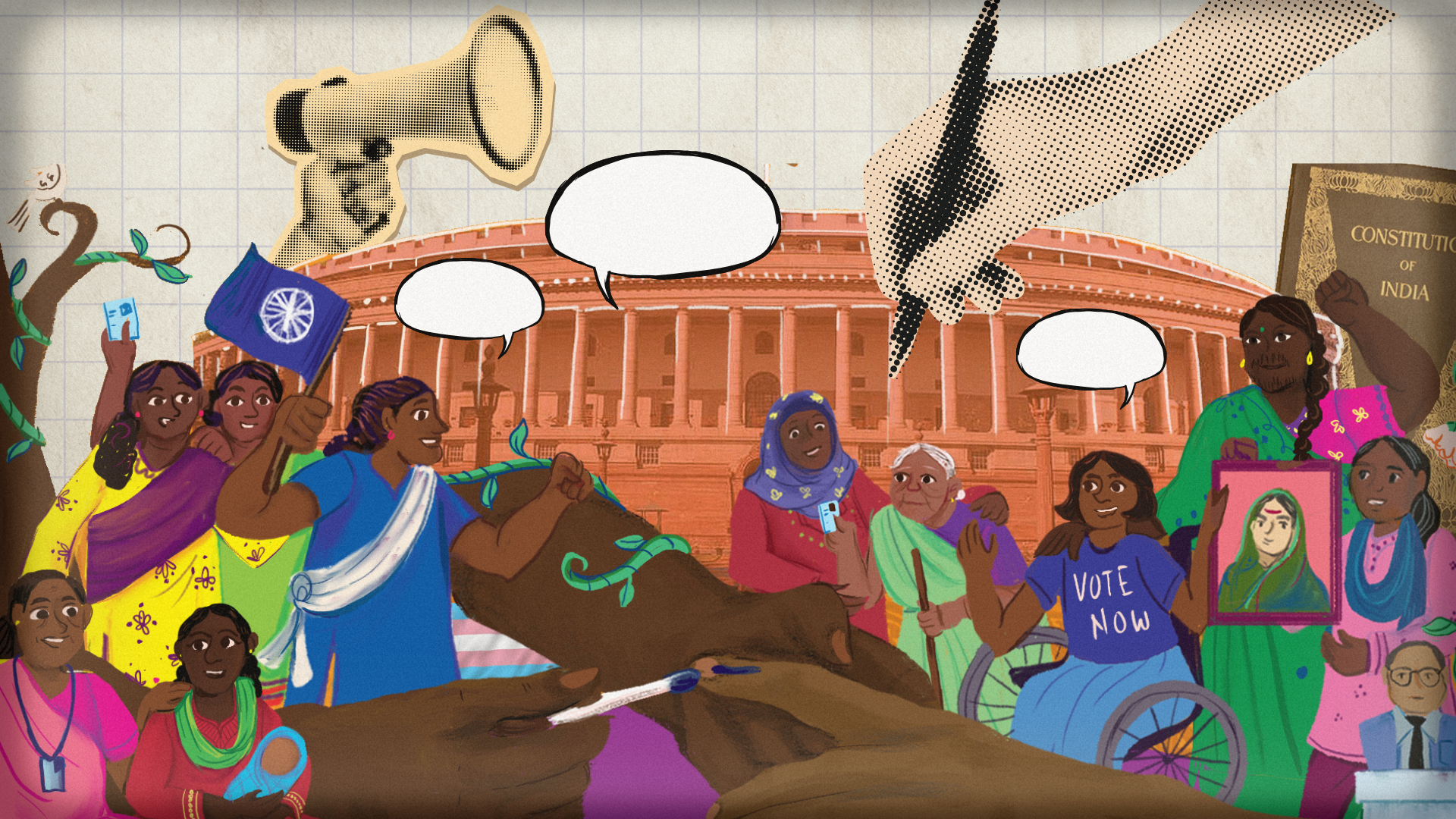

Earlier this year at BehanBox, we found ourselves grappling with a fundamental question: how can our journalism be more useful to the people it serves? Beyond reporting, how do we build a living, breathing community—one that includes both our readers and those we have yet to reach—where people can engage with the most urgent questions of our time? How do we make complex systems—often distant, opaque, and intimidating—more accessible, and invite people into the process of understanding and shaping them?
Journalism is changing. It is no longer enough to document; there is a growing need to convene, to listen, and to create spaces where people can engage, question, and act. The challenge before us is to retain the core of what journalism must be—rigorous, evidence-based, accountable—while building a participatory community around it. What does that look like in practice? What does it demand of us?
The state assembly elections this April, across four states and one union territory, gave us an opportunity to explore these questions. We revived our Feminist Election Newsroom (FEN), the novel experiment we started in 2024 during India’s General Elections. It was our attempt to imagine what feminist politics could look like—what issues deserve attention, whose voices are missing, and what people truly expect from their representatives. At its heart, FEN was envisioned as a shared space: a collective of diverse individuals bound by a common purpose—to engage more meaningfully with democracy.
It also sits as part of our mission: to challenge power in a way that knowledge, experience, and expertise belong to everyone.
Our community member, Baishali Mukherjee, articulated our vision thus:
“I feel so at home here. Political discussions are usually imagined as men with chai and cigarettes at street corners or in boardrooms. But here we are—women and queer folks—discussing politics over breakfast. I’m so glad I joined.”
During these elections, FEN found new energy. We began with a dormant group of around 400 members from the 2024 elections. Rebuilding meant starting almost from scratch—merging databases, re-engaging participants, and bringing fresh energy into the space. Our small team of 8, split into editorial and community functions, ensured a continuous feedback loop: community questions shaped our reporting, and our reporting fed back into discussions.
We began with the basics: political party manifestos.
Early conversations were sceptical. Why do manifestos matter when they are often vague, generic, and detached from the realities of campaigning, which is increasingly driven by identity and division? But as our team analysed these documents—contextualising promises, highlighting gaps, and comparing commitments—we saw community members engage in a wholesome manner. What initially seemed dry and inaccessible became a site of renewed interest and critical engagement.
For Harshvardhan Thyagarajan, an FEN member, the analyses “cut through the noise” and revealed how exclusionary politics shaped narratives. “Work like this feels especially valuable in such times.”
When participants expressed interest in understanding cash transfer schemes for women, we responded with a series of reports and a late-evening webinar featuring academics, economists, and journalists. It ran well past schedule. Even at 10 PM on a Tuesday night, the conversation hadn’t run its course.
But FEN was not just about information. It became a space to process the emotional vicissitudes of the elections. The controversial SIR process, which led to large-scale voter deletions in West Bengal, left many feeling anxious and disillusioned. When the Election Commission released final voter rolls indicating 90 lakh deletions, the community became a space to share confusion, anger, and grief. One member apologised for “ranting”—but that, too, is what the space was for. When systems feel overwhelming, collective expression can offer a measure of solidarity and relief.
There was humour too—small moments of levity in the face of absurdity. From “pandal-style” polling booths with selfie zones to the bureaucratic hurdles of participation, members found ways to laugh together. As one quipped, navigating systems in India is an “obstacle course”—the selfie point, perhaps, is just the final checkpoint.
FEN also showed us the power of collective effort. Community members volunteered to translate key resources into five languages, supporting self-enumeration efforts for the Census 2026. What began as a newsroom initiative became a shared project.
And the thinking is already moving beyond elections. As one of our contributors Aishwarya G suggested: why stop here? Why not build this into a sustained “chai-chat” space—bringing together voices from the ground, academia, and beyond?
For us, FEN is a modest attempt to build an island of hope. Dr. BR Ambedkar reminded us, democracy is not merely a form of government but a mode of associated living. And perhaps that is what we are trying to nurture: a way of being in democracy together.
Because, as Iranian civil rights activist Shirin Ebadi said, “If you want to plant a crop for eternity, raise democracies.”

That’s all for this month’s Postscript, Behans. Our eyes, ears, hearts, and inboxes are always open for your thoughts. Write to us or comment below.


We believe everyone deserves equal access to accurate news. Support from our readers enables us to keep our journalism open and free for everyone, all over the world.
