
Why TN’s Cash Transfer For Carework Should Be A Small Step To A Big Change
The KMUT scheme reaches 1.31 crore women with a monthly cash transfer as a partial recompense for unpaid carework. How does it transform their lives?
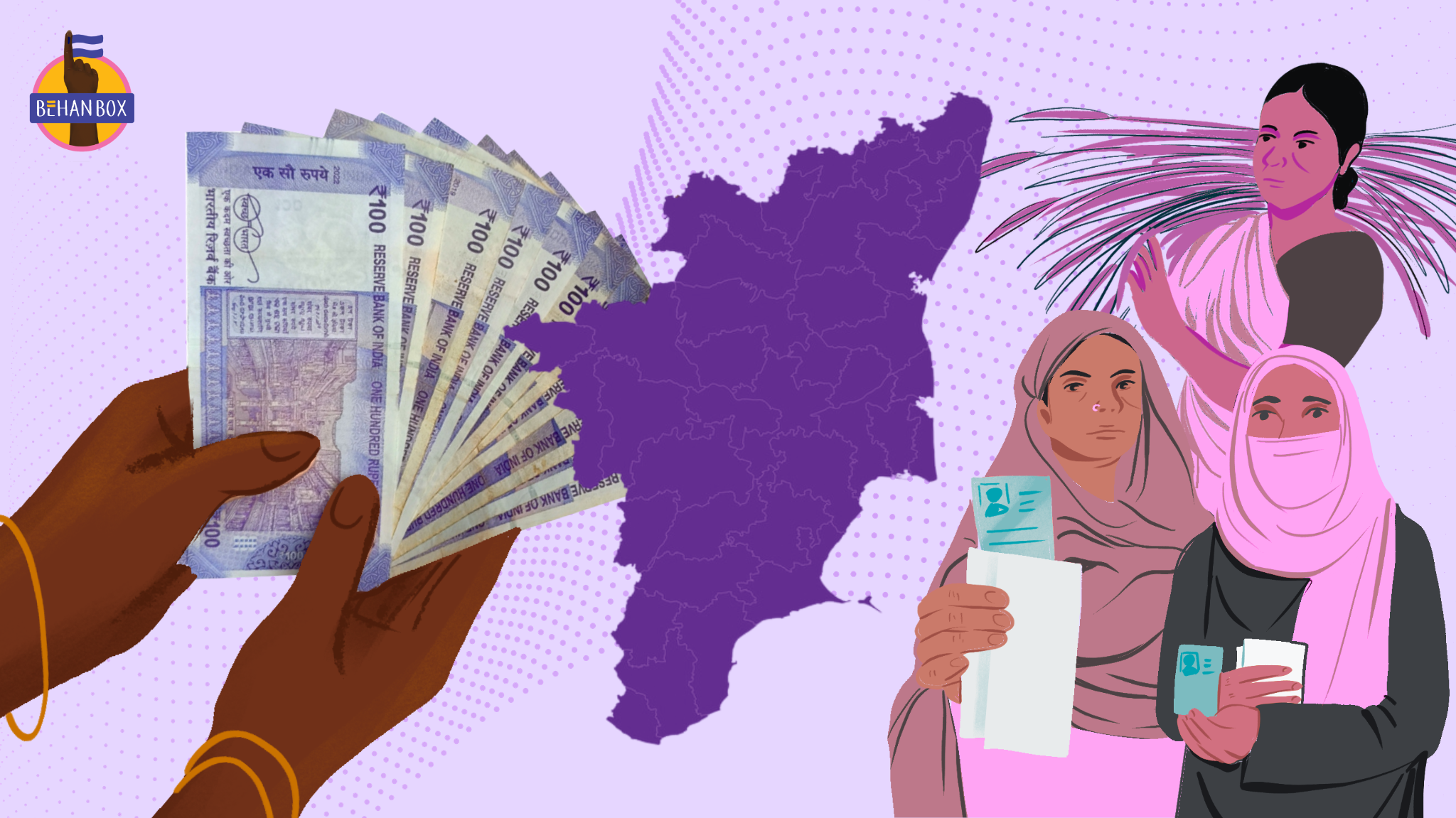
Semmencherry, about 30 km from central Chennai, shows what ‘rehabilitation’ looks like in reality. Built over two decades, this resettlement colony took in tsunami survivors in 2004, families displaced by the 2015 floods, and people evicted during various slum clearance drives. Thousands now live in identical 158-square-foot blocks built by the Tamil Nadu Urban Habitat Development Board.
Life inside these homes is marked by scarcity: there are no attached toilets, water supply is irregular, drainage is poor, and overcrowding is common. Women, here, juggle unpaid care work with unstable informal jobs. However, for the last three years, Rs 1,000 has been coming into the women’s bank accounts every month under the Kalaignar Magalir Urimai Thogai (KMUT) or the women’s rights grants scheme.
KMUT is the government of Tamil Nadu’s unconditional cash transfer scheme, where the state government deposits a monthly payment of Rs 1,000 to women who fulfill certain eligibility criteria – the family income is less than Rs 2.5 lakh per year, own less than 5 acres of wetland or 10 acres of dryland and so on. One of the defining features of the scheme is that the money is deposited into the accounts of women on the 15th of every month.
We interviewed a cross-section of women in Semmancherry, and the semi-urban pockets of Chengalpettu and Thiruvanamalai, to understand exactly what the cash transfer means to them.
Semmancherry old-timer Viji left her nursing job, which paid Rs 15,000 a month, because her husband wanted her to stop working. But now the family of four is struggling. A 25-kg bag of rice costs Rs 1,900, and they need at least 1.5 bags each month. “The Rs 1,000 is gone before I realise it has been credited,” said Viji. There is no discussion over what is done with the money. “It automatically becomes family money,” she said.
Across the street, Belinda, 49, helps her hearing-impaired daughter-in-law run a small shop and also looks after her grandson. The Rs 1,000 is not even enough to fund the family’s grocery purchases. Bashira, 38, is employed as a domestic worker in three homes, but her earnings are spent on buying medicines for her ailing mother. “I earn Rs. 2,500 from each house. I do the same work in my house for free,” she said. Her elder sister Samira, another beneficiary, said that she started the day with Rs 500 in hand but ended it with Rs 20. Most women beneficiaries here Semencherry had only begun to receive the scheme money in the last three months due to administrative issues.
In semi-urban districts, women have a different story. In Chengalpattu, Rekha and her sisters said the Rs 1,000 helps with the the treatment of their mother, a contract sanitary worker, who is recovering from a work-related injury and on half-pay. The KMUT offers the family a small but necessary cushion. In Tiruvannamalai, the money helps Valarmathi, a domestic worker, “survive another day”. With an alcoholic husband, her monthly earnings of Rs 10,000 are just about enough to raise her three children.
Urimai, A Right
Chief Minister MK Stalin launched the KMUT in September 2023, two years after he announced it, citing fiscal constraints after the Covid-19 pandemic. In his speech, he acknowledged women’s unpaid domestic and care work and the transfer as a partial recompense for it.
The Government order stated that: “Women play a significant role in society by investing countless hours in both domestic responsibilities and external work. They contribute to men’s accomplishments, ensure the education and well being of children and support the overall functioning of society.” The scheme’s guidelines state that it aims to improve the livelihood of women, enhance their standard of living and pave the way for them to live with self-respect in society.
If the value of this labour were to be calculated, women’s names would rightfully hold equal status in family properties, without the need for specific laws, he said. KMUT positions the recipient as a citizen collecting what she is owed.
The roots of the Tamil word ‘urimai’ used in the scheme’s title and its implications go back to Periyar’s Self-Respect Movement in 1925 and in the long traditions of “Dravidian common-sense” that has since “shaped the development trajectory of the state”, argue researchers Kalaiyarasan and Vijayabaskar in their book The Dravidian Model: Interpreting the Political Economy of Tamil Nadu.
The researchers distinguish between rights-based social measures – affirmative action, self respect marriages and equal inheritance that target caste and gender inequality, and economic measures that provide direct material support. They argue schemes like KMUT fall into the latter category – not replacing social reforms but complementing them when structural limits are reached.
What distinguishes KMUT in this framework is the explicit vocabulary of recognition. Consider other state schemes across India; they all carry names signalling protection or benevolence – the Ladli Behna (beloved sister) scheme in Madhya Pradesh, or the Mukhyamantri Mahila Samman (women’s honour) in Delhi.
Unconditional Cash Transfers and Feminist Discourse
Since 2020, 12 states have rolled out unconditional cash transfers to women, spending a combined Rs 1.68 lakh crore annually by 2025-26, a figure that has climbed from 3% to 20.2% of total state subsidy spending in seven years. The amounts range from Rs 500 a month in West Bengal’s Lakshmir Bhandar to Rs 2,500 in Jharkhand’s Maiyan Samman Yojana. Goa’s Griha Aadhar scheme,, the national pioneer launched in 2013, pays Rs. 1,500.
Feminist perspectives on such transfers are divided. Scholars like Ashwini Deshpande and V Geetha argue that they risk reinforcing gender stereotypes by entrenching women’s role in unpaid domestic and care work (UDCW), potentially increasing expectations of such labour while making it less visible as “work.” They also warn that cash transfers could divert attention and resources from structural solutions – like investment in infrastructure (water, energy, transport) and universal childcare – that would reduce UDCW, and might discourage women’s participation in paid employment or education.
Prabha Kotiswaran, professor of law at Kings College London (KCL), however, views these transfers as a pragmatic redistributive measure within existing inequalities and constraints of hetero-patriarchal marriage – such as limited inheritance rights and lack of access to marital property – that can recognise unpaid work, strengthen women’s bargaining power within households, and enable greater control over their time and labor.
Unconditional cash transfers reduce administrative costs by removing intermediaries, leakages, and monitoring requirements, said NR Bhanumurthy, director of the Madras School of Economics.
A 2024 meta-analysis by Tommaso Crosta, Dean Karlan and colleagues, covering 115 studies in 34 countries, found positive impacts on most outcomes, including consumption, income, and child health. Studies by scholars such as Prabha have argued that unconditional transfers such as KMUT allow women to seek greater equality and dignity in a marriage.
How Far Does The Money Go
The Economic Survey 2019-20 introduced ‘Thalinomics’ to track the cost of a basic meal across India. An estimate per this framework shows that in rural Tamil Nadu, a basic thali for a family of four – rice, dal, vegetables, and cooking oil – costs about Rs 80-Rs 100 per day. The cash transfer scheme thus pays for 10 such meals.
An assessment by Kings College London examined the scheme a year after it began, surveying 2,221 women across six districts and found that the scheme helped smooth out spending, but also had limits. Beneficiaries were 17 percentage points more likely to eat fish given that the transfer allowed protein diversification, but less likely to have regular meals or eat vegetables, lentils, and pulses. The report calls this unusual. The likely reason is inflation: food prices rose quickly, so Rs 1,000 that once covered 10 days of meals in September 2023, covered fewer days in September 2024.
Another study by the Tamil Nadu State Planning Commission found that 60–70% of the money goes toward food and household needs followed closely by healthcare expenses and children’s education. Less than 10% is spent on personal use – a finding corroborated by the KCL survey as well.
“And that itself tells us something. We live in a deeply gendered world where women hold the responsibility for keeping the family going. So when Rs 1,000 comes in, it takes some of that weight off,” said Kalpana Karunakaran, an Associate Professor at IIT Madras whose research interests include gender, finance and self-help groups. “It’s a small, limited step away from depending on the male head of the household. Not nothing, but not much either,” she reckoned. A woman interviewed as part of the KCL study said that she is now regularly able to buy Boost, a health drink, for her children, without asking her husband for money.
Up to 82% of the women surveyed said that they spent the entire money, while only 6% were able to save anything from it.
The scheme cuts across social groups but its effects are uneven. According to the TNSPC study, 46% of beneficiaries in rural Tamil Nadu and 16% in urban areas are from Scheduled Castes and Scheduled Tribes, while about one-fifth belong to Most Backward Classes (MBCs). Notably, nearly two-thirds of beneficiaries are identified as non-workers.
In Chennai’s urban relocation settlements, many residents – often from Dalit communities – have been moved from informal inner-city settlements to peripheral housing blocks far from jobs. While housing has been formalised, they have been displaced from their old livelihoods. For women in these areas, the Rs 1,000 seldom lasts or accumulates.
“These transfers are effective in stabilising consumption, and they prevent sharp declines in household welfare, particularly among low-income groups. But they are not designed to create structural shifts in income or asset accumulation,” said Bhanumurthy.
Autonomy, Agency and Unpaid Care Work
Greater autonomy and control over their own money was one of the stated aims of the KMUT design. Did the scheme achieve that? Both the KCL and the TNSPC study affirm this as do our conversation with women across districts.
Up to 91% of the women in KCL’s sample said that they felt a sense of autonomy and 95% said that they spend the amount without permission from their husbands. “Don’t you think there is a difference between the money that we take from the husband’s purse and the money that we take from our own purse? We need to narrate the expenses for the money taken from our husband’s purse but we need not worry about the rationale of expenses when we spend our money,” noted a beneficiary in the KCL study. This increased their confidence and dignity, said the TNSPC study.
The money has also not disincentivised women from seeking paid jobs, as some scholars feared. In fact, some have used the KMUT to travel for paid work. “I am now able to get an auto to travel for the 100 days work,” said a beneficiary in the focus group discussion conducted during the course of the KCL survey. The study also records a decrease in the hours spent on unpaid care work; some beneficiaries have used the money to generate paid work inside their home. One used the savings made from the KMUT scheme to buy a grinder that she uses to sell dosa/idli batter, for instance.
“Money is helpful, but we want decent paid work. If there are safe jobs nearby, with a good salary, we will go. We don’t get decent salaries like men,” said Jayapriya who works as a community coordinator in Semmenchery settlements.
“Rs 1,000 can’t replace a job and it was never meant to,” said Kalpana. “The real problem is still the gendered division of labour. Women aren’t staying out of the workforce because of this scheme. They are held back by unpaid work at home, by lack of mobility, by a job market that mostly offers them insecure, low-paid, informal work. And with everything getting more expensive, whatever they earn or receive just disappears. When women say they’d rather have a stable job, they’re telling us exactly what’s missing,” she pointed out.
When Transfer Enters Debt Cycle
In a village near Thoothukudi, Muthammal, 34, is at the ATM by 8 am on the 14th of every month. In February, the money had arrived a day earlier, and she had already set aside Rs 600 for the debt collector, who arrives on the 16th of every month. For Muthammal, the KMUT payment is so closely tied to her debt schedule that the timing of the transfer is more important to her than the amount.
Arokiya Mary, 48, from rural Thanjavur, knows where her Rs 1,000 payment will go as soon as it lands in her bank. A single woman from a backward community, she runs a small chicken shop from home, earning under Rs 5,000 a month, financed through loans from relatives and friends. As the main earner supporting her unemployed son and caring for her daughter-in-law, she manages debt and informal credit with the money.
In Tamil Nadu’s rural households, where debt levels now regularly exceed annual income, the Rs 1,000 arriving predictably every month carries real weight, especially for those managing on the edge of insolvency, as we said earlier. But it enters a debt structure it cannot undo. The average household debt-to-income ratio of 179% in surveyed rural areas of northeastern Tamil Nadu, showed a December 2024 analysis in The Wire by Nithya Joseph, Venkatasubramanian Govindan, Isabelle Guérin, and Sébastien Michiels. For oppressed caste households, the figure was 210%. The debt-service ratio told the starkest story: for every Rs 100 earned, women in these households were repaying Rs 115. Men in the same households were repaying Rs 13.
These women are not borrowing to invest – they borrow for food, medicine, education, and caste-mandated ceremonies. In this situation, the Rs 1,000 that arrives in bank accounts on the 15th of every month gives women confidence and also makes them reliable borrowers. “Loans are given to women because they will repay, and men don’t,” said Sheelu Francis, president of the Tamil Nadu Women’s Collective.
Does this predictability create dependency? “It helps them survive, really,” said Kalpana. “When you know Rs 1,000 is coming on a certain date every month, you can plan around it a little. A lot of women are constantly juggling money borrowing here, repaying there. Having something predictable in that mix does matter.” Public policy expert Andrew Sesuraj points to this regularity as one of the scheme’s most significant features, helping to structure financial behaviour within households.
The RBI’s 2022 Master Direction on Microfinance Loans – removing the margin cap on NBFC-MFIs and raising the household income eligibility threshold to Rs 3 lakh – opened the lowest-income geographies to aggressive microfinance expansion. This means that while the State on one hand provides a modest unconditional transfer, it also sets up, on the other, regulatory choices that allow microfinance institutions to charge the same women uncapped interest rates.
There is another debt-related relief that KMUT likely offers the state’s women but is not visible in spending data. Borrowing from kin has social costs, such as being watched, feeling obligated, and losing independence. These costs make formal loans more attractive if more expensive. A 2025 study in the American Political Science Review by Akshay Govind Dixit found that an income support programme in Telangana reduced borrowing within caste networks by 38.5%, because it cut familial reliance on kin.
The report, however, does not have information on whether this effect is the same for rural Dalit women who depend more on dominant-caste employers than on kin.
Where The Dravidian Falls Short
The Dravidian tradition that gives KMUT its ideological framing, however, has historically been better at reaching the numerically dominant intermediate castes than it has been at reaching the Dalits, political historian MSS Pandian has pointed out in his 2007 book, Brahmin and Non-Brahmin: Genealogies of the Tamil Political Present.
KMUT’s eligibility criteria are class-based, not caste-targeted. OBC women in semi-urban areas with ration cards, along with their husbands in informal employment, meet the eligibility criteria. But Dalit women in rural areas, particularly those in agricultural labour under dominant-caste employers, face documentation problems, ration card irregularities, and the social cost of asserting eligibility against local power structures.
The KCL study noted that 23% of beneficiaries knew someone who was eligible for the scheme but was left out of it or did not apply for it. It also found no disaggregated evidence of whether SC women experienced different outcomes on financial wellbeing, bargaining power, or violence.
What Women Want
Women across districts and social groups demanded decent paid work and conditions that enabled them. More than half (56%) of the women in the KCL study preferred paid work over a cash transfer scheme and 26% said they would like both. “They should make workplaces for women — with childcare, safe transport, and fixed timings. Then we don’t have to depend on this Rs 1,000 or our meagre wage,” Jayapriya told Behanbox.
Regulating microfinance is another crucial step to create structural conditions for women’s empowerment and well being. Researchers advocate for enforcing Tamil Nadu’s Prohibition of Charging Exorbitant Interest Act, 2003, and requiring full cost disclosure before loans are given would help ensure that payments go further for women.
Women also demanded that the amount be increased and expanded to include all women in the state. “Rs 1,000 doesn’t go very far. Everything is costly. They should be at least Rs 3,000,” said both Viji and Belinda from Semmancherry.
Kalpana argues that KMUT is part of a layered welfare system – a set of schemes that work together. “Free bus travel enables women’s mobility. The Pudhumai Penn supports girls from government schools to go to college that directly cuts across caste and class barriers. Naan Mudhalvan is about building skills and opening up job opportunities. The breakfast scheme ensures zero dropout. These are all connected. Together they try to address inequality from multiple sides at once mobility, education, skills, and some direct income”, she says.
Poll Promises
As Tamil Nadu prepares to elect a new government, political parties have been upping their bids. The DMK’s manifesto promises the following – doubling KMUT to Rs 2,000, a one-time Rs 8,000 voucher for household appliances under the Illatharasi scheme and 1,000 childcare centres to help working mothers.
The AIADMK through the Kula Vilakku scheme and even the BJP have promised to match the amount. AIADMK offers free refrigerators for ration card holders and a Rs 10,000 one-time household relief payment, while the BJP adds three free LPG cylinders per year. Neither party engages with the structural conditions needed for a real transformational shift – improved employment infrastructure, childcare provision, and microfinance regulation.
While there is a wider concern that cash transfers might substitute for deeper structural reforms – such as job creation, care infrastructure, and labour protections – Kalpana argued this risk is currently limited in Tamil Nadu because of its long history of combining welfare schemes with sustained public investment. That said, she warned against the perils of KMUT becoming the state’s excuse to justify slowing investments in employment or care infrastructure.
There were also calls to make the scheme a legal entitlement, to safeguard it from political fluctuations. KCL researchers suggest embedding this scheme through a Right to Care law, modelled after similar laws in Latin America.
“Making it a legal right changes the whole relationship and shifts power. Tamil Nadu actually has a track record of holding on to certain welfare commitments across different governments, so it’s not impossible here. The tricky part is building the systems that make it stick to proper funding, clear rules about who gets it, strong enough institutions that it survives political change,” said Kalpana. That’s the real work.
[Additional reporting by Baladevan Rangaraju from Toothukudi]

We believe everyone deserves equal access to accurate news. Support from our readers enables us to keep our journalism open and free for everyone, all over the world.
