[Readmelater]

BehanVox: Budget 2026 | What Will India Bet On?

This week in BehanVox: inside India's nuclear tech utopia, Savarna anxiety over UGC bill, and more

Subscribe to our weekly newsletter that brings you top stories, gender news from the world, and our team’s reading recommendations.

Hello Behans, 

The budget season is upon us. So while tax rebates and other such provisions will be of interest to many of us, we reckon feminist issues on tax and budgetary provisions would be useful too.

 So, we pulled together some essential readings ahead of the budget season. The Brookings Institute has a fantastic primer and roadmap on gender budgeting; India is still struggling with implementing many ideas. We spoke about these challenges and more in our analysis of the gender budget from 2024. It is also worth noting that historically the budget has failed Adivasi and Dalit schemes (we’re tracking investments in the SC-ST sub-plans this year). The rift between budget allocation and usage has always been substantial, and we have analysed the functioning of crucial schemes for right to work, education, and care infrastructures earlier.

The budget is a necessary exercise in taking stock of national priorities, but numbers don’t tell everything. Data—be in the form of the budget, time use survey, or periodic labour force survey—have their own limitations, and should be read as such.

Story So Far

“India’s growing energy demands and clean energy commitments make a strong case for expanding nuclear capacity. Round-the-clock electricity is vital for emerging needs such as data centres and advanced industries, yet existing laws do not provide the flexibility or speed required for such growth.” 

That is how the Union government frames its new SHANTI [Sustainable Harnessing and Advancement of Nuclear Energy for Transforming India] Act which is meant to drive its ambition to meet its ambition of decarbonisation by 2070. It became necessary, the centre argues, to create a “modern legal framework which enables wider participation, leverages indigenous resources, and integrates innovation with safety”.

The new Act subsumes all the earlier legislations on the subject and despite its claim to “wider participation” was pushed through without any consultation and is kept outside the ambit of RTI. The Act opens up nuclear energy to the private sector, dilutes accountability, and raises concerns for public safety. Companies like Adani, Jindal, Reliance, Tata, and Vedanta have already shown interest in nuclear energy and the Adani Group has begun exploring a 1,600 MW project in Uttar Pradesh.

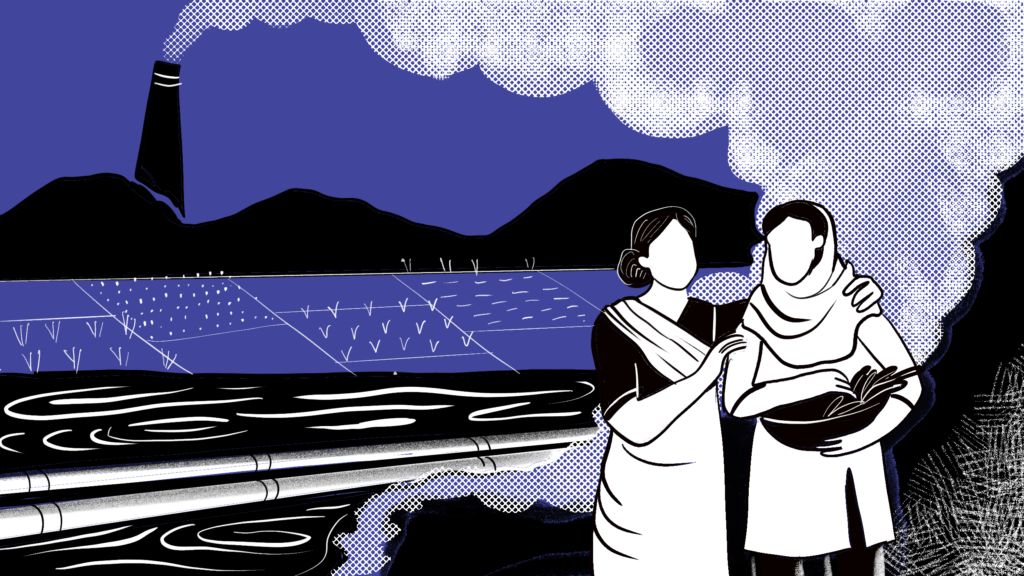
Is this idea of a nuclear techno utopia a reality? Is it really the best climate responsive solution for energy generation? What does it actually mean for the average Indian whose voice is never heard on questions of nuclear energy, a field of such evolved scientific complexity that it is believed to be only the domain of “experts”. But it is always this average Indian whose shared, precious and precarious resources that go into building nuclear facilities, who deal with the impact of potential contamination. And of them, it is the marginalised caste groups, the women, children and the Adivasis who bear the biggest brunt, says Misria Shaik Ali, PhD from Rensselaer Polytechnic Institute. In an interview this week with Anjali D, she draws on her decade of research to answer our questions.

“My work over the past decade shows that nuclear energy is far from safe. Jadugoda in Jharkhand, also called the nuclear graveyard of India, is a stark example where uranium mining and radioactive contamination have resulted in widespread disabilities and diseases, worsened by lack of government support. Nuclear reactors involve radioactive materials with severe biological risks, whether through contamination or warfare. Placing such an unstable energy source in the hands of profit-driven companies raises serious concerns about accountability and public welfare,” says Misria.

She points to the fact that the sector weaponises expertise by suggesting that it is of national importance and thus beyond the grasp of ordinary people. “This pushed me to study nuclear contamination more seriously and form my own opinion,” she recalls.

Her findings from Tumalapalle in Andhra Pradesh and Koodankualm in Tamil Nadu were profoundly disturbing – that contamination happens through invisible particles that seep into water, air, and food, and our bodies, where they remain and continue emitting radiation, causing cellular and genetic damage.

“People only realise they have been exposed long after it has entered their bodies and through small signs like skin discolouration or irregular menstrual cycles. Over time and across generations, this can manifest as spontaneous abortions, children born with disabilities, and chronic diseases,” she says.

The SHANTI Act, Misria believes, deepens all these issues, especially the neglect of affected communities and even more particularly marginalised social groups – the women who deal with contaminated water on an everyday basis, and the oppressed castes whose livelihoods go with their lands.

Read our interview here.

Talking Point

No To Minimum Wage: The Supreme Court has refused to entertain a public interest litigation seeking a comprehensive legal framework and enforcement of minimum wages for domestic workers. It maintained that it cannot issue a writ directing the Centre and states to consider amending or enacting laws. It accepted that domestic workers are subject to exploitation but said that the solution should come not from legislation but from reform and social awareness. Among the arguments forwarded by the court was that a minimum wage will make employers reluctant to hire domestic workers for fear of litigation. The chief justice also had terse words for the involvement of trade unions in the issue: “How many industrial units in the country have been closed thanks to trade unions.”

Stay On UGC Regulations On Caste Bias: The Supreme Court has stayed the University Grants Commission (Promotion of Equity in Higher Education Institutions) Regulations, 2026 introduced with the intent to ensure dignity and equal opportunity for students and faculty from Scheduled Castes, Scheduled Tribes, and Other Backward Classes. The regulations set off intense opposition especially from dominant caste groups though as The Wire reports, data refutes the claims that caste discrimination is exaggerated, pointing out that complaints related to it from universities and colleges have increased by 118.4% over the last five years.

Caste Conference Under Scrutiny: A three-day conference held in mid-January on “Critical Philosophy of Caste and Race” held by the IIT-Delhi’s Department of Humanities and Social Sciences is being put through the scrutiny by an institutional fact-finding committee. It is supposed to examine “serious concerns” raised about the speakers and content of the discussions in the conference. No details are forthcoming on what these concerns are. The topics included Dalit identity, caste psychology, caste-race theory, minority discourse, history writing, and book discussions and scholars point out that no one of these should have led to any objections.

Conversion Law Acquittals: All five cases that have gone to full trial in Uttarakhand under the Uttarakhand Freedom of Religion Act (UFRA) meant to curb “forced religious conversions” have ended in acquittals, shows an Indian Express investigation. Court records, as per the report, show that the statute may be falling short of a basic legal test: evidence. 

Data Drop

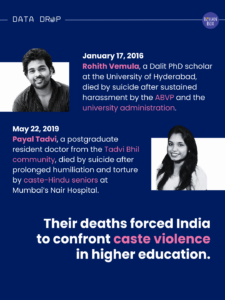
Staying with the UGC Regulation, here’s some data and context to make sense of the discourse. Between 2019 and 2021, we lost 98 Dalit, Adivasi, and Bahujan students to suicide. Following years of advocacy by Radhika Vemula and Abeda Salim Tadvi, the UGC introduced new rules to curb caste-based discrimination in higher education. Anti-caste activists and student groups said even these proposed UGC guidelines were too weak and offered limited protections and no structural accountability for institutions that enable discrimination.

The question remains: Were these guidelines enough to begin with, to address the violence, exclusion, and impunity faced by caste-oppressed students on campuses? What would real institutional accountability look like?

BehanVox Recommends

Love in the Times of Caste: How do ordinary Dalit women and men navigate  passion, pleasure, power, and pain in the crucible of caste, gender, and sexuality in contemporary India? A new anthology of Dalit-Bahujan  feminist love stories is what we need to push the idea of radical love. 

We also suggest this beautiful essay on love as a radical tool of resistance by Deepa Pawar on our website as accompanying reading.

It Never Was Golden: Dipping into nostalgia is an occasional sentimental comfort blanket to wrap ourselves in as well as a political project of othering in many neo fascist agendas. The good old days’ is a virulent falsehood that infects those whose defences have been weakened by fear and insecurity writes Alan Jay Levinovitz in the Aeon magazine. 

The Woman Who Stands Between Donald Trump and Greenland: Mette Frederiksen, Denmark’s leader, never suffered fools and bullies. So it is no surprise that she got Donald Trump to back down on his phantasmagorical Greenland campaign. This profile of her in the New York Times is a terrific read.

Want to explore more newsletters? In Postcards, we send you missives on the places, people and ideas that brought Team BehanBox joy. Our monthly offering Postscript invites you, the reader, into our newsroom to understand how the stories you read came to be – from ideation to execution. Subscribe for more.

Support BehanBox

We believe everyone deserves equal access to accurate news. Support from our readers enables us to keep our journalism open and free for everyone, all over the world.

Donate Now