
‘The GRAMG Bill Codifies The Stealthy Ways In Which NREGA Was Being Undermined’
Dipa Sinha, an economist, explains the perils of centralisation and funding constraints under the new VB-GRAMG Bill
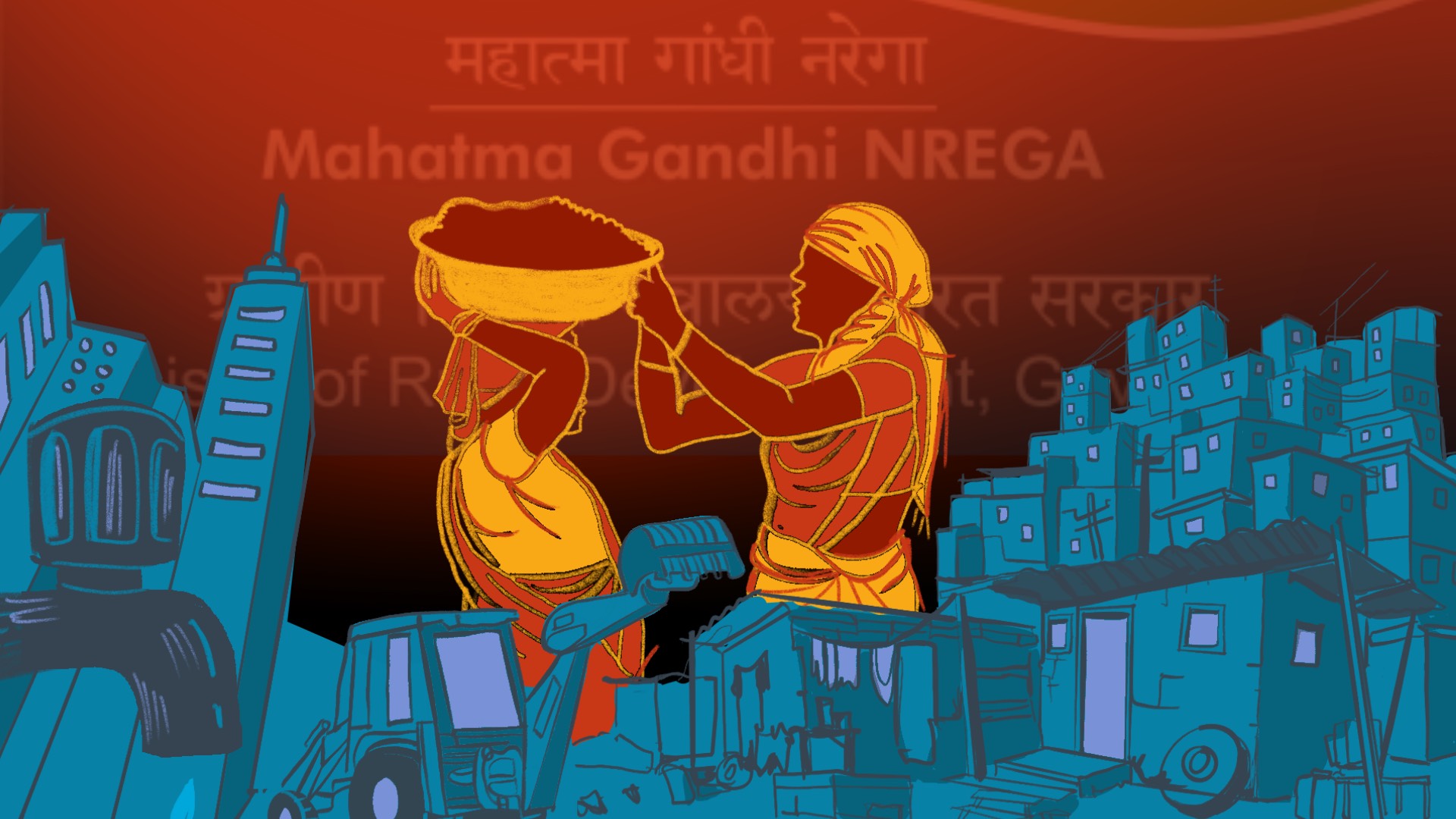
“How will I survive without NREGA?” asked Kamla Devi, a widow from Beawar, Rajasthan, at a press conference in Delhi on December 17. Widowed some years ago and with no land or resources in her name, she has relied on work as part of the Mahatma Gandhi National Rural Employment Guarantee Scheme (MGNREGS) to provide her income.
There are 12.16 crore workers like Kamla Devi whose livelihood stands threatened with a new Bill that stands to repeal the historic MNNREGA. On December 15, the Union Government tabled the Viksit Bharat Guarantee for Rozgar and Ajeevika Mission (Gramin), or VB–GRAMG, Bill, 2025, which was passed by the Lok Sabha on December 18 through a voice vote and by the Rajya Sabha post midnight the same day, amid Opposition protests. The Bill will come into law once signed by the President of India.
Among other provisions, the Bill increases the number of promised days of employment from 100 to 125. The Centre would bear 60% of the costs and give states a “notional allocation” based on undefined criterion; any expenditure beyond this allocation will be 100% the state’s responsibility. With a pre-determined budget and discretionary powers to the Centre, the Bill violates fundamental principles of a rights-based legislation and dismantles the right to work, unions say.
The Bill also centralises power with the Centre while shifting the financial and implementation burden on to the States, says Dipa Sinha, an economist and an assistant professor at the School of Liberal Studies, Ambedkar University, Delhi. “There are many issues on ground but many would have been resolved if the initial MGNREGS itself was implemented in the spirit of the Act,” she points out.
The legislation came on the heels of India’s long history of public spending on rural development and poverty reduction programmes, such as the Food For Work initiative. In 2005, the ruling United Progressive Alliance government passed MGNREGA amid high unemployment, inflation, and resistance by worker unions. In promising 100 days of guaranteed unskilled employment in a year to the rural poor, it legalised the right to work. It remains the world’s largest employment guarantee programme, and at the time of its inception was believed to be a “game changer” and the “single most innovative programme from India and a lesson to the whole world”. A group of social scientists have warned that dismantling MGNREGA would be a “historic error” that would imperil gains made in poverty alleviation, social justice, and environmental care.
However over the last few years, MGNREGS has been hit by budgetary constraints, delayed and inadequate wages, irregular work flow, and issues of digital compliance in the last few years but it still offered social security benefits, encouraged local land development, and bolstered the bargaining power of workers. As the world’s “most significant policy operationalising a demand-driven, legal right to employment”, it affirmed economic dignity as a fundamental right, economists have noted. In an interview with Saumya Kalia, Dipa talks about the proposed reforms and how they dilute the right to work. Edited excerpts below:
Does any aspect of how the recent Bill was introduced – the name, timing, core provisions – strike you as significant or surprising?
In terms of the content, some parts of the Bill codify what the Union Government has been doing stealthily for some time. It fits in the larger narrative of how MGNREGA has been undermined over the years, so that is not entirely surprising. What is surprising is the manner in which it was introduced. Even with the labour codes, they put up drafts and asked for some responses — although they didn’t take anything into consideration — but at least there was a pretense of some process. This Bill did not even see the amount of public consultation the labour codes had; it was just abruptly listed on Monday.
The way it’s being done is a bit puzzling. They want to repeal a rights-based law without due consultation with workers, unions, or activists.
Does the new Bill address any of the limitations of MNREGS in terms of budget constraints, wage delays, or work demand-supply gap?
It’s been 20 years since the Act was passed and times have changed, so there is a need to rethink it for sure. The Amarjeet Sinha committee was constituted in 2021 to review the implementation. But I don’t see the need to repeal the whole Act and replace it with new legislation.
The many issues on the ground could have been resolved if the MGNREGS was implemented in the spirit of the Act. Many difficulties were created in the name of reforms. A major set of these relate to the digitisation of processes in the last few years – insisting on digital attendance records, and real time monitoring through the National Mobile Monitoring System app which have caused many issues on the ground. Now these digital solutions touted as reforms are being made into laws. (Research shows that digital fixes have not brought 100% success. Reetika Khera argues that technological solutions have reduced transparency instead of enhancing it, resulting in corrupt practices in states that could earlier control malpractices.)
Also, the tendency towards overcentralisation began to happen in different ways earlier. Under MNNREGS, the Centre makes an initial allocation at the beginning of the year, states implement the programme, and revised budgets are sought based on actual demand. Earlier this year, the government brought in a notification placing caps on how much states could ask for. The government circumvented questions on this, maintaining that MGNREGS is a demand-based scheme and they will “make funds available as per demand on ground”. Our argument even then was if the Centre signals a cap in advance, states will inevitably underestimate demand during implementation because they are unsure whether funds will be released.
The third concern had to do with wage revision. NREGA has a separate wage rate not linked to notified minimum wages, and its updation each year has been so meager that the current NREGA wages are quite low compared to even the prevailing market wages. The demand for NREGA exists on the ground, and the work being provided currently is inadequate. Also its broader effects – on the labour market for instance – are getting diluted. The Bill is not meeting or addressing any of these concerns.
Activists argue that the new Bill centralises power by giving the Centre discretion over state-wise allocations, while also shifting financial responsibility to the states. How does this change the nature of the job guarantee?
In this new legislation, the Central Government will use some parameters – we don’t know what – and in the beginning of the year make a ‘normative allocation’ for each State. The Bill still uses the word ‘demand’, but what happens if the demand is more than the normative allocation in a state? It also very clearly states that for any expenditure above this normative allocation, states will have to bear the entire additional expenditure themselves, and even this has to be approved by the Centre. So you’re shifting the entire liability to the state government which has to operate within centrally determined norms.
It is important that a job guarantee scheme be driven by demand — because it’s a right and not some largesse of the State. And all these benefits of floor wages, restricting migration, and more are realised if work is available when people need it. So it’s also about shifting power within the labour market, giving the worker a say over where they’ll work and for how much, because currently the power is tilted towards the employer.
Estimates show that states might be expected to shell out almost Rs 55,000 crore. Do they have the fiscal capacity for this and what will this burden do to the delivery of job guarantee?
States are already struggling; we’ve been seeing state chief ministers coming up to Delhi, holding dharna and lodging complaints. It’s not only NREGA, so many things have been shifted to the states. There are delays in GST transfers which are being contested. Over time, GST has also hit the revenue raising capacity of states. At the same time, the Centre has shifted its revenue composition between cess and tax revenue in a manner where cess is becoming higher – this matters because cess is not shareable with states.
So you’re squeezing state revenues but asking them to spend more on development schemes while curtailing their freedom to spend. Take the National Rural Health Mission for example: if the signage over a Health and Wellness Center (Aarogya Mandira) is not per the Centre’s design, they wouldn’t give you the money.
Why is decentralisation important to a job guarantee legislation?
The whole point of NREGA was also to empower the community. NREGA said that you would have a shelf of works which would be decided in the Gram Sabha which would decide if there is a need to construct a road, clean the talaab, dig up the school playground, and so on. And then as and when people demand work, they would look at that shelf of works and pick. The new Bill still empowers the Gram Panchayat to make a Gram Panchayat Development Plan but the main objective and core priorities will be defined by the Centre. And once these plans are made, they will all become part of the Viksit Bharat National Rural Infrastructure Stack [a unified framework under the new Bill for listing public works], from which the centre will pick its priorities. If you have a decentralised mechanism, why insist on a National Rural Infrastructure Stack?
The country is very diverse, and these things should be left to be planned locally. Only when there is local accountability and people have ownership in the scheme can these problems of leakages and so on be addressed. In that sense this Bill is similar to the earlier Food for Work programme, and other such schemes, when the government opened up work opportunities when it felt like it.
The Bill turns a legal right into a centrally sponsored scheme. What would be the impact on the broader landscape of employment security in rural India, especially the landless labourers and women who depend on it? Could there be further casualisation of labour?
The Bill says it will provide 125 days of work but people are not even getting the 100 under MGNREGS. MGNREGS is a fallback option, it does certain things. For instance, it offered basic social protection, ensuring there are no days when people go without food and other necessities. People don’t have savings, so the availability of work through NREGA mattered when there was no other work.
Having this security as a demand-based right had a positive effect on the overall labour market as we saw in the first few years of NREGA, before it started getting diluted.
One effect of this work was that it paved the way for a fallback wage. If there is work available at minimum wages — particularly for women, because there is no gender wage gap here, unlike in agricultural labour markets — it matters greatly. At least 55% of MGNREGS workers are women. If a woman knows that she can demand work under NREGA and earn Rs 250, which is the current average wage, her bargaining power in the labour market increases. She can refuse to work for less.
Studies from the initial period showed that MGNREGS did contribute to raising market wage rates. More recently, however, market wages have risen to around Rs 300 while the MGNREGS wage has remained at Rs 250, and so it no longer plays that role. That is why one of the key demands has been that MGNREGS wages should also be revised, in line with minimum wages and inflation.
NREGA also had the potential to, and in the initial phases did, curtail distress migration. In lean work seasons in villages, the option of MGNREGS ensured that workers wouldn’t have to come to a city to work as rickshaw pullers. With the new programme, that protection weakens.
What are the contradictions built into the Bill when it claims to preserve the job guarantee? What does this mean for the right to work – are we diluting or dismantling it?
One contradiction is the restriction on employment during the agricultural season. [The Bill restricts work for 60 days during peak agricultural season. This “60-day blackout” will hurt the bargaining power of women, landless and other marginalised communities, said the NREGA Sangharsh Morcha in a press release.]
If work is meant to be on demand, then why say that for 60 days you cannot demand work? One section says the schedule of rates should be estimated on the basis of a normal working day of eight hours with a one-hour break. But the very next clause allows for work extending up to 12 hours. Again, like with the labour codes, they are diluting the right to work. If you’re working 12 hours a day and not getting minimum wages, then that’s bonded labour, not decent employment.
The new Bill proposes digital compliance through geospatial planning, AI for fraud detection and more. There is enough evidence that things like biometric authentication have created hurdles. What risk would tech interventions pose for workers?
The Bill uses a lot of big, vague language around things like geospatial planning and AI-based fraud detection, without explaining what these mean. The Bill frames these digital interventions as great successes and therefore making it part of the law.
These digital interventions have already undermined the right to work, as we saw in the last few years, where wages were not being paid on time and many were being excluded. Wage delays push people to migrate, especially to jobs like brick kiln work where they are paid in advance. These are not people with savings so the timing of payment became very important. And many of those delays were the outcomes of centralisation.
A lot of activism and policy debates had led to the recognition of rural employment as a right. Why do these labour gains need to be remembered today?
NREGA came at a time of great rural distress and across the country there was a demand for a solution to unemployment in the run up to the 2004 elections. Towards the passing of the Act, there was huge mobilisation by civil society, by Left parties; on the street, in the Parliament, many of these issues were discussed. Should it be universal or not? Should it be 100 days or 300 days? Should it be an individual or household entitlement? What about accountability measures? Each of these was a struggle, it didn’t come easily. And it is in locations where the struggle was intensive and people’s participation was overwhelming that the programme functioned the best.
Now it has also become difficult to protest. After the passing of the Act, NREGA unions were formed in different parts of the country and they came together in various forums like the NREGA Sangharsh Morcha. They have all been fighting for issues like higher wages, and against digital exclusions among others. They’ve been trying to come out on the streets as much as they can, given the prevailing constraints of, say, obtaining permission to protest at places such as Jantar Mantar.
[The NREGA Sangharsh Morcha called a nationwide protest on December 19, 2025, against the new Bill. The Delhi Police refused permission to hold a dharna anywhere in Delhi, including Jantar Mantar.]
Further reading:
- Nikhil Dey and Aruna Roy explain why the new Bill completely does away with the right to work as an entitlement.
- Jean Dreze’s analysis of MNREGA through the lens of employment generation, women’s participation, and more.
- Read the whole Bill here.

We believe everyone deserves equal access to accurate news. Support from our readers enables us to keep our journalism open and free for everyone, all over the world.
