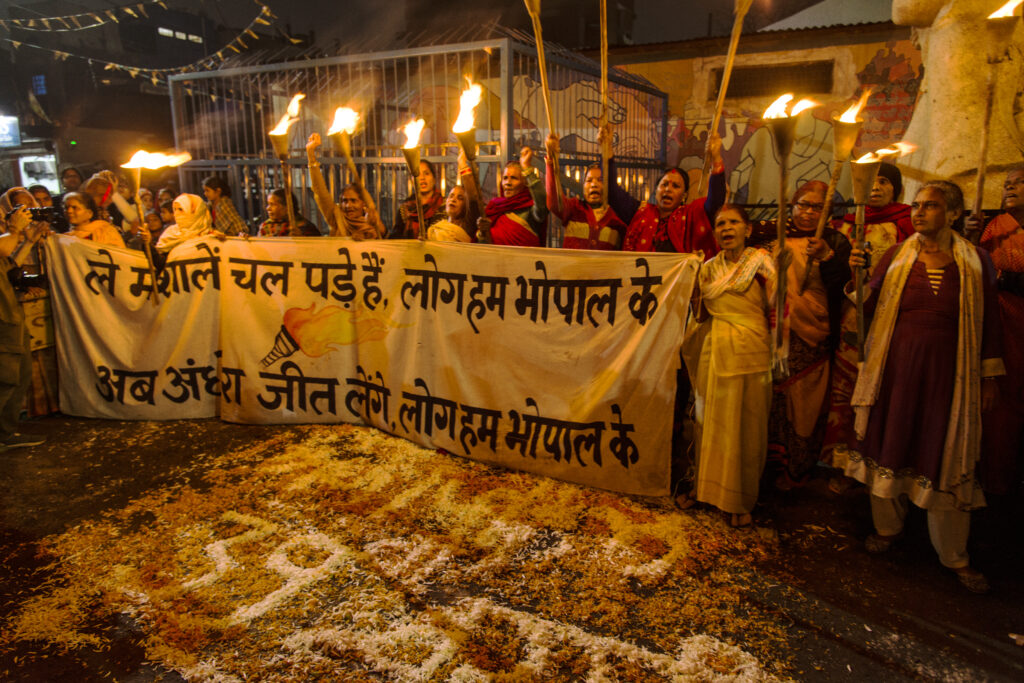
The women came from working class families, marginalised communities and slums and India’s worst industrial disaster had flung them into even greater precarity by killing or sickening their loved ones, forcing them into the workplace. But for 41 years, Bhopal’s women have kept up their campaign for justice for the victims, survivors, and multiple generations of families hit by the catastrophic gas leak.
In the first part of our series to mark the 41st year of the tragedy, we had reported on how the decades have done little to ease the lives of the survivors. Whether it was the contaminated water, the abysmal compensation or livelihoods, the night of the gas disaster never quite ended for many. In the second part, Bhanupriya Rao explores the remarkable role women played in spearheading and sustaining the search for answers and accountability in the intervening decades.
Till December 2, 1984, Rasheeda Bee had never even heard the name Union Carbide. That night, she had just finished rolling beedis, her daily home-based work, and was preparing to sleep when she saw what she describes as “insanon ka sailaab (a sea of people)” running in terror.
Clutching her toddler, with her husband beside her, she fled. They had barely covered half a mile when they collapsed. Her eyes were swollen and her chest was burning.“Maut us din haseen lag rahi thi (death seemed welcome that day),” she says. When she regained consciousness, half her family of 37 were gone. Bhopal lay shrouded in death—human bodies, animals, even fish floating lifeless in the lakes. “Jo us din bache, woh aaj tak til til ke mar rahe hain (those who survived have been dying slowly since then),” she said.
Thereafter, the name of Union Carbide and its successor Dow chemicals, shaped her days and nights and fueled her lifelong fight for accountability. Her unwavering motto all these years has been ‘Bhopal ko insaaf’. It is not just Rasheeda. Nasreen, Leela Bai, Savitri Devi, Reena Devi, Batti Bai, Sakina, Shumaira — and countless other women — and their determination have kept Bhopal’s fight for justice, accountability, medical care and fair compensation alive.
Their struggle has never been around a single issue. It is simultaneously a battle for labour rights for women workers. It was a multipronged agitation with the women devising new strategies to grab the attention of an apathetic administration. They collected data, held public demonstration, travelled the globe, kept night vigils, hosted mock dinners that served up ‘sevin tar souffle’ and ‘sludge mouse’ to shame those who declared the city’s water ‘safe’ and trudged the whole 450km to Delhi several times to draw the country’s attention. And over time, these women, along with economic and caregiving roles, also rose to lead a transnational struggle for ‘all Bhopals everywhere’.
Just last week, Bhopal police filed a case against protestors for burning an effigy of the Rashtriya Swayamsevak Sangh. Ladai badhti jaa rahi hai (the fight hasn’t ended yet), as Rasheeda Bee says. Speaking to the women, for us at BehanBox, has been an unforgettable lesson in solidarity and perseverance.
Read our story here.