
Why ILO’s New Convention On Platform Work Falls Short On Gender Inclusion
Platform workers from marginalised groups face layered challenges in the labour market but this intersectional lens is missing from the convention
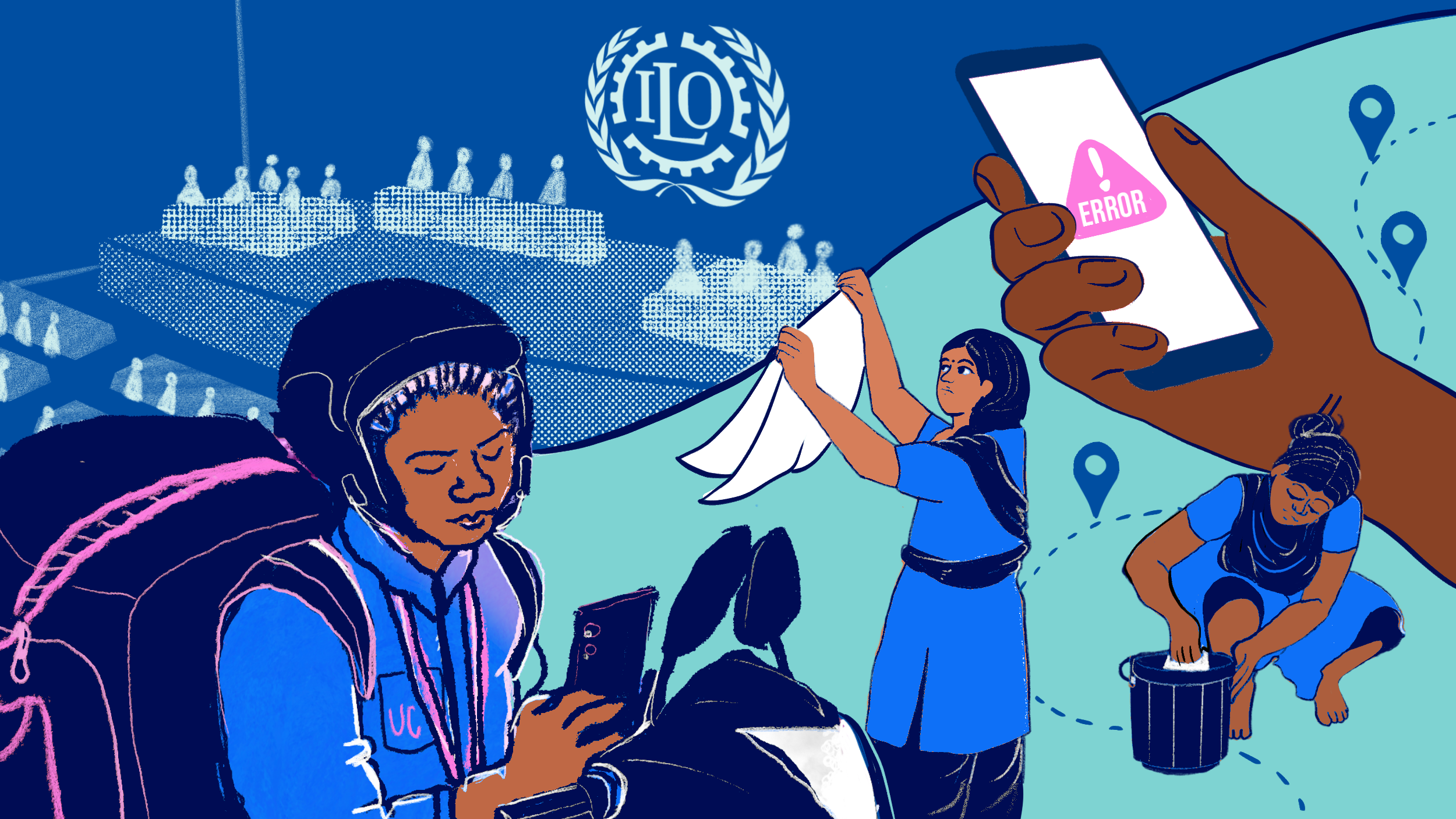
The new Convention on Decent Work in the Platform Economy (C193), adopted in June this year by the International Labour Conference (ILC), evolved through a democratic and consensual process. But the discussion of gender inclusion in that process was both restrained and constrained, and the resulting text largely omits specific language protecting women workers and those from marginalised gender groups, as we detail later in this analysis.
Why was this specific inclusion important? Much of the discussion on platform work focuses on the ride-hailing and delivery sector, a mostly male-dominated space because of gender constraints on mobility, and concerns about safety. As Carina Mineia, the president of SINTRAPILRS (Sindicato dos Motoristas por Aplicativos do RS), the union of of taxi workers in Rio Grande do Sur (Brazil), explained the needs of women workers like her who are a minority in the cab-hailing sector go unmet because they are specific needs and easily ignored.
Further, sectors where women and those from marginalised groups – in terms of caste, religion or sexuality – find work tend to be within households. This could be beauty and wellness work, domestic work, or data work. These are unique workspaces because it needs workers to enter a private household, leaving them vulnerable to harassment or because the nature of the work tends to be violent.
Women workers who deal with unpaid carework at home also shoulder a double, often triple, burden. Since carework limits their time and mobility and they need more flexible work arrangements, they often can’t take on paid work on the same terms as people without these responsibilities. Similarly, platform workers from marginalised groups face layered challenges in access to the platform labour market. Therefore, it is necessary to bring an intersectional gender lens to this new convention.
In the run-up to ILC 2026, several unions, groups and civil society organisations began setting down a set of workers’ demands, and took these to the discussions in Geneva. As a worker group delegate, and affiliated with the Women in Informal Employment: Globalising & Organising (WIEGO), I was in a position to witness how these demands were presented, which worker demands were conceded and which had to be given up. This analysis draws from my experiences at the ILC.
Attempts to Derail Conversations
It took several years of collective action for the ILO to place platform work on the agenda of the International Labour Conference, culminating in the adoption of Convention 193.
The emergence of digital platforms had come with the promise of employment, but soon it was evident that their model was built upon extraction of labour and income from workers. Platform workers began collectivising, both within traditional union structures and in new collectives. The Indian Federation of App-Based Transport Workers is one example. Worldwide, there are several groups, such as the Kenyan Union of Gig Workers, the Data Labellers Association, and Turkopticon.
The path to the adoption of the convention was not straightforward, and employers’ groups used several narratives to derail conversations on worker protection. One such example was the employers’ group’s persistent use of the language of ‘flexibility’ and ‘entrepreneurship’ at discussions to loosen platform regulation. Their argument was that this flexibility was particularly important for young workers and for those with unpaid care responsibilities, and that forcing platforms to set up a minimum standard of protections would harm, not help, workers. This line of argument was disingenuous because workers, even those who may choose to be self-employed, still need a minimum standard of protections.
Tannaree Jaruprasit of the Southern Riders Association in Thailand had articulated these anxieties to the committee. She argued that “flexibility means insecurity and a lack of protections” and that “[this unpaid work] is the result of a failed economic system, and there is no justice without the acknowledgement of women’s work”.
The workers’ group included a diverse set of delegates, both regionally and by sector. While the representation of worker delegates at the ILC was skewed, with 77% of these being men, International NGOs in the room enabled the participation of a more gender-diverse worker group – domestic and care workers, ride-hailing and delivery workers, data labellers, and content moderators. The caucuses were open discussions, and the workers’ Chair, Amanda Brown, made space for dialogue, discussion and disagreements.
At the discussions, however, there were instances when the US, Argentina, New Zealand, and India obstructed discussion on critical issues such as the demand that algorithms should not infringe on fundamental rights at work. An ILO study in Uganda showed how algorithms determined the jobs offered to workers, basis ratings and reviews. And how bad ratings could directly lead to account deactivations, often without channels of contesting this decision. But the employers’ group pushed to delete the article on automated decision-making entirely arguing that regulating technology fell outside the ILO’s mandate and risked hampering innovation, intruding on companies’ operations, and encroaching on intellectual property protections. Ultimately, the workers won an important clause on algorithmic management.
The employers also blocked consensus in discussions on the classification of workers, payments and remuneration, data protection, and other issues, forcing backroom negotiations on these issues.
It was also telling that in a parallel committee on gender equality in the world of work, the US government representatives demanded that the discussion not use the term ‘gender’ and only a binary ‘men and women’. This is not surprising given the rising trend of gender exclusion in the US. But since the US ended up boycotting the discussion, it led to a more robust outcome for the committee.
Over-reliance On National Laws, Practice
Most experts at the discussions and prep meetings pointed out that any ILO Convention, including C193, should be looked at as a floor for regulation that governments will aim to reach and hopefully build further on. Workers from marginalised groups had hoped that the convention would raise the floor higher. It did this but only to a limited extent.
One of the main areas of concern for women workers is the over-reliance on national laws and practice because these often leave out marginalised workers. C193 was a missed opportunity for an international body to build a higher floor in terms of de-linking protections from national policies rather than guaranteeing all workers access to rights and protections. This matters disproportionately for women because across the platform economy, women are overrepresented in precisely the categories of work wherein national laws have historically treated workers as informal, unregulated, or beneath the threshold of “real” employment.
WIEGO’s work throughout the negotiations argued for a convention that recognised platform workers regardless of whether they sit in the formal or informal economy, precisely because a text that defers to national classification systems will reproduce, rather than correct, the exclusions those systems already encode.
Vague Protections For Self-Employed
A significant share of women platform workers – resellers, home-based producers, informal delivery and errand workers – are self-employed or own-account workers. C193 extends some protections to workers “regardless of their status in employment,” but the strength of the obligation shifts depending on that status. Where an employment relationship exists, protections are firmer; where it doesn’t, Member States are frequently asked only to “take measures” or “give consideration” to extending equivalent treatment. For a workforce in which women are already more likely to sit outside a recognised employment relationship, this tiering builds inequality into the convention’s architecture itself.
Article 12, on social protection, is a case in point: workers are guaranteed access to social security only “on terms no less favourable than other workers in similar classifications”, a formulation that leaves the actual content of that protection to be defined – or not – by each Member State. Where a country’s existing social security architecture already excludes informal and own-account workers, C193 does little to force the issue. For example, India’s 2020 Code on Social Security extends social protection to gig and platform workers, but the code provides better protections to ‘employees’ than to gig workers. A LiveLaw article states how employees benefit from gratuity and provident fund schemes, but platform workers are left out. If India were to ratify C193, there would be no obligation to improve this code on social protection, leaving platform workers in their current state of exclusion.
Another example of this is Article 10 on payments or remuneration, which requires that remuneration be “paid in a timely manner, in full, and by lawful means of payment”. For workers outside a recognised employment relationship, however, the operative language softens to Member States being asked to “give due consideration” to extending equivalent protection. Given how many women in the platform economy – particularly in the Global Majority – work as self-employed or own-account workers, this is precisely the group for whom a firm payment guarantee would matter most.
Correcting Disingenuous Labelling
C193 does hold a decidedly clear win for workers – the correct classification of workers within the platform economy. This issue of misclassifying workers as ‘independent contractors’ and subsequently denying them their due rights and protections has been a feature of platforms. Here, the Convention’s classification provisions (Article 9) direct Member States to determine status “guided mainly by the facts relating to the performance of work” rather than contractual labels. This means that platforms cannot falsely claim or categorise workers as “independent”, rather the actual terms of their work will decide how workers should be classified. This is a genuine improvement on the status quo, with implications for all workers.
Another area of concern is the definition of a ‘digital labour platform’ in the new convention because it includes only those that operate through ‘automated decision-making’ or algorithmic management. But we know that women workers in particular, due to issues of access, capability, use a variety of platforms.
HomeNet International’s – a global network of home-based workers and their organisations – Jemina Nyakongo made this apparent at the discussions: home-based workers, who are often own-account workers, may not use popular gig-work platforms, but we are seeing an increasing use of online platforms for sale of goods, including social media, digital marketplaces.
At the same time, the inclusion of ‘intermediaries’ within the convention language, is useful for women. These intermediaries often influence access to platforms, using these on behalf of workers. It is disproportionately women who use human agents to access platform work and employment. Article 24 of the new convention specifies that States must apply this convention not just to the platforms themselves, but also to these intermediaries that operate within the platform economy.
On Occupational Safety and Health
The provisions of C193 stop short of naming sexual harassment. Article 4 requires Member States to ensure risk assessments and preventive measures against “occupational accidents, occupational diseases and any other injuries to health.” Article 6 protects workers from violence and harassment, including at the hands of clients. Both are meaningful advances and new ground for an ILO instrument but neither names sexual harassment specifically, despite it being one of the most consistently documented risks facing women in location-based platform work.
A gender-neutral reference to “violence and harassment” can be read to include sexual harassment, but naming matters. Without it, countries can default to whatever their existing labour code already covers — and in many jurisdictions, that is not much. Nyambura of the Women Commercial Drivers Association of Kenya, explained that OSH is particularly essential to marginalised workers – facilities like clean washrooms, are particularly important to women workers and other vulnerable groups. So is the threat of sexual harassment and abuse.
In India, the realities of caste-based marginalisations within OSH are stark. A report found how women platform workers in the beauty and wellness industry had to carry bags that often weigh over 7kg. “Then we spend time looking for customers’ homes in the heat, and we climb up staircases to reach the customer. After this, we are not even offered a glass of water by the customer,” said a worker featured in the study. “If we even ask customers to fill our water bottle, they will give us a poor rating and leave a negative review stating that she asked for water while on the job.” These are class-and caste-based discriminations in the context of India indicating the need for local, contextual protections within State laws.
Experts argue that C193 should be read in conjunction with C190 – an earlier convention on violence and harassment at the workplace – which pays special attention to sexual harassment and gender-based violence. However, the ratification of this convention, which was passed in 2021, stands at 56 countries. Several, including India, the USA, several African Union nations, are yet to ratify it. There is no obligation for these countries to adhere to the standards set in C190, and C193’s neglect of gender-specific language on OSH remains stark.
What Next?
Several workers’ organisations, mainly unions such as Auaton in Nigeria, are pushing their national governments to ratify C193 and align national regulations with the new international standard. But, will their daily lives change with the adoption of C193? Likely not, as bigger challenges around income inequality in the context of control by capital forces workers into these precarious employment conditions.
As Roshan, a beauty and wellness platform worker and member of the Gig Workers Shakti Group in India, said at the discussions: “There can be laws and rules and regulations, but if they don’t change the lives of workers in real terms, it is of little use.” Pamela from the Nanny Solidarity Network, in the United Kingdom reiterated this view: “The work is not over, and we need to push for rights of all workers. This includes Unions as well, which need to bring in more diversity in their leadership.”
The functionality of several platforms depends not just on technical infrastructures, but social inequalities on which these structures are built. Particularly in feminised sectors – such as domestic work – class inequalities, amplified by religion and caste marginalities dictate how much power workers hold and how they can use it.
Rohini, a worker, was interviewed by a King’s College researcher, and cited in a BehanBox report on how domestic work platforms are affecting the sector. She said: “Customers always ask us for extra work”, which is often impossible to refuse for fear of retaliation in the form of a low rating, bad review, or even physical or verbal abuse. This broader inequality requires systematic and strong worker power building through unions and other collectives. And for this restructuring to be feminist, unions have to hold themselves to a higher standard of inclusiveness.



We believe everyone deserves equal access to accurate news. Support from our readers enables us to keep our journalism open and free for everyone, all over the world.
