
The Many Double Standards Of India’s Maternity Benefits Policy
An excerpt from development economist Reetika Khera’s book, 'Freebies or Rights: Understanding Social Policy in India'
Maternity benefits for women in India’s unorganised sector are among the lowest in the world even as the organised sector compares favourably with developed countries. An excerpt from development economist Reetika Khera’s book, Freebies or Rights: Understanding Social Policy in India.
MATERNITY BENEFITS
Some Women Are More Equal
Some years ago, I came across an infographic on X that plotted the duration of paid maternity leave for select countries. The infographic was attributed to UNICEF. It sought to embarrass the United States, because women there are not legally entitled to paid maternity leave. According to that infographic, India (with twenty-six weeks of paid maternity leave) ranked second after the UK.
It is true that according to the Maternity Benefits (Amendment) Act 2017, some Indian women are entitled to twenty-six weeks of paid maternity leave. Indeed, it is a matter of pride that India is in the same league as the UK and better than the US. Yet, it was exasperating to see this infographic. Why? Because, the 1961 Maternity Benefit Act (amended in 2017) is applicable only to women employed in the organised sector. Employment in the sectors to which the law is applicable is barely 20 per cent of total employment; women’s share is lower still. Most Indian women work in the unorganised sector and the generous benefits under the 2017 law do not apply to them. In fact, until 2013 when the National Food Security Act was passed, women in the unorganised sector did not have a legal entitlement to maternity benefits (see Table 3.1).
The National Food Security Act (NFSA) 2013 envisaged maternity benefits as a universal right of women, providing Rs 6,000 per child. Note that for women in the organised sector, there is job protection and full wage compensation for almost six months. In the unorganised sector, however, where the most disadvantaged women work, a flat-rate compensation of merely Rs 6000 is provided.
Table 3.1 Disparity in Maternity Benefits
Four aspects of maternity benefits | Organised sector | Unorganised sector |
Is it a legal right? | Yes. Since 1961. | Yes. Since 2013. |
Job protection | Yes | No |
Wage compensation | Yes. 100 per cent of salary | Partial. Flat-rate, Rs 6000-18,0001 |
Full-rate salary compensation | 26 weeks | 2-6.52 weeks |
To get a sense of the unfair treatment inherent here, we can set Rs 400 as a benchmark daily wage. This would amount to roughly Rs 72,000 for twenty-six weeks. By contrast, the provision in the NFSA 2013 (Rs 6000) is not even 10 per cent of this very modest benchmark wage. Moreover, there is no provision for inflation-indexing the flat-rate cash support. Consequently, there has been no increase since the law was passed in 2013, more than ten years ago.
The injustice to women in the unorganised sector does not end here. Their rights as per the law passed in 2013 remained on paper for more than three years. After demonetisation in November 2016, when the government was scrambling for some remedial measures to counter the damage from it, it fell back on the provisions of the NFSA 2013. On 31 December 2016, the Prime Minister announced maternity benefits of Rs 6000. Another six months passed before the Pradhan Mantri Matru Vandana Yojana (PMMVY) was implemented to operationalise the provisions of the NFSA.
Surprisingly, the PMMVY reduced women’s legally mandated entitlement (and the PM’s announcement) of Rs 6000 to Rs 5000. Instead of giving it for all births, it was limited to the first ‘live birth’ only. Both were violations of the National Food Security Act, yet few people objected.
The contrast in the public reception to the amendment of the Maternity Benefits (Amendment) Act, 2017 and to PMMVY was revealing. When the PMMVY was announced, some expressed their displeasure. They believed that giving Rs 6000 as maternity benefits would act as an incentive to have more children. There is little empirical basis in India for the assertion that cash support (even of the generous kind) increased fertility. The likelihood of this happening when the cash support is merely Rs 5000-6000 is even lower.
Oddly, some of these critics were themselves beneficiaries or supporters of twenty-six weeks of paid maternity leave. Such objections were not made when the Maternity Benefit Act 1961 was amended in 2017, to increase leave from twelve weeks to twenty-six weeks. In fact, that move was widely welcomed. It would seem that when privileged women are the target, there is little difficulty in recognizing maternity benefits as women’s rights, but when it comes to disadvantaged women, they are readily called freebies.
Table 3.1 shows the status of maternity benefits in India on four dimensions. The maternity benefits law passed in 1961 was limited to those in organised sector employment. With the passage of the National Food Security Act (NFSA) 2013 that changed. Maternity benefits became a legal right of women in the unorganised sector as well. This is not a small achievement.
Yet, on at least three counts, women covered by maternity benefits under NFSA 2013 are at a disadvantage compared to those covered by the Maternity Benefits (Amendment) Act 2017. One, only the jobs of women in the formal/organised sector remain secure. Two, as mentioned earlier, there is a big difference in compensation given to women in the two sectors. Converting the flat-rate compensation of Rs 6000 into daily wages at Rs 400 per day, would imply that women covered by NFSA 2013 are wage compensated for fifteen days. In Tamil Nadu, the flat-rate maternity benefit is Rs 18,000, implying a compensation for forty-five days (6.5 weeks). Both are much lower (2-6.5 weeks) than the twenty-six weeks of full compensation for women covered by the Maternity Benefits Act and the International Labour organisation (ILO) benchmark of eighteen weeks. Three, the ILO’s 1919 proposal included free health services, which in theory are universal in India, but the reach and quality of government health services is quite poor for many.
Returning to international comparisons with which the chapter opened, paid maternity leave is now common among almost all developed countries. The US is an exception, where there is no federal law that ensures maternity benefits for women. Some American states have state laws. Besides this, some private companies may voluntarily offer maternity benefits.
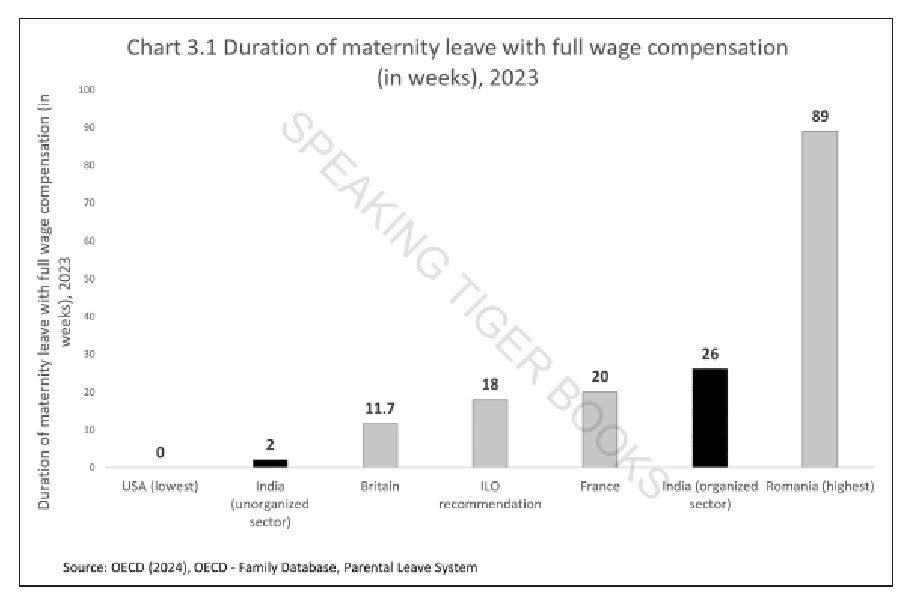
Chart 3.1 depicts countries with the lowest (the US) and highest (Romania) number of weeks for which full wage compensation is provided to pregnant women, with the ILO’s benchmark (18 weeks) in the middle. Between the two extremes lie the ‘two Indias’—the organised sector (26 weeks) and unorganised (2-6.5 weeks). Thus, maternity benefits for women in the unorganised sector in India are among the lowest in the world and much lower than the ILO recommendation (18 weeks). On the other hand, the organised sector is almost twice the ILO benchmark and compares favourably with other developed countries. These double standards are evident in other dimensions of social policy too (e.g., pensions).
Why Maternity Benefits?
The history of maternity benefits goes back to the First World War. In November 1919, as a result of women’s struggle, the ILO passed a resolution that had three main demands: one, twelve weeks paid leave (increased to eighteen weeks in 2000), two, free health facilities during pregnancy and immediately after delivery, and three, job security while on maternity leave (see Siegl 2019 and Jarvis 2010).
In India too, the debate on maternity benefits has a long history. It began before Independence, with Dr B. R. Ambedkar raising this issue in the Bombay Presidency (Tillin 2025 and Drèze et al. 2021).
Maternity benefits are recognised as a legal right for several reasons. First, child-bearing and child rearing need to be recognised as work. Women should be entitled to some social support for such work.
Second, female labour force participation rates in India are low, so fewer Indian women are economically independent, limiting their ability to support themselves. Those who are employed are often compelled to choose between family and career in the absence of maternity benefits. Without the benefits during their pregnancy, they end up quitting their jobs. By the time they are able to work again, i.e., their children are older, they encounter problems in re-entering the job market. Maternity benefits can facilitate women’s participation in the labour market and simultaneously enjoy safe motherhood.
Third, women have special nutritional and health needs during pregnancy. Data from India show that under-nutrition and vulnerability are high among Indian women. According to the fifth National Family Health Survey (NFHS), 57 per cent of women aged 15-49 years were anaemic in 2019-21, showing no improvement over the previous round of the NFHS conducted in 2015-16, when 53 per cent of women in the same age group were anaemic. According to the NFHS, one in every five women is stunted. Research has shown that health and nutrition have inter-generational effects, i.e., the mother’s health affects that of the child. The chances of a child being under-nourished are higher when the mother is poorly nourished. It is therefore not surprising that children’s nutrition outcomes in India are also poor.
For instance, according to NFHS-5 (2019-21), two-thirds of Indian children aged 6-59 months were anaemic. Given this, and the lack of economic independence, cash support to pregnant women becomes critical for accessing better nutrition and health services for themselves and the child.
Fourth, the economic independence that maternity benefits offer allows women to enjoy both rest and access to better nutrition. Without such benefits, women would have to choose between rest and work so that they can meet their nutritional and health needs.
Fifth, maternity leave allows women to follow the recommended practice of exclusive breastfeeding for six months. This is necessary for the healthy growth of the baby. As infants have to be fed at short intervals, women need to be close to their child. This is only possible if either crèches are available at the workplace (by and large non-existent in India, even in the formal sector where it is a legal requirement) or if women get leave from work.
Child-bearing and child rearing is work. Indian women struggle for economic independence on account of poor participation in paid work. During pregnancy and soon after, they have special nutritional and health needs; rest and a supportive environment that allows exclusive breastfeeding for the first six months of the child’s life are necessary. Maternity entitlements exist as a recognition of women’s rights during this challenging phase of their life.
Research on maternity benefits can be classified into two broad groups: its impact in, one, developed countries and, two, in developing countries. Studies of maternity benefits in developed countries focus on three major outcomes: fertility rates, child mortality, and women’s work participation rates. In addition, in developing countries, maternity benefits can
also affect outcomes such as duration of breastfeeding, and birth weight of the child. Most studies of maternity benefits are from developed countries because in developing countries (where the unorganised sector is larger) maternity benefits are not very widespread (Fallon et al 2017).
Amin and Islam assessed firm-level data from 111 developing countries to understand the impact of these benefits on women’s work participation and found that having maternity benefits increases their participation (Amin and Islam 2022). Similar results have also been seen in developed countries, although there, the length of leave also determines the extent to which women’s participation will be affected. As mentioned earlier, maternity leave can also affect the duration of breastfeeding (by staying at home the mother can feed the baby from time to time). A review found that twenty-one studies suggest that maternity benefits can increase the duration of breastfeeding (Navarro-Rosenblatt and Garmendia 2018). Recently, a paper on PMMVY finds that it has a positive effect on post-natal care and wasting (Taneja and Roy Chowdhury 2025).
For these reasons, the PMMVY, launched as part of the National Food Security Act 2013, measly though it is, is an important initiative. Further, there are few countries in the world that have universal non-contributory maternity benefits (Drèze et al. 2021, 47).
Extracted from Freebies or Rights: Understanding Social Policy in India by Reetika Khera. Published by Speaking Tiger Books.


We believe everyone deserves equal access to accurate news. Support from our readers enables us to keep our journalism open and free for everyone, all over the world.
