Gig, Domestic Workers Are Absorbing the Economic Costs Of Heat Stress: BehanBox Survey
Illness, lost productivity, survival costs, and lack of government or platform protections mean workers end up absorbing economic costs

Seema Kaur, a 30-year-old Zomato worker in New Delhi, labours for more than eight hours every day, earning roughly Rs 25,000 in a month. But this June, as punishing heat and humidity dizzied her on the job, she managed to scrape together only Rs 15,000.
Seema’s income fell. Other survival costs rose. And with no labour rights and protections gig workers like hers should be entitled to, she was left to absorb these costs alone.
This is one story of the very concrete economic consequences of extreme heat on informal workers. Informal women across Asia, African, and Latin American countries have lost $57 billion per year to heat-related productivity loss — a figure projected to rise 44% by 2050, per a recent HERA estimate. Closer home, in a study that surveyed about 500 informal workers, the cost of extreme heat is equivalent to 2% of India’s GDP each year, according to a new IIED research. Broken down, this figure meant that outdoor workers (construction, brick making, road-laying) lost 24 work days in a year that cost them $151 per year and indoor workers like those involved in food packaging or garment manufacturing lost $89 per year. The cost mounts even in the digital markets: 71% of workers reported a decline in income during summers, HeatWatch found.
And unsurprisingly, the impact is gendered. A SEWA analysis from March 2022 showed 90% of women in the informal sector reported 30–50% income loss – a finding echoed in other studies that extreme heat undermines women’s income and in turn their health, safety, and agency.
What does one make of these figures? The cost of heat is sharp, rising, and often not accounted for. Existing heat-productivity research is economist-driven and structurally can’t capture how heat results in income losses among informal workers, as we reported earlier.
Evidence — that links extreme heat to workers’ social identities and agency at work — is scant. BehanBox’s new survey narrows this gap.
We surveyed 48 informal workers for one month — domestic workers and platform workers holding up the city’s everyday labour across Delhi-NCR, Patna, and Jaipur – tracking the emotional and economic costs of heat stress on workers’ income, productivity, healthcare spending, care work, and more. What emerged is a record of loss and damage. The hardest parts of their days, workers said unequivocally, were due to infrastructural deficiencies: access to washrooms, access to cold water, no rest areas, no option for paid leaves, rising costs and physical exhaustion. In the case of gig workers, platform dynamics (such as mandatory logins between peak hours or carrying bulky bags in heat) deepened workers’ challenges. And for domestic workers, employer accommodation made a big difference in how much risk and cost workers absorbed: over half the sample couldn’t count on being offered water without asking or going without. Heat relief was inconsistent and shaped by personal dynamics, revealing the caste and class power structures that dictate this paid care economy.
The economic loss is a direct and indirect consequence of illness, lost productivity, survival costs, and lack of protections within the platform economy, we found.
The study also revealed the interlinked but understudied nature of care labour and climate realities. All women workers, including those who worked on platforms, said their time in paid informal work was the same as performing care work at home in the form of cooking, cleaning, fetching water, and child/elder care. This “double shift” and time poverty further reduced their ability to respond to, or cope with, heat stress.
Some of these costs can be counted — rupees spent on water and electricity, hours of work lost. Much of it lives in the emotional bargains workers strike and the toll on their psychological well-being. Losing out on income and economic security also meant delaying — denying themselves — long-held aspirations.
Komal Bairwa, a domestic worker from Dayal Nagar, Faridabad, has just one dream. “I want to buy an earring for myself.” But she has to wait because she is saving up for her daughter’s future so ‘’she can stand on her two feet and not need anyone’s support”.
Our study acts as an evidence that captures how heat materially and emotionally reshapes people’s lives. And offers a template for heat protections that places workers and their rights at the centre. From building rest stops and cooling stations to institutionalising support through paid leaves and health insurance, workers push for relief that is resilient against the biases of labour markets and inequities designed within cities.

Platform Workers
For gig workers, the financial burden of heat was felt from two aspects – lost incomes or wage penalty due to heat and higher spending than usual on heat-related coping mechanisms. On an average, a gig worker’s total financial burden of heat was Rs 5,063 per week, which constituted 88% of their monthly earnings during extreme heat months. In our sample, gig workers, on an average, earned Rs 23,957 over a four-week period, while their expenditure was Rs 23,596 in the same period.
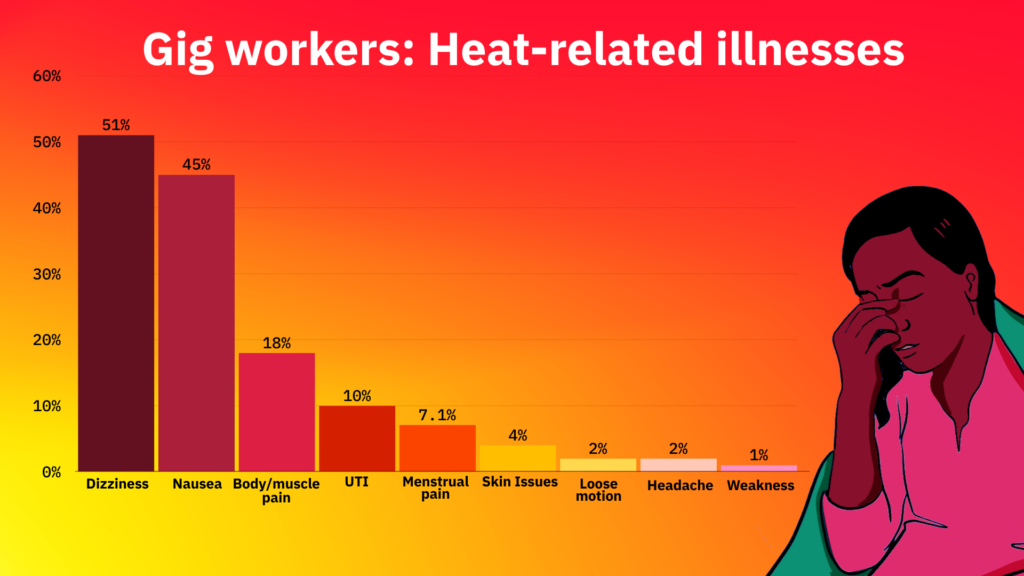
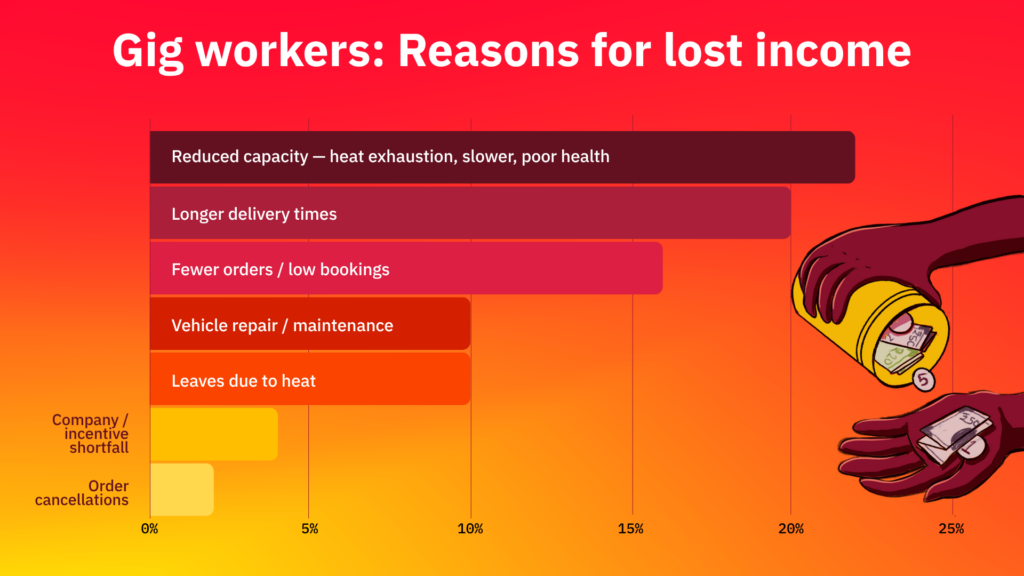
As gig workers are paid on a per job basis, any cause ranging from heat-related incapacity and illness, longer wait times, or vehicular malfunctions due to heat could cause a dent in their potential to earn. At least 22% of workers reported heat related incapacity to work. Seema Kaur (30), a beauty worker at Urban Company from Mandawali in Delhi, said she lost three work days because she had to be admitted to the hospital due to nausea, dizziness, and heat-related illness. She does not carry food from home on hot days as it spoils, so she either skips or spends on buying food from outside. “Jab shareer jawaab nahi dega, toh rukna padhega” (We have to listen to our body and halt when it asks us to). Tanuja Sharma (28), a gig worker from the grocery delivery platform Zepto, hints at another tactic: she shifted her work hours to evenings alone, but fewer hours have meant a loss of weekly earnings ranging from Rs 1,000 to Rs 2,500.
Roughly 20% of workers cited longer wait times due to queues at CNG stations, waiting for customers, and other forms of waiting as reasons for losing potential earnings directly due to heat. Longer wait times could be for any number of reasons–customer do not come on time to collect their deliveries or delay payments, especially those ordering on Cash on Delivery basis (CoD) who make delivery agents wait the longest, said Rajendra Maurya (37), an Amazon delivery worker from Jaipur. In one week, he estimates that he lost Rs 3,000 due to similar reasons whereas his average weekly earnings in other seasons were Rs 5,000.
Customer dynamics too placed a role: 16% gig workers lost earnings due to fewer orders from customers on extreme heat days. Pinki (27), who works with ride hailing platforms Ola and Uber in Jaipur, said that there were less bookings on extreme heat days and coupled with CNG which she says is expensive, spending up to Rs 2,000 a week, has strained her financially. Rising cost of fuel is one of the biggest expenses, workers said, but this phenomenon extends beyond the heat season as well.
Then there were specific occupational costs. About 10% workers said they either lost earnings or spent more due to vehicular repairs like tyre bursts due to extreme heat. Shugna Devi (38), a Dalit Uber and Ola driver in Jaipur, spent Rs 3,000 on CNG and another Rs 3,000 on servicing her vehicle due to heat-related malfunction in one week. Her total earnings for the week was Rs 7,000, barely allowing for Rs 1,000 in savings. Deepak Kumar(27), a Zomato worker from Jaipur, complained that his mobile overheats in extreme heat months, hindering his capacity to take more orders even while he spends half of his earnings on fuel.
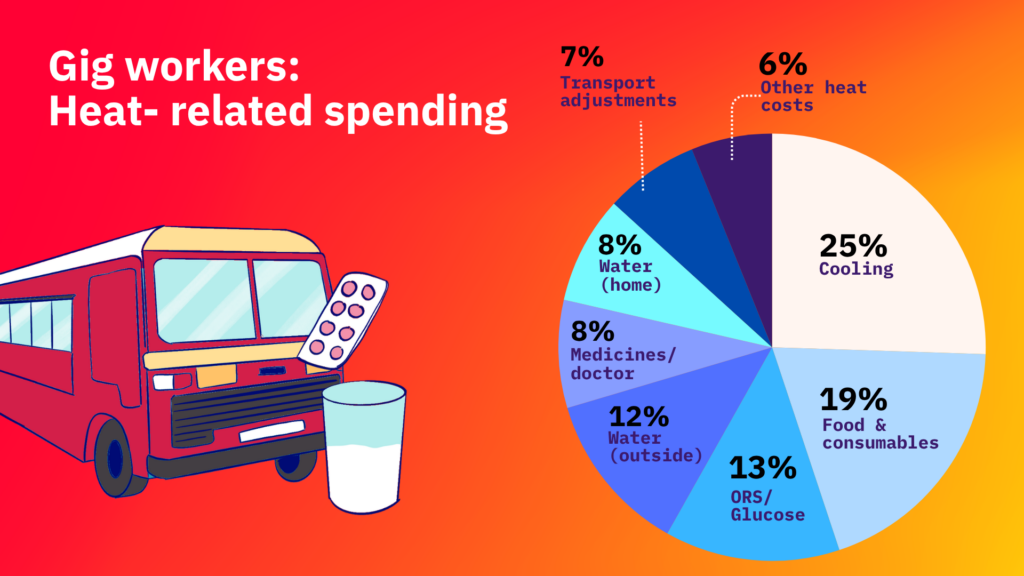
Workers roughly spent 7% of their earnings on transport-related adjustments.
Specifically, gig workers spent 45% of their earnings on coping with heat. Hydration is collectively the largest burden on which workers spend 33% of their money This includes ORS/Glucose (12.9%), water outside (12.4%), water home (8%). Staying hydrated costs a gig worker, on an average, about Rs 771 per week. Medical expenses — visiting doctors, purchasing medicines — eat up nearly 8% of the worker’s incomes.
Domestic Workers
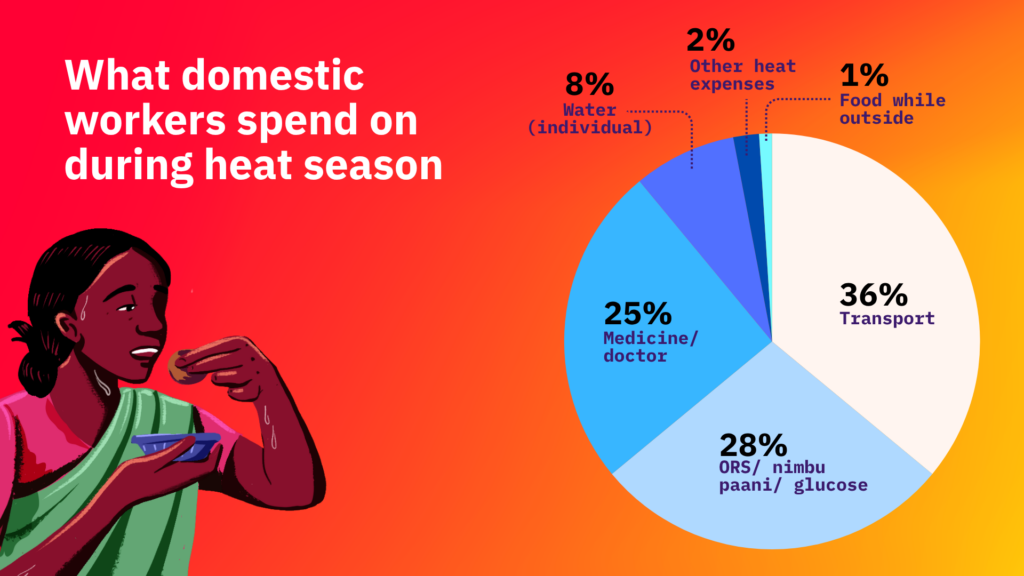
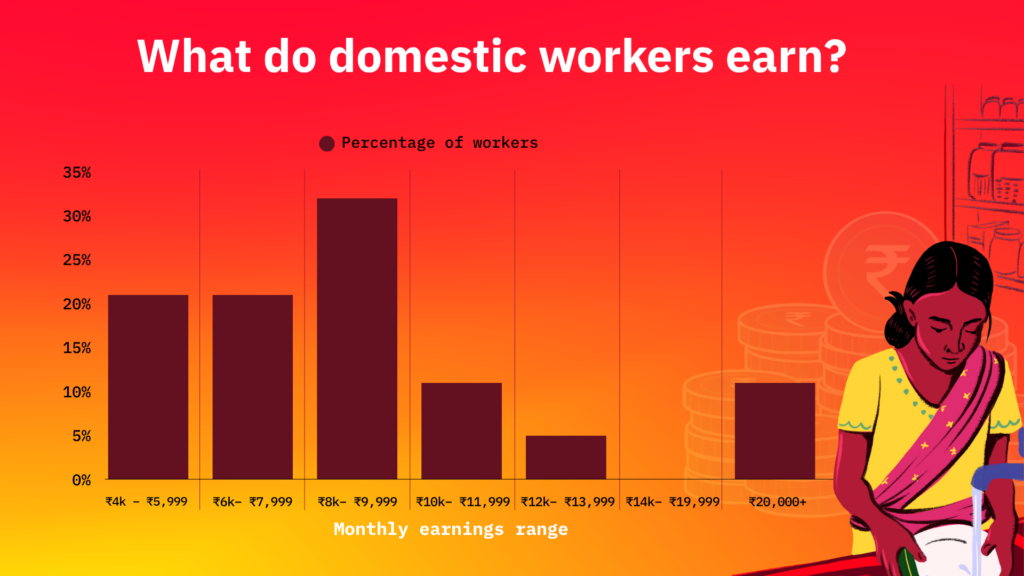
For domestic workers, the financial burden of heat is reflected in increased spending alone as they receive monthly wages from their employers and have less risk of a wage penalty. Even then, on an average, a domestic worker spent 14% of her earnings on heat-related expenditures in the extreme heat months of June-July. Nearly 96 of personal heat spending goes to just three things — transport (36%), staying hydrated (35%) and medical costs (25%).
Manju Devi (40) an SC domestic worker from Gautampuri has to spend more to cope because she has no lump sum money in her account: “Due to the extreme heat I’m buying ice from outside. My refrigerator is broken and I haven’t received my salary yet to get it repaired.”
The most telling aspect of domestic workers’ experiences is the foregone spending– what workers do not spend or hesitate to spend on– due to family commitments and assigned gender roles as mothers and homemakers. For instance, only three of the 19 domestic workers reported having their own umbrella, and 2 shared with their family members. Komal Bairwa (27), a domestic worker in Faridabad said “I don’t have an umbrella with me—I have one at home, but I can’t use it because the children take it. I have to go out in the sun.”
Maya (38) an SC domestic worker from Gautampuri in Delhi said “If I am very thirsty only then I drink water from outside, Otherwise, I drink water after coming home. This way I can save money for my rent.”
Sometimes, heat related spending went into fulfilling the desires of their family members, especially their children. Neha Gaur (28) from Gautampuri spent some of her earnings on buying a water park tap. “The kids were insistent on going to the water park. So, yesterday I brought them a water park tap so they could sit and bathe in it. Because if they go to the water park, it will cost a lot of money. The children were delighted to see the tap.”
Vaishali, through the four weeks of the period, gave several glimpses of how she spent some part of her earnings on her kids’ heat relief while going without her own. In the last week of July, she told us that she spent Rs 300 on juice for the kids. “This week I bought juice for the kids as it was very hot — the kids don’t drink water easily, so I had to buy juice.” She had suppressed her own cravings of having chowmein or sugarcane juice to be able to fulfill her children’s desires.
Sunita Kerketta (35) from Zamrudpur gave a glimpse of that rare small indulgence. “One day I ate an ice cream. I was going home and it was very hot, so I bought one for Rs 50 and ate it standing in a nearby shaded area.”
Hard Days' Work
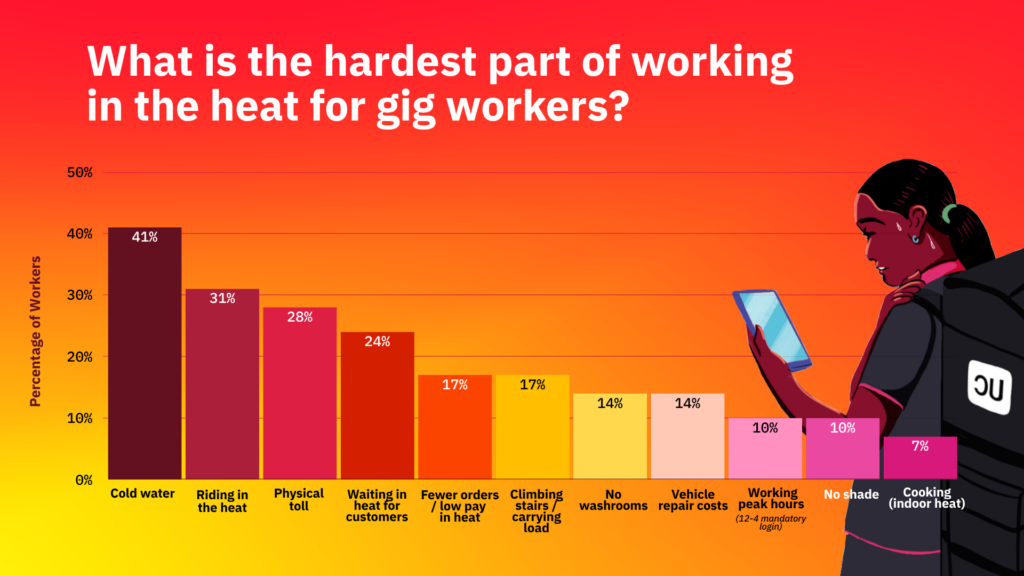
What was the hardest part of working in extreme heat, we asked both sets of workers. For gig workers who worked in outdoor heat, it was the lack of easy availability of cold drinking water and cool, shaded spaces to rest, followed by riding in the sun.
“Due to extreme heat I became physically weak, have skin problems,” said Mohammed Irfan (39), a food-delivery rider on Swiggy from Shastri Nagar, Delhi. For women workers like Seema Kaur who is disabled, and Jyoti, an ST gig worker, both from Urban Company, lack of washrooms and ventilated areas were the hardest part of work in extreme heat months.
For Rajesh Kumar, a SC driver with Uber and Ola in Jaipur, access to AC in his car does not make it easy as it adds to his fuel costs. “Using the AC, with high petrol expense, and maintaining the car, is costly.”
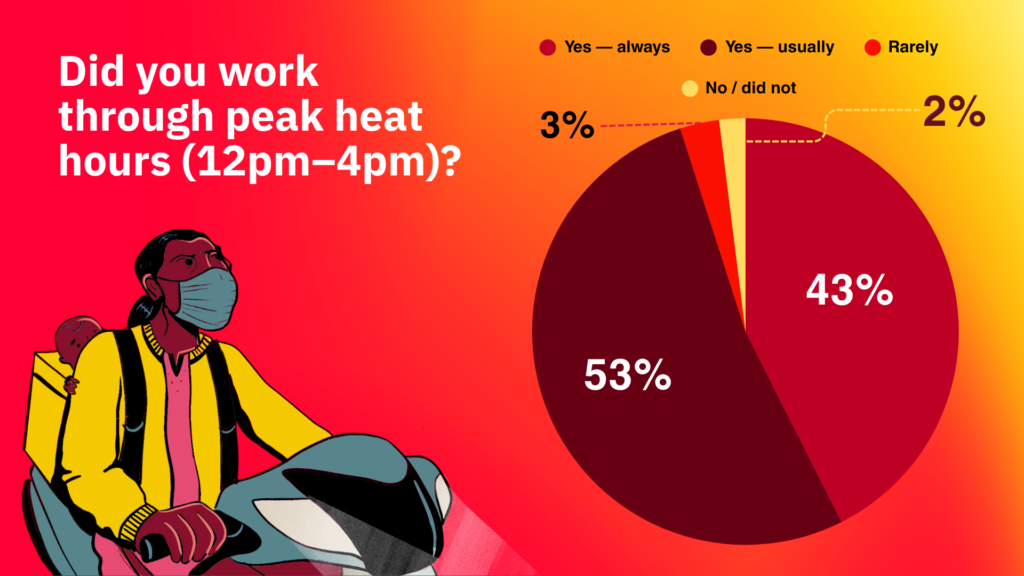
About 43% of gig workers reported working relentlessly during the peak heat hours of 12 PM-4 PM, while only 2% made the choice of not working in this period.
“The mandatory login of 12pm–4pm for getting the incentive is forcing us to work in extreme heat, “said Irfan who earns between Rs 27,000–35,000 a month, with about Rs 5,000 in savings.
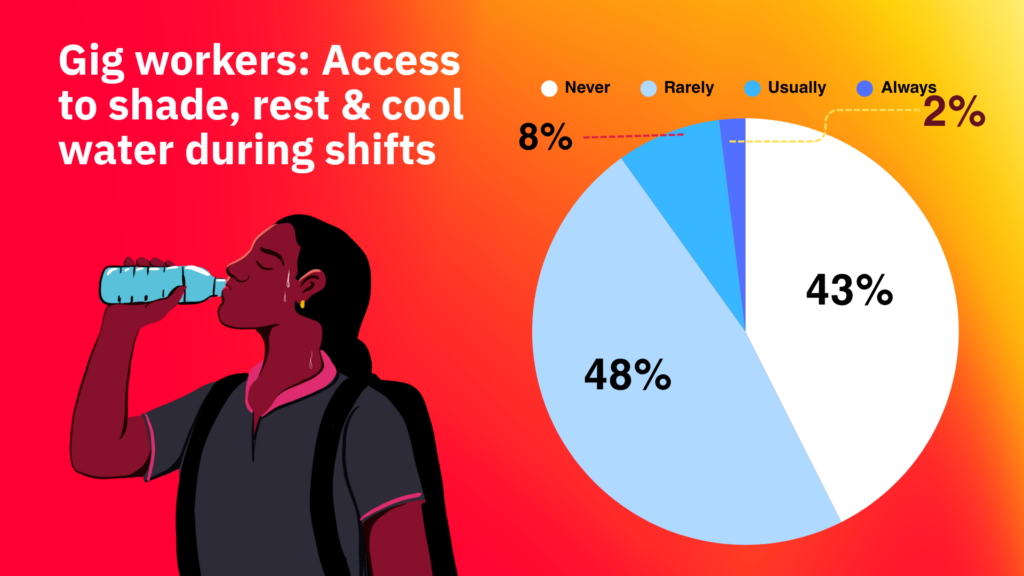
The difficulty of working in heat is compounded by the lack of proper access to shade and rest.
Sonakshi Thapa, a domestic worker on Snabbit, from Noida rues about the lack of places of rest and shade. “There are no designated areas for rest. I wait in a park or public spaces between orders”, she said emphasizing on the need for rest places and clean washrooms.
Even when they find moments of shade and respite, the unkindness of middle-class neighbourhoods takes its toll. Mohammed Irfan, a Zomato worker, recalls, “A lot of times, car owners tell us to move from the shade.”
Only one Zomato worker, Shivam from Kotla Mubarakpur said that the “company does give drinking water in dark stores and sometimes but not always in restaurants”.
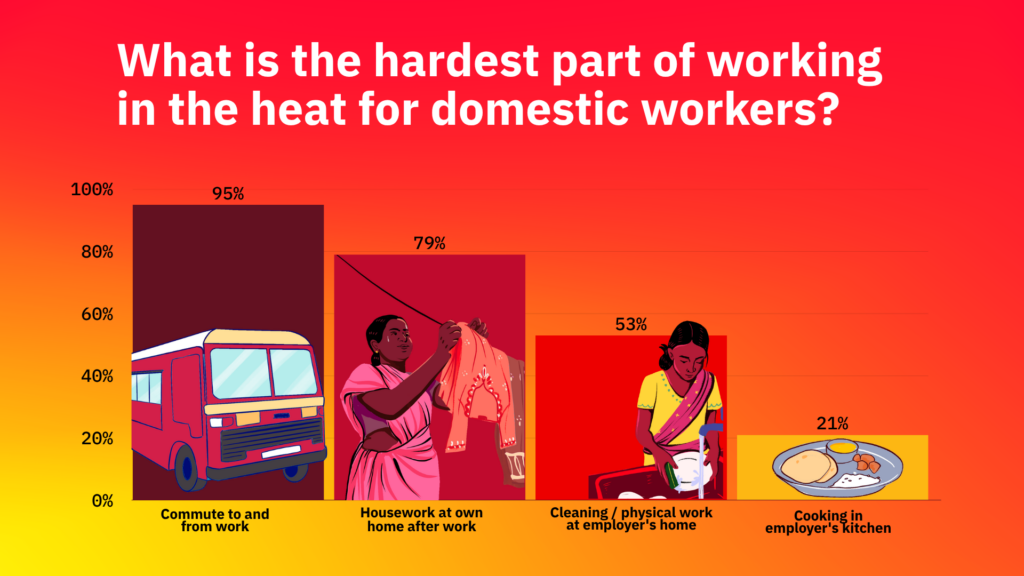
In contrast, the hardest part of working in heat, for 95% of domestic workers, was the commute to and fro from work. Roughly 60% of workers travelled just about two hours to get to their workplaces and most used a combination of bus, walk or a shared auto.
Anita (50), a SC domestic worker from Gautampuri, walks to save money. “My work is nearby so I usually go on foot, thinking that I’ll save the rickshaw fare and use it to buy vegetables.” She is the oldest worker in our cohort. Sanju Devi (35) from Dayal Nagar in Delhi said: “I’m always in a hurry to get to work, so I can never sit anywhere, fearing that if I’m late the bosses will get angry.”
Unpaid housework before, after and in between domestic work was the second biggest issue articulated by 79% of domestic workers. 53% of workers said that physical work at employers’ homes.
Anju from Gautampuri said: “Four stoves are lit at the same time, I feel extremely hot.” Komal Bairawa returns to a hotter home: “We don’t have an AC at home; we make do with fans and coolers. But since there are so many family members, even the breeze feels hot when many people live in a single room.”
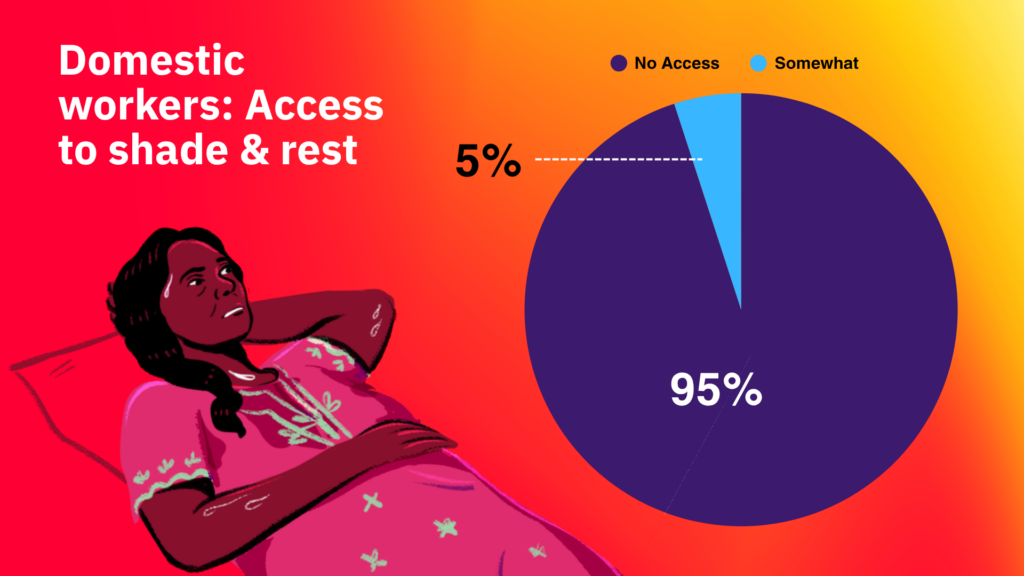
Even with indoor work, domestic workers’ access to shade and rest was not easily accessible. 95% of workers said they had no access to shade while commuting or in-between shifts.
Nazma Khatun (44) from Dayal Nagar said: “There’s no shade, and I’m always in a hurry to get home, so I don’t even sit.” Komal Bairawa put forth the problem of safety even where public places were available. “I can’t find a place to sit. Sometimes I might find a spot in a park, but there are men and boys there, so I don’t go. I just head off to work.”
Saraswati (45) from Gautampuri said: “I stand at the bus stand for a few minutes, but it’s still very hot. And there are a lot of men standing there.”
Inside employers’ homes, the indifference of middle-class households to the vulnerabilities of domestic workers in extreme heat was interpreted both an inconvenience and a source of deep hurt, exposing the exploited labour that sustained households.
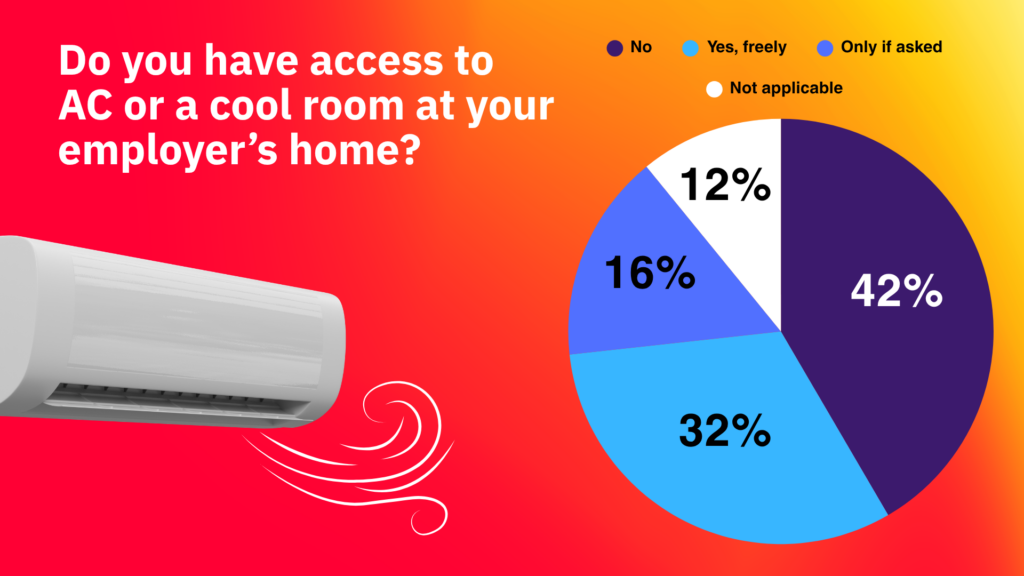
“If I sit down even for a minute, she starts shouting”, said Anju. Priyanka Dayal, from Dayal Nagar in Faridabad had a pithy reply when asked about rest. “When the owners don’t even let us sit on a chair, why would they let us sit in the AC? Even if you sit, they immediately assign another task.”
Komal Bairawa expressed her hurt and exploitation when she said: “They never give on their own. Even though we are the ones who fill their kaanch ke glasses [glass tumblers] with cold drinks, we never get any ourselves.” Anju’s employer looks at her ‘with hostile eyes’. “She doesn’t give me anything to drink in this heat. And if she does give something, it’s stale food”, she said.
Sunita Kerketta (35) from Zamrudpur who cooks and cleans in 3 homes said: “They only order us to bring cold water, but never ask us to drink it. When something starts getting spoiled, then only it is given to us.”
No Platform For Relief
Not a single worker in this sample reported receiving time off or heat-related payout by the platform companies. Gig workers had basic and mostly infrastructure related demands for coping with heat at work. Nearly three-quarters of gig workers want somewhere to rest, and well over half want reliable cold water. At least 21% of workers demanded higher earnings or heat related payouts to cope with heat.
Anita, an Urban Company beauty worker from Jaipur, said “Payout should be good during heat so we can book a taxi and travel comfortably.” Shilpi Kumari and Sangeeta Kumari, both Urban Company workers from Patna, demanded that the state government make arrangements for free, clean water available everywhere.
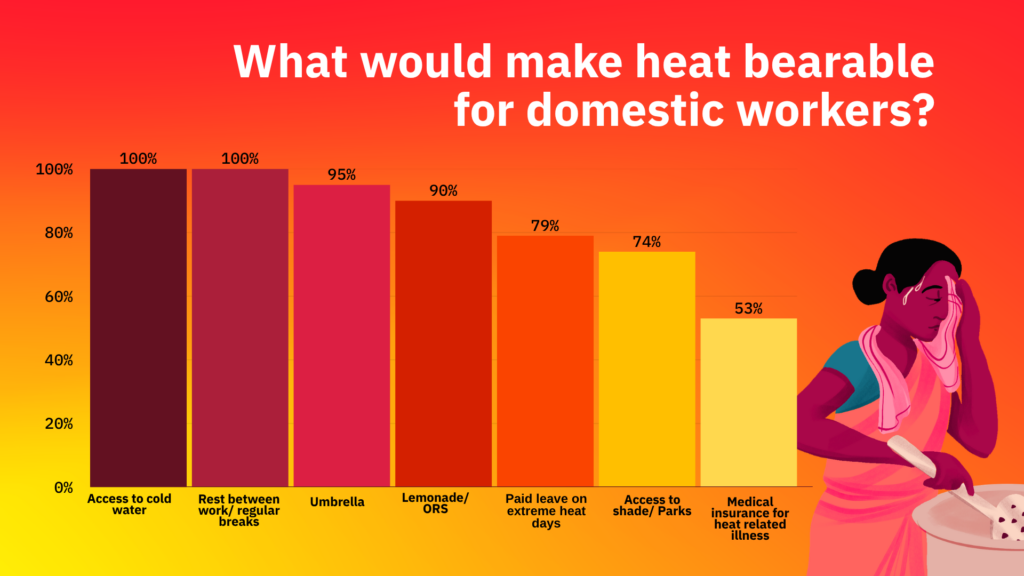
For domestic workers, all of them said that access to cold water and rest between work and regular breaks would be helpful. About 94% asked for an umbrella. On economic measures, 79% said that paid leave on extreme heat days and 52% said that medical insurance for heat related illnesses would be necessary as labour measures.
Saraswati (45) from Gautampuri does not have an umbrella, and she has extra expenses as the roof of her house is also damaged. “I am not able to get it repaired due to lack of money.”
Sanju Devi from Dayal Nagar had to postpone heat relief as she was denied an advance by her employer “This week, considering the heat, I was going to buy a refrigerator, but the owner did not give me the money and said we’ll only be able to pay when your month is over.”
Delayed Aspirations
“If I can’t even afford slippers, how can I keep bigger dreams in my heart? I crave chole-bhature from Lajpat Nagar but can’t eat that either.” Kanika (24) from Gautampuri in Delhi, when asked about her desires and dreams.
The cost of heat is enormous when we account for the delayed aspirations of the workers — a cost that is as much an economic one as it is a social one. In the survey we inserted a deliberate question to both domestic and gig workers on what they would have liked to spend on but could not, and the responses were not just heart wrenching but also reflected on the urgency of labour rights and protections along with decent work conditions.
Some aspirations were small and seemingly mundane and others were grander and bigger. “I want many things, but right now what I want is a bottle in which the water will stay cool”, said Nazma Khatun, a domestic worker from Dayal Nagar. For many domestic workers, household appliances are a desire that will help them with their double shift of work. “I want to buy a mixer and cooler for myself, because after coming from work one can get relief from the heat, and if there’s a mixer it will be a little easier to work at home,” said Priyanka Dayal. Maya wants a washing machine too to make her job easy after a gruelling day at other people’s homes. “I don’t want to spend much on myself, but I want to buy a washing machine. Having one would give me some rest. But I can’t afford it because I don’t have enough money left at the end of the month.”
Anju (34) an SC domestic worker from Gautampuri works four homes and wants to look the part. “I go to work at the bungalow, I feel I should look presentable and well-groomed. But I can’t afford new clothes or anything for myself. All my money goes to household necessities.”
Kanika dreams of home ownership. “I currently live on rent, I want to have a house in Delhi in my name. I try to save money for the house but it gets spent on children’s education and household expenses. But my desire is alive, and one day, I will definitely fulfill my dream.”
Sunita (35) a domestic worker from Gautampuri has extinguished any desire: “What should I think? Due to family finances, I can’t think for myself.”
For gig workers like Rajendra Maurya, Pinki and Ashok Meena, all from Jaipur, a home is their ultimate desire. Pinki, an Ola/Uber rider dreams “to buy my own house, send my children to better schools, take my children on trips, and buy groceries for the house all at one time.”
For others who have aging parents in their care in smaller towns and villages, sending enough money back home after accounting for expensive living costs in cities was of utmost priority. Rohit Joliya, an Ola/Uber driver from Jaipur wants to send money to his parents, while also “buy good clothes for myself, go to good hospitals for treatment, buy a new bike, and save for marriage.” Madhu Devi, an Ola/Uber in Jaipur wants to pay off all her debts.
Vehicles were another priority for gig workers as they are the source of their livelihood. Ramesh Kumar from Patna who works as an Amazon and Flipkart parcel delivery agent, his small wish is to have enough money to change the tyre of his bike. Eshwar from Jaipur, an Ola/Uber driver said “I can’t use my bike throughout the year due to the climate, so I want to buy a car — and pay off all the house debts, and get married, which has been difficult due to money.”
Jyoti, the Urban Company beauty worker, was the rare gig worker with a burning personal ambition. “I want to do an advanced nutrition course that costs around Rs 1 lakh. It could make progress in my future, but right now I cannot find this much money.”
Methodology Note
This story draws on a month-long survey of 48 informal workers — 29 gig/platform workers and 19 domestic workers — across Delhi-NCR, Jaipur, and Patna, conducted by BehanBox in partnership with Janpahal and Shehri Mahila Kamgar Union between June and July, 2026.
The survey was co-designed with appointed note-takers in each city, who were trained through weekly meetings on the questions to ask and collected weekly data from respondents over the course of a month.
All 29 gig and platform workers surveyed were between the ages of 20–40; drawn from Jaipur (10), Patna (10), and Delhi-NCR (9). By sector: delivery (55%), ride-hailing (21%), beauty and salon work (17%), and domestic work (7%). The composition included 16 men and 13 women, and approximately 79% identified as SC/ST/OBC.
All 19 domestic workers are based in Gautampuri, New Delhi and Dayal Nagar, Haryana. On average they serve 1–4 households daily, and travel between their own home and one or more employers’ homes daily. The average paid work span (from leaving home to returning) is 6.3 hours/day, ranging from about 3.5 to 10 hours. Because most workers travel between multiple employers’ homes on foot or by shared transport, this work span includes the heat exposure of the commute itself, not just time indoors at an employer’s house.
Income figures for non-heat months are workers’ own estimates, not drawn from payment records or employer data, and should be read as indicative rather than exact.
This is not a definitive or statistically representative study. There are several other lenses of inquiry that we could not apply, for instance mental health impacts of heat stress or how caste shapes differential exposure to heat. The intent of this survey is to create the context and space to pursue those stories and conduct similar examinations.
We believe everyone deserves equal access to accurate news. Support from our readers enables us to keep our journalism open and free for everyone, all over the world.