
No Surgery, Hormones, Or Recognition: How India’s New Trans Law Is Erasing Transmasculine Identities
The amended transgender law endangers the already fragile support and care networks available to the community
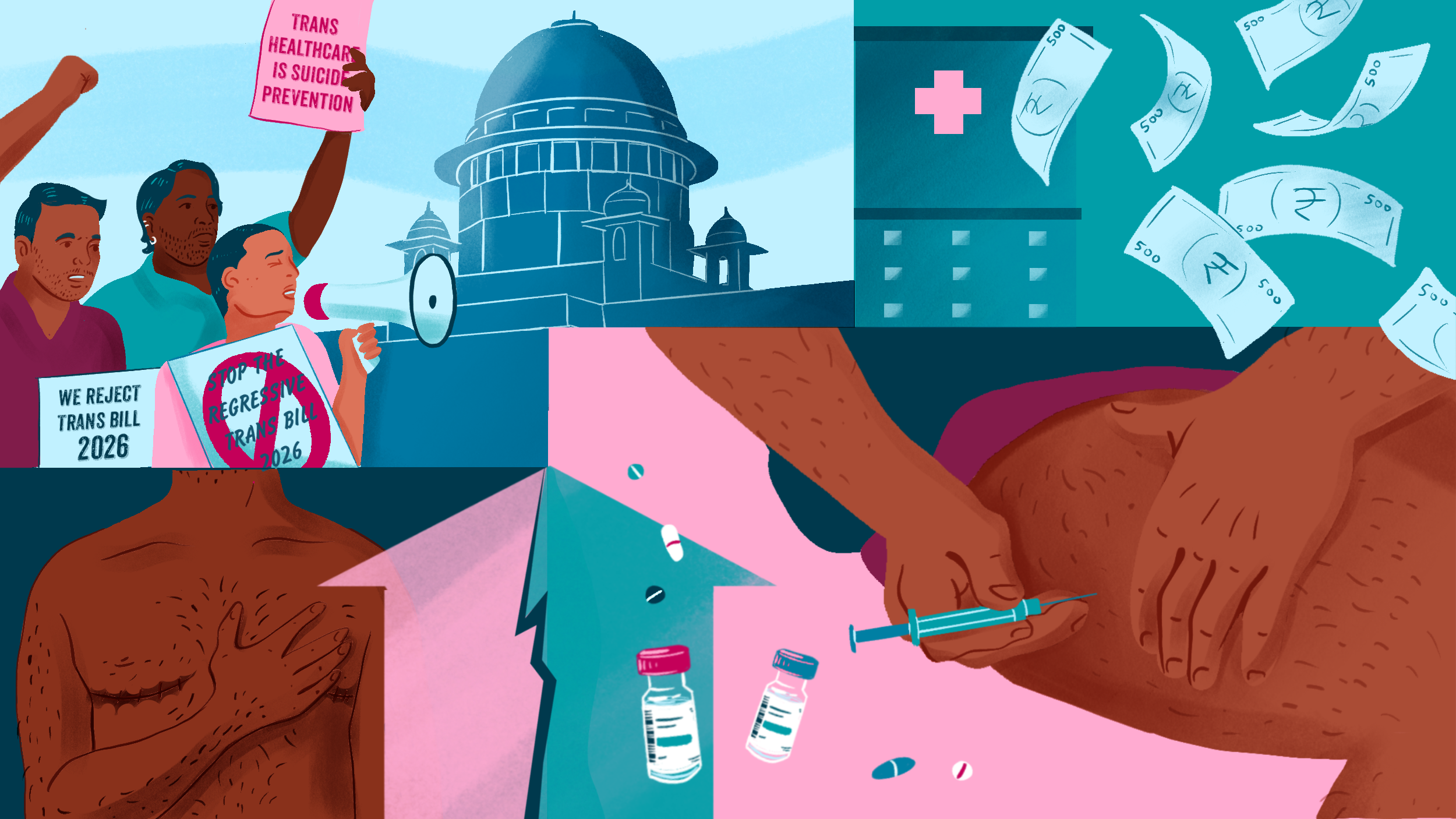
ARIJIT SEN KNOWS what it’s like to spend your whole life as though bracing for imminent danger. A transman, mental health professional and PhD scholar from Mumbai, Sen grew up in a small village in West Bengal with no language or vocabulary to validate who he was and no community to look up to. He has spent the years since trying to change that, building the kind of safety nets the trans community has had to construct for itself in the absence of any institutional framework.
For millions across India, this experience has now become harder to protect and name. The Transgender Persons (Protection of Rights) Amendment Act, 2026, has triggered deep anxiety across India’s trans community for effectively erasing the legal identities of trans men, trans women and genderqueer people from Indian law. But it will have a particularly damaging impact on the lives, and physical and mental health of transmasculine people—those assigned female at birth who identify as men or along the masculine spectrum.
As BehanBox reported, the new Act, by amending the Transgender Persons (Protection of Rights) Act 2019 and identifying only a narrow list of historically transfeminine people—kinner, hijra, aravani, jogta —as transgender individuals, effectively dismisses the right to identify one’s own gender guaranteed by the Supreme Court in its landmark 2014 NALSA judgement.
If you self-identify as any of the omitted genders, have already changed your documents, are on hormones, or are saving for surgery, your identity now stands on unstable legal ground. Transness has now become something to be biologically explained with medical evidence, or else subject to punishment.
The new law has also cut off most of the access to gender-affirming care by bringing in a clause that makes “inducing” a transgender identity a punishable offence and creating anxiety in the medical community.
“Gender affirming care was already inaccessible. The amount of violence you were experiencing was already horrifying. Now that the State doesn’t recognise us as constitutional beings, we can’t even imagine how these scenarios will worsen,” says Tan, a non-binary transmasculine person from Varanasi.
What makes transmasculine people particularly vulnerable? First, they carry the gendered violence and surveillance that comes with AFAB (assigned female at birth) bodies even as they navigate their trans identity that families, society and welfare systems have invisibilised. Secondly, there is little institutional framework, peer support or community based-care for them while the transfeminine and hijra communities have a longer, if inadequate, history within Indian healthcare.
Even research is focussed almost exclusively on trans women and hijra communities.”This erasure is structural rather than accidental, with profound consequences that perpetuate cycles of distress and foreclose equitable access to care,” say the authors of the research.
Apart from all this, transmasculine persons live with the constant fear of “corrective” crimes–such as forced marriage, rape and other forms of sexual violence.
Multiple petitions challenging the constitutionality of the amendment are being presented by trans community members before the Supreme Court and High Courts. On June 15, the Supreme Court stayed all High Court proceedings on the matter and indicated it may take up the constitutional challenge itself. Until then, the amended law remains in force. This has left community organisations, queer-affirmative lawyers and healthcare providers grappling with the impact it will have on access to identity documents, healthcare and welfare schemes.
Body, Now The Only Path To Legal Recognition
To live as transmasculine is to navigate the dysphoria in bodies that have always felt unsafe, we heard in multiple interviews. And it means seeking hormones or surgery for gender transitioning through inaccessible, expensive and apathetic medical systems without family support, shelter, employment, or documents.
The Amendment has precipitated the need for biological transitioning while also making it harder to access. Under the older 2019 Act, a person could identify as transgender through a self-declared affidavit to the District Magistrate. The new Amendment replaces this with a medical board headed by a Chief Medical Officer whose recommendation the DM must now take before issuing even a basic transgender identity certificate. Any medical institution where a person undergoes gender-affirming surgery is now required to report it to the District Magistrate.
On the one hand, the law has now made medical certification the only legible path to legal recognition. But the same law also criminalises "inducing" a transgender identity, as we said earlier. The law is thus demanding proof that it is also harder to obtain.
Public Healthcare, But Only On Paper
India’s statutory architecture for transgender healthcare is radical. But only in law. BehanBox has reported on how trans men and transmasculine persons struggle to access basic public healthcare.
By law, government hospitals in India must provide fair treatment, separate wards, and clean washrooms for transgender people. The central government’s Ayushman Bharat TG Plus programme also offers a dedicated Rs 5 lakh annual cover for gender-affirming care, including hormone therapy and surgery.
Tamil Nadu has long been regarded as a pioneer in transgender welfare, becoming the first state to establish a Transgender Welfare Board and among the first to institutionalise publicly funded gender-affirming healthcare. The state insurance covers these treatments for free, and 12 special Gender Guidance Clinics are up and running in government hospitals in major towns like in Chennai and Madurai. In recent years, gender-affirmation surgery at Chennai's Government Hospital has drawn praise for its outcomes. A private hospital in Tiruporur has also become a trusted option within the community.
But elsewhere in the country, entering government hospitals for gender-affirming care is often a retraumatising and humiliating choice. Transmasc people recount stories of being asked to strip in public health facilities so their gender identity can be "assessed". The World Professional Association for Transgender Health (WPATH, which develops widely used Standards of Care for transgender and gender-diverse people), does not mandate psychiatric/biological verification and emphasises self-identification in accessing gender-affirming care.
For transmasc persons from poor, rural, caste-vulnerable or non-English-speaking backgrounds, even finding the vocabulary, and critical access to networks of care can be hard to imagine. They now fear that violations at hospitals and healthcare providers that have always been rampant will likely worsen.
In Karnataka, activists say some hospitals have stopped providing care altogether. In Tamil Nadu, care continues but has "slowed down." And for now, there is no clear process for issuing new insurance cards to those who need them, with the community told to wait for clarity.
When Networks Are All
Our interviews showed that the transmasc community's survival has always depended on a small network of affirming doctors, therapists and community referrals to access testosterone – delivered through injections, gels, patches and implants – surgeries and mental healthcare.
Fred Rogers, a man of transgender experience from Chennai, has been helping find shelter for transmasc persons fleeing their homes in the face of family violence. Only four of every 100 transmasc persons reaching his team for help have any form of family support. Some may have the confidence of one family member, others may have access to meagre financial assistance. To make matters worse, there are not enough medical professionals who understand trans men, transmasculine persons and AFAB gender-diverse communities.
"And as a result, there are no ethical and operational protocols in place," he says.
A 2024 PLOS study found that of the transmasculine people on hormone therapy who were surveyed, 77.8% had found their doctor through a trans friend, and only 3.6% through a family doctor exposing a care system built almost entirely on informal peer networks and not institutional structures. Over a third of survey participants were planning to begin transition-related care but had not yet done so. And 80.2% wanted at least one gender-affirming surgery — a figure the researchers noted was far higher than the United States, pointing to the depth of unmet gender-affirming care in the Indian context.
But the new criminal provisions around "forcing" or "inducing" a person to assume a transgender identity (Sections 18c and 18d) could be weaponised by hostile families against activists, organisations, doctors, psychiatrists or surgeons helping adult transmasculine people access care, hitting the few networks that made survival possible for them.
This change in the law could further sever access to hormones, surgeries, and psychiatric support. For those who have spent years saving for testosterone therapy or gender-affirming surgeries—or are already in the middle of transition—the amendment has raised deeply unsettling questions about how long these care pathways will remain accessible.
For this population, the decision to pursue surgery is financial, logistical, and "deeply personal," says Rogers. "It is shaped by how much dysphoria a person can live with, and what they can realistically access and realise in their lifetimes."
Unaffordable Care, Few Means
A National Human Rights Commission (NHRC) study reveals that over 50% of transgender individuals have never had access to formal education. Though the data originate from a 2017–2018 survey, the NHRC continues to cite it as the active baseline for its 2025–2026 welfare directives.
"Many are just trying to survive and build a life for themselves after leaving estranged families. Their immediate focus is naturally to finish studies, find work, shelter, change documents and if possible, afford hormones. Mostly, they aren't even in a position to think about surgery," says Rogers.
In Tamil Nadu, Rogers says just around 10 in a network of over 400 transmasculine persons would have graduated. Many are pushed into construction work, delivery jobs, petrol pumps and other low-paying labour.
"A delivery worker earning Rs 300 a day may spend Rs 200 on petrol, leaving only Rs 100 as take-home income. Of the Rs 3,000 that remain in hand every month, to take aside Rs 750, which would be the approximate monthly cost of one 250 mg testosterone shot (Rs 500 for the injection, Rs 200 for a nurse, and another Rs 30–40 for syringe and alcohol swab) is almost impossible," Rogers points out.
Hormone therapy is many times looked at as a pre-requisite to surgery, and also doesn't just end with the shot. Those beginning testosterone also need regular blood work every three months to monitor liver function, cholesterol, sugar, lipids and other parameters. These tests can cost between Rs 5,500 and Rs 7,500. For a transmasc person earning Rs 12,000–Rs 15,000 a month, while also paying rent, food, phone bills and basic survival costs, this becomes nearly impossible. Without monitoring, they may continue taking the same dosage even when their bodies no longer require it, risking complications such as thickening of blood and liver damage.
For many transmasculine people with little to no access to resources, gender-affirming care therefore isn't a single medical decision, but an event around which years of finances and life milestones are planned.
Insurmountable Cost of Surgery
Conversations with Rogers gave us some sense of the costs and why they are unaffordable for a significant population.
The removal of breast tissue is the most commonly sought procedure among transmasc persons, as it comes with least complications as well as recovery time. There are two techniques: keyhole, a same-day procedure done under general anaesthesia through small incisions below the areola, costing anything between Rs 50,000 and Rs 75,000 in private hospitals (Rs 25,000–Rs 35,000 for smaller procedures); and double incision, a more invasive surgery involving larger incisions, visible scarring, and drainage tubes worn for five to seven days, costing between Rs 85,000 and Rs 1.5 lakh depending on the surgeon and hospital. Recovery rules for double incision are restrictive – no lifting and six to seven weeks in button-up shirts before T-shirts are possible again.
These costs too are staggering and insurmountable relative to transmasc people's incomes. Community members say phalloplasty in India ranges from Rs 13 lakh to Rs 16 lakh, with a few surgeons offering it for Rs 7–11 lakh. In Thailand, where outcomes are considered better, the procedure costs Rs 27–30 lakh. Hysterectomy sits somewhere in between — Rs 80,000 to Rs 1.2 lakh if done privately, depending on whether it's open surgery or laparoscopic, with three to five days of dependent post-operative care and a six-month restriction on lifting heavy weights.
Rogers says India currently has no surgeon qualified to perform safe phalloplasty (a reconstructive surgery used to create or reconstruct a penis-like structure as a key component of gender-affirming care) or metoidioplasty (also a gender-affirming surgery that uses a clitoris, previously enlarged by testosterone, to create a smaller penis-like structure).
"For someone from a small town, still in school, with no family wealth, surgery is simply not something that will happen in your life," says Rogers.
As we said earlier, the 2019 Act folded transgender healthcare into Ayushman Bharat TG Plus, offering up to Rs 5 lakh in annual coverage for hormone therapy, gender-affirming surgeries and post-operative care. It mandated that every state set up at least one hospital offering comprehensive gender-affirming care — including endocrine and psychiatric services — under one roof.
Seven years on, this hasn't been implemented equally across the country.
Botched outcomes in surgical procedures are common, say transmasculine people, and they may include: flaps that fail to connect with nerves, severe bleeding, incomplete urethral lengthening, fistulas, and outright rejection of the surgical flap by the body. These complications can often be permanent, and the damage, lifelong.
"You see, with such complications, we may need long-term caregiving, and that is not a luxury available to us. Not many of us can afford to sit at home, rest and recuperate. We must work to earn a livelihood or even just to support the community," says Rogers.
Experiencing Dysphoria
It's important to also note that not everyone experiences dysphoria the same way and not everyone chooses surgery. Some trans men want to have children, and choose not to remove reproductive organs. Others are not dysphoric about menstruation at all, even if they are about their upper body.
But for those who do want surgery and simply cannot get it — because of cost, location, or the absence of a qualified surgeon — the agony of dysphoria must be endured for years, or sometimes for life. Rogers took six years from coming out to accessing his own top surgery. "Before that, I was always angry, frustrated and overwhelmed." What got him through was peer and community support — a privilege he says many in his community do not have. "But thanks to the visibility of social media, younger trans men do stand a better chance to find resonance and connection," he says.
For some the wait can stretch into decades. In her essay ‘The Medical Landscape of Transition: A Personal History’ for the recently released book, Queer India Now!, Sameera Jahagirdar, a transgender woman and physician who developed one of India's first formal gender-affirming surgery protocols, writes of an "internal conflict" that stretched across decades before she felt able to transition. And even then, the path was fraught with her own struggles and bureaucratic failure.
She describes attempting to self-medicate with hormones early on, calling it "a terrible misstep" because it took a year to recognise that it was causing her harm. Even as a doctor, she writes, finding a surgeon willing to operate took years.
Risk, Recovery
Post-operative care, too, runs on an informal, peer-driven system. Most of the information circulates through the peer network — people sharing what to expect and what to avoid — before even walking through a surgeon's door. And the community complains that surgeons do not account enough for the fact that the procedure’s outcomes depend heavily on a person's general health, body mass index, and lifestyle habits.
Recovery from major surgery typically takes three to six months, and a large chunk of the young transmasc population does not have partners or family members to lean on through this period. For those who do have partners, couples' counselling for post-operative care is something that should exist, but currently does not, says Rogers.
There have been examples of surgery-related fatalities in the past. Anannyah Kumari Alex, India's first transgender radio jockey, died by suicide in 2021 after publicly alleging severe complications and medical negligence following her gender-affirming surgery. A subsequent fact-finding report by trans rights groups found that proper protocol wasn't followed in her case — the only evidence of pre-surgery mental health screening was over a year before her operation, and the surgery itself appears to have been rushed through within weeks of being scheduled. The report concluded there were serious lapses in the informed consent, post-operative care and mental health support she received.
Given their multiple intersectional marginalisations, the risks are a lot graver for transmasculine people. Their surgeries are fewer in number, less visible, performed by a smaller pool of surgeons, and almost entirely unsupported by formal post-operative psychological care.
The new Act will only worsen stigma and scrutiny against transmasculine persons, community members say, pushing more people into unsafe routes. If doctors, psychiatrists and surgeons are afraid of being accused of "inducing" someone to assume a transgender identity, and if transmasculine persons themselves fear exposure or humiliation in hospitals, they will intentionally avoid the formal healthcare system.
Criminalisation of Choice
In his PhD on 'Trans Masculine Identity Development', Sen cites the story of a transman as an example of how sexual coercion is used as a means to “correct” and “punish”. "Two days after he came out to his family, he told me his grandfather tried to rape him. When you are born with female genitalia, sexual violence is often the first weapon of control," he says.
This violence will now be exacerbated, says Tan, by narrowing and contorting the definition of transgender persons “by recognising only a limited set of largely transfeminine identities, conflating intersex variations with transgender identities, and describing some transgender experiences through terms such as 'mutilation', 'emasculation' and 'surgical, chemical or hormonal procedures."
Activists like Tan believe it may have just become almost impossible to escape, report or challenge "corrective" crimes, because hostile families may now use Section 18's criminalisation of "compelling a transgender identity", to frame violence as "protection" and portray gender-affirmative support systems as "coercive".
"Gender-affirming care is life-saving care." Since the amendment, this phrase has appeared again and again in social media posts, statements and the larger discourse. In trans forums on Reddit, people talk about how HRT, gender-affirming surgery and therapy have kept them from ending their lives.
'They Will Decide If I'm Trans or Not'
Across interviews, transmasc people repeatedly expressed fear that the amended law will enable insensitivity and misinformation among local district authorities tasked with recognising, certifying and documenting their identities.
Sen says many trans people are "called again and again to the office, when there is no need," even for processes that can be completed online.
"If my district magistrate believes that gender and sex are the same thing — which many of them do — I will not get a transgender certificate from them. After this law, my chances are almost negligible, because these authorities now have more discretion over what my gender is. They will get to decide if I'm trans or not," he says.
Rogers adds that very few district-level authorities — including the District Social Welfare Officers (who may be involved locally in welfare access, paperwork, routing, implementation, or scheme-level gatekeeping), and District Magistrates (who are responsible for issuing transgender identity certificates and revised male/female certificates under the amended law) — are even fully adept with the 2019 act. In Madurai and Coimbatore, he says, community members had to make "back-to-back visits" to the collectorate to get male/female identity cards processed under Section 7 of the Transgender Persons (Protection of Rights) Act, 2019.
Crippling Anxiety Among Networks
As discussed earlier, for transmasc persons, survival has been entirely dependent on a small but consistent network of safe people: therapists, endocrinologists, community organisers, older trans persons who know the way through the system. The new law now threatens this fragile ecosystem of care providers. Among them are trauma-informed, queer-affirmative mental health professionals.
Clinical psychologist Shatavisa Majumder says when the Bill was first introduced, queer-affirmative MHPs were closely tracking parliamentary proceedings, hoping the amendment would not pass. When it did, she says, "there was anger, frustration, betrayal and collective grief."
But these soon gave way to crippling anxiety. Healthcare providers and support groups found themselves grappling with questions like — what now counts as coercion? Would providing gender-affirming care continue to be legally safe? What would happen to people already on hormones or preparing for surgery?
Clients are now worried about whether their identity documents would continue to be valid, if doctors would continue prescribing them hormones, and the years they had spent planning to transition would go to waste. "People who are already in some procedures—taking HRT, planning surgery, or somewhere in the middle of that process—have been very unsure of whether help will be provided any longer," Majumder says.
She adds that some practitioners who had previously identified as queer-affirmative feel reluctant to engage publicly with the community after the amendment. But on the other hand, a whole population of affirmative practitioners—most of them queer and trans themselves—have been actively reimagining what care looks like under these circumstances, and dedicatedly creating ways to show up for each other. They have been convening support groups, offering pro bono and sliding-scale consultations, strengthening referral networks and creating spaces where trans and gender-diverse persons can openly share their anguish around these uncertainties.
India's leading mental health bodies including the Indian Psychiatric Society and the Clinical Psychology Society of India too have issued separate statements asserting that transgender identities are not illnesses to be diagnosed, or realities that can be established through medical testing. They talk about gender-affirming care as an important, legitimate and evidence-based component of healthcare access for queer and trans people.
Community members say what is at stake is an infrastructure of survival a whole generation of transmasc elders have spent decades building quietly and painstakingly. In his research, Sen has found that many transmasculine people spend years shape-shifting to survive, performing whichever version of themselves feels least dangerous in a given moment.
For many, the turning point arrives when they finally find a "mirror"—or someone who has lived through the same questions, fears and uncertainties. Tan has tried to be that mirror for his community. He has chosen to refuse medicalisation entirely, use his body as a political statement, and to demonstrate to society how to treat trans people regardless of what their bodies look like.
"I have taken the decision of not accessing gender-affirmative care," he says. "I am on a mission to change society." But he is also clear-eyed about what made this choice possible for him. "I am well educated, Savarna and grew up in an urban part of the country. I have a supportive family," he says. "These are privileges that the rest of my community does not have access to."
What keeps him going through these uncertain days is the solidarity of the community. Some days, he says, he breaks down. And it is the younger ones—the same people he is trying to shelter—who hold him then. "In many queer communities, this is how care flows. Without hierarchy," he says.
(Names changed to protect identity)

We believe everyone deserves equal access to accurate news. Support from our readers enables us to keep our journalism open and free for everyone, all over the world.
