A Women Farmers Collective Is Hosting Change in Himalayan Villages
Self help groups in Chamba forged an FPO and found ways to rejuvenate dying mountain springs, diversify farming practices and explore alternate sources of livelihood
- Varsha Singh

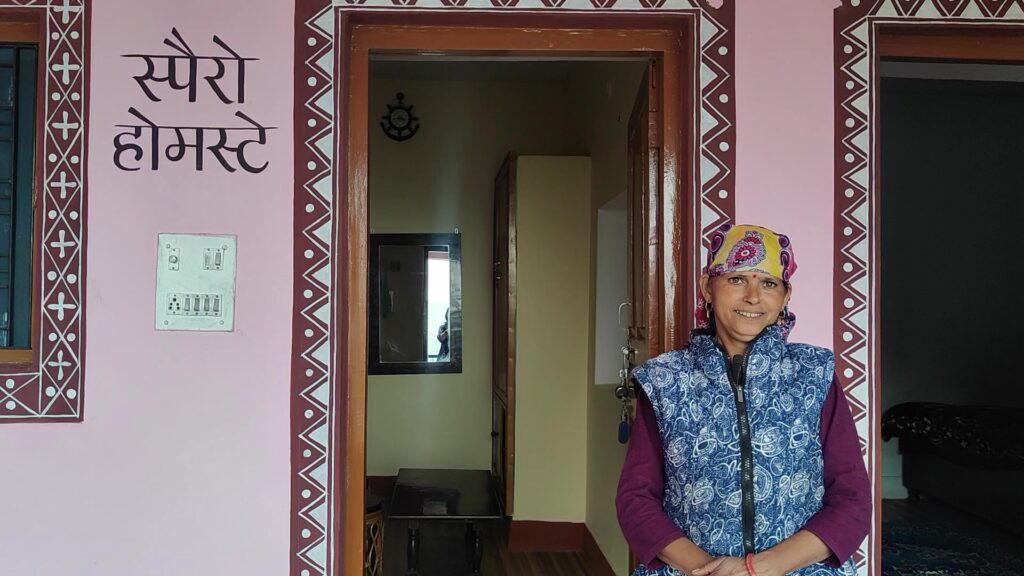
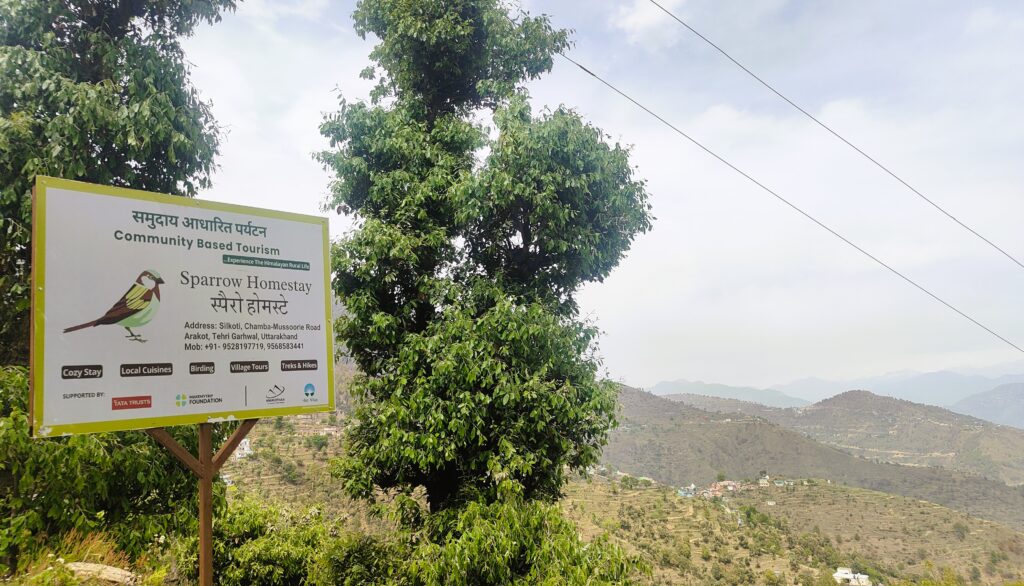
Dark orange roses bloom in plastic drums and dabbas on the veranda of Sparrow Homestay in Silkoti village of Chamba block in Tehri district. With the snow-capped Himalayas looming in the distance and a glimpse of the Tehri lake, the homestay lies off the main road, down a hill in the village where about 60 families live.
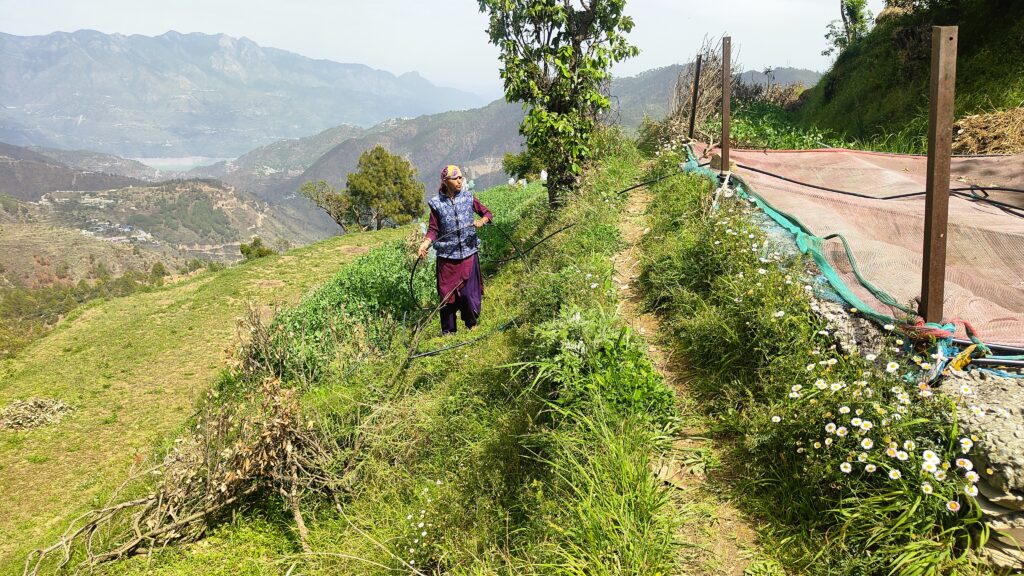
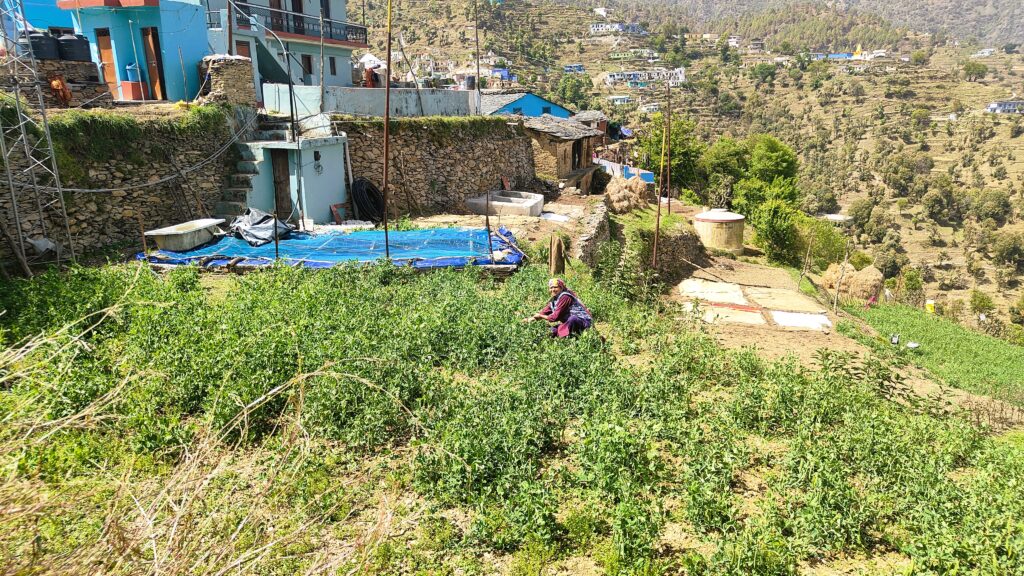
Vimla Pundeer, 56, stands at the doorway of her two-room homestay, ready to welcome guests with a smattering of English. She is a farmer whose work is visible across the valley on a terraced farm – peas, spinach and barley and orchards full of lemons, plums, peaches, apples and apricots grown with backbreaking labour amidst water scarcity.
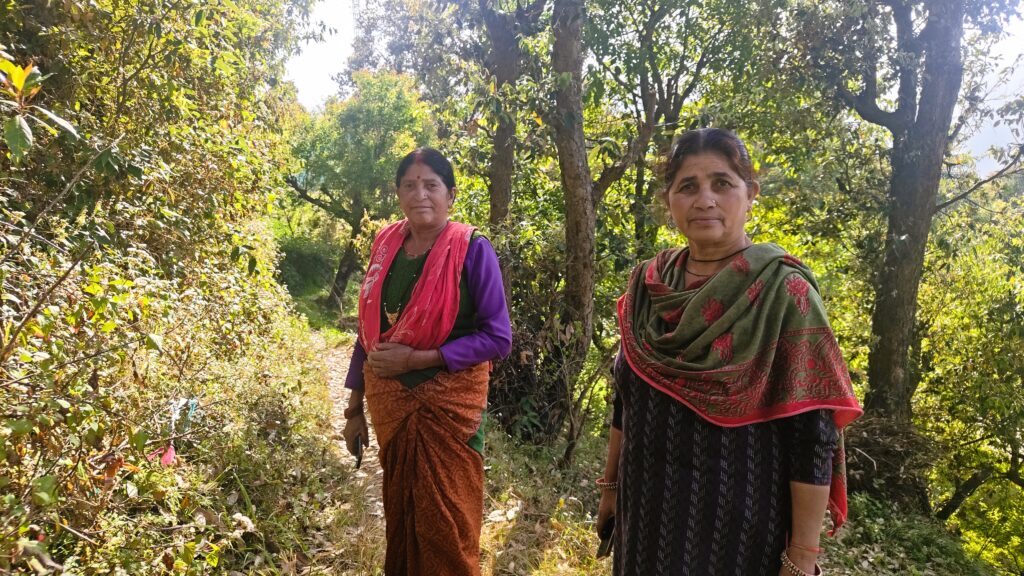
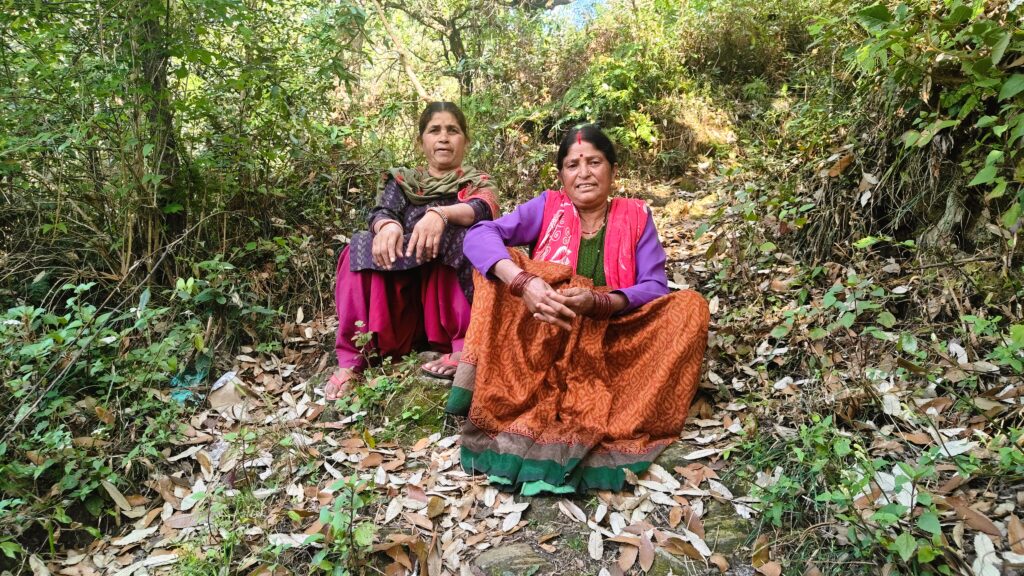
There are 25 such homestays in Chamba now, run by women farmers, some of whom also double up as nature guides for tourists. In the neighbouring village of Churerdhar, Vasu Devi, 60, and Lakshmi Devi, 58, are among a group of 20 women farmers who now work as nature guides. Lakshmi says she has hosted tourists mostly from Maharashtra, Gujarat, Rajasthan and Delhi, introducing them to the joys of plucking kafal and plums along village trails.
The rich produce on Vimala’s farm and the micro hospitality ventures run by the women – these small signs of stability are relatively recent. They came only after a decades-long struggle with the water scarcity in Chamba and the impact of climate change that had wrecked farms and killed yield.
“As rainfall patterns changed, we reduced growing crops like wheat. Our apple yield declined with a decline in snowfall. There was a time when an entire room in our home was filled only with apples. The changing weather affected our earnings. Our water sources also started drying up, deepening the crisis,” recalls Vimla.
As we had reported earlier, drying spring water sources – caused by erratic rainfall and ecological degradation from land-use changes – are a huge challenge for Himalayan villages. Residents of Devprayag in Tehri Garhwal recently held a protest march to draw attention to the acute water scarcity affecting them.
With incomes shrinking, many families are left with little choice but to migrate. The 2020 Uttarakhand Rural Development and Migration Commission’s report noted that over the last decade, around 72,000 people from 934 gram panchayats in Tehri migrated temporarily, mainly for livelihood and education. Around 19,000 migrated permanently.
With men away, it falls upon the women of Chamba to cope with drying farms, orchards and water-strapped households. How then did women like Vimla ensure dependable sources of water, diversify farming practices and even experiment with alternate livelihood opportunities? The answer lies in a story of transformation driven by collectivised efforts to revive springs and strengthen water-secure farming. They set up the Him Vikas Farmers Producers Organisation (FPO).
Now that they have less water stress to shoulder, the women of Chamba earn through multiple streams – homestays and sales of vegetables, milk, and other local products. Last year, the FPO earned around Rs 4 lakh in profit, which was distributed among the women members.
“The Chamba model of spring rejuvenation integrated with women-led village tourism is a strong climate adaptation model, and we want to scale it up. For that, communities must have real ownership,” says Kahkashan Naseem, additional chief executive officer of the state’s Spring and River Rejuvenation Authority (SARRA) which now plans to oversee the setting up of Dhara-Naula Sanrakshan Samitis (spring and water source conservation committees) across the state under the Panchayati Raj system.
Coming Together
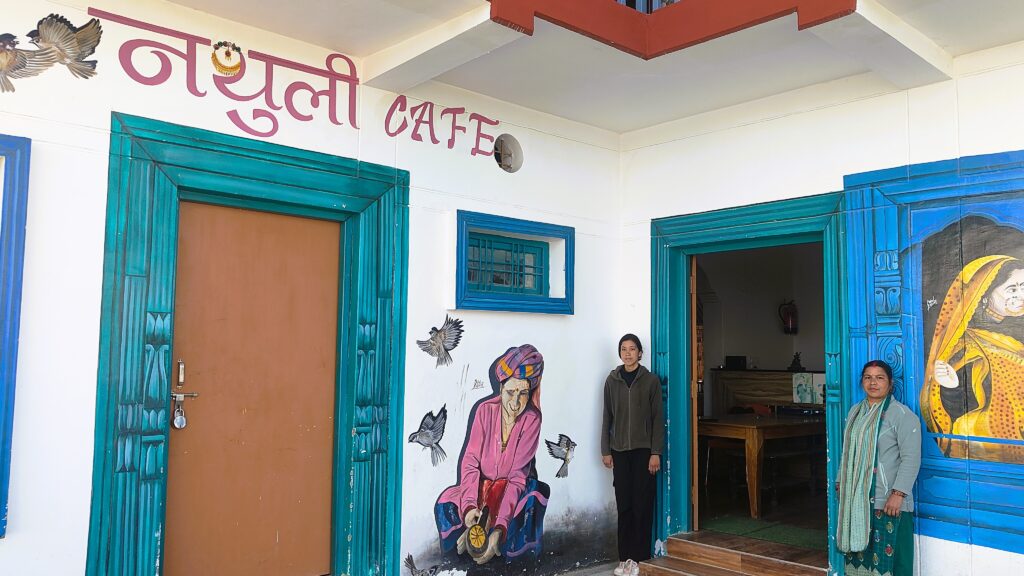
Tucked along narrow, winding roads through fragrant pine, deodar and rhododendron forests is Nathuli Café and a community homestay run by the Him Vikas FPO, inaugurated last year. Painted in a vivid Pahadi style, Nathuli, meaning a large nose ring worn by women of the region.
“We have seen many changes here,” recounts Sulochana Ramola, who works as a cook and caretaker at the homestay on a monthly salary of around Rs 8,000. “I am a farmer, but I also started working as a nature guide. After the Nathuli Café was built, I began hosting tourists. During peak seasons like summer vacations, the footfall increases. Sometimes 50 to 60 people come for official visits or meetings,” she adds proudly.
“It has also created opportunities for nearby villages,” she says, pointing towards packets of rajma, millets, gahat daal and mixed flour, alongside bottles of honey displayed inside the café. “All of this is connected; water, farming and tourism.”
The women we interviewed in Chamba recall 2009-2010 as the year when the water stress peaked. They saw traditional farming become increasingly unviable as unpredictable water and snow patterns set in.
In 2012, the women set up self help groups across Chamba that coalesced into a farmer producer organisation (FPO), the Him Vikas Swayatt Sahkarita. An FPO is an institutional mechanism that allows small farmers to collectivise and improve and aggregate their produce through cooperatives. This collaboration allowed women farmers to come together to access training, farming inputs, processing facilities and better markets for their produce. The initiative also trained the women on how to run a homestay.
“A big part of the work was also reviving springs, training communities to identify recharge zones and carry out basic recharge work such as contour trenching and digging recharge pits near the source,” says Anil Ramola, block coordinator of Himmotthan, a development programme for central and western Himalayan regions backed by Tata Trusts. He estimates the number of self help groups in Chamba at 102 and the FPO’s membership at 1,040.
The women were already engaged in farming, orchards, and livestock rearing. Through the FPO they were introduced to seed varieties and organic farming practices. A Kisan Suvidha Kendra (KSK) was also set up to provide inputs like seeds, fertilisers and equipment, along with market information.
The attempts began to bear fruit soon after the women adopted new seed varieties and farming practices. The improvements in water availability, that we detail later, took two to three years to become noticeable. In five years, changes began to become clear in their lives and livelihoods.
“As water returned to the land, so did the agro-biodiversity, though slowly,” says Lakshmi. pointing towards the plum trees that flowered through April and May and the shrubs lining farm edges and village paths. “We now see local plants blooming, all the blessings of the hills. The kingod (Berberis aristata), a medicinal plant, is flowering these days, as are chia seeds and the Himalayan wild pear (Pyrus pashia). There is also hisalu (Rubus ellipticus), a wild Himalayan berry.”
The women now sell local crops like mandua (finger millet), jhangora (barnyard millet), and varieties of rajma (kidney beans) under the Him Vikas Swayatt Sahkarita label. A Community Facility Centre helped the women with skills training, processing, and packaging of products. Women also run dairy-related activities through these collective systems.
The FPO has also created employment for others in the village. A least 16 villagers work in different roles, handling marketing and managing various operations.
Women’s Farm Labour in Uttarakhand
Sulochna unequivocally calls herself a farmer but she does not own the land she works on. Her husband, Manish Chand Ramola, 42, holds a small share of ancestral land that was divided among the two brothers and their mother after his father’s death. ‘It is about 3 nali, barely enough to sustain the family, she says. In Uttarakhand, nali is a traditional land unit roughly the size of a badminton court. While being an unpaid helper on her own family land, she also cultivates her brother-in-law’s two terraced fields on lease, paying Rs5,000 annually.
“I have prepared the fields for seasonal vegetables like cabbage, radish, beans and rai (mustard greens). My farms are scattered. I do most of the farming work, and my husband helps with heavy tasks like ploughing when needed,” she adds. Together, work on both farms earn her Rs 20,000. Her husband, though, receives support of Rs 6000 annually from the PM Kisan Samman Nidhi, a central government scheme for farmers with land ownership, because the land is in his name.
Women farm labour and recognition in India, in reality, is linked to land ownership even though the National Policy for Farmers (2007) defines a woman farmer as someone who is “involved in agriculture, regardless of land ownership or marital status, including those in rural, urban, and tribal areas, involved in production, allied activities, or collecting forest produce” recognising their crucial, often overlooked, role in farming.
As we reported recently, according to the Periodic Labour Force Survey (PLFS) 2023-24, 60.6% of working women are engaged in agriculture compared to 35.6% men across India. Despite high contributions by women in agriculture, their efforts are often dismissed as ‘unpaid household help’ rather than recognised as legitimate farming.
Reliable official data on women’s ownership of land and housing remains limited in India. A comparison of data from the National Family Health Survey (NFHS), one of the only sources of data in India, shows a modest increase in women’s property ownership between 2014–15 and 2023. The share of land owned solely by women rose from about 7% to 8.3%, while joint ownership by women and men increased from roughly 21% to 23.4%.
Data from the PM-Kisan Samman Nidhi scheme offers another glimpse into women’s land rights. According to a written reply in the Rajya Sabha in December 2024, women account for fewer than 20 million of the more than 87 million eligible beneficiaries nationwide. Since PM-Kisan benefits are linked to land ownership, the figures indicate that women continue to represent a relatively small share of landholders. The gap is even more pronounced in Uttarakhand, where women make up only around 16% of PM-Kisan beneficiaries, suggesting that land ownership remains concentrated largely in men’s names.
Among the women we interviewed for this story, only Lakshmi owns land. Following her husband’s death nine years ago, ownership of the family’s land was transferred to her along with her two sons. All the other women we spoke to cultivate land that is registered in their husbands’ names.
Years of farm work have taken a toll on Sulochana’s health. Earlier, she reared buffaloes as well, which provided milk, curd and ghee for the family and some extra income, but she had to stop after severe back pain made even walking difficult. “I once had to take support just to walk. I gave up livestock to reduce the workload. But I cannot leave the land, whether I have rights over it or not,” she says.
When Aquifers Dried
Natural Himalayan springs, which flow underground through the mighty hills and quietly emerge from cracks in the earth and once the life source of water in the mountainous pockets of Uttarakhand, had begun to dry up around two decades ago, forcing women to walk farther and fight harder for water.
“We have so many things to do—from home to farm, cattle, and the forest. But above all, we have to bring water. Without water, neither the farm nor the cattle can survive, and neither can we,” Vimla says with a sigh.
She recalls carrying 20 litres of water as often as 25 times a day on her head from the springs that were drying up fast. We calculated that the women like her in Silkoti had trudged up and down the hill at least 10 hours a day.
“It used to take us about half an hour for one round to bring the water home. And we also had to go to the forest to collect fodder and wood, at least twice a day,” recalls Vimla. She remembers her hair breaking under the constant weight of the container. “Now look, our hair has grown thick again,” she says with a smile.
The 2018 Niti Ayog report noted that spring discharge is declining across Himalayan region due to rising water demand, changing land use, and ecological degradation. Climate change, through rising temperatures, erratic rainfall, and reduced winter precipitation, is accelerating this crisis. In Uttarakhand, where mountain communities still depend on springs for drinking water, this decline is becoming a serious livelihood concern. The IPCC has repeatedly warned that in developing Asia, climate change hits the poorest the hardest, deepening gendered and livelihood vulnerabilities.
“Our farms depended entirely on rainwater for irrigation. We brought water from springs to prepare saplings, and when it rained, we planted them in our terraced farms. Whatever grew, grew,” says Vimla. “And when the rains have become increasingly uncertain, it adds to our pain. Earlier it used to drizzle for many days, but now it rains all at once, heavily, and damages our crops. Our lives were disrupted, and most men from our village left for cities to earn a living.”
There were some state interventions to deal with the water scarcity. Swajaldhara was launched in 2002, the groundwater recharge and rainwater conservation programme, the National Rural Drinking Water Programme, and later the Jal Javeen Mission (Har Ghar Jal) initiated in 2019. More recently, the state set up the Spring and River Rejuvenation Authority (SARRA) in 2023.
But women like Vimala continued to carry headloads of water. The Jal Jeevan Mission dashboard shows 98.05% of Uttarakhand’s rural households have tap connections, but many taps still run dry due to incomplete infrastructure of the pipeline.
The Uttarakhand MP from Nainital, Ajay Bhatt, argued during the 2025 Winter Session of the Parliament that in the financial year 2025–26, the state did not receive any funds from the Centre’s share under the Jal Jeevan Mission which follows a 90:10 funding ratio—90% contribution from the Centre and 10% from the state. This was also acknowledged by the Union Jal Shakti Minister.

In 2022, under the Jal Jeevan Mission’s Har Ghar Jal scheme, water taps were installed in Silkoti village. But it had limited effect. Vimla explains: “According to the schedule, water is supposed to come once every three days, and we have to store it. We use it for household tasks, but for drinking we still rely on water from our spring.”
It was the women’s collective efforts that finally bore visible results. They were trained to revive springs through contour trenching, a technique that involves digging trenches along a hillside to capture and retain rainwater, and digging of recharge pits near the source. “The size and placement of trenches were decided based on the slope and available land. We supported them to build village water tanks of around 7,000 litres and connected them to the source through pipelines for drinking purposes,” says Ramola.
The water initiative also helped women set up low-density polytanks of 15,000 to 25,000 litres to store water for farms. In villages such as Churerdhar, where the source was lower than the settlement, a solar pump was installed to lift the water.
“When communities come together to revive their springs, and do so by understanding the local hydrogeology and through local decentralised water harvesting interventions, then benefits are often quite clear to see,” says Aditi Mukherji, a climate and water governance expert and Coordinating Lead Author for the IPCC Sixth Assessment Report.
Water Reaches Homes
In 2015–16, villagers in Silkoti dug trenches in the recharge zone of their village spring to revive it. With financial support from Himmotthan, they built a water tank in the village and connected it to the spring through a pipeline.
A water user group has been formed among villagers who depend on the village tank for drinking water, and a ‘water keeper’ has been appointed to regulate supply, monitor the system, and ensure regular maintenance. Each family contributes Rs 100 every month towards maintenance and the water keeper’s salary.
“When water finally reached our village, it was a huge relief. Now we have water for drinking and farming,” Vimla says, showing the irrigation pipes covering her farm. Apart from the other crops, she has also planted new apple varieties that can survive warmer weather. “If apples fail, I have plums. If plums fail, I have vegetables,” she adds.
“Water and livelihoods are directly linked,” says Vishal Singh, Senior Fellow at the Centre for Ecology, Development and Research (CEDAR), and an environmental scientist working on climate and ecological systems. “When you conserve a spring, it opens up multiple opportunities from biodiversity to livelihoods.”
Tourism Trail
With water supply becoming less of a daily struggle and farms thriving, the women slowly began to find the time to look for alternate occupations, like hosting tourists.
Priyanka Rawat, 30, who studied in Dehradun, chose to return to her village Aarakot to join Himmotthan as a tourism block coordinator.
“The state government is promoting tourism and we have been witnessing a rise in tourist footfall in our area over the last five to six years. People living closer to the roads gain the most while villages deeper in the hills are often left out. And if tourism grows without responsibility and harms the environment, it is people like us who end up paying the price,” she says. “So, we thought everyone should benefit, and it should be responsible tourism.”
Four years ago, Vimla Pundeer converted the upper floor of her house into a two-room homestay. The FPO supported her in setting it up by helping with basic infrastructure and essentials such as furniture and appliances, it also promoted her homestay on social media to attract tourists. “I charge Rs 1,500 to 2,000 per room. But, if a tourist comes through the FPO, I have to give 20% to them,” Vimla explains.
“I have seen three worlds in my life. After marriage, my days were spent with buffaloes, cows and goats. Then came the years of raising children, sending them to school and cooking on firewood. And now this life, where I host guests and show them our village,” she said. “Now I have both gas and a wood stove. I cook our Garhwali cuisine for visitors, and they like it very much.”
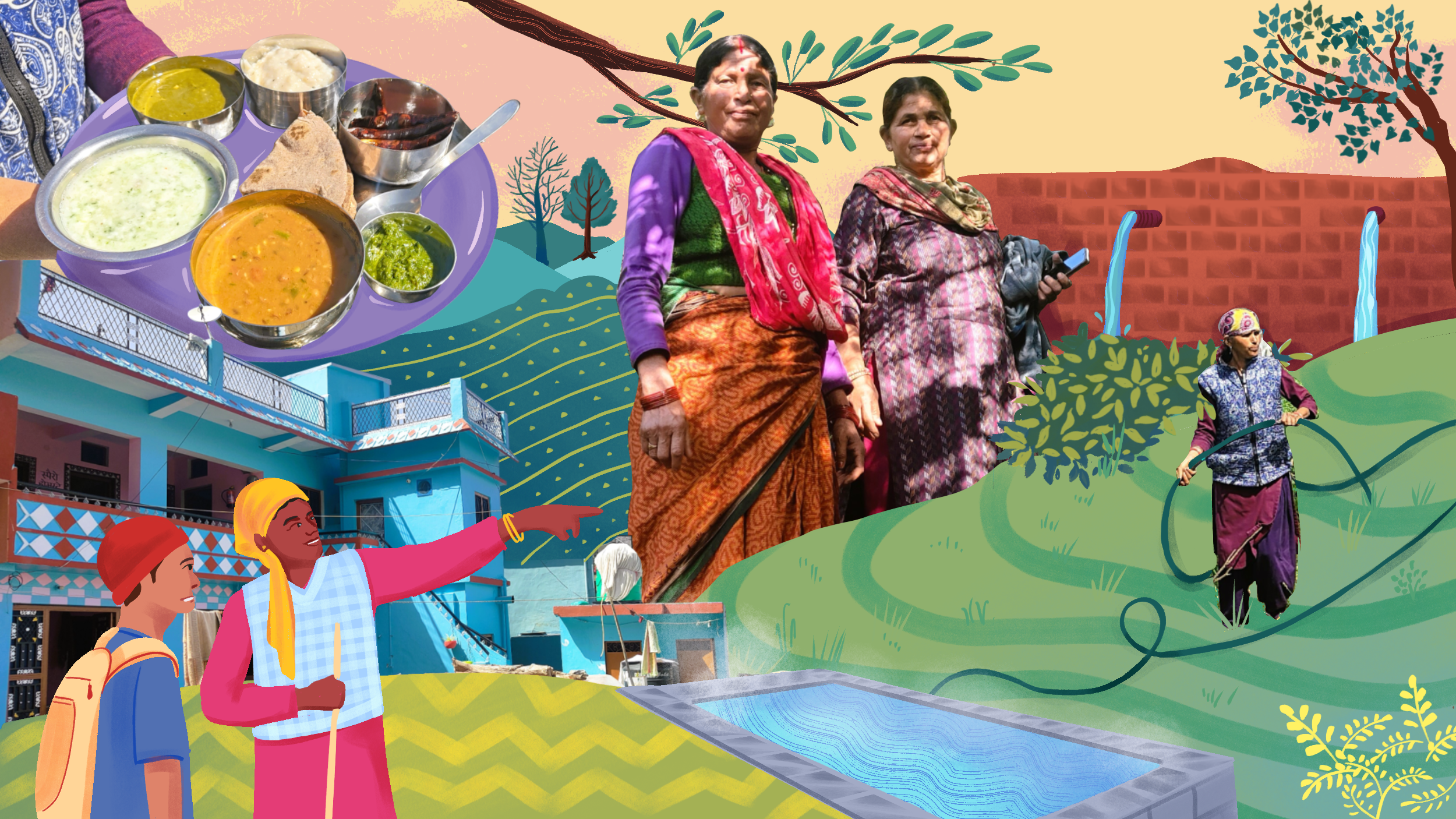
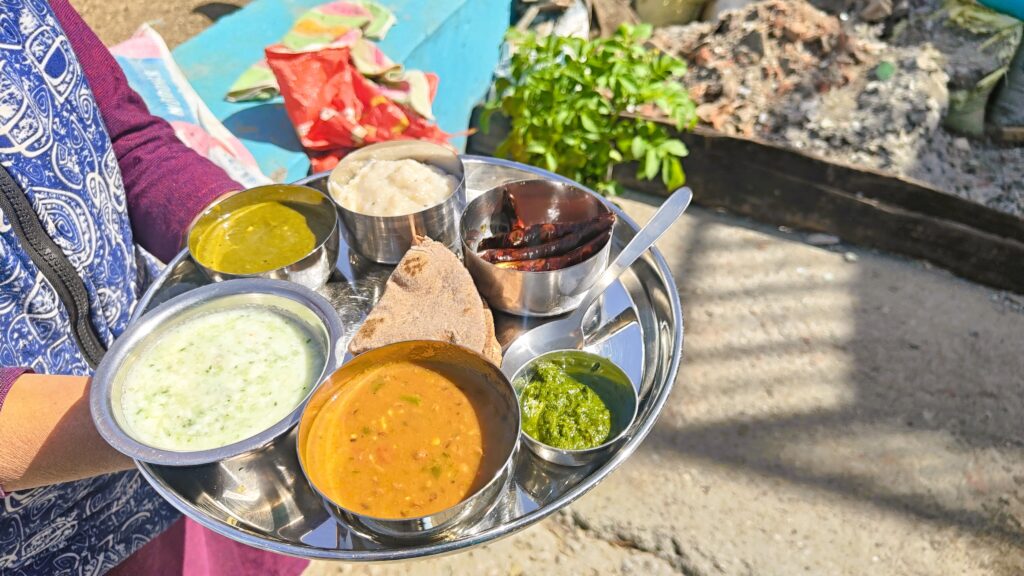
She lays out a traditional Garhwali plate: mandue ki roti (finger millet flatbread), jhingore ki kheer (barnyard millet pudding), rajma dal, rice, raita, salad, and roasted chillies. Much of it is grown in the village itself, and some comes through a barter system like rajma exchanged for vegetables with her neighbours.
Anil Ramola estimates that a woman can earn between Rs 20,000 and Rs 80,000 annually by running a homestay. So far, over the last four years, 17 community homestays have been set up in Chamba through the FPO. Now many villagers are also opening their own homestays,” he says. “Each homestay needs a licence from the Tourism Department, which must be renewed every year.”
Tehri district has around 700 registered homestays, as per Soban Rana, district tourism officer of Tehri. These, he believes, are an offbeat option for travellers who want an insight into the lives of Chamba’s people. “In many villages, women are managing homestays because men are away for jobs or in the army,” he says.
Farmers Turn Nature Guides
At the entrance of the village, a solar water pump glints in the heat of the April sun. From there, the path slopes down towards the village forest. The walk is tricky because the glossy carpet of oak leaves is slippery. The women move through the forest with ease as they guide tourists from across India; these were the tracts on which they once walked with heavy headloads of water and fodder for their cattle.
“We take tourists to the jungle early in the morning,” says Vasu Devi. “We ask them to sit quietly, close their eyes, and listen to the songs of our forest birds – ghughti, ghenduri, suntulu, myoli – the most beautiful of the lot.”
Vasu recalls that the trail now traversed by tourists was once the route she used for years to fetch water. “Earlier, we were totally dependent on rain to irrigate our fields. We saved water the way people save money in a bank. But after water reached our village through solar lifts, our fields flourished with vegetables, traditional crops, and fruits. Now, when tourists visit our village, they also buy our produce.”
Sitting beside Vasu, Initially hesitant, Lakshmi says she now takes pride in the work. She has been a nature guide for the last three years and each trip earns her Rs 300. “We know our farms, springs, village paths and forest trails. Now, we have turned our knowledge into work,” says Lakshmi, who has been working as a nature guide for the past three years.
[This story is part of the series ‘Rewriting the Food Story’, a collaboration between Womanity and Behanbox.]
We believe everyone deserves equal access to accurate news. Support from our readers enables us to keep our journalism open and free for everyone, all over the world.