
‘My Work As An ASHA Facilitator Was Questioned Because Of My Caste, Disability’
Dharmishtha Chauhan from Gujarat opens up about the casteism embedded in her work, the mental toll of harassment and discrimination, and why ASHA workers must be aware of their constitutional rights
This interview is the first of our three-part series on how caste identities shape ASHA workers’ access to opportunities, safety, support, and dignity. There is no reason for a community healthcare programme to be immune to a casteist society’s violence, but these realities are understudied or structurally hidden. This series is an attempt to decenter caste privilege and reframe the history of the programme through the lens of marginalised ASHA workers’ experiences, who carry and content with these truths each day still. We will document systemic exclusions and build grassroots evidence of how caste discrimination is embedded within and outside the healthcare structures for ASHA workers. Read the other stories part of The ASHA Story here, the first public archive of women workers’ lives and histories.
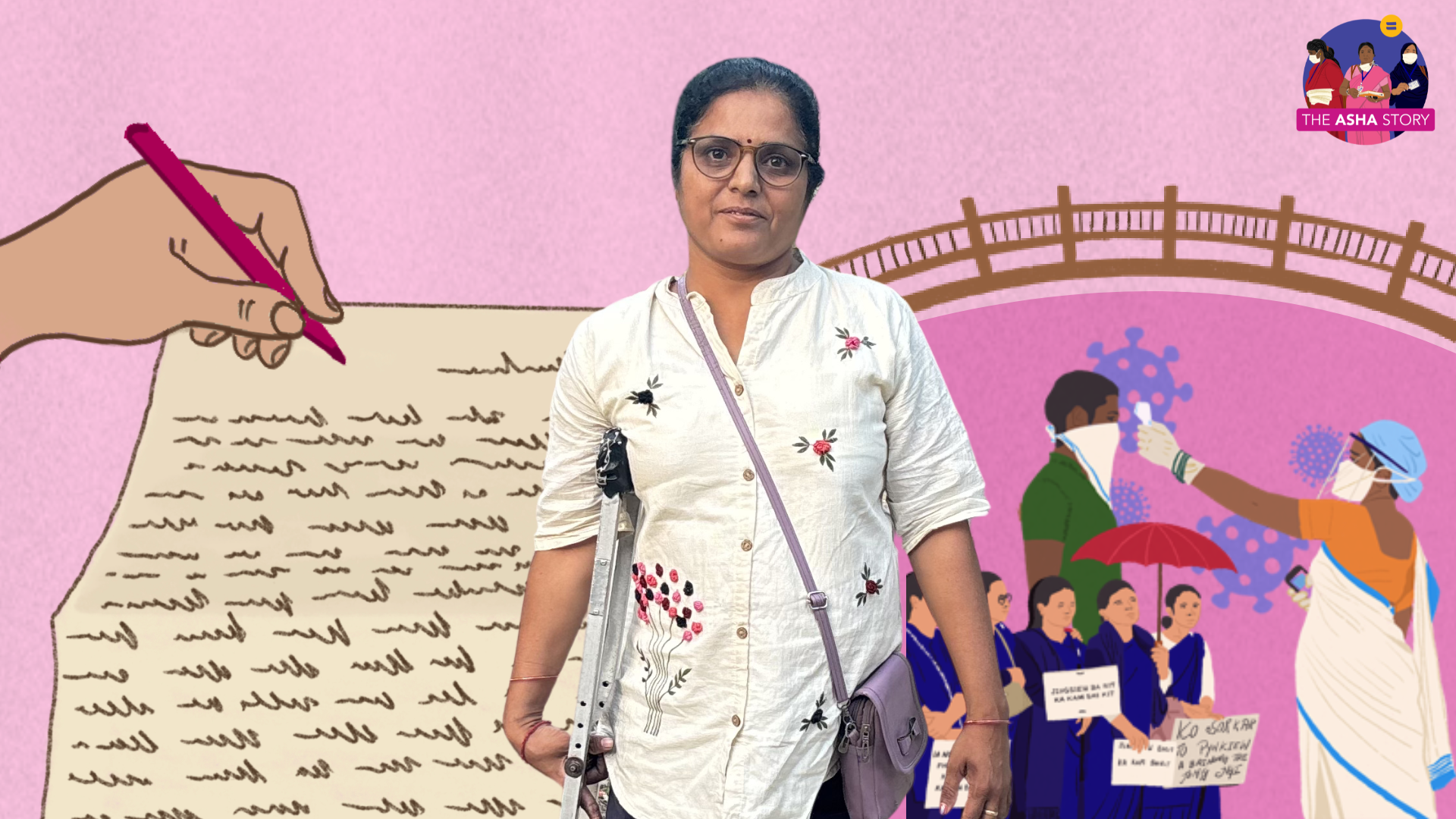
As a young girl in a small village in Gujarat’s Khambhat region, Dharmishtha Chauhan hoped to become a lawyer, inspired by the will to help people find solutions to complex societal problems. But her disability (she was diagnosed with polio when she was 11 months) and circumstances led her to choose other paths. Now, at 46, she manages multiple roles – an Accredited Social Health Activist (ASHA) facilitator, a social worker, and founder of a non-profit organisation for people with disabilities. As the first ASHA facilitator from a Scheduled Caste community in her village, Dharmishtha has had to fight discrimination based on caste as well as her disability, affecting her mental health and curbing professional mobility.
In a conversation with Sarasvati Thuppadolla, she talks about prevalent caste discrimination and untouchability practices. “Initially, my own colleagues would not drink water from my bottle or even eat the food I brought, and would sit separately,” she recalls. Dharmishtha says caste bias remains missing from union concerns, and encourages SC ASHA workers to free themselves of fear. “We have to fight for the fundamental rights that Dr Babasaheb Ambedkar provided to us.” Edited excerpts below:
Tell us about your journey – how did you become an ASHA facilitator?
I completed my education around 2000 and was at home for a while because of my disability. I used to make and sell incense sticks for a living. In 2008, I got an opportunity to work with the Panchayat’s Jan Kalyan department under the Gujarat government’s Gram Mitra Yojana. This was a contractual role, more of social work, where we had to educate villagers about various government schemes, help the elderly access the pension schemes and facilitate other public benefits – all for Rs 1,000 per month. I worked there for three years, which helped me connect with the village residents.
They discontinued the scheme in 2010 and I was left jobless. The Panchayat members asked me to continue doing the same work for free in Nana Kalodra village in Khambhat [about 90 km south of Ahmedabad].
In the same year, a female health worker (FHW) from the primary health centre of the village noticed my work and asked me to apply for the position of an ASHA sahayyak [assistant to the FHW, and an ASHA supervisor], in the health department. During the interview I was asked: “How will you work? This is not Panchayat work, you will have to travel a lot.” The FHW supported me, and assured them that I am capable of doing my job well despite my disability. I worked as a sahayyak for two years, earned Rs 1,500 a month, and then finally became an ASHA facilitator in 2012.
I am the first Scheduled Caste ASHA facilitator from my village. The FHW, who supported me also belonged to the SC community, stood by me throughout.
Did you find that your caste identity was used to discriminate against you?
It happened when I was with the Panchayat and working on the field with a colleague. We asked a resident for water, who then [started to] pour it into our palms. I refused to drink the water in that manner. Even during events at the Aanganwadi centre, everyone used to bring home-cooked meals, but they never touched my food; they talked using code words, indicating to others that it’s my food. I closely observed their body language and the words they chose, and couldn’t help but desire an escape from that work environment.
When I was a child, I was once asked to leave our village temple and the priest later washed the entire temple premises. I still remember that. My father went to fight with them but was calmed down by our neighbours. I never stepped into a temple after that incident. I am reminded of similar incidents while working.
As a facilitator, the initial difficulties were related more to my caste identity than to my skills. All ASHA workers under me belonged to the upper-caste communities. At first, my own colleagues would not drink water from my bottle or even eat the food I brought, and would sit separately. This is true, they come for signatures or other work, but they never drink water at my place till date. They always have excuses, but if you ask me, they practise casteism in reality.
They would send me only to SC households, and they would go to upper-caste households during field work. These things were very common, even before I took on this role. Not all of them practise untouchability explicitly, but there are many ASHA workers who still do in different subtle ways.
One time, I refused to sign the salary form of one ASHA worker due to continued discrimination and when a senior questioned me about this, I confided in him about my experiences. Our senior called all the ASHA workers, and warned them of the Atrocity Act (Scheduled Caste and Scheduled Tribe (Prevention of Atrocities) Act, 1989).
During Covid-19, people would maintain strict social distancing from us because we were in the health department, but they reached out if they needed help. At that point of time, they were good to us. When they need us, they don’t see caste. But when we are alone, they would practise untouchability.
Are ASHA workers from SC communities systematically excluded from career progression? How so?
Incidents of discrimination have always bothered me. It prevents us from focusing on our job – our capacity to work is naturally affected and we can’t always achieve the level we aspire to reach. I’m an example of that: I wanted to pursue other courses, but realised too late that I could do it. No one told me that since I was educated till Class 12 I could study further to apply for senior posts like Auxiliary Nurse Midwife (ANM) in the primary healthcare system. When I was eligible to take the course for FHW, my senior, from an upper-caste community, never informed me that I could apply for a better post. I learned about it when I was no longer eligible to apply. I was told that they forgot to inform me, but no one forgets – they do not want us to progress.
I am good at my work, and it hurts me that no one told me, otherwise I would have been in a government post right now. I have suffered a huge loss because of this lack of knowledge, and casteism is a huge factor.
I have survived through my small business of incense sticks. I have been able to provide education to my children but I couldn’t provide them with enough nutritious food, like dry fruits or a glass of milk every day. I am handicapped and need a glass of milk every day, but I don’t think I can afford that sometimes. I have to manage many bills with meagre earnings.
How do these daily acts of discrimination impact your work and relationship with others? Were there spaces to register complaints or talk about them?
As a facilitator, ASHA workers from the SC category often come to me with concerns. They say when they go for field work in upper-caste communities, residents don’t co-operate or respond to them properly. There have also been instances where SC ASHA workers faced harassment in the form of false complaints from residents. They would tell me: ‘I provide medicine, I provide everything. Even then, people complain about me.’ On prompting further, they would confess that people in the Patel area do not tolerate ASHAs from the SC community, and request me to send an ASHA from their area to cater to them. But our FHW and community health officer (CHO), who are from our community, stood by us. I encouraged ASHA workers to start maintaining proof of every field visit in the form of photographs and signatures, this helped us address any sort of complaints thereafter.
On the other hand, sometimes ASHA workers from the general category refuse to go to SC areas, they said: “There’s an ASHA from the SC category, that’s her area, send her.” The truth was she didn’t want to go to that area.
In my village, many people would try to create issues around ASHA workers from the SC community and then propose that we replace them with women from the general category. Earlier, these women were not interested and had to be encouraged or convinced to partake in the ASHA programme, but now they are eager. “If any ASHA is expelled, then let us know, we will join,” some say.
Honestly, we are able to tackle issues of discrimination because our cadre, the FHW, CHO, and Multipurpose Health Worker (MPHW) are from our community. I worry that if our cadre changes to an upper caste one, then we might face the same problems which I experienced firsthand when I joined. Though I gave correct reports, officials would always find fault and tamper with them. I had to start keeping two copies of the same records, one for myself, one for them.
I, and other SC ASHA workers too, were not informed of or allowed to attend certain campaigns that would provide avenues for earning additional incentives. But we would be informed when we had to gather crowds for government programmes or do other unimportant work. We were being exploited in a real sense.
It was only in 2023, when I joined the National Council of Women Leaders (NCWL), that I learned that even we have fundamental rights that Dr Babasaheb Ambedkar provided to us and we should fight for it. It made me aware about caste violence, something I experienced in my life, but I didn’t know it was violence, I did not know the underlying reasons that caused it.
There are many people who face discrimination but are not always able to speak up, which pushes me to find ways to educate ourselves about our rights, and be assertive about it, so that they know they can’t treat us inferior to them in any way. It is our right.
Among the upper-caste communities, there are good people too, but the ones who practice violence and discrimination are in majority. They try to restrict us or instill fear in us; even when we want to move ahead and do certain things for our betterment, we are discouraged from pursuing it.
How do you encourage the ASHA workers working under you to tackle such incidents?
My only message to them is that we fulfil our duties with utmost integrity. There are some ASHA workers who hesitate to go to upper-caste households. I tell them that if you accept discrimination even before you go, how will we fight it in the long run?
Now we have a group of our ASHA workers and I have taught them that if we want some change, we should come forward and speak. Whenever we have meetings, we talk about these issues. Many still hesitate to talk about discrimination but I tell them: ‘Look, I’m handicapped; I can’t do anything else. I might lose my job. I might have problems at home, but even then, I speak up because I’m right. If you’re right, speak up.’
There are many ASHA workers who agree to do any work in addition to their duties, but they should learn to say no or assert their ownership of their work. I have brought about this change in my group: if ASHA workers end up doing more than they are supposed to, they should be clear about letting people know this is extra work.
I have seen ASHA workers from our community staying quiet, because they are ultimately seeking some acceptance or individual advantages. But I have spoken against such casteism even if it meant they never interact with me ever. And secondly, we should show people who we are, and make them aware that untouchability can be subject to the Atrocity Act.
Because I come from an SC community and am also disabled, people have two reasons to treat me as inferior and doubt my capability to get work done. But, I have always challenged people who hold prejudices.
What kind of biases did you have to face due to your disability?
I have been disabled since I was 11 months old. Initially, I used to walk on double crutches, then I started using calipers when I had my baby, and now I am on a single crutch. I don’t know what exactly it is, but people who had the same problem told me that it is due to polio.
The biases came from both upper caste people and those from our SC community. They would call me even during out-of-duty hours for work, and because of my disability, I had to take private rickshaws and autos, spending Rs 100-200 for every visit. When I was an ASHA sahayyak, they would sometimes ask me to travel to areas where it was difficult to enter using a vehicle, and I had to walk and go. I walked a lot back then, for days at that time, and I see the impact now – I cannot stand for long durations now.
My work has been recognised by people as well as my seniors at the health centre but still, there were times when the Patels in the area would deliberately try to complain to our FHW saying: ‘She doesn’t work. She’s handicapped, and can’t work properly.’ They would try to order me around, but I would do what I feel is right: I would answer back if I was treated differently, and they didn’t like it. However, there were some people from the upper-caste communities also who have supported me in my journey.
I’m still working as a facilitator, and I’m constantly threatened. ‘If you speak too much, you’ll be fired. Whatever you do, be cautious of the consequences. You are handicapped, who will hire you?’ I’m told. But I can’t tolerate being suppressed, so I speak up, and continue to do my work. This also means that I work harder and put in more time, irrespective of my official hours, compared to others. I couldn’t leave early or fall behind; I had to prove my capabilities and ensure that no one could question me again.
Tell us about your organisation, Atmabal Viklang Seva Mandal.
I wanted to work for people like me, which is why I started my own organisation Atmabal Viklang Seva Mandal in 2010. We had a handicap sabha of more than 100 people. I didn’t know how to run an NGO back then and struggled to find support, but one of my friends from our disabled community offered to help me, and seniors from NCWL further taught things useful for running an organisation.
I detested the attitude traditional NGOs had towards us. We were just a part of the crowd or a tool for tokenism in an event, nothing beyond that. I decided then that if I am leading an NGO, I will ensure that no donor or anyone disrespects or discriminates a disabled person. I refuse to accept help from such people; my people should not be treated differently from the so-called ‘normal’ people.
We are just starting. We now have eight core members in our organisation and divide work between us. We don’t have any major CSR funds and that’s why we can do only limited work, such as connecting disabled people and their families to government schemes. I also run a small business of making incense sticks and employ those without jobs to make them financially resilient.
We consider our group as a community, and I owe my progress to them. This is just the beginning for me, and the runway is a little short, but it will get better. I believe we are not disabled internally – we are physically present, so no one should think of us as disabled. We should seek help from others but become self-reliant. And I believe that disabled people should not consider themselves helpless, we have to find ways to move forward.
What policies or allowances could ease the challenges for disabled ASHA workers?
First, I think the government should provide disabled ASHA workers with travelling facilities and when ASHA workers age, they should be assigned desk work instead of field work. I am now being paid Rs 10,000 monthly and I have nine ASHAs, from three villages, under me. I have to travel 7-14 km from my place, spend money to attend meetings (for their salary or review purposes) in these villages. It is very difficult after a point, especially for disabled people. I also feel that the government should set up a committee for disabled ASHA workers, provide allowances like houserent, travel costs, and provide opportunities for a permanent job.
Another thing is we work in the health department, and due to the nature of our work, we are more vulnerable to falling sick sometimes. Government workers like the FHW, MPHW and CHO do not treat us contract workers well and they ask us to do extra work, which is not part of our duties (like sputum collection from TB patients). We do not know who is infected, who has which disease, and we end up being the first targets. We do not even earn enough to take care of ourselves properly, in terms of nutrition. Some nutrition supplies for ASHA workers are also necessary. Most importantly, there should be some financial support for education of children of disabled ASHA workers if they are not able to finance their higher education, at least for those who want to study further. There are many kids I have seen giving up their education.
Do you think ASHA unions and collectives actively address these difficulties?
The union of ASHA workers and facilitator ASHAs should speak out about caste – our lives are greatly impacted by our caste identity. Currently, the leaders who represent us do not talk about caste at all. If I ever get a chance to take up a leadership position in our union, I will make it a point to talk about these incidents. We are growing and will continue to grow, but these experiences have greatly affected us mentally.
It is because of ASHA workers that people at the grassroots level have trust in the health system. But it appears that while change has occurred there is no inner transformation, not yet. Upper caste communities exploit our people and harass us, and this affects our morale and disturbs our mental stability. My mental health had once deteriorated to a degree that I was ready to quit my job, but I was helpless and did not have work elsewhere. There are so many ASHA workers who confide in me about how their job, along with caste-based discrimination, impacts their mental health. We should have a group where we can discuss how to resolve it.
When I founded my organisation and started my own business, I learnt things that built my confidence. My financial condition is improving a little, so now I can handle these issues better.
Do you have any support systems? How do you care for herself? What do you do in your leisure hours?
The staff from our community at the health centre have always been supportive of me and other SC ASHA workers. We attend training sessions together, share meals, help each other in preparing reports when we can’t approach other ASHA workers, and have developed friendships in the process.
When an upper caste ASHA worker calls us for weddings, events or even funerals, everyone will visit them, but they don’t do the same for us or join us in our joys or pains. So I told my ASHA workers to maintain relationships only with those who see us as equals, and to stop engaging in formalities outside work. Many of our community staff even caution each other informally of potential casteism or caste-related troubles in the health centre – that’s our way of protecting each other.
My husband and children have also been very supportive in my journey. My husband helps with household chores and manages things when I have to go out. When I am stressed, I have friends from the NGO and the health department to confide in. I meditate. I also like music, so I listen to songs when I am free, preferably Hindi music and ghazals.
When I am alone, my mind is always active, occupied with ideas about what more I can do to help members of the disabled community.


We believe everyone deserves equal access to accurate news. Support from our readers enables us to keep our journalism open and free for everyone, all over the world.
