
‘No Process, No Consultation, No Scrutiny’: The Perils Of Linking Delimitation With Women’s Reservation
The bills are a “smoke screen” that give the government discretionary powers to change the nature of our electoral democracy, says Maansi Verma, founder of Maadhyam
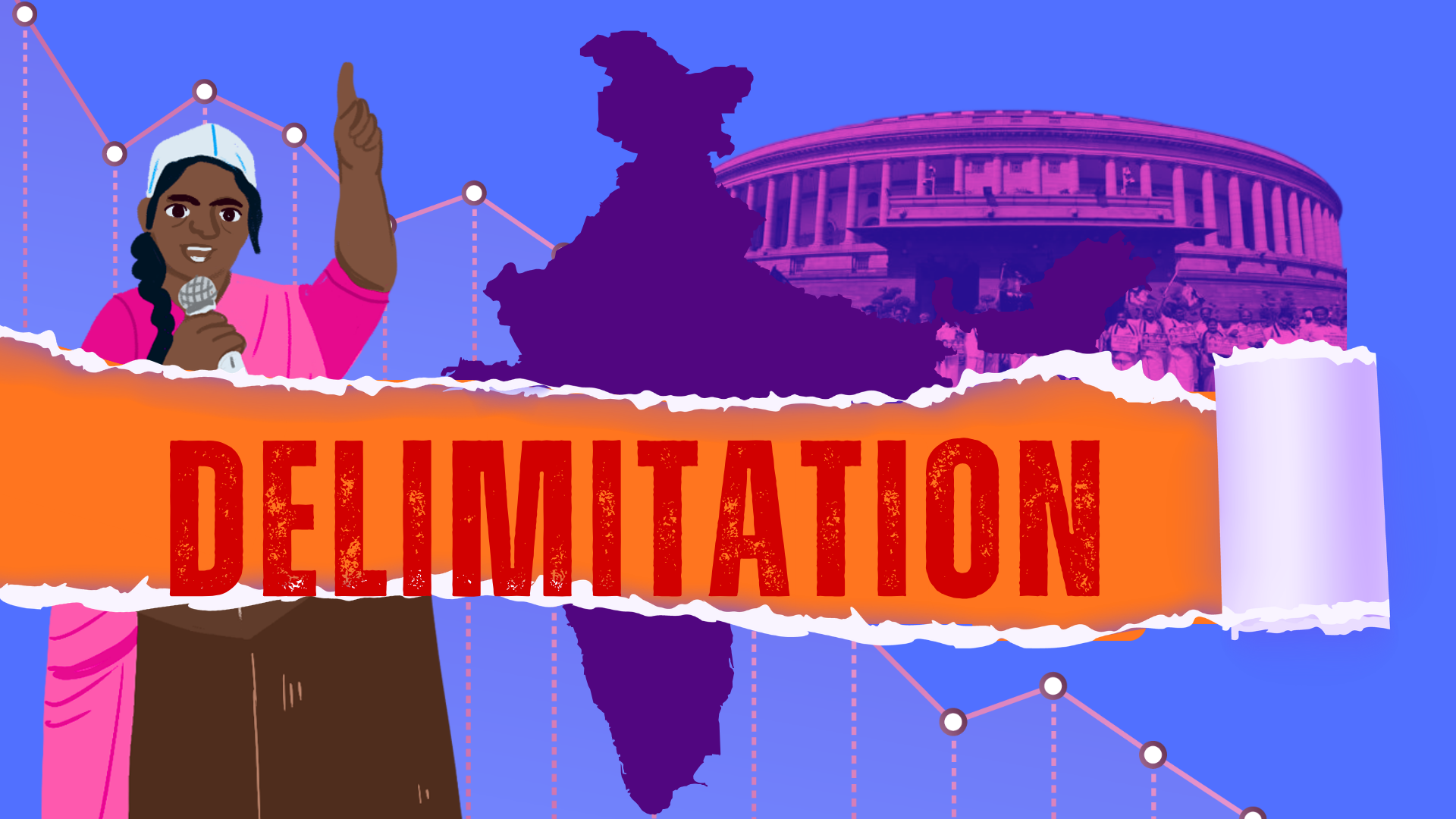
In the thick of the election season, a legislative thriller writes itself. The Union Government on April 14 tabled three Bills purportedly to increase women’s participation and representation in the Lok Sabha and the assemblies of States and Union Territories. These are: the Constitution (One Hundred and Thirty-First Amendment) Bill, 2026, the Delimitation Bill, 2026, and the Union Territories Laws (Amendment) Bill, 2026. The women’s reservation bill, which was passed in 2023, came into effect from April 16 as discussions continue about its merger with a delimitation bill — a move the Opposition called “bizarre”.
At the time of publishing this piece, the Parliament continues to debate the three bills that were shared in the public domain three days before the session began. The Bills propose a 50% increase in the Lok Sabha strength, and to amend the Constitution in a way that would give the Union Government powers to decide when and using what data are future delimitation exercises carried out.
Without any proposed safeguards, the Bill gives arbitrary discretionary powers to the government, which can be misused to manipulate future electoral outcomes, says Maansi Verma, a lawyer and founder of Maadhyam, a civic engagement platform that tracks the parliament and policies.
Under scrutiny is the timing, the premise underlying these legislations, and the hasty process with which they were introduced. Why link delimitation, a constitutionally-mandated exercise, with women’s reservation bill? Why do it before the Census 2027 data is published? Why 850 seats?
According to Maansi, the three bills together are a smoke screen, which violates the spirit of the women’s reservation bill. “What they actually wanted to do is not upset the existing arrangement; they did not want any male MP to make space for women,” she says. Opposition MPs have further noted the Bill will negatively impact women from SC and ST communities.
In its current form, the bills give discretionary power to the government, which without judicial oversight, changes the nature of our electoral democracy. “This is not how bills should be made, how the constitution should be amended, not how parliament should function,” says Maansi. Edited excerpts below.
What do you make of the timing, intent, and ongoing debates behind the delimitation push?
There was absolutely no inkling that the government was planning something like this till about a month ago. The Transger Persons (Protection of Rights) Amendment Act, 2026, was brought on March 13, then it completely took over the news cycle and at that point of time, when the budget session was going on, the government did not indicate that it was planning something like this.
That is strange, because on April 16, while speaking in the Parliament, the Prime Minister said that they have been doing deliberations and consultations, not just with different political parties, but also with constitutional experts and women activists, that there have been structured and informal conversations. But who are these experts? Who was the government speaking with? Where did these consultations happen?
Apparently, the government called two all-party meetings which happened during the budget session, but even then, it wasn’t very clear whether the government gave any justification for why this needs to happen now.
On the last day of the budget session — which was originally scheduled to end on April 2 — it was announced that it would reconvene during April 16-18. Elections were going to take place in four states and one union territory… why choose these three days? The Opposition also asked: if you want to implement the Women’s Reservation Bill quickly, why could you not have waited till the elections got over? The government has so far not come forward with any justification. All it is saying is: women have waited too long, this needs to happen. But then why did they wait from 2023 till 2026?
It remains a mystery why it had to happen now. Some people link it to elections – that the government wants to get political mileage in the middle of election season. And they are building a narrative that they are doing this for women. So if the opposition opposes delimitation, the government will spin that to say the opposition is against women’s reservation. And that is what we see. The Prime Minister very categorically said in his speech on April 16 that everyone can take the credit if they support the Bill, but if they oppose it, he is definitely going to get political benefit out of it.
Why is delimitation linked to the women’s reservation bill, what is the government’s argument? Is there a precedent for tethering a constitutional process to specific legislation?
In 2023, when the government brought the Women’s Reservation Bill, it said that whenever this act comes into force — and this act came into force on April 16, 2026 — the census which happens after it, delimitation will happen on that basis. And then whatever is the number of seats in the Lok Sabha finally, one-third of that will have to be reserved for women.
A lot of questions were raised even then. Instead of implementing the one-third reservation on the existing 550 seats of Lok Sabha, everyone asked: why postpone it, deferring it to a date when a new census happens, then a delimitation happens, and then it is implemented? The concern was the next census would have been the 2031 census, and once the census happens, then delimitation happens, so before 2034 at least, the reservation could not have been implemented if you go by the formulation mentioned in the Act. A lot of people also criticised the government for this formulation, noting that they don’t need to link women’s reservation to census and delimitation — just apply this one-third formula on the existing 550 seats and implement it from 2024 onwards.
The government offered no real justification at that time also, and even then the government did not do any public consultation on the bill. A special session of Parliament was suddenly called and the government kept saying that some historical decisions would be taken. The bills were introduced without any knowledge of the contents or indeed any consultations.
The most plausible theory of why the government insisted on census and delimitation first, is it would lead to a reallocation of seats, and eventually, seats in Lok Sabha would have to be increased. Then giving one-third of that to women would be more acceptable to the men who are currently holding on to these seats — men who somehow consider it their birthright to rule, so they would not be upset when their seats suddenly become reserved for women. So, to not upset the existing arrangement — where we had only 14% women in Parliament and the rest were men who were not willing to make space for women — this formula was proposed.
Tejasvi Surya on April 16, when speaking on the new bill, more or less confirmed this to be the government’s thinking. He categorically said that if they would have reserved seats on the basis of the existing Lok Sabha strength, a lot of male MPs would end up losing their seats. What the government wanted to do was to prevent the existing seats from “encroachment” — that was the word he used for women’s reservation.
The idea is that the existing makeup of Lok Sabha should be disturbed as little as possible, and additional seats be created which can then be reserved for women.
If the government had implemented the Women’s Reservation Bill in 2023 or if it were to do it right now, then conduct the delimitation post-Census, how would that play out?
If this would have been implemented in 2023 itself — without linking to it to census and delimitation, and simply said one-third of existing seats have to be reserved — then in 2024 itself, out of 550 existing seats, one-third would have been reserved for women.
What complicates things now is that there was another provision in the Constitution [the proviso to article 81(3) and the third proviso of Article 170] which had frozen the reallocation of seats till 2026. The Constitution currently says that the Lok Sabha seats have to be reallocated and readjusted after every census. But this was frozen earlier — in 1976 and then again in 2001 — to say that this arrangement should not be disturbed till a census after 2026 is conducted.
This was done because some states would have ended up losing out on their seats in Lok Sabha because they had implemented population control well. What is written in the Constitution is that as far as practicable, the population-to-seat ratio should be the same. That would mean that if, for instance, in southern states there are 15 lakh people in every constituency, and if you use that ratio to apply to Uttar Pradesh, the number of seats would have to increase. The population disparity was such that if this principle was followed, the seats for certain northern states would disproportionately increase in comparison to seats for southern states. Therefore, a political arrangement was reached between the union government and state governments to freeze it till the time a more just division of seats could be achieved.
In 2026, the government again has an opportunity to freeze it for a certain number of years. But some people — and this argument also has weight — have been saying that since 1971, population has drastically increased, so there is a need to reconsider the seating arrangement in Lok Sabha. Right now, some constituencies are unduly large and no MP is able to do justice to representing lakhs and lakhs of people.
But what also needs to be noted is, what existed earlier resulted out of a kind of political negotiation and agreement. What needs to happen now also needs to be a result of some kind of negotiation and agreement. But the government has done this process unilaterally — again, no consultation happened, up until two days ago we didn’t even have a text of the bill in the public domain —and decided that the total number of seats in Lok Sabha will go up to 850. How this 850 will be divided is still not known
The assurances the Prime Minister and the Home Minister gave in Parliament — that whatever is the existing proportion of seats each state has will be maintained and on top of that every state will gain 50% — are not written anywhere in the bills.
In the parliament, the government has said the proportion of seats will remain the same for states like Karnataka and assured southern state’s seats would not be decreased. Is the arithmetic correct? How can they claim that without any data or recent census figures?
The government is doing a delimitation right now, before the 2026-27 census figures are available, and is proposing to use the 2011 census for this purpose. According to their calculation — and I don’t know how they have done these calculations, because psephologists like Yogendra Yadav have done their own calculations and have given different numbers — the government is saying that no state will lose, because they are also increasing the total number of seats, and every state will eventually gain seats.
But this is not laid down in the law — it is just what the government is saying, assurances they have given. Yesterday, the Home Minister in his speech gave some numbers but this is their calculation on the basis of the 2011 census.
What the bills themselves actually say is very different: they say that the government is empowered to conduct delimitation whenever it wants to, and can use whichever census data it wants for that purpose.
What is also very strange is that the government is already coming up with these formulations and deciding the reallocation of these seats, which is actually the job of the Delimitation Commission to determine on the basis of the principles laid down. The Delimitation Commission is supposed to function independently, place its draft report in the public domain, invite comments, interact with all political parties, and go on the ground. A very technical but also very consultative process is supposed to be followed, after which you arrive at these numbers.
The government can tomorrow take back these promises. They can say that we gave these suggestions to the Delimitation Commission, but it is an independent body and ultimately has to come up with its own numbers, and we can’t do anything about it. The government would be legally correct in saying that.
Even if the government brings a schedule to the delimitation bill laying down the maximum number of seats for each state, to what extent that is going to be binding on the Delimitation Commission is an open question, because the body is supposed to function independently.
It is very difficult to understand why the government is insisting that all these assurances should be believed, and that just on that basis we should take all of this — the 850 number, the delinking of delimitation from census, the use of the 2011 census — on face value. Clearly, the government has not made any attempt to justify its decisions or to do open public consultations on this.
Do the three bills address reservations for SC, ST, and OBC women within the broader framework? What would that arithmetic for SC/ST reservation look like?
The Constitution Amendment Act of 2023 did say that within the one-third of seats reserved for women, seats have to be reserved for women from Scheduled Caste and Scheduled Tribe communities. But the Scheduled Caste and Scheduled Tribe reservation happens on the basis of population — the idea is that those constituencies where people from Scheduled Caste and Scheduled Tribe communities are in greater proportion should be reserved for them.
So if you use an outdated census of 2011, it is quite possible that it doesn’t reflect the true reality on the ground of where people from Scheduled Caste and Scheduled Tribe communities are more concentrated and should be represented. Constitutionally, the representation of Scheduled Caste and Scheduled Tribe women within the larger quota of women is protected. But how it will actually play out on the basis of the 2011 census remains an open question.
The government is also planning to do a caste census in the upcoming 2026-27 census. It is quite possible that the political demand for OBC reservation would become stronger after that data came out — the opposition is already raising that demand. To avoid that situation, what the government is saying is: we will do a delimitation right away, using the 2011 census, before the caste census data comes out.
[MP Brinda Karat wrote in The Hindu: “In the name of urgency for women’s reservation, implementing a delimitation exercise which ignores the current population of SCs and STs will be a manuvadi injustice to oppressed communities, denying them a fair increase in the proportion of reserved seats.”]
Why are we proposing a 50% increase in seats? What’s the arithmetic? Does it align with past increases?
No, it has never been a 50% increase in one go and the government has not given any justification for this. This is a very big jump from 550 to 850. If you look at past increases, they have always been very modest and gradual. For instance, 1971 is the last census we used to increase seats. The Constitution was amended in 1973, and if you look at the Statement of Objects and Reasons of that constitution amendment, you see that first the 1971 census happened, and the delimitation process was triggered immediately after. It was realised that if the existing 500 seats remained, some states would lose out and some would gain. So to make sure no state loses out and everybody gains, an increase in the number of seats was proposed.
Also note that this increase in seats was proposed after they already had the census data from 1971 and the delimitation process was underway — so the government had some idea of what the reallocation might look like. And even then, it was a very modest increase from 500 to 525. Then in 1987, some reorganisation of states happened and this number went up from 525 to about 530 for states. Every time, these increases have been quite modest — you want to make sure nobody loses out, that even if it is a gain of one to two seats every state is gaining — but it’s not like the gain is 50% in one go.
Even if we lived in an ideal world and every census since 1971 had seen a modest increase — 25 to 30 seats every time, in 1981, 1991, 2001, 2011, 2021 — even then, it would have amounted to a total increase of maybe 100 to 125 seats at most, which means from 550 you would have gone to 650 or 675. Just because that didn’t happen and there is this pent-up need to increase seats, you can’t suddenly jump from 550 to 850. There have been MPs and experts who said that a 10% increase would have been sufficient to ensure no state loses.
Also consider how women’s reservation fits with this. If you do one-third of 850 it is roughly 267. And if you subtract that from 850, you arrive at the current number of seats in Lok Sabha. The number of seats being added is exactly the number of seats that need to be reserved for women. What they wanted to do is not upset the existing arrangement, they did not want any male MP to make space for women. So they just added one-third to whatever seats are there, arrived at that number, and are now justifying it by saying “we are giving a 50% increase to every state.”
The Constitution requires the delimitation exercise to happen after every census, but the amendments want to remove this clause and give the government arbitrary power to decide when to do this exercise. What are the potential risks with this change?
One of the reasons why this is laid down in the Constitution is to give a certain kind of certainty and predictability. You know for sure that every time a census happens, it will be followed by delimitation. Every political party can prepare itself accordingly. It is important to have a set frequency laid down in the Constitution as it enables a process which can be followed in a rhythmic pattern, and is not left to the arbitrary whims and discretion of whichever party is in power at a particular point of time.
Now, this is what the government is proposing to change. The government is saying that now they can decide when delimitation has to happen. If the 2026 freeze had been left alone per the Constitution, whenever the 2026-27 census data gets published — say, by next year — delimitation would have had to happen automatically. The government would have been forced to use the 2026-27 data only for the purpose of delimitation.
Since the government is also planning to do a caste census in this data collection, it is quite possible that the political demand for OBC reservation would have become stronger. To avoid that situation, what the government is saying is: we will do a delimitation right away. And the government could not have done that without giving itself the discretionary power to decide when delimitation should happen. So the government is proposing to delink delimitation from the census so that it has the power to decide when delimitation should happen and which census it should use for that purpose.
And this can also mean — and legally there would be nothing stopping the government from doing this if this amendment is passed — that every five years, just before elections to Lok Sabha or before elections to a particular state, the government can order delimitation and also decide which census to use for that purpose. This can become a tool in the hands of the government to manipulate electoral outcomes. It may not happen in the Lok Sabha because of the kind of attention this may garner, but it could happen in the states.
We have already seen something like this in the case of municipal elections. The 74th Constitution Amendment gave municipalities a constitutional status and provided for elections to municipal councils every five years. But just like a frequency for delimitation was laid down for Lok Sabha and Assembly elections, that was missing from the 74th Constitution Amendment. State governments were given absolute discretion to decide when they want to do delimitation, which census to use. And we have seen instances of extreme misuse of this discretion, that every state government — irrespective of party — has done it. If they are not expecting favourable results in the municipal election, they would suddenly announce delimitation or a change in reservation status. This has happened every five years, and sometimes more than once within that five year period, they would arbitrarily announce delimitation or they would delay delimitation, they would announce just before the elections are due to delay the elections. We have seen this in Bengaluru, in Mumbai, in other cities as well.
What we have seen is where this discretion exists, this discretion can be misused. The argument here is not to say it will be misused, but you cannot give unbounded, unguided, without any safeguards, arbitrary discretionary powers to the government because they are ultimately political actors who will use that discretion, who will be tempted to use that discretion for political gain, and that possibility will always exist. The point is that this may not always lead to misuse of power, but it can. And even that possibility is something that should not be allowed.
There will be no judicial oversight of the delimitation committee. Should this be a point of concern?
That has always been there in the Constitution. There is a Supreme Court judgment from the 1970s which has upheld it — that delimitation is not open to judicial review, and so delimitation exercises from the very beginning have been shielded from judicial review.
But now, with so much discretion being given to the government — a government that is not bound to give any justification for why it is ordering delimitation in a particular state at a particular point of time, or why it is using a particular census data for that purpose — to also not have judicial review on top of that becomes problematic. Maybe this might also mean that this question itself — of whether delimitation decisions should be open to judicial review or not — may be up for reconsideration, because the basis has changed.
What have we learned from the delimitation exercises in Assam and Kashmir?
What happened in Assam and Kashmir is a lesson in why this kind of discretionary power should not be given. In Jammu and Kashmir, the commission set up for delimitation purposes ended up delimiting constituencies in such a way that the Jammu division gained more seats than the Kashmir division. BJP was more confident of its performance in Jammu as compared to Kashmir, so it would have definitely gained advantage out of it.
In Assam, geographical consistency — which is one of the principles that has to be followed — was violated: constituencies have been drawn across rivers and across mountains, in ways that geographically would not make any sense on a map. Essentially, wherever Muslim populations were concentrated, those areas were divided into smaller constituencies so that their concentration came down and the number of seats that Muslims could influence was reduced. The BJP, wary of not getting support from Muslims, essentially reduced the influence that Muslim votes can have on the eventual outcome of elections.
Experts have also noted that even all of these new 850 seats can be redrawn in such a way that the population makeup of particular constituencies is engineered to benefit a certain party.
The ruling government is arguing that doubling the MP count and having longer Parliament sessions will lead to better representation. What do you make of that argument? How does an altered parliament composition affect legislative processes in the future?
With the way Parliament is functioning currently, we are seeing very, very few sittings in a year. We are seeing MPs’ time — which is supposed to be for Question Hour, Zero Hour, private member business — often lost because of disruptions, protests, and repeated adjournments by the government. And when that doesn’t happen, the government simply prioritises its own business over these other things. A case in point is the session happening right now: an ordinary session should have had Question Hour, Zero Hour, private member business. But the government suspended these three things to say that only these bills will be discussed and nothing else will happen in this session. And this happens very frequently. MPs hardly get any time to represent people, raise their concerns, ask questions.
Even when debates happen — and debates don’t happen that often in Parliament — very few MPs get to speak. Smaller parties, regional parties, get very little time. Usually it is BJP which gets a lion’s share of the time, and even there, you repeatedly see the same MPs making speeches. A lot of MPs may have had an opportunity to speak maybe once on a bill in a year. So if this continues, and you have more MPs in Parliament, essentially those MPs will just come to sit in Parliament, not get any real opportunity to speak much, vote occasionally, and then leave.
And most of these new people who are going to come to Parliament are going to be women MPs. You want more women to come to Parliament — but to do what? Just come and sit. Vote occasionally, then leave. That is all that you are looking at: women as just numbers.
Legislatively, we don’t see a lot of debates happening in Parliament. Even committees — as of now, committees have about 30 MPs, 20 from Lok Sabha and 10 from Rajya Sabha. Now, Rajya Sabha numbers are not going up, so Rajya Sabha MPs will continue to be 10, but Lok Sabha MPs will increase, so you will have 40-MP committees. How much time would MPs get to actually make a contribution even within committee meetings? And the government anyway is not sending bills to committee as much as it should. So we are seeing not just the functioning of Parliament coming down, but also the functioning of committees — and to these processes, which are becoming less and less alive, we are just trying to add numbers without creating the space where these additional MPs can make their presence felt.
A lot of people have also raised questions about the role of Rajya Sabha being further diminished. You’ll have an 850-MP Lok Sabha and just about one-fourth of that in Rajya Sabha. If a joint session of both houses needs to be called to pass a bill — and it hasn’t happened in the last two decades at least — but if it does, Rajya Sabha MPs would hardly have any influence. Even in committees, if you have 30 MPs from Lok Sabha and 10 from Rajya Sabha, even there their influence will go down. What role would Rajya Sabha then even play in the kind of deliberations that need to happen in Parliament?
Another valid point that a lot of people have raised is that essentially all these numbers are being generated just so that the government can ensure it has the numbers it needs to pass bills — even, in the future, constitutional amendment bills. If it has a larger number of MPs from the northern states, it will become easier to get bills through even without any debate. There are also concerns about cost — how much it is going to add to the cost of running Parliament, the salaries and all other perks and housing that has to be given to parliamentarians.
All of this is what one should remember from this entire episode: this is really not how laws should be made. There is something called a pre-legislative consultation policy of the government from 2014, which essentially says that every draft bill, before it is introduced in Parliament, should be placed in the public domain. The government should invite comments for a minimum of 30 days, do open consultations, give justification for why it is bringing a certain bill, and only after having done that process should a bill be introduced in Parliament. After introduction, ideally it should be sent to a committee for a further round of scrutiny, and only then should it be taken up for debate and passage.
All of this has been sidelined and fast-tracked. No consultation, no discussion, no deliberation, no committee scrutiny.
This is not how an ordinary law should be made, and definitely not how the Constitution should be amended — in such a rushed manner without any consultation. There are very real implications of what happens on the ground after you make these changes in the Constitution.
This story was produced with support from Report for the World, a global media service strengthening local independent journalism.


We believe everyone deserves equal access to accurate news. Support from our readers enables us to keep our journalism open and free for everyone, all over the world.
