
‘I Do This As A Sadaqa-e-Jariyah (Continuous Charity)’: An ASHA Worker’s Story From Kashmir
Shaheena Bano talks about navigating political uncertainties, curbs on mobility, public apathy, and a health department that does not dignify her work
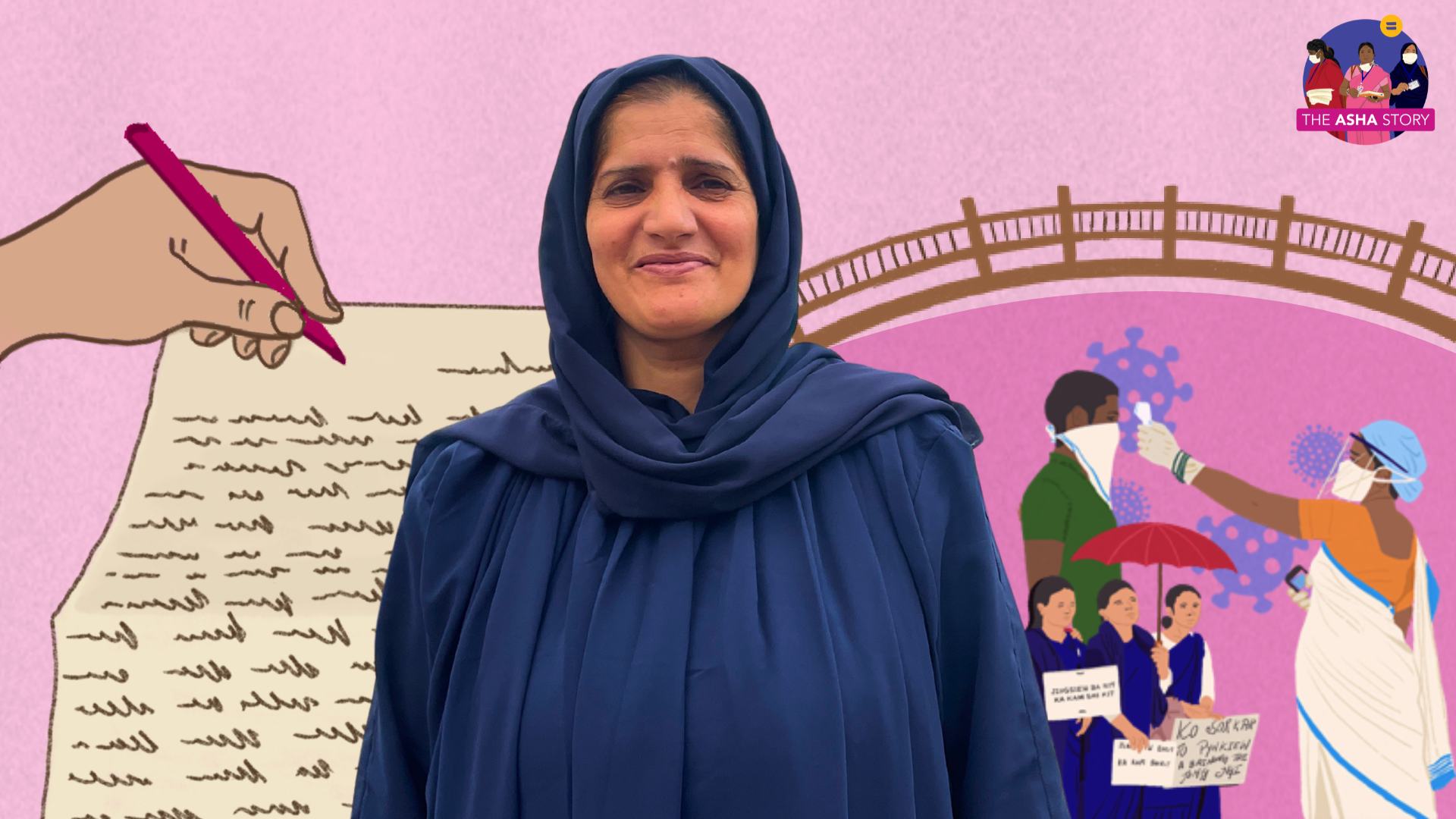
This interview is part of The ASHA Story, the first public archive of women workers’ lives and histories. Read the other stories here.
Shaheena Bano, 42, has been an ASHA worker in Srinagar since October 2019. In the years since, she has navigated political uncertainties, curbs on mobility, public apathy, and a health department that does not dignify her work. Despite this, she has built a house for herself, educated her children, and stood alone outside the Chief Medical Officer’s office to demand fair pay. We spoke with her on a day when with restrictions in place in Srinagar, mobile connectivity was curtailed, and the streets were largely deserted. She had just returned from her duties, having walked most of the way home.
In conversation with Tooba Towfiq at her home, she speaks of her contributions to her community as a form of sadaqah-e-jariya (continuous charity) and her belief that ASHA workers deserve respect, dignity, and fair pay. Her manifesto: ‘Na haqq khao, naa khaane do (Do not take anyone’s rights away, nor let anyone take what is rightfully yours)’.
Excerpts from the conversation:
How did you become an ASHA worker?
Before becoming an ASHA worker, I was an artisan. I was self-employed and was mostly engaged with raising my children. [But] Being an observant person, I never missed the issues outside my door. As a mother of two girls, I felt particularly concerned about the young girls in my vicinity. I had heard about volunteer work from my sisters, all of whom were working in various government offices at the time.
I applied to join as a volunteer in 2019. At the time, I was not aware that such volunteers were now called ASHAs or that the work entitled us to honorariums. In October, when I joined, there were only 13 of us in Srinagar. When I joined, we did not receive training. We learnt most skills on the job itself.
There was also a personal reason behind the decision. My father, a visionary man, wanted all his daughters to work. But societal pressures drove him to marry us all off early. He was always worried about us. I was the last of us to get married. As fate would have it, he passed away soon after. Getting married so early meant that I only passed 10th class.
I carried my father’s unspoken wishes within me for years. When I got to know about ASHA work, it seemed like work he too would have found meaningful.
What did the work feel like initially and how has it evolved for you over the years?
When I joined in 2019, the workload was manageable. It was only zaccha aur baccha (pregnant woman and child care). But over the years, this has changed. Now, the work never ends; it comes home with us. During the day, we are out-and-about in the field, and when we are not, we are expected to be online. One would think that we work 24/7 because we are on call for emergencies, births, and other community needs. But apart from these, it is the online work that makes our days disappear. We collect data from numerous households and have to upload these on various online platforms daily. The data entry takes forever to complete.
Work beyond our defined responsibilities is constantly outsourced to us. At hospitals and dispensaries, ASHAs are expected to do everything, even the work beyond ASHA’s scope. This is often work we are not even trained to do.
GPS attendance, geo-tagged photos, and video calls are a daily ritual to prove our attendance and efficiency. Which guidelines ask for ASHAs to mark their attendance daily? We are expected to work as full-time employees and are treated like volunteers. There have been weeks when we have even worked on weekends.
The health department is completely unaware. It is they who need to be educated about the legislations, nature, and the scope of ASHAs work. Unko khud nahi pata ki ASHA hai kya (they dont even know who an ASHA is).
I have fought so much for this. I’ve been to the mission director, the CMO, the BMO, and was even planning to visit Jammu but could not go. They expect us to be everywhere. If there is contaminated water somewhere, they put the blame on us and say, “ASHA kahan hai?” How can we be responsible for everything? Hum sipahi ki tarah humesha field mai rehte hain (we are like soldiers; always stationed in the field).
How has the shift to digitalisation changed your experience working as an ASHA?
It did create a lot of issues, especially for women like me who weren’t as educated. I could not sit for the matriculation exam because I was married off early but I can read and write. There are some ASHAs who have never seen a classroom. Many of them took their children or husbands in the field with them to help them use mobile phones. As daily work stretches beyond evenings, many of us come home, hand over our phones to our children, and leave them to finish the updation work. When I can’t do some tasks online, my daughter helps.
What’s worse, the government does not even provide us with mobile phones or tablets for such tasks. We use our personal phones and resources. The money given to us for an internet top-up is not adequate for a fast internet connection either. How does one keep up with the volume of online work with a low internet data pack?
In my designated zone, I oversee a population of over 2,000 people. My work involves collecting large volumes of health-related data, conducting biometric authentication, gathering samples, and managing documentation related to various government digital health cards. I am expected to carry out these tasks offline and then upload them to various government platforms. Take, for instance, the recently introduced ABHA card (Ayushman Bharat Health Account). It seems like an attempt to imitate western healthcare systems. But the government has not taken into account the lack of resources, education and infrastructure on ground.
What do you make of the honorarium and incentives you receive?
Considering how much work we do, we are definitely not paid enough.
I take care of a pregnant woman from the beginning – counsel her and keep track of her vitals for nine months. I accompany her to the hospital for delivery if need be. In the following weeks, I do home visits to ensure the child is being properly breastfed. I keep track of the baby’s weight, immunisation, and nutrition. I also ensure adequate postnatal care for the mother. After doing so much for nine months, I’m paid all of Rs 200 for this work. We are often entitled to more but are not paid the amount under one pretext or the other.
We do all the work that nurses and doctors do. We mark daily attendance, go door-to-door, attend meetings, and facilitate the implementation of many healthcare schemes. What makes our work any less than that of a doctor?
We are paid only Rs 2000 a month. Apart from this monthly honorarium, we are entitled to task- based incentives of up to one thousand rupees. More often than not, we do not even receive these incentives. Even new CPHC (Comprehensive Primary Health Care) incentives which we are entitled to are not paid to us in full. Where does this money go?
You became an ASHA in 2019 in the middle of a political and communication blackout in Kashmir. What was that like?
Political conditions often bring up challenges unique to ASHAs in Kashmir. The communication gag affected people’s access to us as well as our ability to reach them. We still continued to carry out our work. It took us longer to reach people as we could not call anyone for precise details. Soon after, the COVID-19 lockdowns were imposed, and it made our work even more challenging.
Due to the protests against what is happening in Iran in recent weeks, government institutions are closed and movement is restricted in Srinagar city. There is heavy deployment of security personnels, vehicular movement is restricted, and public transport is not available. As ASHAs, we are still expected to work even in these conditions.
Two days ago, when restrictions were already imposed, I was asked to report to a hospital 8 km from my home. As a woman, it was already hard for me to leave for work when everyone else was home. The streets were deserted with only security personnel deployed. They allowed me to proceed when I showed them my ID Card. The absence of public transport meant that I had to walk the distance to the hospital. I did so. Fortunately, for half the stretch, I was able to hire an auto, but it cost me Rs 200.
It was not just me, ASHAs belonging to all zones were working even amidst restrictions. No exceptions were made for us. Even as everyone is aware of these practical barriers, we are not excused. I’m still expected to update online portals. How can I do it? The apps have been buffering. My phone screen is frozen. Ye abhi bhi ghoom raha hai (the screen is still buffering). This affects our incentives as well; the logic being that if it is not online, it was never done.
Despite these challenges, what keeps you motivated?
I do this as a sadaqa-e-jariyah (continuous charity work).
Last year, when Tulip Garden was opened for tourists, there were massive crowds and traffic jams. There was no room to move. I was notified about a pregnant woman in labour who was finding it impossible to reach the hospital. She was not from Srinagar. I took it upon myself to locate her. As roads were blocked, I took her to the hospital on a shikara and admitted her in time for delivery. It is these instances which continue to motivate me to do the work that I do.
Even if no one acknowledges an ASHA worker’s contributions, my Allah does. It is Allah who will reward me for doing the work that I am doing.
The honorarium is another factor, though not in the way that one might imagine. Ek aurat humesha mard ki mohtaaj rehti hai (a woman remains dependent on men). [But] Even if our husbands or sons are doing well, we cannot fully rely on them. We need to have something of our own. Har ek aurat ko khud se kuch karna chahiye, kamana chahiye (all women should be able to earn independently).
Tell me about your family, your husband, your children, and the lives that you have built together?
My husband is very supportive. He is a casual labourer but also works as a computer operator with the floriculture department though not as a permanent employee. We understand each other’s struggles.
I was from Sopore and shifted to Srinagar after my marriage. I moved in with my in-laws. When my son was born, I was still living with them. However, after my daughter’s birth, my mother-in-law told me, “Mere ghar mai ab jagah nahi hai (there is no place for you in our house now).” She kicked us out and said they could no longer afford our expenses. My husband was not earning at the time.
Ever since, we have worked extremely hard to make ends meet.
Buhut mehnat ki humne, kabhi kisi ke ghar pe bartan dhoye, kabhi kisi ka kaam kiya. Kuchh bhi kiya, lekin bacho ko padhaya. Maine socha ki chalo agar mainey nahin kuch kiya, kum se kum bachay toh karenge (we have worked really hard. At times we washed people’s dishes, did other people’s work, we did everything we could. But we made sure to educate our children so that they can make a mark in the world, even if we can’t).
Things got better when I convinced my husband to open a barbeque stall at Makai Point near Dal Lake. I told him: “Ab kuch karna paday ga (we need to do something now).” Initially, he was quite hesitant. However, I remained persistent and supported him behind-the-scenes. I accompanied him to the stall for two years, even though it was not considered an appropriate profession for women. I would source mutton, marinate it, and prepare it for the day. By the grace of God, this business soon kicked off. We have now employed people to work there.
It is this venture which helped us fund our children’s education. This has been a priority for us. I never bought gold for myself, even after we started earning. I have worked relentlessly for years only to give my children a good education and a good future. Look at them now – my daughter is in the final year of MBBS, my son is pursuing Civil Services, and my youngest one just qualified her 12th standard examination.
We had to take out loans to educate them but their education was not optional for us. Agar jaeb mai paisay nahin hotay, koi aapki izzat nahi karta (no one respects you when you have no money).
How do people in Kashmir view ASHA workers? How do people receive you?
Recently, when I was going door-to-door for documentation work, some people told me off saying, “Maaefi thav (maaf kardo, a local phrase often used to shoo away beggars)”. They assumed I was there asking for alms or chanda. People have no awareness or respect for ASHA work. Visiting people’s houses for their own benefit does not make it undignified.
I do not blame them. Jab humara apna department hi humari izzat nahi karta hai (our own department does not respect us). If they see us sitting on a chair, they ask us to stand up. The doctors tell us: Aap mulazim nahi ho, aap ek worker ho (you are not employees, only volunteers). Even during COVID-19, we were not given protective gear. The doctors would give us one mask and one pair of gloves. We were asked to wash it and use it again. But doctors kept themselves safe. They’d ask us to handover medicines to Covid patients to avoid contracting the infection.
The lack of respect that we get from our own locality is just an extension of our own department’s apathy towards us. Sometimes, the disrespect gets too much to endure. Only a few weeks ago, a man threw cigarette ash at us when we were in the field. This is the reward we get for caring for our community.
Have you felt unsafe in the field as a woman?
There are many instances where I’ve felt unsafe. It happens all the time.
Our work involves a lot of public dealing. Very often, we give out our phone numbers to people so they can reach us. What follows are unsolicited and inappropriate phone calls from men. My phone is filled with such blocked numbers.
The danger seems closer in the field.
Once, I along with another ASHA, went to a house for routine work. They had a smart gate which was remote-controlled. We went inside the gate and waited in the lawn for someone to come out. A man came out and he was visibly drunk. Before we could react, the gate was locked shut behind us. The man stood there and refused to open it even as we protested. Finally, we had no choice but to shout and alert the neighbours. Only then did he finally relent and open the gate.
We are also leered at very often. I wear an abaya of my own choice. It does not stop them [from misbehaving] but I feel safer. The problem is not the way young girls dress today. Unki marzi, unkay ghar walo ki marzi (it is their choice, their parent’s choice). The problem is the older men who think they can look a woman up-and-down and blame it on her clothes.
People are also very uncooperative. On a recent door-to-door survey visit, we were asked to identify houses which refused to provide the details we were collecting. In one of the posh neighbourhoods, we pasted a slip on the gate of a house when they refused to open it or give us the necessary details. We were instructed to do so. What followed was horrifying. The residents of this house used their security footage to stalk me around the neighborhood. They went around asking people to identify me and direct them to my house. They even went to the police station to complain about me. I alerted the doctors about this but they did nothing.
Who do you turn to in such instances?
We have felt largely alone in our struggles. I had reported some of these issues to the seniors but they did not do anything about it.
A few days back, a 19-year-old died due to jaundice. She was my daughter’s friend. She did not know the water was contaminated. She was admitted to the hospital and unfortunately passed away. I went around in my area asking people to boil water and take precautions. I assured the locality that a team would be sent to test the water. I waited days for the authorities to send a team but no one came. After a few days, I went personally to collect samples and take them for testing. How will people trust me if this is how their issues are addressed? What can an ASHA worker do alone?
We are our own saviours. I have often organised protests and participated in ones which are organised by our union. I always ask my fellow ASHAs to not fear the authorities. I tell them, na kisi ka haqq khao aur naa kisi ko apna haqq khaane do (neither take away anyone’s rights nor let anyone take away ours).
You may have heard of our recent protests demanding implementation of the Minimum Wages Act. These often go unnoticed but we do not back down. I believe in standing up for my rights. Very often, I have stood alone outside the CMO’s office, putting forth my demands. In Kashmir, they often deploy the police at places where they know a protest could take place. The press club is shut down as well. But we find a way to put forth our demands.
What are you most proud about?
Once in the field, in 2024, I came across a middle-aged man who was showing signs of substance abuse. We had received training in how to identify such cases back in 2022. Though he was older than me, I called him beta when I saw him. His own parents were doctors but were based in America. He lived alone in his house with one househelp. I told him aapki zindagi kharab hojayegi (you will ruin your life). I convinced him to seek help and accompanied him to the drug deaddiction centre. Now he is doing well. Personally, I feel proud of myself for being able to help him. Kyunki koi insaan agar kisi ki wajah se theek hojaye, ye buhut accha kaam hai (if you can better someone’s life, it is good work).
Another thing I’m proud about is how I took care of my children. Mujhey fakhar hai apnay aap par, ek aurat honay k naate (I am proud of myself as a woman). Agar mei haemat aesiha haercmich, teli aasiha ne yi haal weinkeinas (if I had given up, I wouldn’t have been able to give them all I did).
What makes you believe in ASHA work?
The women. That is what makes me come back to this work again and again. When a girl cannot go to her mother, she comes to an ASHA. Maa ko nahi bol sakti hai magar mujhey bol sakti hai (she cannot go to her own mother but she can tell me). When I sense a woman is not doing well, I tell her: ‘Bolo, mai aapkay saat hu (I tell her, speak to me, I am with you). Har ghar mai mental torture hota hai, kisi na kisi tareeqe se (in every home, a woman is tortured one way or the other). Our work puts us in situations where we can help such women.
The work has also given me something in return. Auraton ke saath dealing hai. Issey mera mind bhi theek rehta hai (we help women, it keeps me whole).
I wish more people understood what we do. We don’t go door-to-door aimlessly. People should understand that ASHA work is for their hifazat (safety). We leave our own families for their benefit. I also want all ASHAs to know their work matters. I want to tell them — fight for your haqq (rights). No one else will.


We believe everyone deserves equal access to accurate news. Support from our readers enables us to keep our journalism open and free for everyone, all over the world.
