
Why India’s Budget Fails To Recognise Care Work
‘Capital expenditure’, ‘development’, ‘welfare delivery’ but not ‘care work’ or ‘domestic workers’. Care remains a hidden infrastructure in the Budget, receiving platitudes and not long-term reforms, experts say
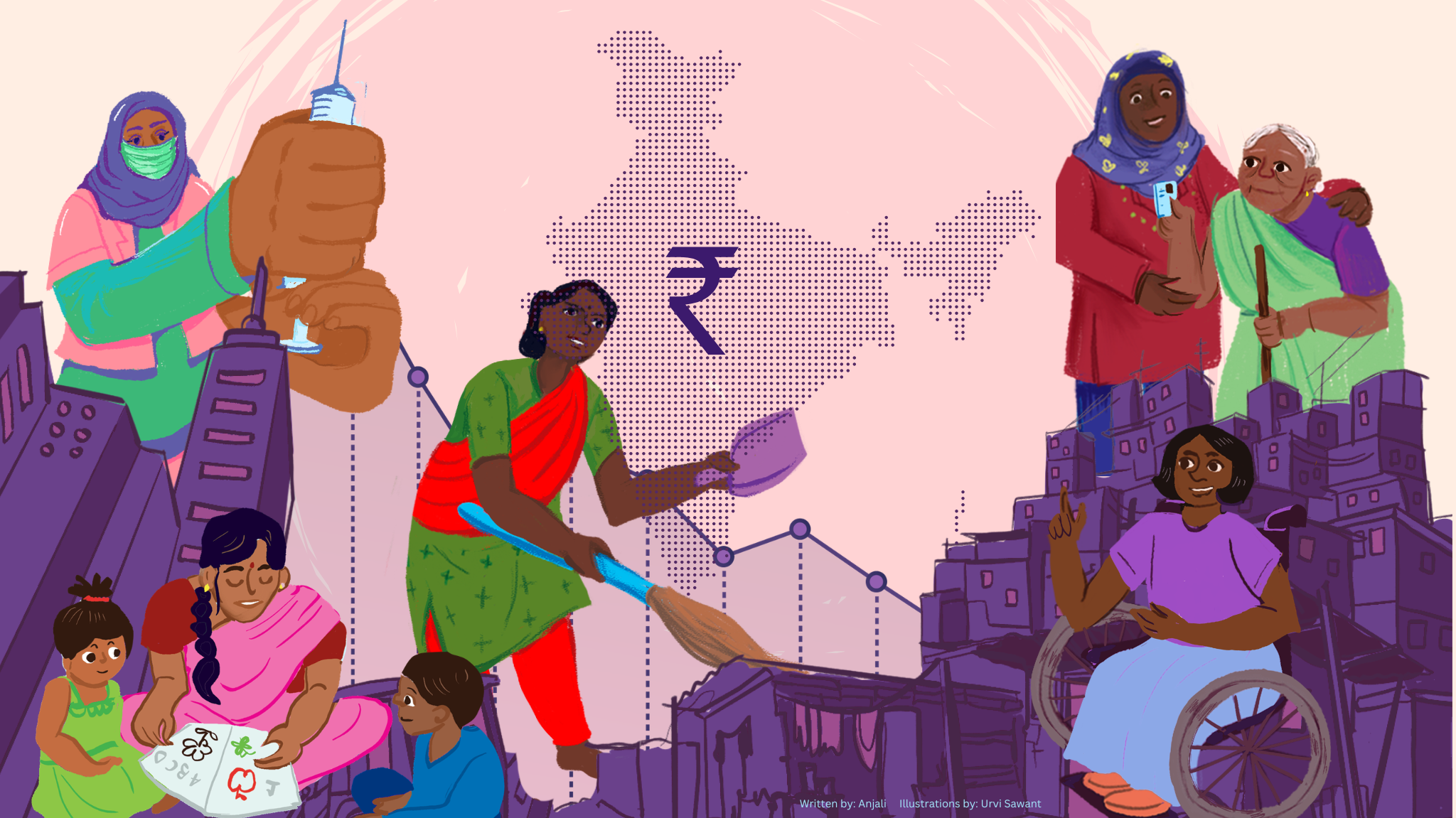
Buried in last month’s Budget announcements, in line item 54, was a contradiction in how India understands care work. The finance minister, for the first time, spoke of developing a “structured care ecosystem” for “geriatric and allied care services” to address changing demographics and “create professionals for Viksit Bharat”.
In earlier budgets too, care was hinted at – in women’s employment, childcare support, welfare delivery, and now, elderly care. But this Budget, for the first time, looked at care as a sector warranting a trained workforce. But at the same time, it continues to underspend on creches services, Anganwadi centres, health, education and omits the question of minimum wages for caregivers — factors critical to the care ecosystem.
What does this reveal? “The Indian economy, like many other countries in the Global South, runs on a contradiction: it depends on care but does not recognise or adequately fund it,” says Srujana Boddu, a scholar of labour economics at SRM University, Andhra Pradesh. “Despite making the economy and human well-being possible, care is a very hidden infrastructure. It is not reflected in mainstream policymaking, even less so in the budget.”
The care economy is everything everywhere all at once: it includes unpaid domestic labour, community health workers, people in formal caregiving roles (nurses and midwives), domestic workers, care receivers (disabled people, elderly people, people with illness), community mobilisers, and several other actors and networks that provide an “invisible foundation” and “invisible backbone” for household and social welfare.
What the Budget offers are “symbolic gestures” – women’s hostels and health coverage for frontline health workers, for instance – but not structural long-term commitment. How is the government going to support community-based creches, or motivate industry actors? Will frontline scheme workers get minimum wages, given they carry the major care infrastructure of POSHAN 2.0 and National Rural Health Mission? What about an economic policy for domestic workers? Does the Budget see caste and how marginalised women are overrepresented in low-paying care jobs? How do they plan to measure and redistribute unpaid care work?
Gender budgeting as a political tool since 2005 was devised to respond to these questions around women’s care needs. But its mandate is limited, partly due to bureaucratic challenges and lack of quality data, and partly because it disregards how caste structures shape care work, as we explain later.
The paradox around care, French philosopher Sandra Laugier says, is not the “difficulty in perceiving but rather a refusal to see…Invisibility is thus denial.”
Inflated Promises, Underfunded Reality
In the 1940s, Dr BR Ambedkar, while introducing the Mines Maternity Benefit (Amendment) Act, argued that paid maternity leave and security of work even during pregnancy were important to encourage women’s labour force participation and in turn empowerment. Policymakers again in the 1990s similarly, with conversations about a ‘Women’s Component Plan’, tried to understand, recognise and visibilise care work. This became the basis of gender-responsive budgeting – an exercise India officially adopted in 2005.
“The entry point was to understand the contribution and role of women in the economy, how to change or transform that role, and provide women with more agency and greater empowerment by following the 3R framework – recognising what they do, reducing the work they do as unpaid workers, redistributing this work across the state, communities and households,” says Sona Mitra, an economist with IWWAGE at KREA University, a policy research centre working on improving women’s economic empowerment.
She points out that when analysing gaps, researchers found that while women were spending time performing household duties, looking after children, elders and the community, they were losing out on earning incomes that invisibilised their identity as economic agents.
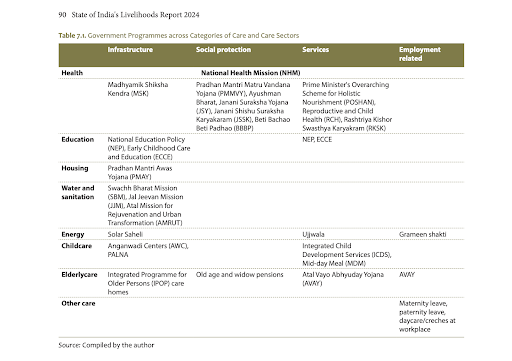
Schemes and policies came in response to these ‘care deficits’. This included Anganwadi centres for nutrition, PALNA (earlier called the National Creche Scheme) for creche services, hostels and one-stop centres under Mission Shakti for women’s employment and safety. Different government schemes at the national and state level targetted at efficient water supply, safe cooking fuel and safe maternity – the Jal Jeevan Mission, Pradhan Mantri Ujjwala Yojana, Pradhan Mantri Matru Vandana Yojana – were targeted at reducing the burden on women’s care work.
But these schemes work in silos and in an ad-hoc manner, as we detail later. The other challenge is implementation: there is a lack of political will and bureaucratic lethargy, says Vibhuti Patel, a feminist scholar and former professor at TISS. Funds remain underutilised: only 40% of funds earmarked for Beti Bachao Beti Padhao were released in FY23-24, which fell to 15% in the next year, and by November 2025, only 13% had been released, according to the Foundation for Responsive Governance. The pattern of underspending has plagued the working of One Stop Centres, Women Helplines, and creche centres under the Palna scheme in the last five years. When spent, funds are only used for “decorative purposes”, never reaching the community, Vibhuti adds. Almost three-quarter of the funds for Beti Bachao Beti Padhao between 2016-19, for instance, went only for advertisements instead of being routed for girls’ education, health, skilling, and safety.
In 2024, the Ministry of Women and Child Development recognised in a 2024 policy brief that the invisible burden of care work created a “market failure”: it trapped women in time poverty and pushed them toward low-paying work.
“That acknowledgement [of care] in terms of platitudes has always been there, but the gap between promise and practice is the problem,” Vibhuti says.
Fitting Care Into Gender Budget
A gender budget could also be read as a care budget, argues Sona, because it is occupied with the question of improving women’s access to formal jobs, political offices, leadership positions, and their overall social well being. But it is both too small and imprecisely targeted. Consider this – the gender budget 2025-26 accounts for 8.86% of the total expenditure, about 1.61% of the GDP, far lower than the United Nation’s recommendation of 5% of GDP. Even there, the actual spending was down to 8.01% of the total expenditure and about 1.31% of the GDP, revealing a gap of Rs 51,000 crore, as we wrote.
Currently most allocations go towards housing, girls’ education, food and nutrition for children and pregnant women, women’s reproductive health and livelihood creation. There has been a longstanding demand to separate the women and child department to develop targeted outcomes for children, women and gender diverse people. “The articulation got lost with time as we’ve been moving backwards on women’s rights,” says Sona. There is also no coherent framework for what counts as care infrastructure. Some care needs like childcare are recognised but inadequately funded. As we wrote earlier, public funding for creches has gone down despite growing industrialisation and migration. From over 3,000 creches in 2023, the number fell to 2,163 operational creches by June 2024. Eight states now report no active creches at all.
Between 2001 and 2011, the number of women migrating for work increased by 101% – double that of men’s (48.7%) – but there is a critical shortfall of hostels. Hostels are either limited in capacity (in states like Tamil Nadu and Maharashtra), not running on full capacity, or not there in the first place (in Bihar and West Bengal). Between 2022 and 2024, no new hostels were sanctioned. Among other issues, as we pointed out here, the hostels were designed for single women, not for married women who move in with their families and perform care work in these spaces.
Except for the Awaas Yojana (housing welfare scheme), the remaining are such small allocations that neither make a dent on the status of women nor do they address care deficits. In 2025-26, the Pradhan Mantri Awaas Yojana–Gramin (PMAY-G) alone accounted for over 51% of Part A of the gender budget – a section theoretically reserved for 100% women-specific schemes. In contrast, the Ministry of Women and Child Development, which funds creches, women’s hostels, maternity benefits, nutrition programmes, received less than half of that – an expenditure of Rs 26,889 crore that has remained unchanged over the years.
Both PMAY-G and urban housing schemes consume more than 70% of Part A. But only 23% of houses built under PMAY-G are actually owned by women. “The Awas Yojana takes away the lion’s share of the gender budget. It is unclear why so much amount is allocated or shown as expenditure on women– these are provisions for both single and joint household house ownership, it’s not only a woman thing,” says Sona.
Experts also point to the fact that schemes built around providing better household infrastructure – piped water supply, continuous electricity in rural areas, clean fuel, LPG connections – reduce the time women spend on care work but are considered indicators of general development.
The gender budget also sees women as a homogenous category, not differentiating between an upper caste woman’s care from a Dalit woman’s, says Srujana. For example, it misses asking which women are concentrated in unpaid care, how caste segments labour into low-paying, unsafe work, and how migration status and job precarities shape this work.
The Union Government’s Garima Greh scheme funds trans shelter homes for people who have been expelled from families and who face disproportionate health vulnerabilities. Among its other limitations (it excludes people who beg, do sex work, or are over 60 years old, for instance) the scheme sits under the Ministry of Social Justice, not Women and Child Development, and does not appear in the gender budget statement at all – and by extension, it is not seen as a care infrastructure. Like gender budget allocations, funds are inadequate and delayed.
“Thinking of care policy only through the lens of gender blurs, obscures – does not recognise – hierarchies within gender. We universalise the language for care, and that is very dangerous,” Srujana adds.
Caste, Always Invisible
It has been more than two decades of gender budgeting, and almost half a century since Scheduled Caste Sub-Plans and Tribal Sub-Plans that pushed for minority recognition were introduced. Caste continues to be “administratively present” in budget heads (SC/ST sub-plans, targeted schemes) but analytically and actively absent from care policy, says Srujana.
This is partly a problem of data collection, Srujana adds. Measurement tools like time use surveys and labour force participation metrics have a western, industrial lens to work, thus automatically undercounting and misclassifying informal and unpaid work, she noted along with scholar Varghese Daigy in an EPW paper
Care labour differs and changes across sections. For Dalit and marginalised women, lines between paid and unpaid care work are blurred. “Women go from cleaning and cooking in gated societies for 8 to 10 hours a day, to cleaning and cooking at home,” says Anita, a domestic worker and activist with Shahri Mahila Kaamgar Union. This makes precise calculation of labour tricky but necessary.
Currently, there is no attempt to link caste location to unpaid care work within households, or base budgeting exercises on the labour market data – figures themselves plagued with inadequate recognition of informal work.
“It is important to come up with data and a structural recognition in terms of care responsibilities…The recognition is what will lead to budgetary inclusions and in turn policy making,” Srujana says, adding that disaggregating data along the lines of caste would bring to visibility the care labour of marginalised women.
The care infrastructure needs of a MGNREGA worker, platform worker, or domestic worker vary and identifying these can indicate what the government should invest in. For a platform worker, penalising platforms that block worker IDs is care support. For domestic workers, Anita says, it is free bus service, access to toilets in building societies and prompt implementation of sexual harassment laws. “We don’t get decent wages or dignified work conditions. Our right to ownership is going – bastis are being demolished everyday, we are becoming homeless. Its impact on women as caregivers is enormous” she says.
For an MGNREGA worker, the care needs of women are tied to access to daily work, and the law was designed as such that recognised care infrastructures as a worker’s right. For instance, the Act mandated work and creche facilities near where workers lived. The National Food Security Act additionally offered maternity benefits.
But even when care found mention in the law, budget implementation undercut it. The National Food Security Act mandates Rs 6,000 per child in maternity benefits but the Pradhan Mantri Matru Vandana Yojana in 2017 provides only Rs 5,000, covering 17 days of lost wages even though recovery from childbirth takes weeks and breastfeeding requires months. In Budget 2026-27, the MGNREGA funding was cut by 65%, and Rs 28,715 crore of funding was redirected to formal sectors where a majority of beneficiaries are men.
Instead of scattered schemes, Srujana says what will help is a localised care approach that recognises caregivers as workers with rights. “Without confronting the nature of housing precarities, informal employment, caste structured and segmented labour markets, infrastructure will not be enough,” she points out.
The question for Srujana is: are we bold enough to treat caste as an economic, social variable, rather than a mere welfare concern?
Capex, Not Care
For most of the last decade, care labour and infrastructure were primarily seen as vehicles for welfare delivery – investments in Anganwadi centres for instance – and then linked to women’s employment. Certain questions of recognising unpaid work, caste discrimination, workers’ rights, are never addressed.
Nirmala Sitharaman’s speeches from 2021 through 2024 repeatedly emphasised the “capex multiplier effect on growth”. Whereas care-related terms – “care,” “caregiver,” “domestic worker,” “unpaid,” “ASHA,” “anganwadi” – remained peripheral at best. The one significant trigger came during the pandemic, when the labour of frontline workers resulted in announcements about wage hikes (which are yet to be implemented), and later in 2024, when the Interim Budget extended Ayushman Bharat coverage to ASHA and Anganwadi workers–an empty declaration, workers said, as healthcare infrastructures remained lacking. Workers’ unions welcomed it as a small step, but their core demand – fixed salaries and official recognition not just insurance – went unmet.
“Care work does not fit in the capital expenditure matrix; it gets subsumed under social sector heading instead of being treated as a core economic priority. But the social sector is itself a large bracket, care is invisibilised next to health and education,” which themselves do not get their due (education gets less than 2% and health receives less than 1% of the GDP), Vibhuti points out.
Economist Jayati Ghosh in her book Never Done and Poorly Paid: Women’s Work in Globalising India details how reduced social expenditure places a larger care burden on women, and degraded or privatised common resources increase the time spent on doing these essential household chores.
India spends less than 1% of its GDP on care sectors as compared to 5% on ‘capex’ infrastructures like roads and highways – though the economic value, even if underestimated, of unpaid domestic and care work falls between 15-17% of the GDP. India has not ratified the ILO Convention 189, which guarantees decent work and minimum wage protections for domestic workers – a standard adopted by countries including South Africa, Brazil, and Namibia.
How is it that despite contributing to the economy, workers remain invisible, Anita asks: “Care work is a service to society. If the domestic worker doesn’t take care of the homes of doctors or engineers, they wouldn’t even be able to earn. But because 99% of this workforce consists of women, otherwise no budget or policy would have ignored them.”
Unlike industries with organised chambers of commerce or formal sector unions with political leverage, there is little sustained organising around care work. Fragmented moments, like ASHA and Anganwadi workers’ protests that mobilised for better pay and work conditions, have not shifted how the budget looks at care work, says Srujana.
This sits in contrast with elderly care advocacy. For instance, organisations like HelpAge India have spent years building an evidence base around demographic change – documenting migration from tier 2 and 3 cities, the collapse of traditional family care networks, the growing population of older people without facilities or nearby caregivers. This has produced visible results. In addition to this year’s budget mentioning geriatric care, the Ministry of Social Justice and Empowerment already runs a course training people how to care for older citizens and people with dementia and Alzheimer’s. Mumbai’s 70+ senior citizen organisations had separately lobbied to create ‘nana nani parks’ and Kerala has state-funded elderly care schemes. But most states lack structured care investments.
Another gap in this advocacy is the near-absence of dedicated research and development funding for care as a field, according to Vibhuti. This research could give policymakers evidence and the political cover to act. “It’s not a glamorous field for the state to invest in,” she says.
According to Sona, who advocates for including elderly needs in the budgeting process, showing that elderly care systems in addition to childcare can create jobs for women and keep them within the labour force struck a chord with the government.
Fixing Unemployment, Not Care Neglect
India ranked 144th out of 148 in the World Economic Forum’s economic participation index in 2025, and the report cited unpaid care work as one of the major reasons for India’s consistently low female labour force participation rate.
Never have we had a visible, educated, aspirational group of women unable to find formal work, Vibhuti says. The cohort from the Sarva Shikshya Abhiyan – women who went through expanded schooling from 2001 onwards – are more educated than any previous generation of Indian women, yet are entering a labour market in crisis: it is contracted at the middle due to automation, agrarian distress, and IT layoffs.
India is investing in care infrastructure – creches, working women’s hostels, skilling – but the motivation, experts argue, is instrumental: it as a means to an end, to fix women’s unemployment crisis. Not because it recognises care work itself as work deserving of wages, rights, and recognition.
“The government can offer platitudes about investing in care infrastructure, but at a ground level, we have to ask: How much was invested, what kind of systems and structures were created? Have we recognised unpaid care work?” asks Vibhuti.
Political parties both celebrate women’s workforce participation and entrench their role and duty as caregivers. So to “homemakers”, “married women”, “mothers” they promise wages and offer unconditional cash transfers as electoral promises. But these claims reinforce biases: to care is a woman’s duty, ‘societal work’ necessary for men to enter waged labour, and thus destined to sit at the periphery of the economy.
It also strains government resources, says Sona. States running large cash transfer programmes have less capacity, and less political bandwidth, to think about women’s care needs in any structural sense: public childcare systems, elder care facilities, at least 8-10 hours functional Angwanwadi centres for informal and migrant women workers.
What If The Budget Cared?
For Srujana, the first step is to formalise frontline care workers, provide minimum wages, and ensure wage parity across castes. Affirmative steps could follow soon, she says – designing surveys and methodologies that disaggregate caste data, provide wages for unpaid housework, extend creche hours near informal settlements, provide skilling and mobility, and explore ways to recognise and compensate unpaid care work.
Vibhuti says we should pay special attention to strengthening and integrating schemes — primary health services, ICDS, Anganwadi bodies, welfare boards, piped water, sanitation – into mainstream policy that recognise and value women’s needs. Infrastructure designed for care workers where access to primary healthcare, free public transport, housing legal aid, sanitation, exists without any documentation barriers.
Then there are examples of transforming remedies, such as this city in Mexico that invested in ‘care communities’ and recast local institutions as spaces offering an array of services for caregivers, such as healthcare and legal services.
For Adivasi or a Dalit domestic workers in cities dealing with poor sanitation, poorly ventilated homes, precarity and discrimination, universal public care infrastructure would move the needle. Consider this experiment: in 1979, an NGO in Mumbai, the Family Welfare Agency, introduced day services, ‘Programme for the Elderly’, to work with senior citizens living in closed quarters, in bastis and chawls. During the day they got together to socialise, read newspapers, sing bhajans.
This proven community care model, that countries like Greece and Japan adopted as a standard, was not embedded in India’s institutional policy – the government invested more in old age homes instead. In contrast, Japan’s Mitsugi model that was first experimented in 1974 in a small town spread to cities and became the model for the national policy implemented in 2012. It had shown success: the proportion of bedridden elderly in Mitsugi fell and costs dropped. Japan later opened Community-based Integrated Care Centres in every district across the country, staffed by nurses, social workers, and care managers, funded jointly by national and local government and mandatory insurance.
Srujana recommends a transformative thrust that dismantles the concentration of marginalised women in undervalued, insecure, exploitative roles while simultaneously reducing unpaid, unequal care burdens. “Without sustained conversation or political pressure to redistribute care responsibility through public investment, even when policy documents or budget may mention care, we offer only symbolic gestures rather than structural long term commitments,” she says.
This story was produced with support from Report for the World, a global media service strengthening local independent journalism.


We believe everyone deserves equal access to accurate news. Support from our readers enables us to keep our journalism open and free for everyone, all over the world.
