
For Women, A Shaved Head Is Often A Mark Of Protest, Both Political And Personal
For women, tonsure is often a declaration of protest, autonomy and resistance to patriarchal beauty norms
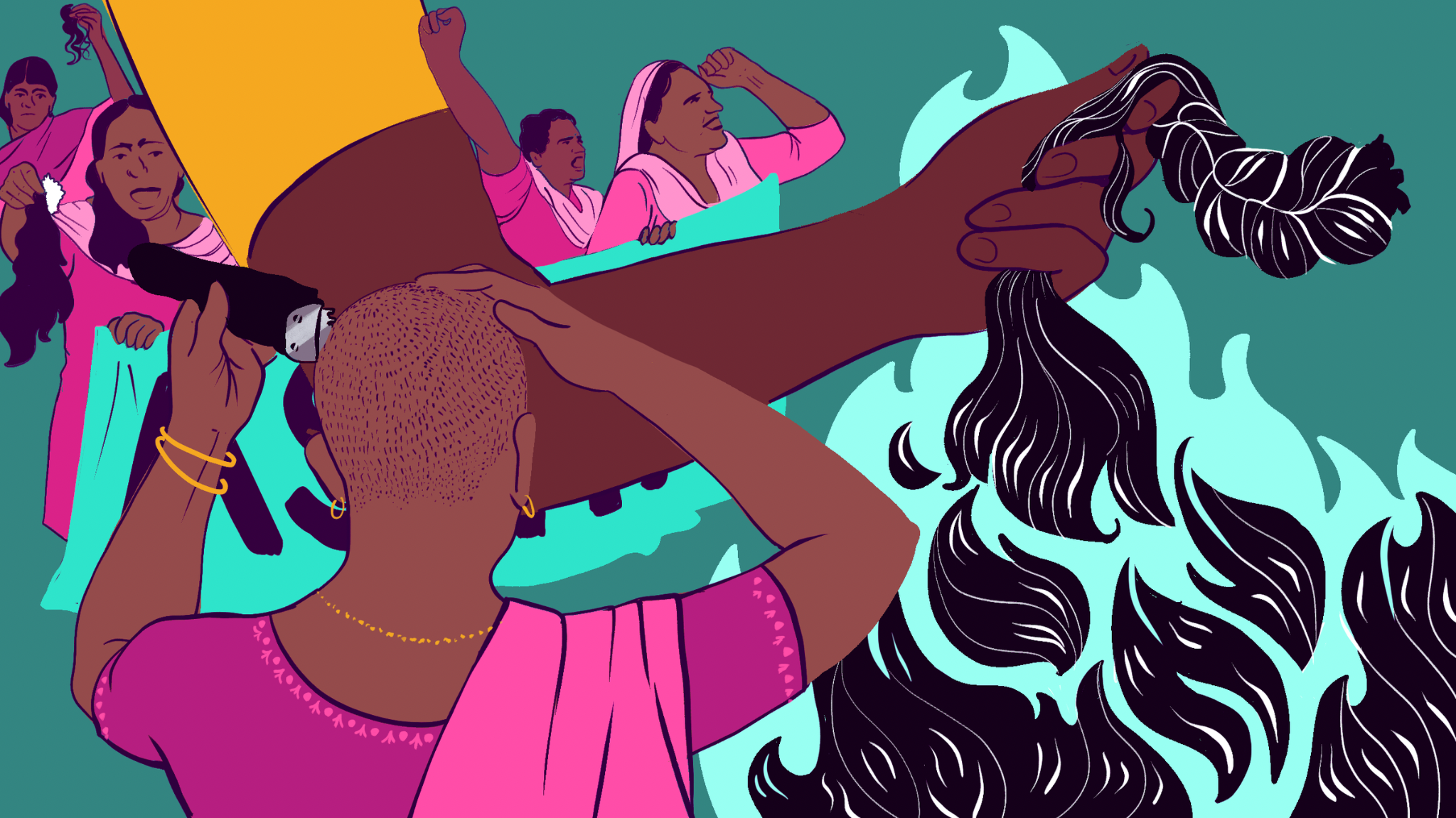
A YEAR AGO, the streets of Thiruvanathapuram witnessed a powerful and unsettling sight. Hundreds of Accredited Social Health Activists (ASHA) workers staged a protest, marching through MG Road, their hair loose over their shoulders. Then they settled down at the Secretariat, and many proceeded to cut off their hair. Among them were Padmajam, attached to the Thiruvallom family health centre, and Beena from the Chemmaruthy family health centre.
The workers then marched through the streets, holding up their chopped hair and flaunting their shaved heads. It was an act of defiance and despair, a strong symbol of protest as their demands for better pay, post-retirement benefits, and official recognition as government workers had gone unheard for 50 days.
“Our hair is precious to us, like our children. Despite our genuine demands, the Kerala government is silent. We are not going to remain silent and we will not call off our protests till our demands are met,” said Bindu, one of the women leading the protests by ASHA workers, according to an NDTV report.
The ASHA workers were not the first to use tonsure as a form of protest. Across the world, women have shaved their heads for deeply personal and political reasons – to reclaim agency after an illness, challenge traditional norms of beauty, break free from patriarchal notions of femininity, or simply mark new beginnings.
In September 2017, in Guwahati, three women shaved off their hair to protest against the BJP government on the question of providing citizenship to Bangladeshi Hindus. Lathika Subhash, former president of Kerala Mahila Congress, publicly tonsured her head in March 2021 to protest being denied a ticket and the party’s failure to give tickets to women candidates. And in May 2024, seven women shaved their heads and embarked on a cycle rally to promote peace and unity in Manipur.
According to the TOI report, Kh Shanti, a middle-aged woman who joined the protestors in Manipur explained: “Shaving off hair is a symbolic gesture and to protest the government’s inability to check on periodic gun attacks on fringe areas of Imphal valley by militants based in adjacent hill areas of Churachandpur and Kangpokpi. We are all tired. We want peace.”
In the demonstrations following the killing of 22-year-old Mahsa Amini in Iran – for not hiding a lock of her hair by a scarf – protestors cut their hair and shaved their heads. Women supporters across the world did the same to express their solidarity.
Breanna Fahs, professor of women and gender studies at Arizona State University, has researched and written extensively on body hair ideals and how closely these are associated with ideas of gender.
“Perhaps because we spend such an enormous amount of time managing and containing our hair—making sure it does not get too unruly or wild; trimming and shaving and plucking it into submission; cutting, dyeing, waxing, and styling our hair—it becomes impossible to truly assess how strongly we cling to ideas about “proper” and attractive hair and, by association, “proper” femininity and masculinity. Hair brings out deeply personal notions of morality, cleanliness, beauty, attractiveness, and status,” writes Breanna in her essay for the anthology Body Battlegrounds.
Long, Lustrous – The Hair Ideal
On a woman, hair isn’t just about beauty, it is also bound up with issues of religion, culture, and social identity.
Thick, long, lustrous hair has been considered an intrinsic part of a woman’s beauty in South Asian cultures, and also tied to gender identity, and wealth. For instance, in Japan, Heian noblewomen sported Suberakashi, or “hanging hair” – long, straight black hair, symbolised elegance and nobility.
Indian literature, dance, and cinema are full of descriptions of a woman’s beautiful locks: In classics such as Kalidasa’s Meghadoota and Kumarasambhavam, women’s hair is frequently compared to flowing rivers or dark clouds. Many of Raja Ravi Varma’s paintings depict women with long tresses, left open or loosely tied. And the number of Hindi film songs poetising about the zulf are too numerous to be counted.
“Hair is considered an integral part of a woman’s identity, and beauty, so when a woman shaves it off, it is a radical move, and a strong statement,” says Bernard D’ Sami, social scientist, Loyola Institute of Social Science Training and Research (LISSTAR).
In Hinduism, long hair is associated with abundance and auspiciousness while baldness in women is associated with death, mourning and sickness. “Hair is a powerful metaphor in Hindu mythology. By definition, the myths represent traditional sacred stories, typically revolving around the activities of gods and heroes, that purport to explain natural phenomena or cultural practices,” says Swiss professor of dermatology Ralph M Trüeb in a 2017 essay ‘From Hair in India to Hair India’ published in the International Journal of Trichology.
Tied Up With Symbolism
Communities keep a close watch on how women keep or style their hair. Unbound, unruly hair, for instance, is supposed to represent a rebellious streak while oiled and combed hair is seen to indicate a certain docility. And this is true of the female deities as well. Fierce Kali’s hair is unbound, while gentle Parvati's is well bound, Trüeb's essay points out. In Mahabharata, a furious Draupadi vows not to braid her hair till it is bathed in the blood of Dushasana, who tried to disrobe her in the royal court.
Trüeb points out a woman was allowed to keep dishevelled hair only in times of great sorrow or calamity. “In the Ramayana, Kaikeyi remained with dishevelled hair in her apartment with the object of getting two boons from Dasaratha which were detrimental to the interests of Rama, the favourite of Dasaratha. Indian teacher, philosopher, economist, jurist, and royal advisor Chanakya (350–275 BC) famously untied his tuft to display his rage and tied it only when the Nanda dynasty of Magadha had been brought to its knees,” he writes.
Cultural historian and writer Nanditha Krishna points out that tonsuring is also a tool for communities to control a woman’s sexual agency. “It used to be customary, for instance, to shave the heads of widowed women and dress them in white, an austerity they were supposed to exercise for the rest of their lives,” she says. “Since a wife has a share in the husband’s property, the idea was to make her undesirable so that she cannot get married again.”
Tonsure also has strong religious connotations, it is given up as an offering – a sign that you surrender ego, pride and vanity to a deity. At religious centres such as Tirupati, Palani and Velankanni it is a mark of gratitude for a wish fulfilled.
The sheer number of products available in the beauty market for hair – shampoos and conditioners, oils, growth serums, root touch-up powders and hair mascaras --- bear testimony to the obsession society still has with thick, black locks. For many women, especially those nearing or past menopause, it’s a never-ending battle to cover receding hairlines, bald spots and greys, as social media posts indicate.
Hair Loss And Trauma
Indumathi (name changed), 40, started losing her hair when she was in high school. “My parents took me to many doctors and I was finally diagnosed with alopecia,” she says. “Neighbours and relatives looked at me with pity and my parents were worried no one would marry me.”
As she began losing her eyebrows and eyelashes she went into depression. “The wigs that were available then were terrible and my classmates teased me. But I learned to toughen up and my parents were supportive,” she says.
When she was in her early 30s, she got eyebrow microblading (a semi-permanent cosmetic tattoo technique used to create fuller, more defined brows) and a very natural-looking wig. “I didn’t want to be stared at all the time and this makes me feel more confident,” Indumathi says.
In her book, Song of The Clay Pot, ghatam player Sumana Chandrashekhar speaks of losing all her hair as a child of just six. On stage and in public, she now sports a flamboyant turban that draws a lot of attention. She recalls that San-Te, the shaven headed protagonist of the film The 36th Chamber of Shaolin, became her hero. “In a car or on a bike, I could allow the breeze to wash over my head while others struggled to keep hair from failing on their eye or getting dishevelled,” she writes.
Those who can afford it, deal with the trauma of hair loss by investing time and money in expensive cuts and therapies. Hairstylist Teremi Chawngthu often sees middle-aged women seeking volumising haircuts and anti-hair fall treatments. “After 50, they opt for shorter hairstyles and also cuts that cover receding hairlines,” she says.
Neerja Malik, 71, who describes herself as a ‘cancer conqueror’ and counsellor says she advises patients to cut their hair short before treatment and then shave it before the hair begins to drop so the loss is less traumatic. She has held the hands of many cancer patients’ hands as their heads were shaved; for many of them losing hair meant the loss of femininity.
“I have met women who, though shaken when they have a mastectomy, can still handle it, but are miserable when their hair falls off. They feel they are incomplete,” says Malik. “I advise them to tell people they did it for religious reasons if they don’t want to disclose that they have cancer.”
Malik has shaved her head around six times during her illness. “I was diagnosed with fourth stage cancer of the left breast in 1998, and of the right breast in 2004. My doctors warned me my hair would begin dropping by 21 days. When it did, I plucked it out and blew it away into the breeze, like dandelions. I felt a sense of immense relief,” says Malik. Though she initially wore a wig, she later opted for dupattas to cover her head. She has documented her experiences in a 2015 book, I Inspire.
The Tonsure Way
Women cope with hair loss in different ways, and tonsure is one of them. Seven years ago, IT professional and dancer Radika Makaram decided to deal with her anxieties around her receding hairline and bald spots by going bald. Her hair, the subject of admiration all her life, started to thin in her 40s and she got her gratuitous advice on how to fix the problem.
A classical dancer whose headgear is an essential part of her stage appearance, this was a big blow. “It’s not acceptable to dance bald,” says Radika, who tried various hair oils and treatments. “I became someone who could only see flaws when I looked in the mirror. It was the last thing I thought about when I went to bed and the first thing when I woke up.”
One day, while out with cousins, she took a photo. But all she could see when she looked at it later, were the gaps in her hair. That’s when she decided to let go of her hair. After informing her parents and in-laws, she asked her husband to accompany her to the salon, where she had her head shaved.
“When I went home, appa said I look like Cleopatra. I realised that with the hair gone, the focus had moved to my big eyes and other features. When I looked at the mirror, it was as if a huge burden had been lifted off me as I no longer worried about my hair,” says Radika. But on stage, during performances, she did wear a wig.
But women who tonsure as a personal act of freedom say people around them often find the act incomprehensible and unsettling.
“Though there is cultural, social and religious stigma associated with a woman going bald, today women do not go by such sentiments and may embrace a fine buzz cut as a hairstyle,” psychiatrist N Rangarajan. “It’s because they are confident people who believe in their own identity.”
Meeting Myself For The First Time
Growing up in Kerala, dark-skinned and underweight, nothing about my appearance fit the traditional standards of beauty, except my hair. I remember amma trying to tame it with coconut oil before plaiting it into two braids secured with bright red ribbons. When I saw some of my other classmates sport short hair, I longed to cut mine but it was taboo.
And then I saw her – the simply stunning singer Sinéad O’Connor looking up at me from the pages of a magazine, her head shaved. At 20, two years after she signed her record deal, this was as an act of defiance against her label that wanted her to have a more conventionally feminine image. But I was told that “only someone as beautiful as her” could carry off the look.
At 51, after a lifetime spent battling patriarchal notions of what a woman should embody, at the personal and professional front, I was drawn once more to the idea of tonsure. I saw it not just as an act of shedding vanity but also as a means to reclaim agency over my own life.
As the first locks of hair fell, I felt a rush of freedom and joy. And when I gazed into my eyes in the mirror, I felt that I was meeting myself for the first time.
Social scientist D’Sami believes that tonsuring is a way of breaking the idea that you have been assigned a particular role: “It can also be seen as a war cry, a powerful way of showing that you will go to any extent to fight for your rights.”
Bengaluru-based writer and communications professional Sandhya Menon chose to go bald twice and for her, it was an act of defiance and a search for identity. “Being bald changed my body language. My shoulders were squarer, I stood taller and walked more confidently,” says Menon. “The lack of hair highlighted my features, and when I put on kajal, and lip gloss, I looked like someone else. I felt more confident, like a gangster,” she says with a laugh. “There was no sense of femininity or masculinity. I was agender, I felt like a person.”
The first time she tonsured was in 2013 when she was forced to take a break from work. “I had gone from being a person who lived a carefree life and spoke her mind to a mother of two. Strangers think you are a boring amma, and at 34, my life wasn’t what I had thought it would be,” she recalls.
Sandhya had always had long, lustrous hair since class 8, something she inherited from her mother’s family. “I went to the salon intending to donate 12 inches of my hair but, as the stylist was giving me options, I asked him to just shave it all off,” she says. When she saw herself in the mirror for the first time, she had mixed feelings. “Then I had a bath and feeling the water on my scalp felt really good,” she says.
While her young children were first shocked, then excited by her new look, her father was extremely upset. “I didn’t get a single male reaction that was positive. While the people who were romantically involved with me didn’t say anything impolite, they didn’t feel it was attractive at all,” says Menon. “When I shared my photo on social media later, people thought I was sick and sent me links to turbans and headcovers I could use. So much of my sense of my own attractiveness to the world was tied to my hair, so my question to myself was if I can still be attractive in unacceptable ways.”
Two years later, she chose to go bald again. She went to a salon with two friends who had very short hair. But they couldn’t go through with it. “I realised that going bald was drastic for even women with really short hair, and how much of our identity is tied up with our hair,” says Sandhya.



We believe everyone deserves equal access to accurate news. Support from our readers enables us to keep our journalism open and free for everyone, all over the world.
