
‘We Feared Nothing, We Focussed On Protecting The People And The Movement’
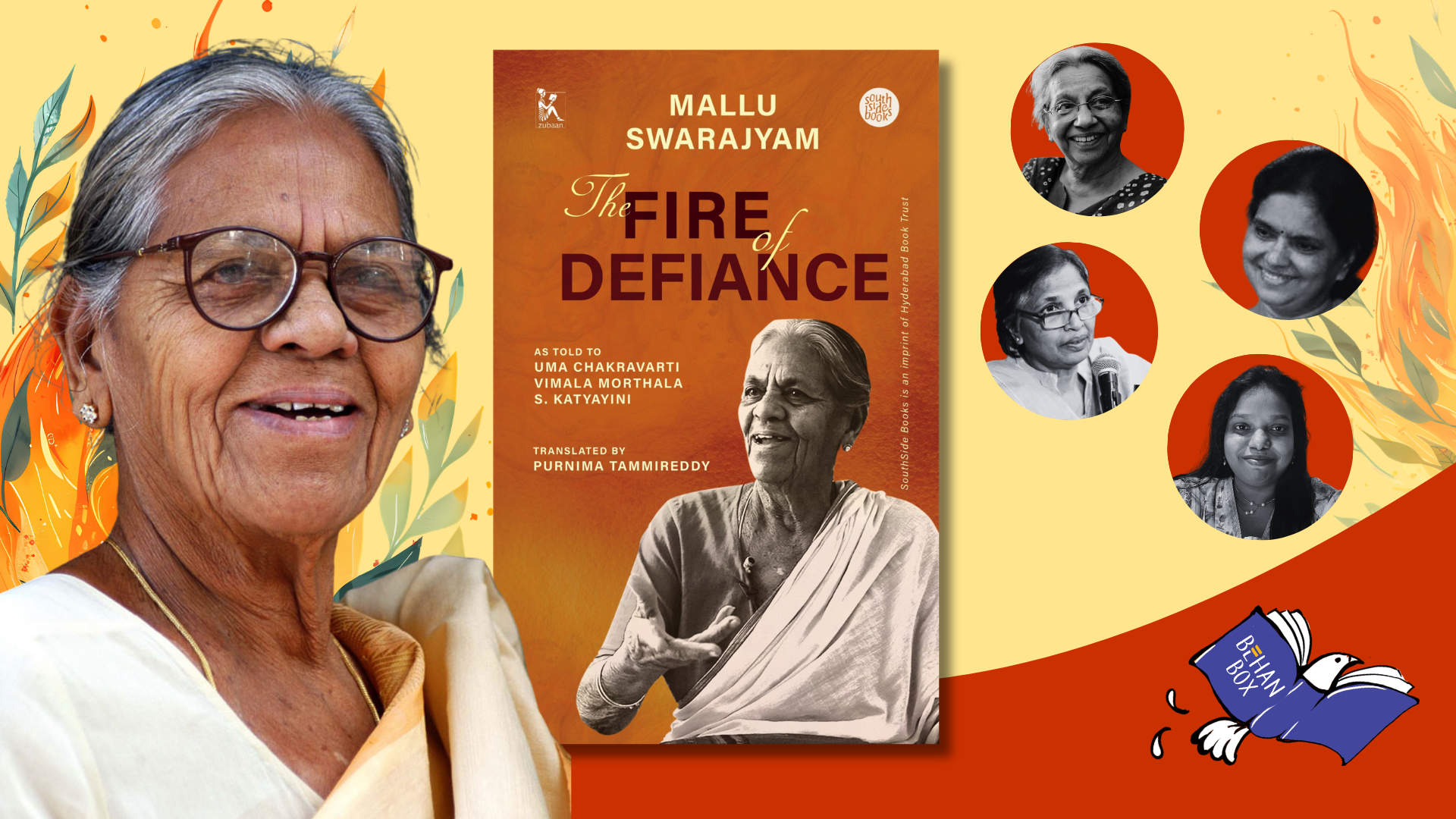
In the 1940s, the left led a historic armed agrarian struggle against the tyranny of the oppressive feudal structures in the Nizam dominions in Telangana. Mallu Swarajyam, who died four years ago, was one of the most respected leaders of the movement. Her recently published memoirs, The Fire of Defiance: Mallu Swarajyam, bring alive her extraordinary life that straddled many worlds – the daughter of a patriarchal zamindar family who, along with many other feisty women of her time, broke every rule in the book to participate in the struggle. The men who led the movement, as this excerpt tells us, left the women to deal with their unique challenges on the field
The Rebellion
On 15 August 1947, India’s Independence was announced. Of course, this was true only for the areas under British rule. Hyderabad province continued to be ruled by the Nizam, and atrocities against people persisted, as did the relentless battle against them.
The Union government of India attempted to merge the princely states with the union. However, the Nizam insisted that he would continue to rule independently. In response, the Indian National Congress launched a satyagraha movement, demanding that the Nizam join the Indian Union.
The Communist Party also demanded that the Nizam merge the province with the Indian Union while continuing to focus on its activities: mobilising people against feudal landlords. We exhorted the public and publicised the need for feudal domination to end. We rallied people to stand against vetti and forced exactions. The grama dalams confiscated grain stores from landlords and distributed them to impoverished rural communities. Regarding the issue of surplus land, we established that landlords could receive only up to 100 acres, with the remaining land to be distributed among the people.
Instigated by this uprising, the Nizam ordered the deployment of Razakar units to quell it. The army assisted the Razakars in reaching the villages. There were countless instances of looting, rape and murder, and entire villages were set on fire. Despite these brutal assaults, the communist and Andhra Mahasabha dalams demonstrated immense courage in remaining loyal to the people.
While discussions between the Nawab and the Union government were in full swing, the party opted for the precautionary measure of reducing its activities and shifting into self-defence mode until some clarity emerged. The police saw this latent phase as an opportunity to escalate their attacks on us. Aided by the Razakars, their acts of brutality were endless. None of us could move from our locations. Those in the forest remained there.
The Union government aimed to merge the province and diminish the influence of the Communist Party. They monitored the movement of our dalams in the forests and dropped pamphlets containing Nehru’s speeches from aircraft. I read these pamphlets while in the woods.
The pamphlets attempted to persuade people to stop the communist struggle and support the Union: ‘We are fully aware of the Nizam’s cruelties and the best possible resolution for this is to have the province merged with the Union. As per Gandhi’s principles, we will establish the grama rajyams and redistribute the land fairly. Drop your weapons and take part in the elections.’ The party brainstormed the stand we ought to take. One could not trust the Congress leadership, as they favoured feudal landlords. Withdrawing from the struggle at their behest would only mean that the landlords, who were at a disadvantage after losing to us, would regain their power and continue their oppressive ways. We made a decision: to stand up for the people and persevere with our struggle.
The party had divided the eight districts of Telangana into two: the North Area Committee and the South Area Committee. Omkar, Mallu Venkat Narasimha Reddy and I worked on these committees. Based on the functions, two additional committees were formed: military and political. Raavi Narayana Reddy, Baddam Ella Reddy, Lakshmi Narasimha Reddy and my brother were grouped together in a ‘struggle’ committee. The question of whether or not to withdraw from the struggle was a highly debated one. Rajeshwara Rao and Sundarayya were given the charge to lead the dalams in each area committee. My brother primarily worked from Bombay but would occasionally take shelter in Hyderabad. However, after the Razakars got involved, seeking refuge in Hyderabad was no longer an option. He had to restrict himself to working for the central committee in Nagpur. After some time, the movement regained its footing. The tribals were ready for battle as the movement gained momentum in regions like Bayyaram, Garla, Yellandu and Kothagudem.
I also worked in the Kothagudem coal mines. Our informants were tribal women who went into the forest to gather mahuva flowers. On one occasion, we received information that the police were travelling in a bus along the route. I stormed onto the road, stopped the bus and punctured its tyres with my pistol. Once it came to a screeching halt, I got on the bus, found a constable, searched him for arms and grabbed his pistol. In similar incidents, I came across policemen in the bushes a couple of times. I shot them and seized four guns from them. Like me, my husband, Mallu Venkata Narasimha Reddy, aka VN, was also good at finding the police and confiscating their weapons.
This was the situation at the time: the country was free, and the news that the Nizam’s rule was ending was spreading everywhere. The police were also on the defensive. Taking advantage of the situation, we looted a large number of pistols. We joined forces with the villagers and launched an attack on police camps, successfully seizing numerous weapons with their assistance.
Our victory became unstoppable after a retired military officer named Jaipal Singh joined us from the north to train us in using weapons. On our path to success, we took on whatever role we were given and tried to do our best. We also fought the Union army and looted their ammunition.
To elaborate on how we attacked the police camps, I will share the details of one particular strike on the Errapadu base. The police had camped in the gadi of Errapadu village in Suryapet district, and we decided to attack it. The gadi’s compound wall was too high. Our repeated appeals for the police to surrender fell on deaf ears; they were holed up in one of the bungalow rooms. Seeing no other option, we called the villagers and surrounded the gadi.
Digging into the gadi’s walls with crowbars did not cause any significant damage. Some of our people reached the bungalow’s window using a ladder, lit a bundle of grass and chillies with a matchstick and threw it inside. Smoke billowed everywhere. Fearing the smoke would suffocate them to death, the police began firing at us from the bastions and windows.
Two or three people died in this attack. It was challenging to take the injured to a safe place. There were multiple military camps on the way and the villagers attacked the camps and seized weapons, demonstrating their grit and determination.
Each area committee had five or six dalams, and each dalam had a commander at the helm. Our area committee had three organisers, each armed with a pistol. They were responsible for managing the unit, along with the grama paripalana. Their primary responsibilities included distributing land, resolving social issues and providing medical support. I was also part of it.
In addition to my work in the committee, I had another responsibility: to recruit women for the dalams. As I mentioned earlier, if the men of a family were already our members or allies, their women could also join the dalam. Otherwise, it took a lot of effort to get women to join. Some women even ran away from their homes to join us. They accepted all duties, just as the men did.
At this point, let’s talk about some specific women in the movement. A woman called Ramulamma, along with her husband, joined the party in 1946. She was from Cherukupalli village in Nalgonda taluka. After two years, her husband left the party and returned to their village. However, she refused to quit the movement and took special training for protests against the Nizam, in addition to military training. Initially, she worked for a dalam and later became secretary for a party centre (kendram) in Miryalaguda taluka.
Once, when she went to a village, the landlords captured her and handed her over to the police. Even though she had a weapon, her chances of escaping were bleak. Standing amidst the police, she gave a public speech. Ramulamma’s dalam was famous. She accomplished many great things and withstood numerous attacks. She was arrested and jailed for a while. After her release, she married another comrade.
There was another woman, Nagamma. She was short, not even as tall as her rifle, but she was an excellent fighter. She never missed a target while shooting. One needs incredible strength and stamina to fire a shot. If the shoulder supporting the rifle is not stable while pulling the trigger, the bullet will not fire. Even if it manages to fire, it will miss the target and kill someone else. When Nagamma carried the rifle on her shoulders, it touched the ground. ‘It’s okay, I will carry the gun over my head, but I have to have one,’ she insisted.
Nagamma’s husband was a dalam commander. Once, their dalam planned to attack the police. There were two or three others in front of Nagamma. When the police arrived, all of them, including Nagamma, had to cover their bases from every possible direction, attack the police and loot their weapons.
Despite the plan, her commander-husband did not fire a shot to signal that the police were nearing them. However, realising they were too close, Nagamma decided to open fire. The police, fearing for their safety, surrendered their weapons.
The mission was successful. However, Nagamma’s commander husband, his ego bruised, accused his wife of not sticking to the plan. The argument between them escalated to a point beyond reconciliation. The other leaders had to intervene and convince the man to compromise. The real issue was that the husband was not as spirited and courageous as his wife was. If the fight worsened, the movement would have to bear the brunt. Although men and women were considered equal according to the party’s policies, regressive notions held by individuals were always a hindrance and any hopes of improvement were minimal. Despite these challenges, competent women were able to progress in the party. The overall spirit of the movement was encouraging for women. Over time, Nagamma’s husband was left behind as she rose to the rank of commander in a dalam.
I would like to share something else. Once, a woman member and I were given directives to work in a particular area. We both met the organiser there. ‘Aiyo! What is this? Why have they sent you here? I can’t supervise womenfolk and make you productive. Please leave,’ he told us. Indignant, we challenged him: ‘We will prove our calibre and show you that we’re better than men at work.’
After a few months, I had to move to another area. The party assigned three women the responsibility of organising 30 villages. We did our best to intensify the movement. The man who had disregarded us earlier came to the same area. We were so busy that he could not meet us for several days. Only after repeated requests did I meet him, but I brought my 30-member dalam with me.
‘Even the police and gundas are scared of Rajakka’s dalam,’ he heard people saying. He wondered who this Rajakka was and where she came from. When he realised it was me, he was perplexed. He rushed towards me, excited. ‘How are you doing such incredible work at such a young age?’ he asked me, astonished. His change of attitude was proof of the vigour and spirit with which women worked.
We did not fear anything in those days. Our only focus was to protect the people and the movement. We stood our ground and remained unwavering even in the face of police and military cruelties. The realisation hit us hard: we would not make it out alive if we were captured. The forests were dangerous too, but we had learnt to manage these risks. We received training in first aid so that we could treat ourselves in case of insect bites or illnesses.
Once, our dalam had to sleep in a forest. The police used the light of full moon nights to their advantage, so poorly lit areas were more suitable for sleep. On that particular night, a bear was close to where we had chosen to rest. It might have been its territory; there was a peculiar smell in the air.
The creature began to drag us away while we were fast asleep. We slept in a row, with me as the third or fourth person. I woke up when it approached me. The moment I realised it was a bear, I threw my bedsheet over it. The wise people of the koya tribe always say that you should put a cloth over it or point a torch at it to stop a bear in its tracks.
Struggling with my bedsheet over its face, the bear tried to stand up sluggishly. Sensing an opportunity, I held its leg and pushed it from behind. It fell on its face. With its entire focus on the sheet, the beast did not care about humans any more, giving us a chance to escape.
Another time, I came across a tiger. All I could do was stand on a rock. I remained motionless, unsure of what might provoke the creature. It also stayed still and stared at me. After a while, as it was about to take a step forward, I pulled the trigger and misfired. Had I aimed at the creature and it managed to escape, I would have been in even greater danger. The sound of the misfired bullet hitting the rock was enough to frighten the beast, and it fled. There were countless incidents similar to these.
Women face unique challenges, both in terms of their physical and social experiences. Despite the obstacles, no one was discouraged. Finding shelter while moving from one village to another was particularly challenging.
Back then, women from upper castes or wealthy families were distinctly different from commoners, especially in terms of their beautiful appearance and refined speech. When it was necessary to hide such women who were working for the party, either from the police or landlords, it proved to be a challenge. They stood out from the rest of the villagers and were easily identifiable during police raids. Remember Lalitamma, the daughter of our village karanam, whom I mentioned before? She experienced this more acutely when the movement was at its peak. I shall narrate that incident later.
Women faced many physical challenges too, particularly during their menstrual cycles. Back then, cloth pads, our only option, were impossible to obtain in forests. Dried forest varieties of ridge gourd and bottle gourd, full of fibre, served as shells to hold gruel. We wrapped the fibre in an old cloth to use as a pad. Afterwards, we threw away the inner layer and washed the fabric to reuse it.
During their visits, doctors would bring cotton with them. It was too precious to be used for menstrual needs, so we reserved it for injuries. Sometimes, even vegetable fibre was not available. In the past, sarees were 16 cubits long. We draped that long cloth in such a complex manner, it served as our innerwear too.
Pregnancies and the infancies of children were also demanding phases for women. There were instances of women leaving their babies with somebody else. My brother had to do it once. When he was in the dalam, he asked his wife to meet him in the forest. She came to a dalam meeting at Ellampet with their infant in her arms. Suddenly, the police fired on the camp. What would happen to my brother’s wife and son? Chari, a typist who noted the minutes of our meetings at the centres, came to their rescue. The police had encircled the camp, but the dalam members managed to breach the police cordon and helped my brother and his family escape. Since it was too unsafe for my sister-inlaw to return alone with the baby, Chari carried the baby on his shoulders and assisted her in escaping.
They could not regroup on the same night. My sister-in-law and others came across a tanda and spent the night there. They requested the members of the hamlet for help; it was too unsafe to carry the baby any further, so they were entrusted to take care of him until the return of his parents. Many pregnant women who gave birth during the movement gave their babies away to relatives or allies so they could continue with their dalam work.
None of these arrangements were made by the leaders. The women involved were steadfast in their dedication to protecting the movement and made countless sacrifices without hesitation for its advancement.
The Fire of Defiance: Mallu Swarajyam
As told to: Uma Chakravarti, Vimala Morthala, S. Katyayini
Translated by Purnima Tammireddy
Published by SouthSide Books with Zubaan


We believe everyone deserves equal access to accurate news. Support from our readers enables us to keep our journalism open and free for everyone, all over the world.
