[Readmelater]

Budget 2026: Women and Marginalised Groups Have Been Shortchanged Again

Overall allocations towards women and girls and their utilisations do not seem to show any qualitative change
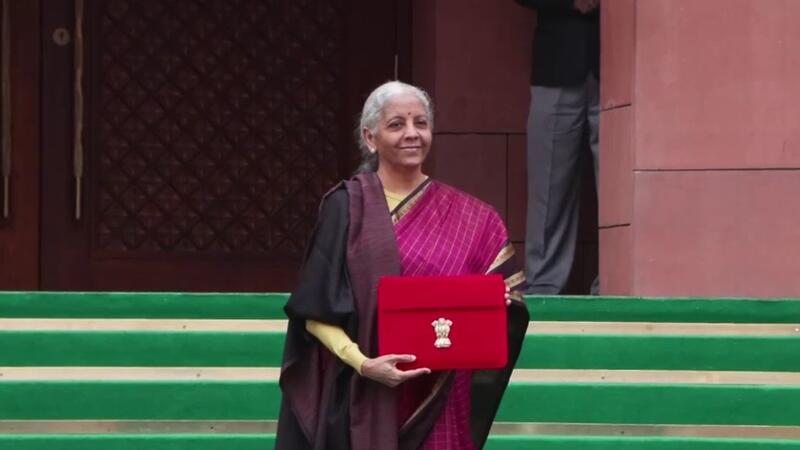
As the details of the Budget for 2026-27 began to emerge last week, it became clear that despite 7.4% economic growth, the revenue collection target for the current year (2025-26) is not being met. The gross revenue target in the Revised Estimates has been reduced from Rs 42.70 lakh crore to Rs 40.77 lakh crore.

Along with this, in an effort to keep the fiscal deficit and government debt under control, the expenditure for the current year (2025-26) has been reduced by Rs 1 lakh crore in the Revised Estimates compared to the original Budget Estimates. The combined budget for all centrally sponsored schemes has also been reduced from Rs 5.41 lakh crore to Rs 4.20 lakh crore in the Revised Estimates for 2025-26. This means that the government expenditure on most of the important social sector schemes, including those relating to schemes to empower women,  is going to be lower than what was budgeted in 2025-26. 

The downward revision has also affected the budgets of key social sector ministries like  those of Education, Health, Drinking Water, Rural Development, and Urban Development, whose allocations for 2025-26 have been cut compared to the original estimates. Particularly severe cuts were made in the Jal Shakti ministry and the Ministry of Housing & Urban Affairs — their budgets have been reduced by 58% and 40% respectively in the revised figures. Similarly, reductions have also occurred in the revised estimates of the Ministries of Social Justice and Empowerment, Tribal Affairs, Minority Affairs, and Women & Child Development.

This  means that the schemes that affect the lives of women in critical ways such as the Jal Jivan Mission, Swachchh Bharat Mission, Pradhan Mantri Awas Yojana – Urban and Rural and the Pradhan Mantri Gram Sadak Yojana, Mission Shakti (Mission for Protection and Empowerment of Women), Post Matric Scholarship for SCs, Pradhan Mantri Anuschit Jati Abhiyoday Yoajana, Programme for Development of Scheduled Tribes will have lower expenditure than the budgeted allocations. 

No Boost To The Social Sector

In the estimates for 2026-27, gross revenue receipts are projected at around ₹44 lakh crore in 2026-27. However, gross tax revenue as a percentage of GDP is estimated to fall from 12% in the current year to 11.25% in 2026-27. This indicates a reversal of the trend of gradual increase in the tax-to-GDP ratio over the past few years.

The total budget size for 2026-27 is set to be Rs 53.47 lakh crore, which is Rs 3 lakh crore higher than last year’s original budget estimate and about Rs 4 lakh crore higher than the revised estimate. The government is also planning to borrow Rs 16.63 lakh crore in 2026-27.

However, this significantly larger budget size does not bring any special benefits to social sectors such as health, education, drinking water, nutrition, rural development, and urban development or for people from the marginalised sections such as Dalits, Adivasis, Minorities and women and children. 

For example, in 2026-27 compared to 2025-26 BE, the education ministry’s budget increased by only 8%, total health budget (including AYUSH) increased by just 6.8% and rural development budget increased by only 3.5%, and Ministry of Agriculture’s budget for Farmers Welfare increased by just 2%. The budgets of the Jal Shakti Ministry and the Ministry of Housing & Urban Affairs have actually decreased compared to 2025-26.

Food Security and Nutrition

In her Budget speech last year , the finance minister had announced that the “cost norms for the nutritional support will be enhanced appropriately”, meaning the per person unit cost for the nutritional schemes like ICDS and MDM will be increased. But no action has been taken on this. The cost norms for supplementary nutrition given through Anganwadi centres to young children, pregnant and lactating women have not been revised since 2018, despite rising prices.

The Budget for Saksham Anganwadi and POSHAN 2.0 see a negligible increase this year too, with the allocation of Rs 23,100 crore compared to Rs 21,960 crore last year (2025-26 BE), an increase of just 5.19%. This additional Rs 1140 crore translates to about 40 paise per day for the 9 crore beneficiaries of the supplementary nutrition programme, and insufficient to improve the quality of the meal provided or to include more nutritious items such as eggs and fruits. Further, there is no scope for enhancing the wages for Anganwadi workers and helpers – the central contribution towards which has also not been revised since 2018. This contribution at main Anganwadis remains at Rs.4,500 per month and at mini Anganwadis at Rs. Rs.3,500per month, and for Assistant Anganwadi workers at Rs. 2250 per month. The state governments add their contribution to this central contribution, which varies by state. 

Resources For Marginalised Groups

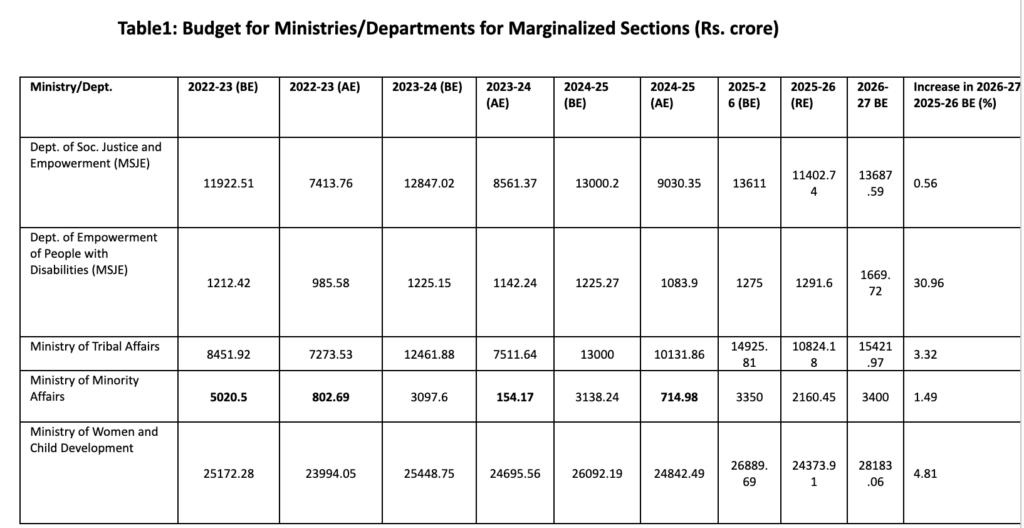
The budgets of important ministries that serve socially marginalised sections – Social Justice & Empowerment (Dalits, PwD and other marginalised populations), Tribal Affairs, Minority Affairs, and Women & Child Development – have not seen any significant increase in 2026-27. It remains at  almost the same level as last  year’s allocations for the Department of Social Justice and Empowerment and Ministry of Minority Affairs (See  table below).

Budget allocations and expenditure for Ministries and departments pertaining to marginalised sections

The only exception in this category is the Department of Empowerment of People with Disabilities (MSJE) which saw a 31% increase over the current year’s budget estimates. 

In the Ministry of Women and Child Development, apart from the ICDS and the PM Poshan, budget for the Mission Shakti (including “Sambal” and “Samarthya”) has seen negligible increase. Important schemes such as Beti Bacaho Beti Padhao, One Stop Centre, Nari Adalat, Mahila Police Volunteer, Women’s Helpline and so on are included in “Sambal” , while critical programmes such as  Ujjawala, Sakhi Niwas (Working Womens Hostel), Palna (National Creche Scheme), and Pradhan Mantri Matru Vandana Yojana are included in “Samarthya”. 

For instance, the budgetary allocation for “Samarthya” has gone up from Rs 2521 crore in 2025-26 to only Rs 2573 in 2026-27, and even these small amounts that were allocated are not being spent, as suggested by the Revised Estimates (Rs 1678 crore, i.e. only two-thirds of the budget estimate). The services funded by this budget  are important not only for the health and nutrition of the beneficiaries but also contribute to reducing the unpaid carework burden on women.

Budget for Welfare of SCs and STs

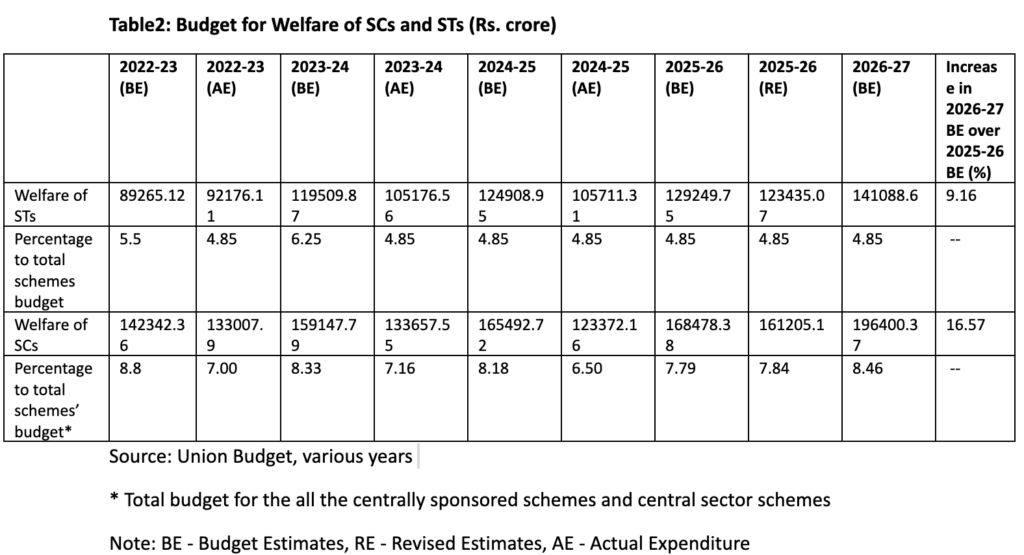
The Statements 10a and 10b of the union budget track the expenditures going towards the empowerment of the Scheduled Castes and Scheduled Tribes respectively. These statements reporting the Allocations for Welfare of Scheduled Castes and Allocations for Welfare of Scheduled Tribes (earlier known as Scheduled Caste Sub Plan and Tribal Sub Plan respectively) provide a clue about the allocations towards the SCs and STs across the ministries of the central government. 

Budget for the welfare of SCs and STs

As the table above suggests, the allocations for the Dalit and tribal communities have not shown any increase as percentage of the total schemes’ budget of the Union government over the years and they remain much lower than their share in the country’s population. If anything, the percentage of allocations towards the welfare of SCs and STs to the total scheme budgets have declined slightly since 2022-23. 

Also, the allocations towards welfare of SCs and STs also follow the same trend of lower actual expenditure compared to the budget allocations year after year barring one exception.

Gender Responsive Budget

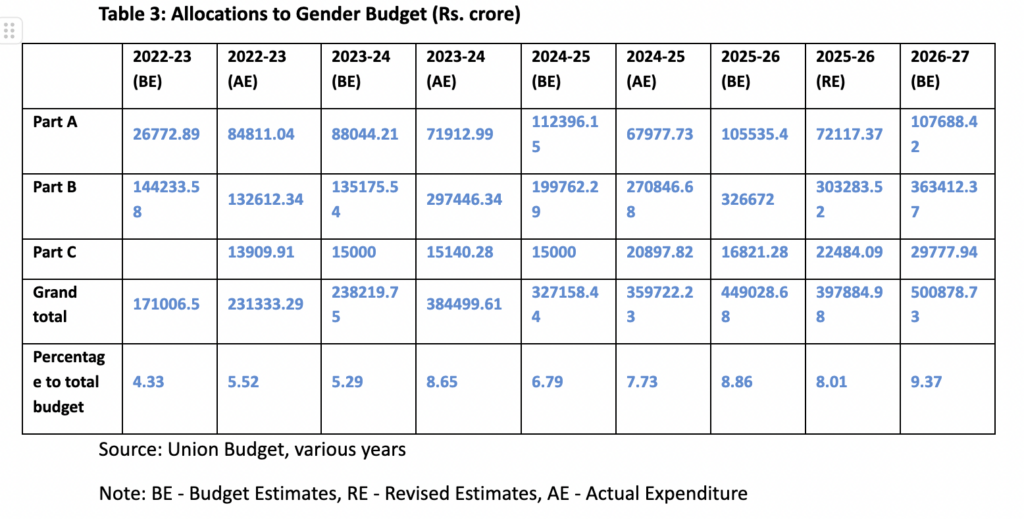
As mentioned above, the allocation towards the gender-centred schemes and ministries shows a negligible increase. But the allocations reported in the Gender Budget Statement, however, show the allocation towards the women and girls across the ministries of the central government. This statement has three parts: Part A lists those schemes and programmes in which 100% benefits are going towards women and girls, Part B lists the scheme/programmes in which 30 to 99% of the beneficiaries are women and girls and Part C lists those scheme/programmes in which less than 30% of the beneficiaries are women.

In recent years there is improved reporting in the gender budget by those ministries/departments that  did not do so earlier. Schemes and programmes, earlier excluded from GBS, have also been added. This has increased the size of gender budget and also the percentage of gender budget in recent years specially in Part B, which shows schemes / programmes with 30-99% allocations towards women and girls. 

Allocation to Gender Budget for FY 2026-27

The gender budget allocations in the current year (2025-26) has also seen a decline of 11.6% in the revised budget, bringing the gender budget down to 8.01% in RE from 8.86% in 2025-26 BE. There is a massive decline of 31% in the Part A of the revised GBS compared to the budget estimates for the year 2025-26. This is due to the major budget cuts in all the main schemes reported in Part A of the GBS. Schemes like PMAY Urban and PMAY Urban 2.0 and PMAY Urban 2.0 interest subsidy scheme (Ministry of Housing and Urban Affairs), Deen Dyal Upadhyay – National Rural Livelihood Mission and PMAY-Gramin (Ministry of Rural Development), and Mission Shakti (Ministry of Women and Child Development) saw a major decline in the revised budget of 2025-26. 

In the year 2026-27, the gender budget has increased from Rs. 4.49 lakh crore in 2025-26 BE to Rs. 5.00 lakh crore in 2026-27 BE, an increase of just Rs. 51 thousand crore. In percentage terms the gender budget increased from 8.86% of the total budget in 2025-26 BE to 9.4% in 2026-27 BE. The increase has been mainly in Parts B (Rs 37000 crore) and C (Rs 13,000 crore) of the GBS. 

The increase in Part B is mainly due to the increased allocations towards VB GRAM G scheme and Jal Jivan Mission. Interestingly the total budget for Jal Jivan Mission has increased only by Rs. 670 crore (from Rs. 67000 crore in 2025-26 BE to Rs. 67670 crore in 2026-27 BE) but the gender budget component of the Jal Jivan Mission has increased from Rs. 20476 crore in 2025-26 BE to Rs. 33022 crore in 2026-27 BE, showing now increased percentage of JJM being reported as gender budget component. The GBS, however, does not provide any rationale for increasing the gender budget component of the JJM. Increased allocations in Part C of the GBS has come mainly from reporting of a new scheme called Pradhan Mantri Viksit Bharat Rozgar Yojana (earlier known as New Employment Generation Scheme) by the Ministry of Labour and Employment, which is a scheme to support employment generation across the country with objectives to formalize  workforce, incentivize job creation and strengthen social security. It is a big programme for which a total of Rs. 20,000 crores was allocated in 2025-26 but it has now been revised to just Rs. 848 crores. For the year 2026-27, an amount of Rs. 20082 crores has been allocated out of which Rs. 4088.84 crores (20%) has been marked as gender budget component. In Part B also, the Ministry of Development of the North Eastern Region has started reporting this year. 

Overall, the GBS is becoming robust by having newer ministries reporting in it and new schemes being added specially in Parts B and C. Also, some schemes like JJM are now showing increased percentage as a gender budget. But the overall allocations towards women and girls and their utilisations seems to have had little qualitative change.  

The finance minister, in her budget speech, made very few announcements on new programmes. However, announcements like Lakhpati didi 2.0, SHE Marts for self-employed women and the girls hostel in every district are among the few noteworthy and welcome announcements for women and girls in this year’s budget speech. However, the focus remains largely on income generation through credit-linked schemes. Critical issues such as “time poverty”—the heavy burden of unpaid domestic work—remain unaddressed. Women need access to time-saving infrastructure, including piped drinking water, electricity, and sanitation, as well as improved and accessible care facilities to reduce domestic burdens and enable fuller participation in economic and social life.

  • Feminist Policy Collective is a voluntary group working towards transformative financing for gender justice in India.

Malini Nair (Editor)

Malini Nair is a consulting editor with Behanbox. She is a culture writer with a keen interest in gender.

Support BehanBox

We believe everyone deserves equal access to accurate news. Support from our readers enables us to keep our journalism open and free for everyone, all over the world.

Donate Now