
How Digital Systems Are Excluding Adivasi Women from Maternity Entitlements in Andhra
India’s flagship maternity programme now banks on a robust digital chain, efficient apps and stable internet – none of which can be assumed in many Adivasi areas in Andhra Pradesh
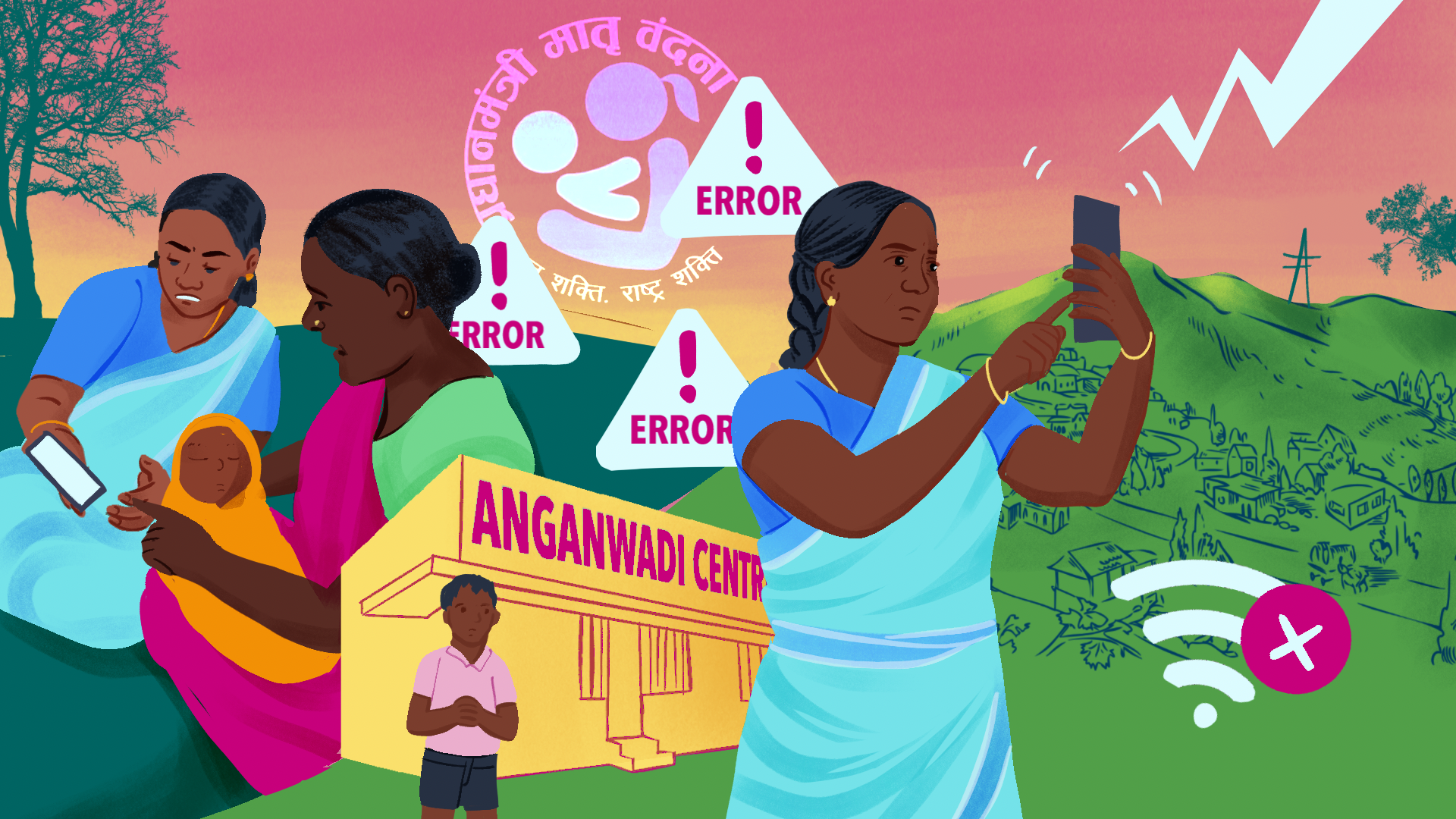
In her first pregnancy, Latha*, an Adivasi from the Alluri Sitharama Raju district in northeastern Andhra Pradesh, had registered with ease for the Centre’s flagship maternity benefit scheme, the Pradhan Mantri Matru Vandana Yojana (PMMVY). By the time she conceived a second time, the scheme application had been digitised. And then began the challenge – of finding an uninterrupted internet connection, getting the login to work, finding a window when the app was without any glitch.
Latha’s first attempt at registering online failed. The second time, her Anganwadi worker was not comfortable using the app and the PMMVY logic dashboard malfunctioned. Then another Anganwadi worker, from a nearby village, was called in to help. Together, all three travelled nearly 4km to a junction where they hoped the internet connection would be better. Latha bore all the travel expenses.
The three waited at a Mee Seva centre that offers a one-stop service platform for citizens for more than an hour as the PMMVY login failed repeatedly; the app opened once only to automatically log out a few minutes later. They returned home, dismayed. Two days later, the login worked and they filled in the details, but the app glitched again. After another round of waiting and countless failed login attempts, the workers had to leave.
By then Lata had spent around Rs 250, waited for hours, travelled repeatedly while pregnant, and still had no clarity about accessing a scheme she was entitled to. She was not hopeful that her registration would be completed, she told us.
Before the digitisation of the system two years ago, the scheme’s delivery chain was a simple transfer of money into a woman’s bank or post office account. Since 2024, when registrations moved fully online, the chain has become far more dependent on digital interfaces: app-based registration, worker logins, Aadhaar-linked records, online routing of applications and digital verification.
This means that Latha’s experience is not an exception. Across Adivasi habitations in Andhra Pradesh’s Alluri Sitharama Raju and Parvathipuram Manyam districts, the PMMVY scheme, a maternity entitlement designed to support women during pregnancies, is becoming restrictive and inaccessible because of the digital systems through which it is delivered, we found through field visits to Adivasi habitations in both districts and through responses to Right to Information (RTI) requests filed by the authors with the Integrated Child Development Services (ICDS) —the implementing body for the scheme.
Since 2017, PMMVY has promised Rs 5,000 to eligible pregnant women to support nutrition and compensate for some loss of wages. In remote Adivasi areas, this amount matters even more. Women and families told us that they would use the money, if it comes on time, to buy more eggs, meat and other nutritious food.
Given poorer nutrition among women and children of tribal communities (here and here), longer distances to health facilities and higher transaction costs incurred by way of time lost, transport expenses and payments to intermediaries, Adivasi women arguably need more support than women in better-connected areas. Yet many are unable to receive even the limited entitlement that already exists, because eligibility alone is no longer enough; access now depends on whether each step of the digital registration and verification chain works.
PMMVY’s reach now is linked to a fragile digital chain that assumes the community has functioning mobile applications, active worker logins, stable internet connectivity, Aadhaar-linked records, correct routing of applications, and the digital capacity of frontline workers. In Adivasi areas, as we said earlier, habitations are far from service centres and mobile networks are weak. Many families do not have sufficient documentation, and their cash reserves are limited. Women often depend on Anganwadi workers, Mee Seva operators or other intermediaries to navigate online systems.
These barriers, ushering in the demise of a crucial scheme, reflect a central accountability failure. The digital systems record transactions but not the emotional and economic costs women incur – the money spent on autos and hours lost waiting for an OTP – in seeking support. The delay becomes a lost opportunity to strengthen nutrition during a critical period.
The Scale Of Breakdown
Official records show at least 43 Anganwadi worker logins were inactive in Parvathipuram Manyam district as of December 2025, as per responses to the RTI requests filed with the ICDS. And in both Parvathipuram Manyam and Alluri Sitharama Raju districts, not a single new PMMVY registration was completed between January and August 2025, when the PMMVY programme went from being the responsibility of the health department to the women and child welfare department.
Connectivity issues only deepen the problem. In Parvathipuram Manyam district, 369 of 2,027 Anganwadi centres lacked internet connectivity as of March 2026. Where centres lack reliable internet, the digital requirement does not disappear; instead, workers and entitlement holders are forced to travel to network points, nearby villages, Mee Seva centres or block offices, wait for logins and apps to work, or depend on personal phones and mobile data where available. These informal costs are usually borne by Anganwadi workers or entitlement holders, as we said before.
Even when applications are submitted, they do not always move forward. In the Ananthagiri hills project area of the Alluri Sitharama Raju district, RTI data shows that 563 of 1,073 PMMVY registrations submitted before January 2025 – when the health department administered the scheme – were later routed to incorrect project logins after the programme’s responsibility was transferred. This meant that more than half of all applications were left in limbo without proper verification.
Rejections are also high and poorly explained. In Alluri Sitharama Raju district, 998 of 4,324 PMMVY registrations during 2025–26 were rejected — a rejection rate of nearly 23%, well above the state average of 14.23%. Review instructions reportedly call for re-verification of rejected applications, but we found many Adivasi women had no way of knowing whether their application had been approved, rejected, or left pending.
These RTI findings do not provide a complete measure of PMMVY exclusion among Adivasi women. There is no clear public data that allows us to compare the number of eligible pregnant women in tribal habitations with the number who were successfully registered and paid. But that absence is itself revealing. The system records applications, logins, payments and rejections, while failing to clearly document how many eligible Adivasi women are never registered, wrongly routed, rejected without explanation, or did not receive the entitlement.
Cost Of A ‘Free’ Scheme
Pangi Sravani*, who lives in the Alluri Sitharama Raju district, was pregnant for the first time when she tried to enrol for PMMVY. She went to the village Anganwadi centre with her documents thrice but the registration could not be completed on the PMMVY mobile app. Her Anganwadi worker suggested that she try applying through a Mee Seva centre.
By then, Sravani had gone to her parental home in another village. To complete the registration, she travelled with her mother to the nearest Mee Seva centre, around 11km away. After an hour’s wait they were able to submit the application, but now, like many others, she has no way of tracking the status of her application.
Muvvala Mahi*, from another Adivasi habitation in the district, had a similar experience. Her pregnancy was recorded in the system, making her eligible for PMMVY, but her local Anganwadi worker could not complete the registration because the application would not function. Mahi then travelled 5km to another village, spending Rs 120 and losing a day’s wages, but the registration still did not go through. A few days later, she tried again at a Mee Seva centre, waited more than two hours, and returned again without success. After repeated attempts, each costing money she did not have, she stopped trying.
In another case, a woman was repeatedly denied registration because the system flagged her Aadhaar number as a duplicate. She was asked to re-enrol and paid Rs 5,000 to an operator, but the process still failed.
For low-income Adivasi households, Rs 120, Rs 250 or Rs 300 spent on travel, waiting, repeated visits and failed registrations is significant. Families, with limited cash reserves, are forced to absorb expenses or depend on relatives for support. The path to a free scheme is paved with expenses and exhaustion, and many decide to stop trying before they reach the end.
Anganwadi Workers Trapped In Systems
Anganwadi workers in the state are the only visible face of the scheme, so when an app fails or the payment is postponed, their credibility comes into question. But the workers’ challenges sit inside the same inept digital system.
In Adivasi regions of Andhra Pradesh, many Anganwadi workers have limited formal education and low digital familiarity. Officials in Alluri Sitharama Raju district told us that around 60% of Anganwadi workers lacked the reading and writing skills — leave alone digital skills — needed to manage PMMVY registrations. Yet they are expected to operate several applications, including Poshan Tracker, Balasanjiveeni (state-sponsored health programs for mothers and children) and PMMVY, while also handling additional government tasks such as surveys, pension-related work, APAAR ID, a unique academic identity for students, and ABHA ID, a digital health identity.
Several workers said they now spend hours each day on mobile applications, often outside office hours, leaving less time for children’s learning and activities. In remote habitations, the burden is sharper. One mini Anganwadi worker from a Kond PVTG habitation, serving a smaller centre meant for a small and remote hamlet, said there was no mobile signal in her village and that she had to travel around 15 km to the block headquarters for connectivity.
Most entitlement holders in her village do not have phones, making digital verification even harder.
Another Anganwadi worker from a remote hill village, who had no formal education and was not comfortable with digital systems, said she had to travel around 5km to a nearby village with network connectivity.
For PMMVY registration or Take Home Ration distribution, she often has to accompany rightsholders to places with network coverage. Unlike regular government officials posted in tribal and hill areas who receive special allowances, Anganwadi workers receive the same honorarium as their counterparts elsewhere — around Rs 11,000 for regular workers and Rs6,000 for mini Anganwadi workers — despite the extra travel, connectivity costs and digital labour imposed by difficult terrain. Several workers told us that these unreimbursed costs and repeated digital failures made them feel like quitting. But, they are discouraged from resigning and asked to continue delivering whatever services they can. The result is an informal arrangement in which Anganwadi workers absorb the failure of the digital system — through their own time, travel, money and credibility — while the state continues to treat the scheme as functional.
Lakshmi*, an Anganwadi worker from a remote village in ASR District, said the applications change frequently, but workers do not receive proper training. In the case of PMMVY, the interface changed twice. The mobile phones distributed to workers often do not support the applications properly, forcing some to buy new phones themselves. Lakshmi said she bought a phone worth Rs 13,000 in 2022 just to carry out her work.
These failures create tension between workers and women in the community. Anganwadi workers face questions and accusations, even when they have done everything they can. This tension is not limited to PMMVY. Similar problems have been documented in tribal Anganwadis in ASR district, where app-based errors and update failures led to workers being blamed for problems they could not correct, affecting their relationship with rightsholders. One Anganwadi worker described the situation as “mundu nuyya, venaka goyya”— between the devil and the deep blue sea.
The state has made Anganwadi workers responsible for delivering PMMVY to communities without giving them the tools, training, connectivity or authority to resolve failures.
When Digital Lists Replace Local Knowledge
The shift to digital systems has also changed how eligible women are identified. In villages, community health workers know who is pregnant, who has migrated temporarily, who has returned to her parental home, who lacks documents, or whose name appears differently in records; their local, intimate knowledge defines welfare delivery. Anganwadi workers, ASHA workers, ANMs and local processes earlier played a more direct role in identifying pregnant women and helping them access maternity-related support.
This local network is especially important in Scheduled Areas, where Gram Sabhas are legally recognised institutions for community-level identification and oversight. While Gram Sabhas do not appear to have a formal role in PMMVY registration, they could help identify pregnant women who are known locally but missed by digital databases. But when eligibility and registration are mediated through databases, apps and pre-existing digital records, the Gram Sabha loses its practical ability to identify excluded women and correct errors.
What It Takes To Make An Entitlement Work
The failures seen in PMMVY are not isolated glitches. They reflect a welfare model whose organising principles assume internet connectivity, functioning devices, meticulous digital records – assumptions that cause technical frictions and community fractures in caste-marginalised communities.
This is how digital exclusion works. There is no explicit denial but repeated failed attempts that eventually force women to give up. Latha and Sravani did not opt out of PMMVY; they were pushed out by frozen screens, incessant login attempts and forms that restarted when they were close to submitting. Each failure erodes their dignity and weakens their rights.
These failures are not inevitable. PMMVY can be made more accessible if the state treats registration failure not as an individual problem, but as a system failure requiring correction.
The scheme needs a reliable offline and assisted-registration fallback, so that a pregnant woman does not lose access when the login does not work or a village has no internet. Every applicant must also have a clear status trail: women should be able to know whether their application is submitted, rejected, or approved – and the reason for rejection should be communicated in a language and format they can understand.
In Scheduled Areas, the Gram Sabha’s role must be restored. Local identification is often the only way to reach women who are invisible to digital databases. Digital systems should support this process, not replace it.
The state must also audit inactive logins, wrong mappings, pending applications and unexplained rejections, especially in tribal areas. Anganwadi workers need functioning devices, and apps that require low connectivity and understand local-languages. They should be supported with hands-on training, technical helplines, and reimbursement for travel or connectivity-related expenses.
The test of PMMVY should not be through an online form or a functioning dashboard, but whether a pregnant Adivasi woman in a remote habitation can actually access the support without repeated travel, private payments, or dependence on fragile digital systems.
Until accountability for exclusion lies with the state rather than with the excluded, maternity entitlements will continue to reach women who least need the help — and fail the ones for whom they were meant.
(Names of individuals and villages have been withheld to protect privacy.)


We believe everyone deserves equal access to accurate news. Support from our readers enables us to keep our journalism open and free for everyone, all over the world.
