
In Andhra’s Shrimp Factories, Tariff Threats Have Left Women Workers Acutely Vulnerable
In Bhimavaram, a massive hub for shrimp exports, the continuing uncertainty over US trade tariffs has left a devastating impact on the lives of women workers
- Laasya Shekhar, Bhaskar Basava
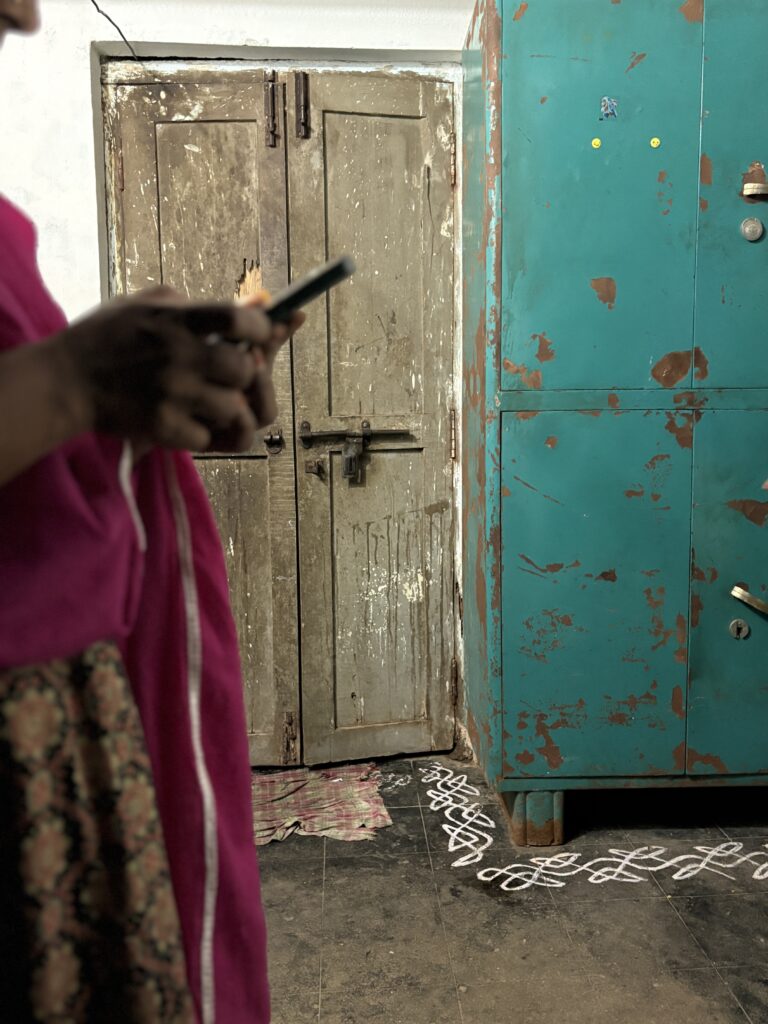
Barely any light reaches the 300 sq ft home of Radha*, a 27-year-old wage worker from West Godavari’s Akividu village. Radha has shut the windows so that her neighbours do not hear her husband’s screams or the sound of the lashing she gets nearly every day. But her demeanour — frail body, sunken eyes, visible scars on the arms, and the way she lowers her voice in her own home — speak of the violence she lives with. Rushing to finish our conversation before her husband returns, she nods when we ask if she is abused.
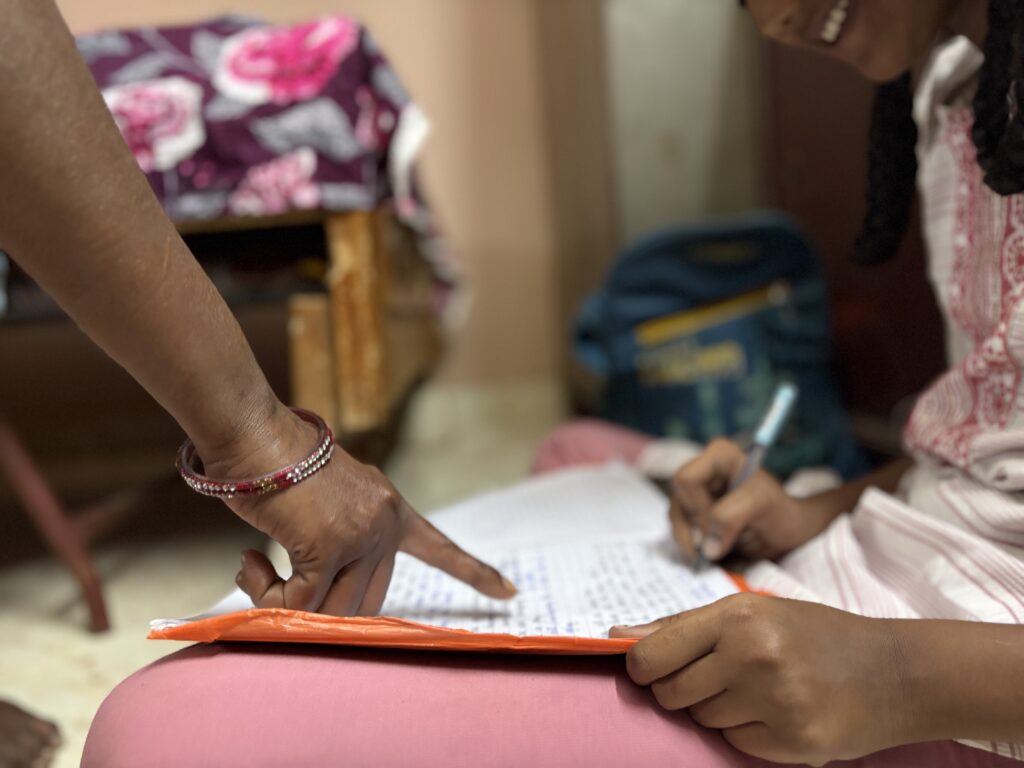
“In the past six months, I haven’t been getting work throughout the month and I earn only half of what I used to earn,” says Radha. “I have to educate my eight-year-old daughter, repay loans, and manage household expenses. My husband hits me when I ask him to pitch in.”
There was a time Radha used to earn around Rs 15,000 a month deveining and de-heading shrimps at a local factory. The work allowed her to avoid the trauma inflicted by her alcoholic husband – she was home less often and financially independent. But the sharp rise in the tariffs imposed by the United States on Indian exports, including shrimp, has hit work opportunities in the sector.
Radha says she now lives in a state of constant anxiety and fear. Her husband is upset she does not hand over her earnings to him. “But he would spend it all on alcohol. How will I run the family?” she asks.
Ponds filled to the brim, lush coconut trees, and aqua farms extending to the horizon — every scenery in West Godavari’s Bhimavaram evokes prosperity. But not Durga’s* 280 sq-ft home in Akividu, where the living room becomes the bedroom at night.
For the past 15 years, Durga, 38, like Radha, has been deheading and deveining shrimps in factories, occupying the lowest rung of the seafood supply chain. Till about a year ago, she too earned Rs 15,000 a month, a steady income that substantiated her painter husband’s earnings and helped educate their two daughters.
In August last year, in addition to the existing anti-dumping and countervailing duties of about 8.26%, US President Donald Trump imposed fresh tariffs on India — a 25% punitive tariff linked to India’s purchases of Russian oil and a 25% reciprocal tariff — taking the total effective duty burden to about 58.26%.
Deployed as a geopolitical tool, these tariffs have upended the lives of women like Radha and Durga. Their livelihoods were dependent on India’s agricultural exports. In the financial year ending March 2025, India exported frozen shrimp worth about USD 5.9 billion globally, with the US alone accounting for nearly half the sales.
“Over time, many grew reliant on large-volume orders from the US, far exceeding those from other destinations. Several exporters from Andhra Pradesh even expanded their supply chains to cater specifically to the US market, setting up processing plants and cold storage units there,” says Gembali Seetaraju of Lito Marine Exports Private Limited.
Meanwhile, US tariffs have been fluctuating wildly in recent months, adding to the precarity. The US–India trade deal in early February brought the tariffs down from 50% to 18%. However, in addition to the revised tariff, Indian shrimp continues to attract anti-dumping and countervailing duties of about 8.26%, taking the total effective duty burden to roughly 26%.
Then again, late February, the US Supreme Court invalidated the reciprocal tariffs, effectively ending the Trump-era measures. But the US government issued executive orders imposing 10% tariffs on certain products from all countries for a 150-day period. Trump, meanwhile, asserted on his platform Truth Social his authority to impose new tariffs. On March 11, he launched trade investigations into multiple countries, including India, paving the way for a potential new wave of tariffs to replace the repealed ones.
Meanwhile, Ecuador, the world’s largest shrimp exporter and India’s closest competitor in the US market, faces a combined duty burden of about 18.78%. But given its geographical proximity to the US, exporters say that despite the tariff reduction, the effective 26% duty still places India at a competitive disadvantage. As Ecuador and the US finalise a trade deal, it remains unclear whether Ecuador will continue to face the current rate tariffs or be included in the zero-tariff framework.
‘I Get Work Only 10-14 Days A Month’
When export orders slowed after the tariff hike, the impact travelled swiftly down the supply chain — reaching women like Durga who work on daily wages in shrimp-processing units. “I have been able to find work for only 10– 14 days a month since August. I barely earn Rs 5,000 now,” she says.
The fall in income has left her scrambling. Her swollen eyes speak of sleepless nights and the empty coffee cups on the living room table of her stress. “I can’t sleep till 12 am because my mind is flooded with these thoughts. Where will I work tomorrow? How do I pay the rent? How do I pay for my kids’ education? How do I pay interest for the loan?” she says.
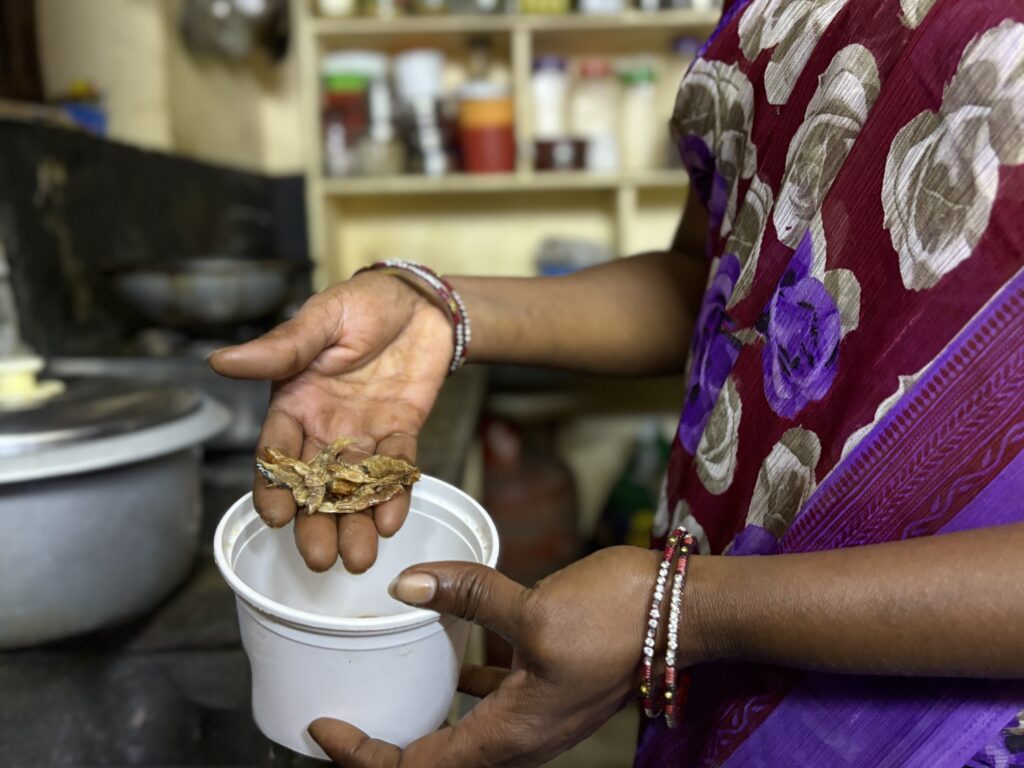
In the last one month, Durga has had to take on work in five different places to make up for the loss of earnings. It meant spending at least two hours commuting and earning Rs 300 a day against the Rs 500 earlier. And then there are the commute expenses.
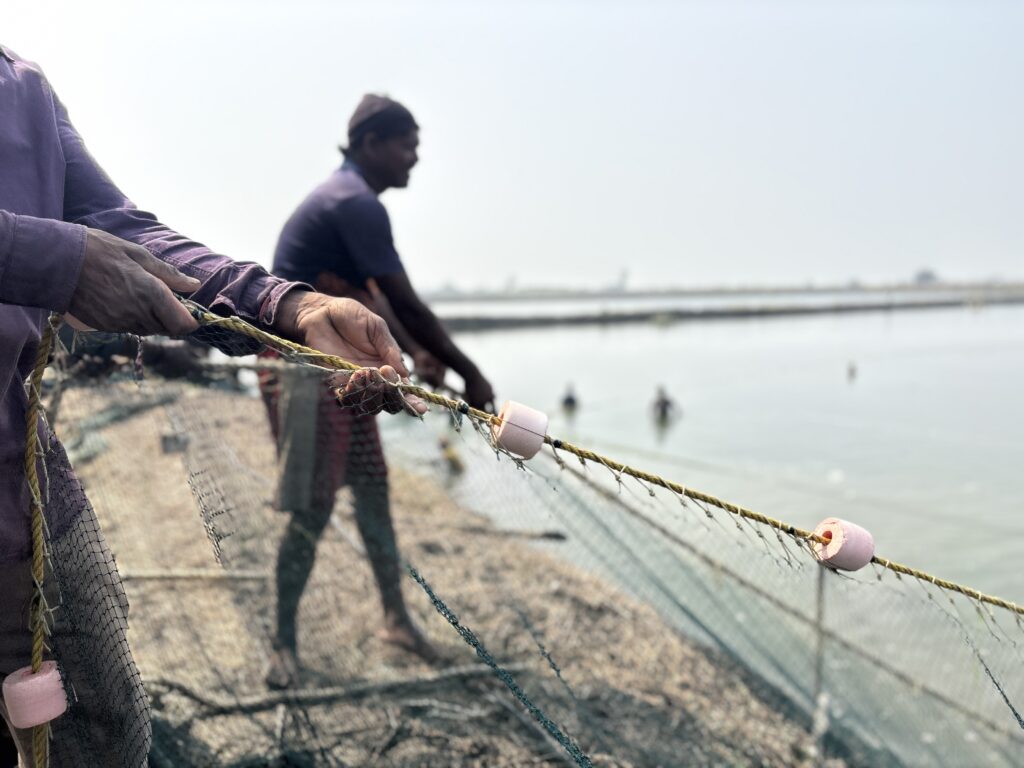
In the twin Godavari districts and in the Krishna belt, farmers started replacing traditional agriculture with aquaculture in the 1990s because shrimp cultivation offers higher incomes than traditional crops. Today, Andhra Pradesh contributes 80% of India’s shrimp exports and 34% of its overall marine exports, valued at around Rs 21,246 crore annually. The sector supports the livelihoods of over 2.5 lakh families and sustains nearly 3 million people directly and indirectly.
Working In Freezing Rooms
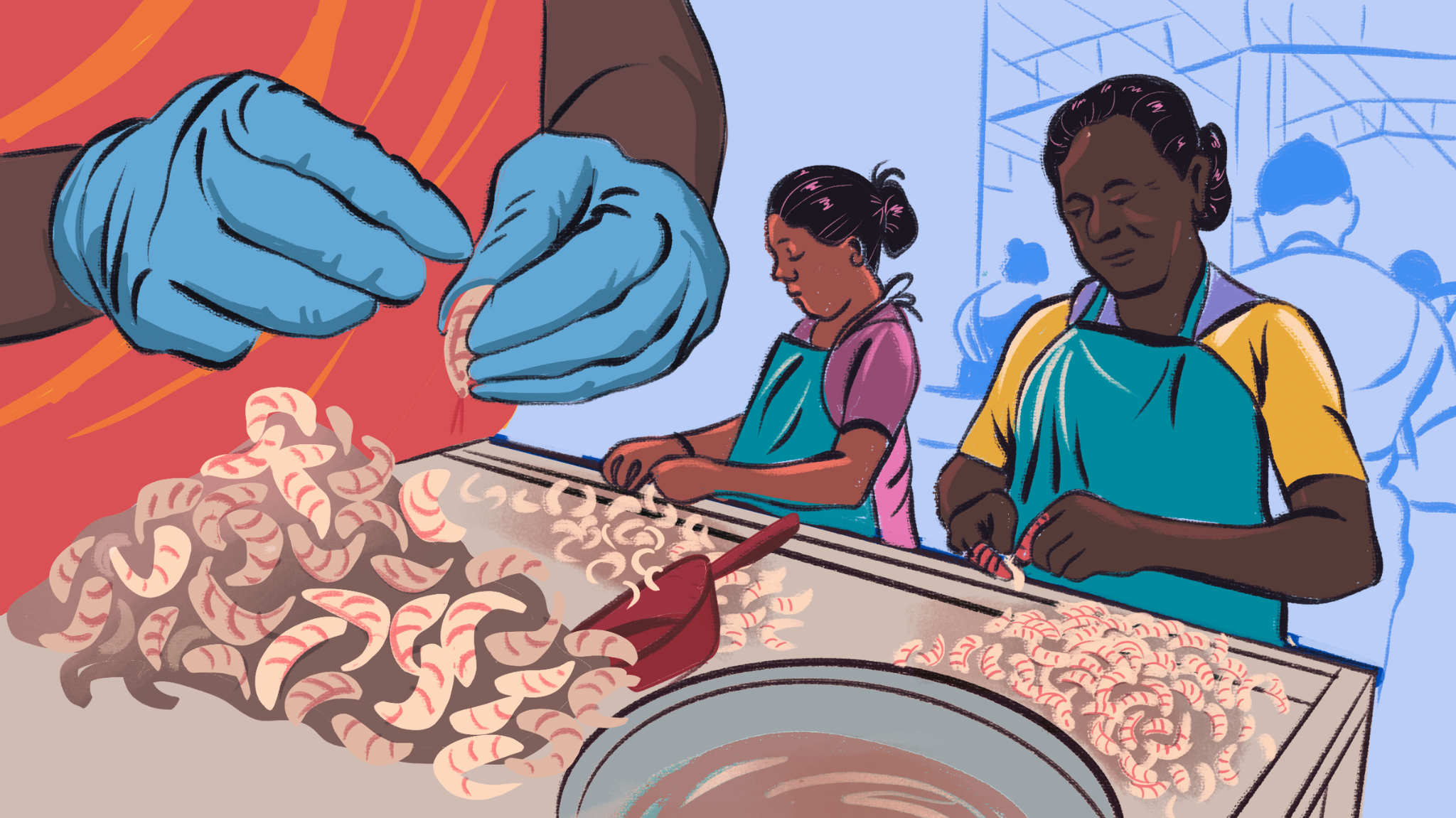
Within the value chain, women are largely confined to processing plants, where they perform repetitive and labour-intensive tasks such as peeling, deveining, and de-heading. Women also work as supervisors and security staff in the industry. Most of them are hired on a contractual basis so employers do not have to pay them a fixed salary and also avoid paying benefits such as health insurance, bonus, and provident fund. Although contractual workers are technically eligible for benefits such as health insurance, bonus, and provident fund, these are rarely provided in practice.
“In the factory I work, there are barely 80 men against 300 women. Men work outdoors lifting goods and women work in rooms kept extremely cold to preserve shrimps. But that takes a toll on our health,” says Devi* who works at a shrimp processing factory in Seesali village, Bhimavaram.
Since November, Devi, despite being a permanent employee, works for only 10 days a month and earns a third of the Rs 15,000 she earlier earned. “I pay Rs 1,400 to settle a loan every week. With meagre earnings, I am digging into my savings right now,” Devi says.
With the arrival of children in families, women have to take on some work that brings in an income even as they shoulder care work at home. “My parents did not let me pursue higher studies as they said that I just had to fulfil the role of a housewife. My husband’s earnings were enough initially, but after having kids, I had to start working,” says Kavitha*, a 27-year-old wage worker. She had studied till Class 12 and started working only in the past two years to support her children’s education.
Following the amendment to working hours by the Andhra Pradesh Labour Department in November 2025, workers’ shifts went up from 8 to 10 hours. The workers we interviewed complained that this was not accompanied by any wage increase, and particularly impacted women workers.
Pushed to work at least 12 hours a day for the same pay, they had only two choices – quit or comply. This move to increase work hours also made it easier for employers to intensify their demands on workers amidst shrinking export orders from the US, we were told.
When Health Takes a Backseat
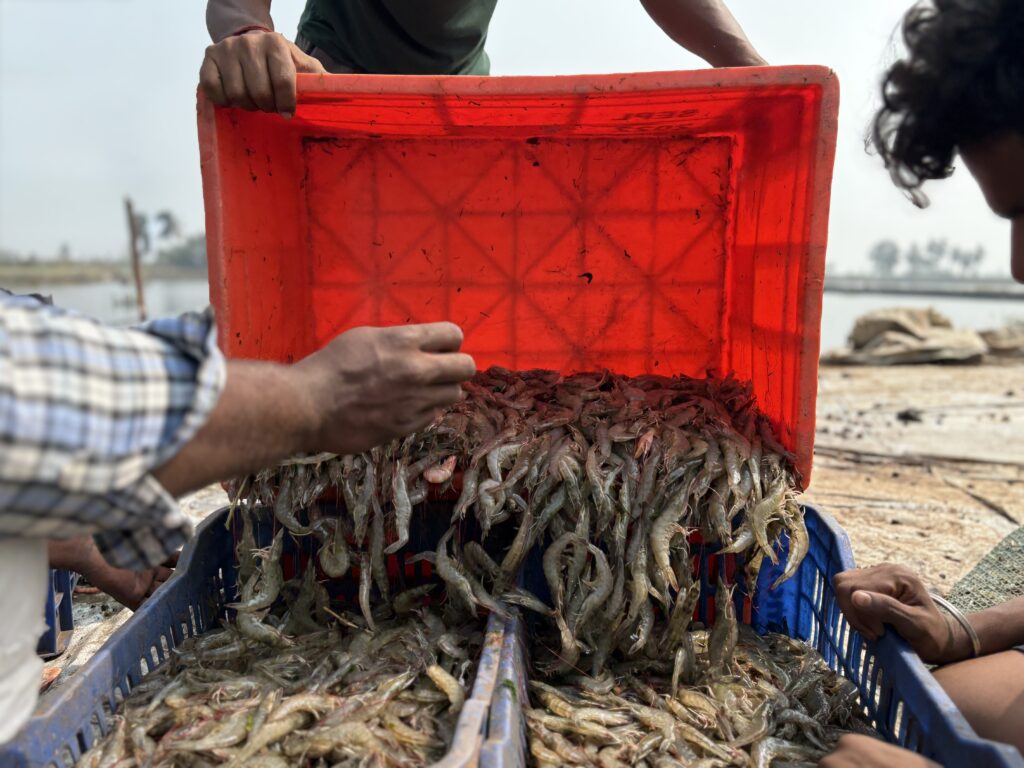
In the factories, as soon as shrimp arrive from farmers, they are washed, segregated, and sent to the valuation section [the term workers and employers use to refer to peeling, deveining and deheading departments], where the temperature is maintained below 10°C. In units, where the shrimp are pre-cooked for sale, they are then put through temperatures of around 100°C. They are subsequently frozen at –40°C and later stored and transported at –18°C, allowing them to remain fit for long-distance exports, including to the US, says the manager of a shrimp factory who did not wish to be named.
While the segregation of the shrimp is on the basis of their size, their cooking and freezing is mostly mechanised, it is in the valuation section that women workers find work.
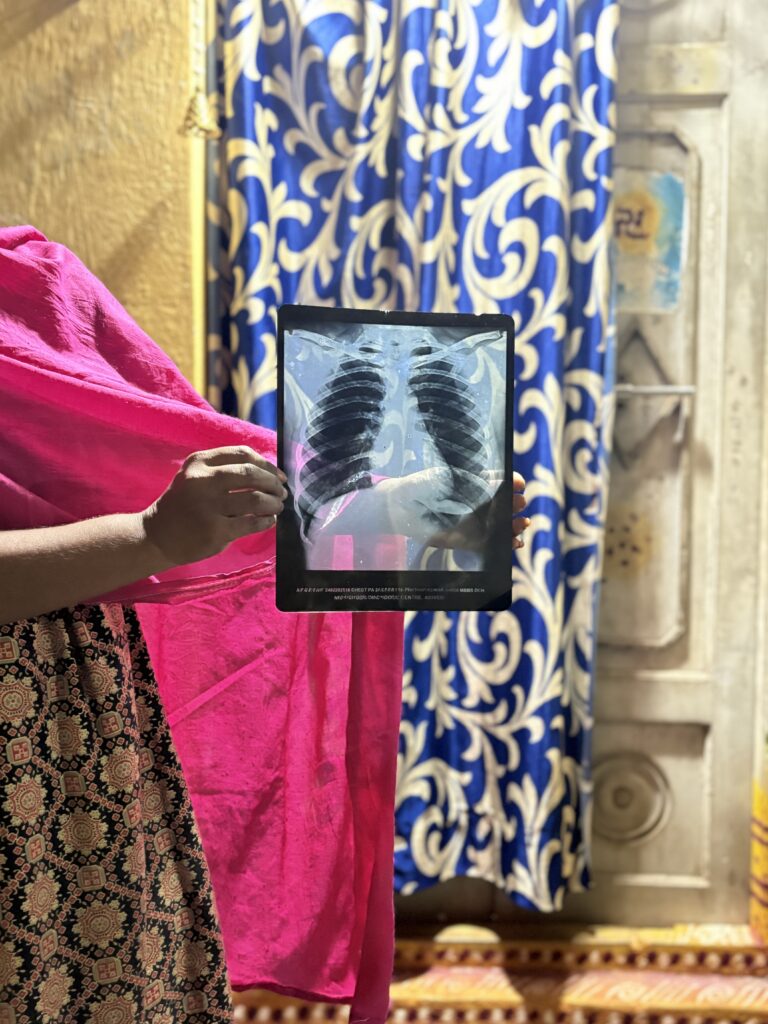
The effect of their work conditions on their health has been documented. “Shrimp processing workers had four to five times higher odds of reporting acute upper and chronic lower respiratory symptoms than the controls,” says a March 2025 study, ‘Respiratory Symptoms, Sensitisation and Occupational Exposure in the Shrimp Processing Industry’. Air samples from the workplace contained high levels of tropomyosin and other allergenic proteins, which are known respiratory sensitisers, the study revealed.
Kavitha’s hands are swollen and her glass bangles have broken from the over-use of her hands. So she puts on the gloves before she sits down to peel shrimps for long hours. She struggles to stand for long and has developed a sway-back posture, and she is comfortable only when she sits leaning back.
“I have developed asthma working in such cold temperatures. I spent Rs 10,000 on medical bills these past two months,” says Kavitha, catching her breath.
An October 2024 study which specifically looked at women in fish processing (similar to shrimp processing) found out reductions in lung function and symptoms likely due to cold environments and bioaerosols in the processing facility.
All workers complained of various medical issues ranging from ophthalmoplegia to asthma, and they often went to hospitals for treatment. The issues only slightly vary for contractual workers and those who work full-time. Women workers also complain of not getting adequate breaks and there are no separate toilets for them in the work space.
Despite this risk-prone environment, none of the nine women we spoke to were provided with health insurance, provident fund, and bonuses. All workers said that their employers paid a travel allowance of Rs 50.
Elephant In the Room
The unavailability and uncertainty of work is hitting the women in more ways than one. The reduction in income means they have had to cut down on nutritious food intake and like Radha continue in abusive relationships.
There is no mental health support for these women in the locality. The District Medical and Health Officer B Geetha Bhai confirmed that the government hospital in Bhimavaram (headquarters of the West Godavari district) does not have a psychiatry department.
What happens when mental health issues remain unsolved? “In India’s patriarchal context, women’s limited autonomy and decision-making power significantly influence their nutritional health. Evidence from NFHS-5 shows that higher women’s autonomy is associated with a lower risk of undernutrition, highlighting the need to address gender norms alongside health interventions,” says Madhuri HN, a psychiatrist with the National Institute of Mental Health and Neurosciences (NIMHANS), Bengaluru. Over time, this affects their capacity to work safely and productively, compromises caregiving, and limits participation in community or collective action, she adds. Madhuri specialises in women’s mental health particularly in the areas of perinatal mental health, gender-based violence.
Over time women start seeing anxiety, exhaustion, and hunger as “normal,” says Madhuri, but this can erode their sense of self-worth and bodily awareness. It also leads to delays in seeking healthcare, poor adherence to treatment, and reduced ability to advocate for better working or living conditions.
Short-circuiting Worker Rights
Wage workers are legally entitled to social security benefits such as Provident Fund (PF) and Employees’ State Insurance (ESI) and annual bonus including Payment of Bonus Act, 1965, and Minimum Wages Act, 1948.
The daily-wage workers are also entitled to statutory welfare benefits, says A Rani, Joint Commissioner of Labour. As per the notified minimum wages for processing workers in the fisheries and seafood sector, the daily wage works out to approximately Rs 489 (Rs 12,732 for 26 days). She adds that piece-rate payments are expected to correspond to this daily minimum, and companies are asked to deposit in the bank accounts directly and not pay in cash to enable transparency.
She maintains that there are no irregularities in the payment of bonuses, insurance, and Provident Fund benefits “except perhaps in small industries”. Officials who inspect the factories are selected on a random basis through the Labour Inspection System (LIS) to ensure impartial checks, she points out.
However, women we interviewed across units—ranging from well-known export houses to medium-scale processing plants—say they receive their wages in cash from the mesthri (supervisor) who in turn are paid by the companies. The wage rate, they allege, is often as low as Rs 3 per kg of shrimp processed. Meanwhile, women like Devi, who are employed full-time, say they have been opting to receive their wages in cash instead of having them credited to their bank accounts for the past six months.
CITU’s efforts to link them with the existing ESI hospitals in Kakinada and Rajahmundry to help them deal with their health issues have so far been a futile effort. “They are entitled to a once-a-year bonus equivalent to a month’s salary, and ESI after completing one year of service. But the management circumvents these obligations by terminating them just before they complete a year and rehiring them shortly after, resetting their eligibility period,” says G Baby Rani, national vice-president of the Centre of Indian Trade Unions (CITU).
Vaishali*, has been working at a reputed shrimp processing plant in Bhimavaram for seven years now. She reports that her company had to send back more than 100 women workers, many of them migrants from the Hindi-speaking states, after the Trump tariffs caused a steep decline in export orders.
Indu*, who works at a shrimp processing plant as a wage worker, says her factory no longer contributes to her PF. “They told me that if I wished to continue the PF account, both the employee’s share (Rs 1,800, which is 12% of Rs 15,000) and the employer’s share (another Rs 1,800) would be deducted from my salary itself. That would mean a total deduction of Rs 3,600 every month,” she says. “I couldn’t afford that, so I agreed to stop PF contributions altogether and receive only cash wages instead.”
Durga’s income helped her run the household while her husband’s earnings were used mostly to repay a Rs 1 lakh debt, pay the house rent, maintenance, and children’s school fees. These carefully balanced finances are now jeopardised.
Women working in shrimp farms have it worse — they have no designated restrooms, they work in sheds set to freezing temperatures and take home meagre paychecks. “There is one functional washroom, but it is used by the supervisors. So we have to go outside, so we reduce our water intake,” says a woman in her 40s who works at the Bhimavaram plant. There are no menstrual hygiene facilities either at the plant.
*Names changed to protect identities
[This piece is co-published with The Xylom, a nonprofit newsroom reporting on global health and environmental disparities.]

We believe everyone deserves equal access to accurate news. Support from our readers enables us to keep our journalism open and free for everyone, all over the world.
