New Transgender Bill Will Have Us Believe A Whole, Vibrant Community Does Not Exist
I would not have come out had I not had my hand held metaphorically by the dozens of trans people. This community, its very existence and the embrace of its solidarity now stands threatened.
IN AS MUCH AS anyone cis is interested in trans lives, there is an established narrative that we all know – we are trans from the time we are young. My closet, however, didn’t have hinges – it was a revolving door that swept me in and out as I tried to articulate the confusion I felt about being different.
I no longer remember the first time I realised and denied that I was queer. The call from within existed, but I — and my straight, cis world — was not ready to hear it. For years, I had not entertained the possibility that someone with my assigned gender could transition. It was just not an option. One could perhaps change one’s presentation and the way one moved in the world, but to be another gender? Absurd.
Trans women, naturally, existed. A hijra woman I used to speak to on the local train in Mumbai once tenderly told me that I was one of them. I smiled in confused, lurching joy. I remembered her a few months later when someone I followed on social media proclaimed he was trans masculine and later blossomed into a trans man. I followed his public transition with a hunger I rarely felt for public figures.
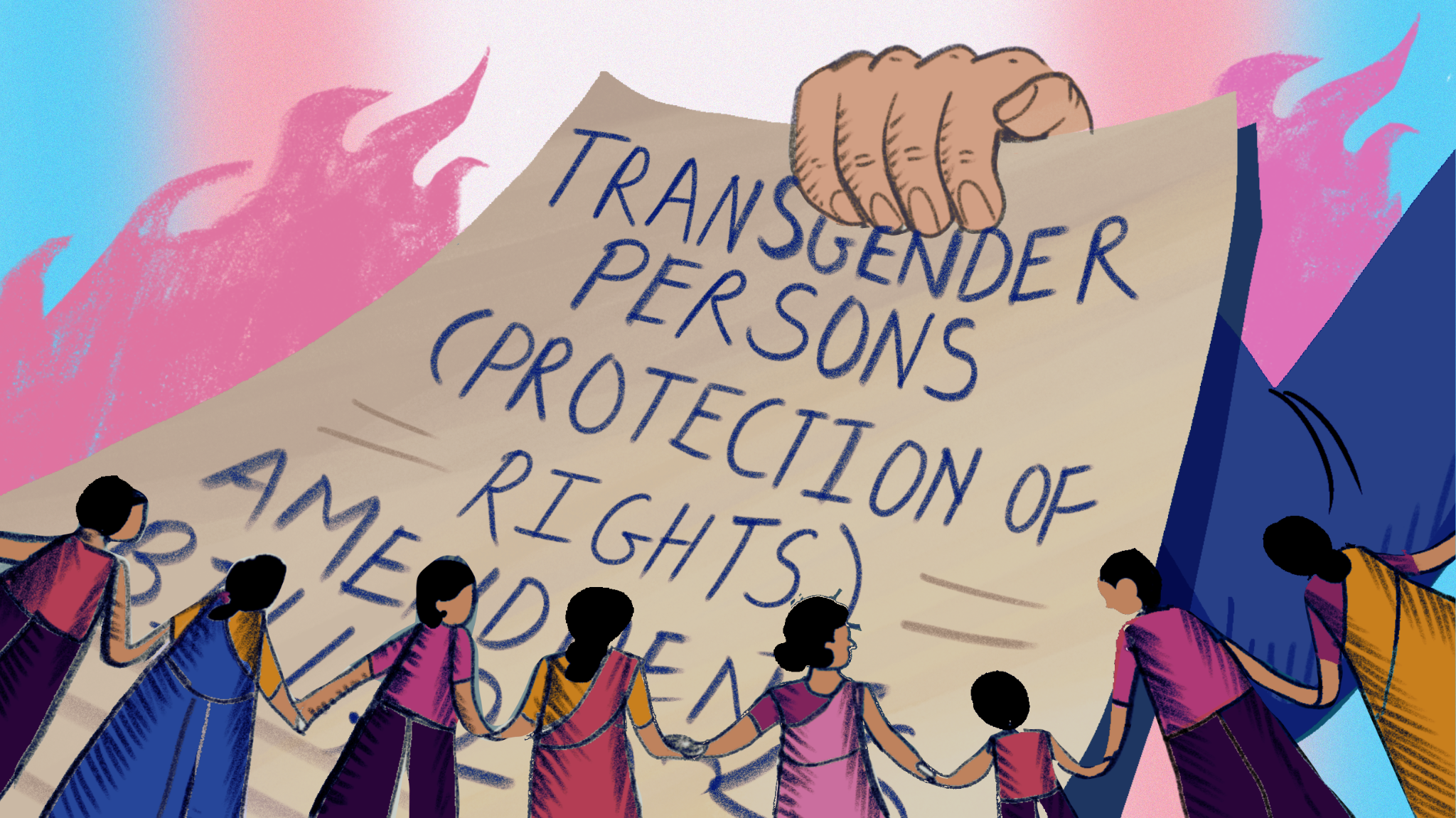
The proposed amendment to the Transgender Persons (Protection of Rights) Act, 2019, would have me believe that I do not exist. This is laughable, considering how long I spent looking for myself, despite a rich, expansive trans world existing right beside me. The care I took to be beyond certain that I was indeed what I wanted to claim that I was took years. What could have changed had acceptance been the norm instead of the stigma and silence that hid the vibrant voices of the trans community?
The amendment Bill aims to raise this wall of silence decisively.
One cannot overstate the reverberations of the National Legal Services Authority v Union of India judgment by the Supreme Court, commonly referred to as NALSA, when it was declared in 2014. At its most prosaic, it paved the way for the bureaucratic recognition of other genders in government forms, but conceptually, it opened possibilities that had not been considered in many parts of the world. It was the culmination of decades of activism and organising and was the first legal recognition not just of non-binary identities, but the concept of self-determination itself. It recognised a “third gender”, referring in this instance to people who were transgender — male, female, other.
I am that “other”, as are my siblings in trans-ness, whose struggles have cleared the way for my existence. NALSA ensured that people who legally transitioned would be protected from discrimination by the state. Medical gatekeeping was explicitly prohibited. It drew the nuanced separation of body and gender and recognised that people transition in many ways that are not always hormonal or surgical.
The Transgender Persons (Protection of Rights) Act, when it was passed in 2019, came as a disappointment. Though it was before I even admitted to myself that I was trans, I joined protests against it in Mumbai. While it was enacted in the wake of NALSA, the Act omitted many critical distinctions that the judgment had upheld. Though it said that transgender persons had the right to self-perceive their gender identities, it predicated this upon an application to the District Magistrate for an identity certificate to confirm this.
Tens of thousands of trans people have applied for identity cards under the Act, though the procedure remains mired in red tape and daily humiliations. Shelter homes set up under the Act to provide respite for transgender persons fleeing from violent natal families are chronically underfunded and abandoned (here and here) by the Centre. Critical clauses that were introduced in earlier versions of the Act that related to horizontal reservation — setting aside 2% of seats across every category for trans people of those caste identities — were omitted in the 2019 Act. This has been a key point of contention for transgender activists.
Erasing Ambiguity
Ambiguity is a tricky place to be in when it comes to gender. People expect you to be on one or another side of the gender binary. The idea that it might not exist at all or even that it might be a spectrum, is difficult for many to understand. The 2019 Act nodded towards this ambiguity, but the amendment Bill will erase it entirely.
The Bill has several alarming implications. Some of these include the erasure and conflation of intersex identities (where bodily variations deviate from the binary) with transgender identities; the retrospective legal erasure of trans men, trans women who do not belong to “traditional” communities, non-binary people, and any other self-determined gender identity; the presumption that nobody can be transgender without being coerced into medical procedures; and the addition of layers of bureaucracy to the process of legal and medical transition.
Trans and queer communities, across identities, caste, and geographies, have mobilised in great numbers, both online and on the streets, even as fear of a straitened future haunts us.
NALSA allowed for people to self-identify their genders—without medical transition. The proposed Bill explicitly does away with that. It says, in its statement of objects and reasons, that: “The intent, object and purpose of the Act is and was to protect a specified class of persons socially and culturally known as transgender people who face societal discrimination of an extreme and oppressive nature. The purpose was and is not to protect each and every class of persons with various gender identities, self perceived sex/gender identities or gender fluidities.”
Narrowing Definitions
To this end, the Bill narrows the definition of transgender persons. It says that any person or child who has been induced, deceived or influenced with or without consent to transition outwardly or by surgical, chemical or hormonal procedures will be considered to be transgender. It also includes people who are members of “traditional” communities such hijras, kinnars, jogtas, and aravanis, who have intersex variations (the word “intersex” itself has been deleted). It does not entertain the possibility that people are innately transgender and transition by choice.
Trans men and non-binary persons such as myself are to be excluded, as are trans women who do not belong to “traditional” communities. Crucially, the 2019 Act recognised, in accordance with NALSA, that transgender identities are about a mismatch in gender identity and assigned gender, and that it was irrelevant whether or not a person had made medical interventions. Now, combined with later clauses in the Bill, trans men who have already obtained legal identity cards will have no specific protections under the law. The clinching erasure is that the Bill applies retrospectively. It states that not only are people with self-determined identities not to be recognised, they shall be deemed never to have existed.
This narrowing of definition is a long-standing argument of the Centre, backed by certain traditional communities, that transgender people are only those communities that have been historically recognised in India. Soon after NALSA, the Centre had filed an appeal arguing that the definition of transgender people was too wide. This appeal was dismissed and did not make an appearance in the 2019 Act.
When Identity Is Innate And Inexorable
I spent the bulk of 2024 reading Biological Exuberance: Animal Homosexuality and Natural Diversity, a brick of a book that played a role in the decriminalisation of homosexuality in the United States. It is a running narration of queer behaviour scientifically recorded in hundreds of species. Every paragraph brims with examples of variations in sexuality, gender, behaviours and relationships. I do not think that one needs to refer to other species to affirm one’s own validity, particularly when it comes to gender and sexuality, but the book did its part by establishing without doubt that when it comes to non-normative identities, the “claimed self-perceived identity” that the Bill disparagingly refers to is hardly a matter of “personal choice”. It is innate and inexorable.
The Bill dashes the spirit of NALSA in another way: by adding layers of medical gatekeeping and bureaucratic structures to deeply personal decisions. The old procedure of getting a transgender identity card—the basis of your future rights—was, despite being mostly online, fraught with humiliations, as people sent dozens of emails to relevant officials and did rounds of their offices, begging them to approve their applications. The procedure, trans lawyers have pointed out, has turned from a two-step process to a five-step one.
The new Bill now adds the provision that the District Magistrate can take the opinion of “medical experts” and a medical board with a chief medical officer who will decide on the validity—and lack of coercion—of a person’s application to legally change their gender. The DM can reject the application and send it to more experts.
There is a layer of vagueness underlying this. A trans person who wants to pursue medical options can do so on the condition that their medical provider will report the case to the District Magistrate. However, a person cannot legally be considered transgender unless they have already had surgery. Neither step can be taken without the other, resulting in an impasse.
Criminalising Solidarity
I would not have come out had I not had my hand held metaphorically by the dozens of trans people I followed online. When I found words for my identity, I began to look for myself everywhere. I devoured anything written by trans men, from PhD dissertations to memoirs. I spent hours looking up queer magazines for first-person essays. When I did come out, I realised that my straight, cis world did not contain the expansiveness and acceptance that I would find in my mid-30s, when I was embraced by my queer community, largely 20-somethings, in Mumbai.
These points of support would be criminalised if the Bill is enacted. Apart from coercion and deception, anyone who is deemed to have influenced an adult or child to present as trans or get medical interventions of any kind can be sentenced to 10 years to life in jail, as well as be fined from Rs 2 lakh to Rs 5 lakh. Shelter homes, government-run Garima Grehs, community-based organisations, and even individual transgender people who help others are vulnerable to this provision, where simply the process of prosecution is the punishment. Also at risk are chosen families and partners, both vital support systems for transgender people who already exist at the margins of society (here, here and here) and have to leave their natal families just to survive.
While this web of bureaucracy descends on transgender people, intersex people stand to be erased entirely. Collapsing the definition of intersex people into the category of transgender, as the Bill does, does a deep disservice to both. Not all transgender people are intersex and not all intersex people are transgender. Their experiences are different, as are their demands. Intersex people are often subjected to forced gender realignment surgeries at young ages to bring them into alignment with their assigned genders. These interventions can cause lifelong trauma.
There are many people who realise much later in life, sometimes even in their 70s and 80s, that all their experiences lacked was a matter of language and acceptance, even as there are as many who know that vacuum with a keenness from young ages. The vast diversity of trans communities have always existed, always struggled, and we will continue to fight for our rights.
This article has been written with the help of the labour of all the trans people across fields who are leading, organising and mobilising trans communities across India. I owe my understanding to them and any errors are my own.
We believe everyone deserves equal access to accurate news. Support from our readers enables us to keep our journalism open and free for everyone, all over the world.
