[Readmelater]

BehanVox: No Fuel, Long Queues, But ‘All Is Well’

This week in BehanVox: inside the chikankaari industry, asylum for Iranian women's football, and more

Subscribe to our weekly newsletter that brings you top stories, gender news from the world, and our team’s reading recommendations.

Hello Behans!

Those of us who thought that the rain of fire streaking across the skies in West Asia would leave our lives mostly untouched are in for a nasty shock. LPG supplies in India have been hit by the disruption of LPG shipment through the embattled Strait of Hormuz, caught in the US-Israel-Iran conflict. The first to take the blow are restaurants and hotels that use commercial LPG. Many are closed or running limited operations. Fear of a crisis is driving up the sale of induction stoves and building queues at petrol pumps. The government in the meanwhile maintains that all is well.

This week, we bring you a superb report that questions claims about what home-based chikankari work actually does for women’s empowerment in a small town off Lucknow. And a personal essay on what it means to go bald in a society that eulogises the femininity of long hair.

Story So Far

In its campaign in the 1970s to organise poorly paid homebased bidi workers in Gujarat, mostly women from poor and marginalised homes, SEWA activists went to meet the labour commissioner. He maintained that they are not workers. “They just do it to pass their time hence the employer-employee relationship is not applicable.”

That is how home-based work for women is seen even today – ‘time pass’ squeezed into the cycle of cooking, cleaning, caring for the young and elderly. Even when it holds up an entire household or a big part of it, it is not dignified as employment and the earnings as income. And even when the homebased work requires tremendous artisanal expertise.

Embroidery and empowerment came to be linked when in the late 1970s, SEWA led the movement to support women’s crafts skills across Patan, Banaskantha and Kutch in Gujarat and Lucknow in Uttar Pradesh. Aari, rabari, chindi, bandhni, soi bharat, mutva and of course chikankari. But close to 50 years after these efforts began, it is time to assess exactly what these initiatives have done to empower women.

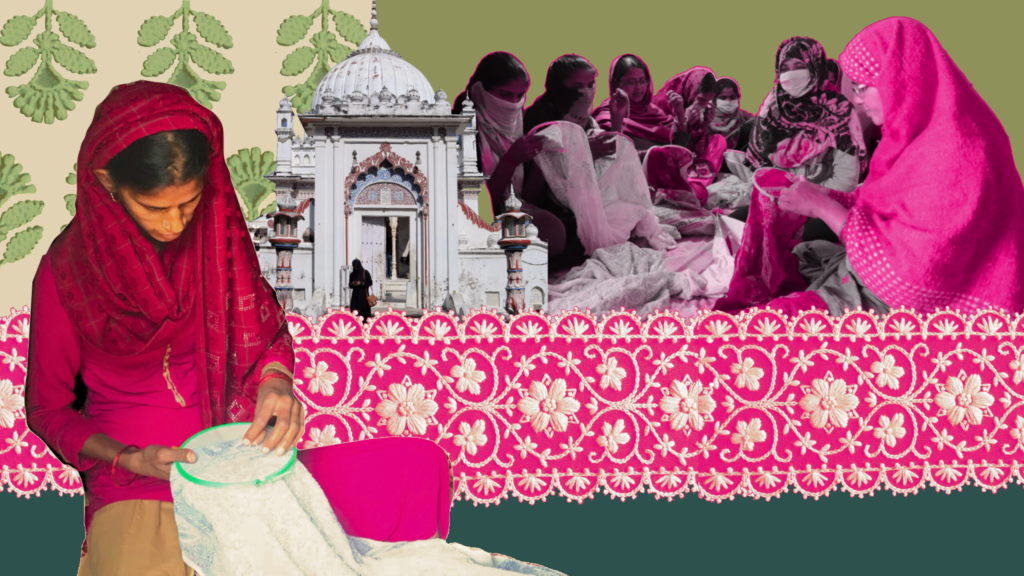
Researcher Garima Agarwal spent eight months in Katra Bazaar in Kakori, just off Lucknow, between 2020 and 2021 following the lives and labour of 15 households where the women were engaged in chikankari work. This is important and valuable work – at least 2.5 lakh people depend directly on chikankaari, and the industry is valued at over Rs 4,000 crore annually, generating at least Rs 200 crore in indirect export revenue. The UP government proudly cites it as a model of women’s economic inclusion – a craft that brings employment to women’s doorsteps without requiring them to leave home.

Garima’s investigations found that despite the long hours of labour-intensive work, women are underpaid, and their income dismissed as “pocket money”. And the very features that make the craft “suitable” for women—its home-based nature, its flexibility, its piece-rate structure—are what trap them in low-paid, invisible work.

“The “empowerment through craft” narrative, I found, hides the deeper structural problems that shape women’s work by celebrating income without choice, agency or control. What matters is who controls production, who sets prices, and who has the option to walk away,” Garima says.

 In Kakori, over 80% of women are involved in the chikankaari industry. So Garima’s findings are strongly indicative of how women in the crafts sector are treated. Economic participation, she found, has neither shifted their social position nor integrated them meaningfully into markets. And their dependence on middlemen means no visibility, no control over finished products, and no pricing power. The home is both the workplace and the boundary, she concludes.

Read the story here.

gender tonsuring in india

In a sharp, and hysterically funny essay published in 2012 in Kafila, Malayali historian and feminist J Devika had written about the ludicrously important place that long hair holds in the idea of feminine beauty in Kerala. As a youngster, in rebellion against her grandmother’s routine of “combing, plaiting, oiling, washing with shoe-flower paste” her hair, Devika decides to get herself a “fashionable bob”. Predictably, all hell broke loose.

“The female part of the household went into deep mourning: my mother on one cot, my grandmother on another, and the lady cook, and the lady helpers standing here and there all stooped, heads down, one arm crossed on the waist, another bearing the weight of a mournful-looking face.”

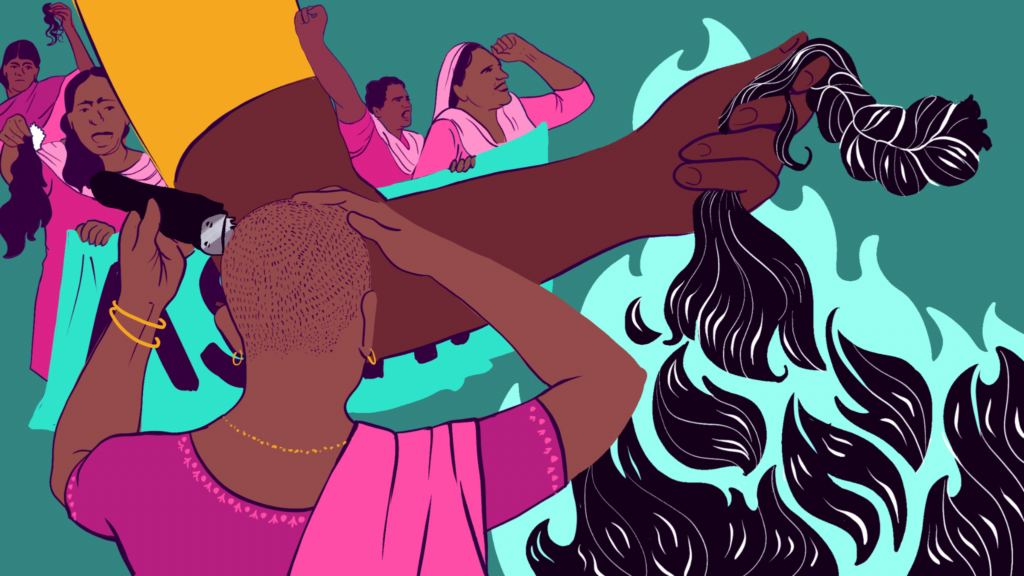
It is not just Kerala, across India and in many parts of the world, hair isn’t just about beauty, it is also bound up with issues of religion, culture, and social identity. So when Kerala’s ASHA workers decided last year to chop off their hair in public as a mark of protest against exploitative work conditions, the move was nothing short of radical. They were not the first to use tonsure as a form of protest. Across the world, women have shaved their heads for deeply personal and political reasons – to reclaim agency after an illness, challenge traditional norms of beauty, break free from patriarchal notions of femininity, or simply mark new beginnings.

In a personal essay, Priya Menon talks about why she was at 51, drawn to the idea of tonsure. “I saw it not just as an act of shedding vanity but also as a means to reclaim agency over my own life. As the first locks of hair fell, I felt a rush of freedom and joy. And when I gazed into my eyes in the mirror, I felt that I was meeting myself for the first time,” she writes.

Read the story here.

Talking Point

Gig Workers Hit: Among those left anxious by the commercial LPG crisis are gig workers whose livelihood depends on quick delivery of food from restaurants. With restaurants, dhabas, cloud kitchens and other food vendors resigned to full or partial closure, daily orders have fallen by 50-60%, says the Gig and Platform Service Workers Union (GIPSWU). They have issued a statement asking that in view of the crisis, workers be protected from financial shocks and not penalised for delayed deliveries.

Asylum For Footballers: Five members of the Iranian women’s football team who sought asylum in the course of the Asian cup tournament have been allowed to stay on in Australia, reports Al Jazeera. It was feared that they would be punished at home for not singing the Iranian national anthem before their first match against South Korea. This act was described as the “pinnacle of dishonour” by a commentator of Iran’s IRIB state broadcaster. The match started around the time Iran was struck by air strikes launched by the US and Israel, killing Ayatollah Ali Khamenei.  Global football players’ union FIFPRO said the team could be labelled “wartime traitors”.

Anti-Abortion Fears: With Jose Antonio Kast, an ultra conservative taking office as President, women’s rights activists in Chile fear that abortion rights will be in peril. Kast, according to Guardian, has opposed moves to ensure rights and equal opportunities for women in his 30-year political career. He  opposed the 2017 legalisation of abortion under limited exceptions and since then pushed to bring back a total ban on abortion. 

Birth Rate Push: The Glorious Letter reports on what it calls the ‘Baby Letter’ – the French government’s mail campaign to disseminate what it calls a “targeted, balanced, and scientifically sound information on sexual and reproductive health” to everyone at age 29. It is to be a part of France’s new “demographic rearmament” plan which includes research and care support for reproductive issues and the establishment of 70 egg-freezing centres by 2028. But this effort to fix declining birth rates – at a time when pronatalism is spreading – is not going to go anywhere as long as social structures around childcare do not change, argue experts.

BehanVox Recommends

Defeat As Method: “How can one think from within brokenness, from within the ruins, and still produce meaning, and even possibility?”  In these dark times, anthropologist Shahram Khosravi looks at defeat as a method to demand justice, speculate the impossible and envision life beyond the ruins of racial capitalism and colonial racism.

A Woman Should Be Ambitious…but also come home and cook food’: In this Vittles magazine essay, Saba Imtiaz digs into the archives in Karachi to see how women have continuously forged and documented culinary histories in Pakistan.

The Subverse: If you want a momentary escape from the horrors of the world, we have a podcast recommendation that invites you to explore the wondrous. The Subverse, presented by Dark ‘n’ Light is a podcast that uncovers the hidden and marginal in stories about nature, culture and social justice. 

Want to explore more newsletters? In Postcards, we send you missives on the places, people and ideas that brought Team BehanBox joy. Our monthly offering Postscript invites you, the reader, into our newsroom to understand how the stories you read came to be – from ideation to execution. Subscribe for more.

Support BehanBox

We believe everyone deserves equal access to accurate news. Support from our readers enables us to keep our journalism open and free for everyone, all over the world.

Donate Now