BehanVox: All Eyes On West Asia
This week in BehanVox: notes from a Bahujan social worker, a woman leader's history from the 1940s, and more

Subscribe to our weekly newsletter that brings you top stories, gender news from the world, and our team’s reading recommendations.
Hello Behans!
Suddenly, we have on our hands a war that nobody wanted. As feminists, we at BehanBox have always argued, war is a masculine enterprise advancing the military industrial complex as well as patriarchy. We did this when India and Pakistan pulled back from the brink of calamitous hostilities last year. And we do so now when the lethal aerial attacks between US and Israel on one side and Iran on the other threaten the lives of millions across West Asia. It is the innocent who pay the biggest price in a war as sabre-rattling strongmen refuse to sit at the table and talk. And now the use of AI tools in the US strikes has given us a terrifying new unknown.
This is exactly why we need a strong feminist media infrastructure and allies willing to challenge the resurgence of a dangerous masculine narrative. At a time when funding for feminist journalism is shrinking, the Fuller Project continues to do essential work exposing the rollback of women’s rights under authoritarian regimes. Their issue on Revolutions is a must-read. Women are often at the forefront of struggles for democracy, yet when protest gives way to policymaking, their roles are diminished and their demands sidelined. In this issue, Ester Pinheiro looks at Nepal’s Gen Z protests, where women survivors of gender-based violence took justice into their own hands as the system around them faltered.
We are kicking off Women’s History Month with a fascinating excerpt from the memoir of Mallu Swarajyam, a revolutionary woman leader of the 1940s’ agrarian movement from Telangana. And a personal essay on who gets to be a social worker and who gets to remain a field worker forever.
Story So Far
In popular imagination, social work is an equitable field where everyone works for the higher ideals of altruism and social upliftment, unaffected by questions of caste or class. But researcher Srimoyee Biswas argues that social work in India is a highly contested terrain – that the ideals are often masked by unequal power structures in which this work is practised.
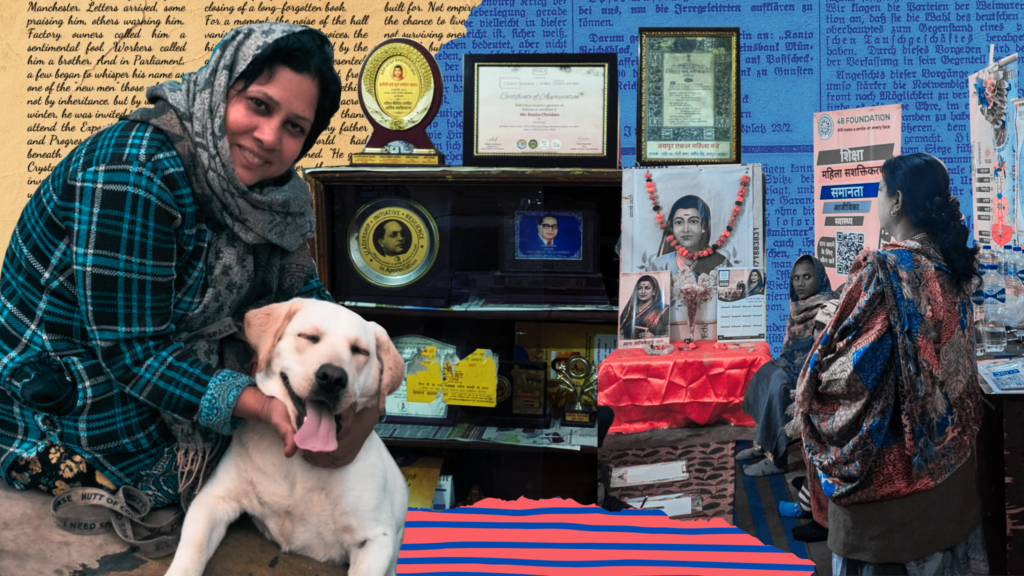
When Sunita “enters” the field in south Delhi’s Kusumpur Pahadi, she does not arrive at a site of work — her life begins and remains within it. For, the basti is not a destination for the community mobiliser; it is her home. She is not armed with a degree, does not have the backing of an institution, a regular salary or the resources that it can afford her.
What she does have however is priceless – trust that emerges from shared histories, social location and everyday proximity. She is, at once, a social worker and someone who lives the very conditions she documents. When she defines herself as a social worker it is a deliberate and political stance: she wants to be recognised as someone who works for the society she belongs to, not as an intermediary acting upon it.
“People feel comfortable talking to me about their problems, especially women from my community,” she explains. “They see me as one of their own.”
Kusumpur Pahari is shaped by the persistent kind of infrastructural neglect that most such settlements deal with. Water supply, for one, is a huge challenge, structuring the rhythms of everyday life. Early in the morning, women spill into the gallis, veils drawn loosely over their heads, their bodies already at work. The children linger close by, the older ones helping with the repetitive labour of survival. These scenes are familiar, almost routine and they are also moments of frequent documentation.
“Researchers like myself pass through, members of the press arrive with microphones, photographs are taken, sound bites recorded, surveys completed, and consent forms signed,” recounts Srimoyee. But little changes. Despite recent efforts to foreground agency and reflexivity, hierarchy continues to structure the production of social knowledge, she says. Caste occupies a particularly complex position within this dynamic even in urban settings.
If social work as a discipline claims to be ‘transformative’, then the labour that sustains it, especially of Bahujan women, has to be institutionally valued and materially recognised. Anything less risks the chance of reproducing the same hierarchies the discipline aims to dismantle, says Srimoyee.
Read the essay here.

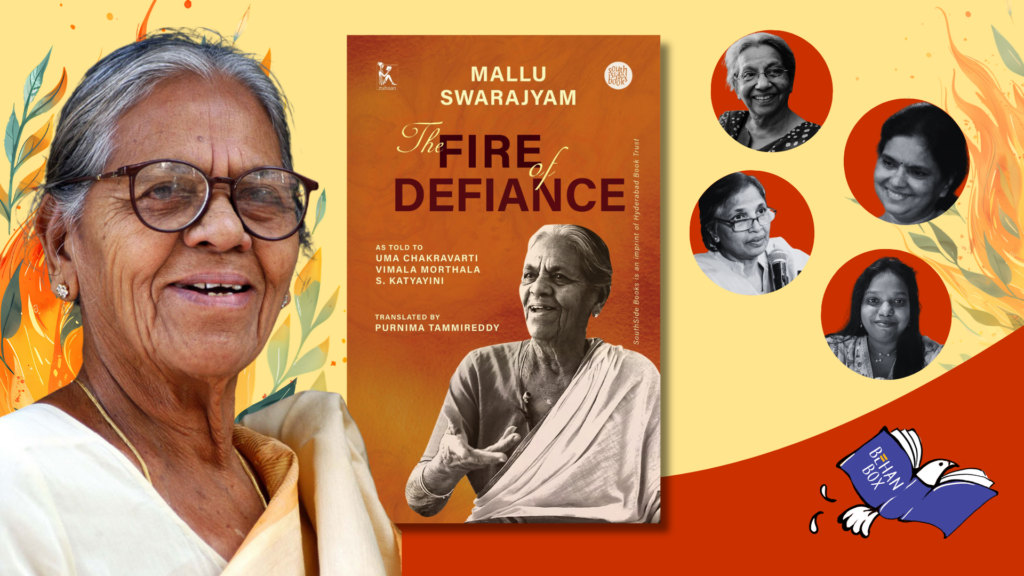
In her introduction to The Fire of Defiance, feminist historian Uma Chakravarty talks of an iconic black and white image of four women kneeling on the ground, wielding arms and ready to fire. What few know, she says, is that in this photograph that is symbolic of the armed agrarian struggle against the tyranny of the feudal systems in Telangana of the 1940s, features a remarkable woman leader – Mallu Swarajyam.
The Fire of Defiance is her memoir as told to Uma, Vimala Morthala, S Katyayini. This week we publish an excerpt from this unputdownable book published by SouthSide Story and Zubaan.
The historic battle waged by Swarajyam and her comrades was against the doras, powerful upper-caste zamindars who enforced oppressive rules of forced labour or vetti on sharecroppers and agricultural labourers. The story of the struggle itself is riveting but what is equally riveting is the story of the women who led it or participated in it.
Swarajyam was born to a small zamindar family where the usual rules of patriarchy applied. But her older brother was keenly engaged with the movement and her mother was as supportive as she could be even as the older men of the family frowned on the rising rebellion.
Our excerpt dwells on the years just after Independence when the rebels were being squeezed on both sides – by the Nizam’s soldiers and the Central forces.
“In addition to my work in the committee, I had another responsibility: to recruit women for the dalams. As I mentioned earlier, if the men of a family were already our members or allies, their women could also join the dalam. Otherwise, it took a lot of effort to get women to join. Some women even ran away from their homes to join us. They accepted all duties, just as the men did,” she writes.
There was Ramulamma from Cherukupalli village in Nalgonda taluka who was captured by the landlords and handed over to the police. She stood amidst the police and delivered a speech to her dalam. There was Nagamma who was so short that when she carried the rifle on her shoulders, it touched the ground. ‘It’s okay, I will carry the gun over my head, but I have to have one,’ she insisted, says Swarajyam.
But even in the midst of this turbulent resistance movement, sexism prevailed. The women went through pregnancies, domestic fissures, child care, menstruation and multiple other very physical challenges and coped on their own or with help from each other. “None of these arrangements were made by the leaders. The women involved were steadfast in their dedication to protecting the movement and made countless sacrifices without hesitation for its advancement,” says Swarajyam.
Read our excerpt here.
Talking Point
Nepal Votes: Nepal voted this week to elect a new parliament, the first to assess public mood after the so-called Gen Z protests against corruption and economic distress brought down the government. In a landslide victory, the 35-year-old rapper-turned-politician Balendra Shah defeated the veteran and ousted Marxist leader KP Sharma Oli. But as Himal reports, of the 3,484 candidates in this election, only 395 (11%) are women. And they face a host of challenges, not the least of which is a sexist social media backlash.
Death Of A Feminist: Iraqi women’s right activist Yanar Mohammed was assassinated this week by gunmen outside her home in Baghdad. She was one of the country’s most prominent women’s rights activists who has been active for over two decades to fight gender-based violence, “including domestic abuse, trafficking, and so-called ‘honour killings’”, as per the human rights group, Front Line Defenders.
Incel Blather: The incel jargon, which is pure gobbledygook, has apparently turned mainstream. The US Department of Defense described the lethal capabilities of the US military as: “Low cortisol. Locked in. Lethalitymaxxing”, reports Guardian, adding that “algorithms, in-jokes and a Trump administration keyed into the language of these communities”. Leading this linguistic assault are leading incel icons such as Braden Peters or Clavicular, the star “looksmaxxer” whose title refers to his spectacular clavicles that he believes defines male beauty. All the clever wordplay can be summarised in one word – misogyny.
Back To The Beginning: Gen Z men are twice as likely as Baby Boomer men to have traditional views on decision-making within a marriage, shows a survey conducted by Ipsos in the UK and the Global Institute for Women’s Leadership at King’s Business School London. The 29-country survey that included India found that close to a quarter of Gen Z men believe that women should not appear “too independent” or initiate sex. A good 59% are of the view that all talk around gender equality has gone “too far”.
Data Drop
We’re reported, here and here, how heat stress is contributing to a labour rights crisis and why it’s particularly threatening for women. New evidence from HeatWatch and Tata Institute of Social Sciences illustrates this vulnerability.
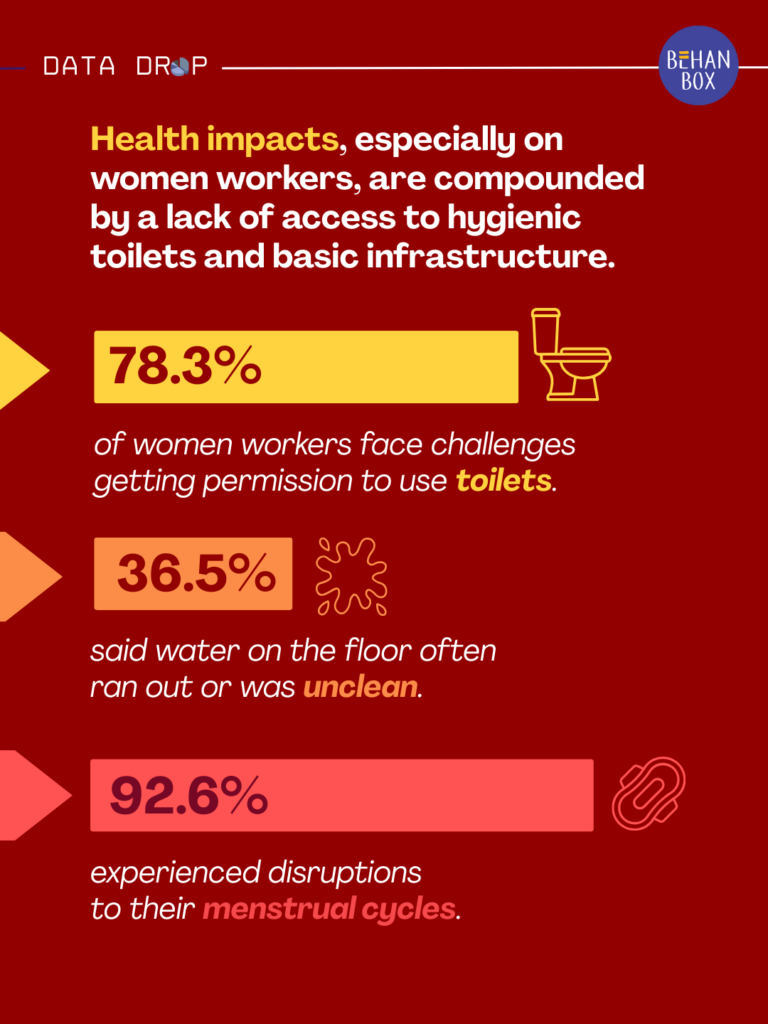
Out of the 115 garment workers surveyed in Delhi-NCR, Tamil Nadu, and Gujarat, 87% workers experienced symptoms including headaches, dizziness, and muscle cramps, and 78% skipped breaks, which doubled their stress levels and reduced their ability to cope with extreme heat.
For women, lack of sanitation facilities and poor work conditions contributed to health ailments.
“When we ask for fans, or even to use the toilet more often, we are criticised — ‘Don’t you have AC at home?’ Most management and owners are men, so there is no one to recognise heat stress as a real labour issue for women,” says Jothi, a garment worker from Tirupur.
Extreme climate conditions – paired with long working hours, gender dynamics, inadequate safety measures and insufficient heat adaptation policies – are jeopardising the lives and health of India’s women garment workers, the report found.
It is important to demand better working conditions and recognise heat as an occupational hazard. What other measures are working in your communities? Write to us at contact@behanbox.com.
BehanVox Recommends
If you’re trying to make sense of the ongoing war in West Asia, these essential readings offer crucial context and perspective.
The Dry and Wet Burn Together: “‘The dry and the wet burn together’ is a Persian expression invoked when a fire spreads without discrimination”- thus begins this most essential reading on the current war by Eskander Sadeghi-Boroujerdi. The war launched against Iran by the United States and Israel is a war of choice and of hubris, he says.
History of Modern Iran: Here is a five-part radio documentary on the history of modern Iran by Eskander Sadeghi-Boroujerdi and Golnar Nikpour.
Dance and Doves: in Iran, as mourners come to terms with the death of their loved ones, they are defying the Shiite mourning norms, as a mode of resistance against the regime.
Want to explore more newsletters? In Postcards, we send you missives on the places, people and ideas that brought Team BehanBox joy. Our monthly offering Postscript invites you, the reader, into our newsroom to understand how the stories you read came to be – from ideation to execution. Subscribe for more.

We believe everyone deserves equal access to accurate news. Support from our readers enables us to keep our journalism open and free for everyone, all over the world.