They are ghostly figures on the farthest margins of the digital labour that feeds Artificial Intelligence. Most of them are faceless figures working from laptops and phones out of their homes, earning a livelihood they desperately need but constrained by the need for flexible hours. Some have the advantage of formal employment, an office and structure. But at the end of the day, data workers work and live in precarity, nurturing the very same technology that will make them redundant any day.
It was not the easiest world to investigate but we were intrigued enough by its hidden corners to want a closer look. So Saumya Kalia had set out to understand exactly who data workers are and who employs them and under what conditions so that we can then explore its inner workings. Last October, we published our first story, an introduction to this invisibilised labour that few of us know anything about.
We found that this labour feeds transnational forums like ChatGPT, Instagram, and the internet so that they seem like the work of automatons but are actually the product of efficient human intervention. Workers are reeled in mostly over the internet, especially social media, and they have few ideas where the product of their effort goes or who they interact with at times. They could be scrubbing content for graphic images or cleaning an Excel sheet with 500 rows of data. The wages are paltry, irregular and workers have little negotiating power in this opaque system.
This allowed us to shed light on the hidden architecture of intelligent machines and chatbots and platforms and how the intelligence of AI and machine learning rests on an invisible workforce of people who collect, clean, and create data. We decided to push further and turn to the lives of workers, whose tasks demand attention, context, judgment, and emotional endurance. None of this is valued, respected or rewarded as it should be, we found.
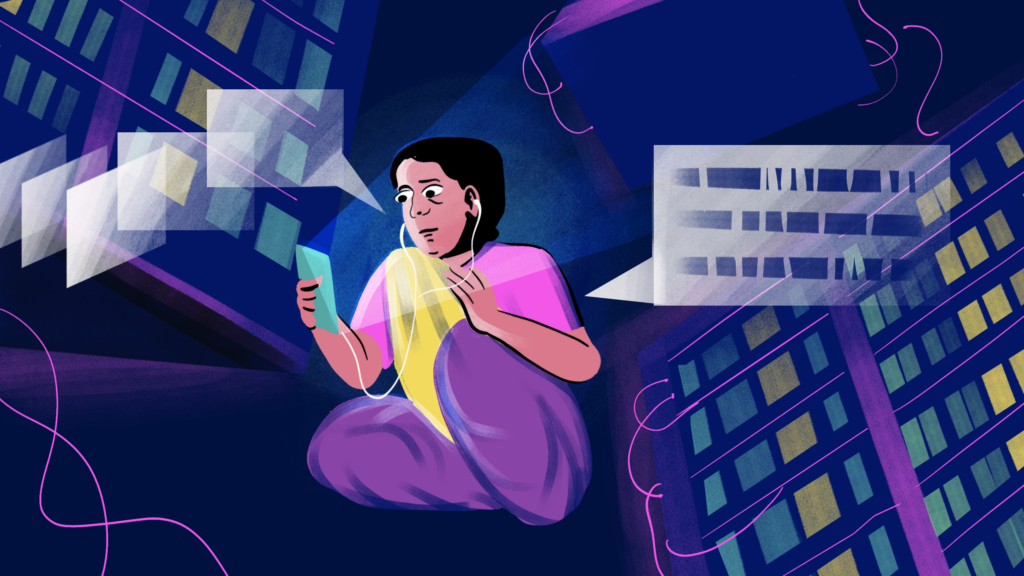
Muskan, just a little over 40, has taken on a freelance gig with a local NGO that is building a women’s sexual and reproductive health chatbot. First, she learnt to iterate small sentences and then she started playing around with emotions to reflect concern or urgency. Then the scripts became longer, on issues of pregnancy, fertility, family planning, which she would narrate with enunciations. She fumbled at times, asked her children to practice with her, but kept going.
Without her emotional and linguistic labour–her voice, accent, pacing and emotional delivery–the final AI chatbot cannot reliably interact with users, who are the women from her slum.
Muskan took on this work because it promised flexibility and other jobs needed qualifications she did not have. She was a teacher but the effort of juggling carework with work schedules was draining her: waking at 4am, cooking for the family, packing, and the long commute; all to be repeated in reverse order in the evening. “This work feels much better…sitting at home and getting the same payment as other work.” Her current AI gig may go on for three more months, or six, if she’s lucky. Her husband is an auto driver, and with rising costs and their children’s education fees, the two still struggle but try to make ends meet.
It is not that this work is meant to be essentially numbing but it has been made so because it requires little engagement and is done without transparency, we found. This leaves no room for meaning or creativity in the labour. This and many such complex layers of challenges emerged in our investigations.
Read our story here.