[Readmelater]

BehanVox: Sabka Saath, Kiska Vikaas?

This week in BehanVox: the Epstein list grows, life after bail for Bhima Koregaon accused, and more

Subscribe to our weekly newsletter that brings you top stories, gender news from the world, and our team’s reading recommendations.

Hello and welcome to Behanvox!

This week we kick off our Budget series focussed on its underreported aspects, analysing what it means for the most vulnerable social groups. And gender news from around the country and world.

This week our Associate Editor Saumya Kalia was in IIIT-Delhi as part of a panel on ‘Building Gender Responsive Policies and Ecosystems’. Here she made a case for building a new architecture of feminist media that has the potential to fill the gaps on gender and marginality for what data does not see.

Story So Far

The devil, as the cliche goes, is in the details. But so keen are we to grasp any passing skein of hope that we have begun celebrating all kinds of announcements, deals, and agreements before we know anything about the nitty gritty or what it implies. It happened with the FTA with the EU, the so-called Trump deal and now the 2026-27 budget. Take a close look and you start to question the enthusiastic and premature optimism.

As usual, this budget too, we decided to not jump in and wave our arms in triumph as many pink papers and others did with hurrah headlines and over-the-top illustrations. We took a breath, stepped back and invited analysts with a firm footing in their subject to take a long, and hard look at the details. Our analyses will be spread over the month and will focus on issues that are close to our heart – what the allocations mean for women, marginalised groups, employment, and carework. Exactly what are the resources in schemes relating to them, what is for real, what is sleight of hand, who stands to benefit and who will lose. We will be addressing these questions.

The first of these we published this week, a sharp and clear-eyed study by Varna Sri Raman of what the budget holds for women’s employment. Central budgets have critical linkages to our daily lives but most of us are so intimidated by the numbers and jargon we rarely progress beyond headlines and bullet points. Varna is a rare development economist who lays out the dots and then links them methodically for us to understand what the officialese hides.

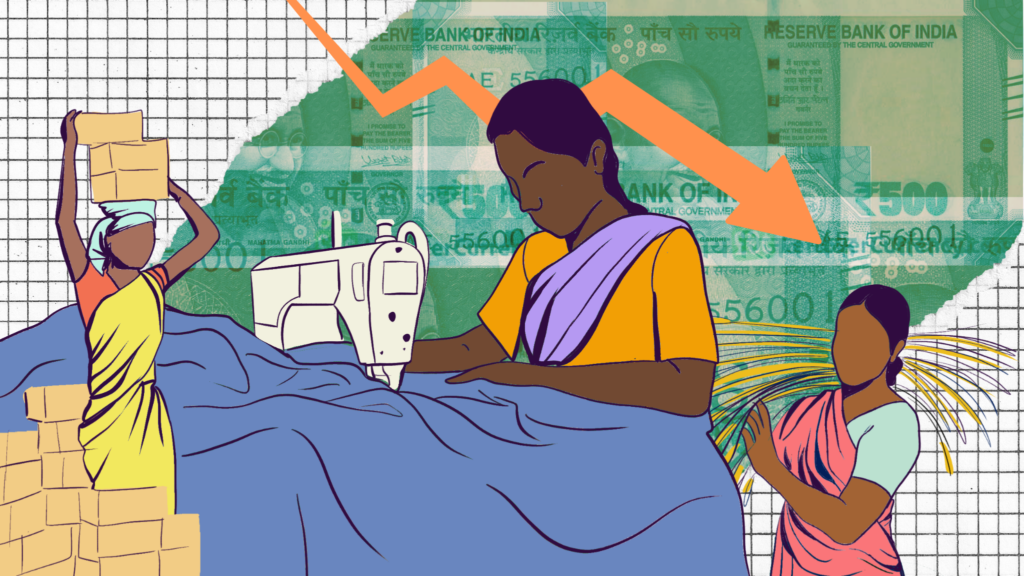
Here is what she concludes – the budget cuts this year to the MGNREGA funds impact the most vulnerable – rural women in the informal work sector from mostly poor states. The arithmetic she points out is direct: MGNREGA funding dropped from Rs 86,000 crore to Rs 30,000 crore. The PM Viksit Bharat Rozgar Yojana, an employment incentive administered through the Employee’s Provident Fund Organisation (EPFO), received Rs 28,715 crore. The first programme serves rural households, in which 59% of workers are women. The second serves formal-sector establishments, in which 75% of new subscribers are men.


The lines become clearer if you look at who benefits the most from MGNREGA, further imperilled by the newly minted VB-GRAM-G which changes a legally guaranteed employment right in11 into a scheme and banks heavily on state funding. It is the women from the poorest of states who bank on the Act the most.

“Sunita Devi understands this arithmetic even if she has never read a budget document. She is a 35-year-old mother from Bihar who supports her family through MGNREGA. The programme enables her to work locally, manage household responsibilities, and earn a fair wage. When I spoke with her, she kept returning to the same worry: fewer jobs in her village, less money for her children’s school fees. Her state government now needs matching funds, which it may not have,” says Varna.

Wait and watch, and check how the guidelines pan out in the future to see if these conclusions come true. We fear that they might.

Read our analysis here.

Assam Asha worker interview

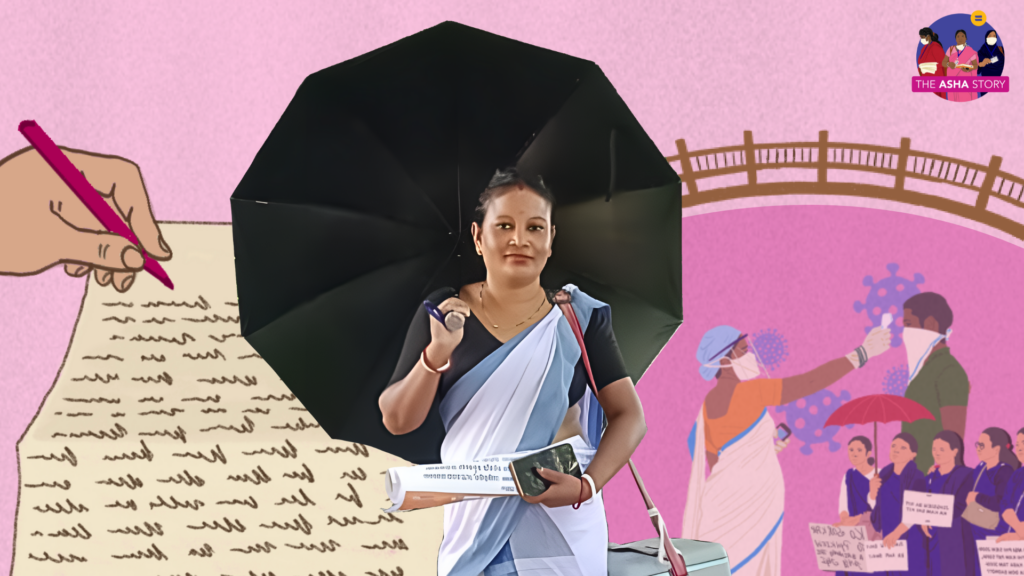
As a part of our 20 years of ASHAs project, we have been interviewing ASHA workers to get a sense of how the cadres evolved over the years – their personal journeys, what the early years of work looked like, the rise in workload and how they deal with it and issues of solidarity. This week Tora Agarwala  interviewed Pratima Barman, 37, an ASHA worker from Mechaki Chapori, one of remote riverine villages of Assam. Her challenges are exacerbated by the distances she has to travel through tough terrains with little connectivity or resources. She also does this while supporting and caring for her five children.

“During especially bad floods, the water stays for about 15 days. The flooding is so severe that taking a bicycle is impossible. The roads disappear completely. On those days, we depend entirely on boats and rafts. When the water is shallow, we walk, but many times it reaches our waist, and sometimes even our chest,” says Pratima.

The money is so paltry there are days she wonders what she is doing. But there is one thing that keeps her going – the respect she gets.

Read the interview here.

Talking Point

Hospital Horror: Clips of women in hospitals, undergoing gynaecological exams, admitted to labour wards, delivering, breastfeeding in general maternity wards or  lying unconscious in ICUs — all recorded on CCTV and left unsecured on networks — are being sold on internet as pornography, reports a chilling News Minute investigation. Clearly, none of the patients knew they were being recorded on CCTVs and there appeared to be no off-limit zones for these. The reporters joined Telegram channels where these videos were being sold. Within minutes they secured access to the films — all for a payment of Rs 1,500 via UPI.

Hostel For Girls: Among the words we had wagered that FM Nirmala Sitharaman would use in her budget speech was Lakhpati Didi. And bingo, she did. This time to announce that to build on the scheme’s “success”, the government would set up a girls’ hostel in every district “to promote astrophysics and astronomy via immersive experiences”. There will also be something called SHE Marts, “community-owned retail outlets”. How this is to be done and what it all means is anyone’s guess. 

The Epstein List Grows: The surreal Epstein saga is unfolding every single day bringing more lurid details of venerable men from the industry, films, banking, academia, philanthropy and “cellular” spiritualism, exchanging embarrassing emails with the late predator. There is talk of seats in college, movie roles for children, “cute girls”, and vapid chit-chat of the most cringe-making kind. 

Testosterone Testing: The latest buzz in the manosphere is testing for testosterone levels and “fixing” it to optimise masculinity, whatever that means, reports The Glorious Letter. But none of these tests or fixes mean anything, say scientists, but the aspiring Alpha male is not listening.

Data Drop

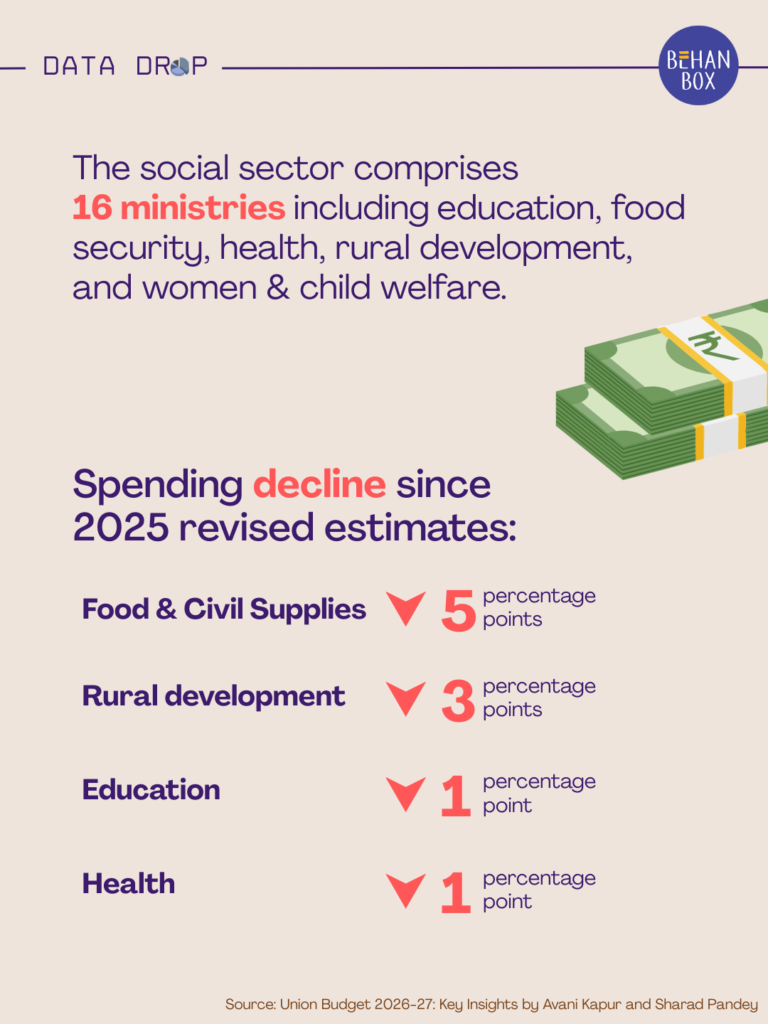
The budget is an inherently political document, and nowhere is this politics more visible than what our priorities are–who and what we choose to fund. India’s social sector expenditure has been drastically declining since Covid years. Between FY 20-21 and FY 24-25, it declined by 28%. As a share of GDP, it has declined from 5.3% to 2.5% in the same period. That’s not all: over 50% of total Union expenditure goes towards defence, road and railways development, transfers to states and interest payments.

Where has money been reduced? Health, jobs, education, rural development. 

BehanVox Recommends

The Disappearing Art of India’s Street Lettering : For decades, India’s street lettering has been an art that amused, inspired, provoked artists and the public alike. And now it all seems to be disappearing. Pooja Saxena, a street lettering and typeface artist, has documented this over the last 15 years and this sounds like a delight.

Life After Bail: We have memoirs and reflections of political prisoners of their time in jail. But what does life look like for them when out on bail. “A small jail to a bigger jail’, is how Anand Teltumbde described it. Indian Express spoke to the fourteen people accused in the Bhima Koregaon case.

A Lot like French Resistance: After the ICE agents killed Renee Good in Minnesota, there is a  network of solidarity and resistance has been seen emerging in streets and neighbourhoods.  This may not exactly be like the French resistance, but historians see some parallels in how they’re responding to the federal agents, writes Diane de Vignemont in New Lines Magazine.

Want to explore more newsletters? In Postcards, we send you missives on the places, people and ideas that brought Team BehanBox joy. Our monthly offering Postscript invites you, the reader, into our newsroom to understand how the stories you read came to be – from ideation to execution. Subscribe for more.

Support BehanBox

We believe everyone deserves equal access to accurate news. Support from our readers enables us to keep our journalism open and free for everyone, all over the world.

Donate Now