
Choking At Work: How Delhi’s Air Is Harming Women Gig Workers
Gig workers are compelled to take on tasks even during severe pollution episodes, without hazard pay, adjusted shifts or protection gear
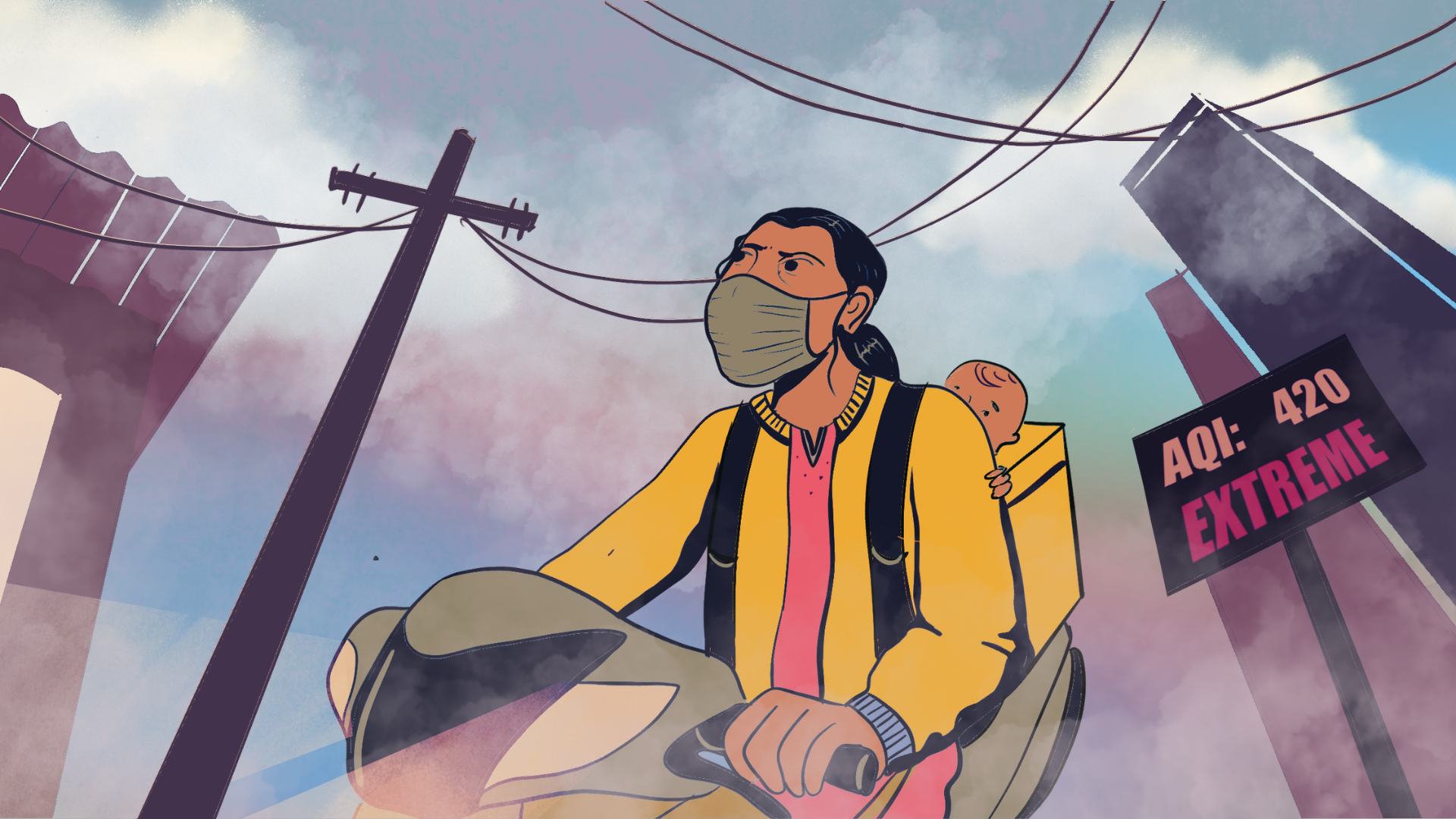
“I cannot breathe,” says Pooja, 30, a food delivery worker, of her experience of riding on the streets of Delhi in the ongoing smog season. A single earner for her family, she works at least 11 hours every day, regardless of the weather. Over the last two months, she has been experiencing not just breathing difficulties but also ocular irritation.
Frequently crossing 400, Delhi’s Air Quality Index (AQI) is often categorised as “Severe” and “Hazardous.” While schools and colleges declare holidays and offices decide to work from home, there is no such reprieve for the city’s outdoor workers, including gig and platform workers. Their work continues even as the air becomes unbreathable.
Indian labour laws and the Occupational Health and Safety (OSH) frameworks have centered around manufacturing industries, where hazards can be spatially fixed and regulated. Air pollution has been recognised as an occupational hazard primarily within such industrial settings. India is a member of the International Labour Organization but has not ratified Convention No. 148 on air pollution, noise and vibration in the working environment, meaning there is no binding international obligation on it to implement the convention’s protections for workers exposed to airborne hazards in their jobs.
A Rest of the World (2024) report documents how gig workers are consistently breathing air that exceeds WHO safety thresholds by 10 times or more.
When The City Is The Workplace
Air pollution in a city is considered ambient or atmospheric, and is not something that is necessarily linked to a job, says D Raghunandan, policy expert and activist at the Delhi Science Forum. But, he adds, this framing does not work when applied to gig or other outdoor workers, whose workplace is not a factory or warehouse, but the city itself.
If the city is the workplace, polluted air is a work-related hazard.
Labour organisers argue that to effectively address climate impacts on gig workers, regulations need to be rethought: gig and platform work should be recognised as work, the city should be recognised as the workplace, and air pollution should be categorised as an occupational hazard. While some outdoor labour is considered essential work, this is not the case with gig workers. Yet, they are compelled to work even during severe pollution episodes, without hazard pay, adjusted shifts, or protective gear.
It is not possible for gig workers to simply log off the app during high-AQI days. While gig work claims to offer flexibility, these narratives are nothing more than an illusion. Logging off means reduced income, loss of incentives, and sometimes, penalties. For most workers, staying logged off even for a day or two can severely dent their earnings.
The only choice the workers have is to continue working even as the toxic air affects their health.
At least 2 million lives were lost in 2023 alone due to air pollution in India. According to a report by the State of Global Air (SoGA) 2025 released by the Health Effects Institute (HEI) and the Institute for Health Metrics and Evaluation (IHME).
Environmental health specialist Adithya Pradyumna says that while acute problems associated with air pollution – eye and throat irritation, respiratory infections, and coughing – are commonly known, what often gets overlooked is its long-term health effects. Chronic exposure to air pollution can be linked to increased respiratory, cardiovascular, neurological diseases, as well as cancer.
For women gig workers, these risks are compounded by the gendered organisation of work, care, and space.
Gendered Differences
Air pollutants, particularly PM2.5, are known to cause acute and chronic bronchitis, asthma flare-ups, and respiratory symptoms such as coughing and shortness of breath, but for women, studies indicate additional risks, including adverse reproductive and menstrual health outcomes.
“The lack of rest stops and clean toilets have been a problem for women gig workers, especially during menstruation. Air pollution adds another layer to these existing issues, causing severe stress and health problems,” remarks Vandana Narang, an organiser with Gig Workers Association (GigWA).
The impact of air pollution varies with social factors and spatial locations. Most informal households in Indian cities live in cramped conditions with little to no ventilation. Pooja, for example, lives in a small rented house in Delhi’s Mandawli with cramped living areas and no ventilation. Having struggled with breathing difficulty all day outdoors, she says that there is some relief to be home, but this is temporarily because when she starts to cook, her eyes are irritated by the fumes.
The World Health Organisation states that cooking with solid fuel, such as wood and coal can increase indoor air pollution. This particularly puts women and children at risk because they are most exposed to indoor air pollutants. In poorly ventilated dwellings, indoor smoke can have levels of fine particles 100 times higher than acceptable. In such conditions, the home ceases to function as a site of recovery.
Capitalist economies depend not only on paid labour, but on the unpaid care work that keeps workers healthy enough to return the next day. Women gig workers, after a long day of backbending work that takes a toll on their bodies, return home where they have to resume care work. The costs of both paid and unpaid labour accumulate, without compensation or protection, on the bodies of women.
Pooja, for example, is also responsible for her younger sister, who has recently been diagnosed with tuberculosis. She is aware that living in cramped housing, caring for a patient with active TB, and being exposed to both outdoor and indoor air pollution can increase her own health risks. But she continues to do food delivery work in order to make ends meet, for a platform that neither compensates her financially nor protects her health.
Children, Care, and Exposure
Another worker, Seema, a 45-year-old gig worker who lives in Krishna Nagar in East Delhi. A single mother of five, she lost her husband five months ago. Unable to afford private school fees, she plans to move her children to public schools next year. Her youngest child is three years old and cannot be left alone at home. A food delivery worker for Swiggy, she often carries him with her, strapped to her back, for almost 10-11 hours a day.
For children, prolonged exposure to polluted air is linked to impaired lung development, higher risk of asthma, and recurrent respiratory infections, effects that can carry well into adulthood. As Delhi’s air quality worsened over the last two months, both Seema and her child developed severe coughs and breathing difficulties This created an intergenerational health crisis.
Class And Clean Air
Exposure to clean air is also stratified by issues related to class. Reports indicate that sites of pollution, such as landfills, worsen the AQI in their surroundings.
Gulshan, 35, is a delivery worker for Amazon who lives with his family near Delhi’s Ghaziapur landfill. The stench from the landfill, he says, can be smelled from several roads away. Over time, though he and his family have gotten accustomed to the stench, their bodies have not. He wears a mask even indoors, though his young sons often refuse. The entire family experiences eye and throat irritation, and Gulshan worries constantly about their health.
For low-income workers, luxuries and technologies that mitigate exposure, such as clean neighbourhoods, larger and well-ventilated homes, air-conditioned cars, and air purifiers, remain out of reach. Clean air, in the city, has become a commodity.
“The rich can buy facilities that we cannot even think about,” says Rekha, a 30-year-old worker with Urban Company. She has noticed a significant improvement in the air she breathes in her clients’ homes, compared to her own. Only recently did she realise that this relief was likely due to the air purifiers present in most middle and upper-class Delhi households.
‘We Are Ignored At Hospitals’
Despite widespread respiratory symptoms such as persistent coughing, sore throats and breathlessness, all the workers we interviewed either delayed treatment or did not seek medical care at all.
“They won’t even look at us,” Rekha says, referring to the class and caste-based discrimination she has faced in private hospitals. She has visited public hospitals before, but it has not improved her condition significantly. She says she already knows what the doctors will recommend: to remain indoors, something that she cannot afford to do.
Pooja narrates her recent experience with a public facility, where an X-Ray revealed a severe chest infection. She took medications that cost her nearly Rs. 3000 for 7 days, but her condition did not improve. Her doctor advised her to continue medication for another week, but she could not afford it. Having already missed over a week of work and subsequent loss in earnings, she decided to return to work even while feeling ill. She was advised to visit AIIMS for an in-depth examination, but due to long lines at the superspeciality hospital, she feared that she may have to skip yet another day of work, and decided against it.
Most platforms provide no protective gear, health insurance, compensation for pollution-related illness, or even health camps. Masks, when used, are paid for by workers themselves. The costs of polluted work are fully externalised onto workers’ bodies and households.
Way forward
Gig workers are officially included in the Code on Social Security (2020), but it is still unclear how schemes like the Employees’ State Insurance Scheme (ESIS) will be operationalised for them. The State has issued advisories identifying outdoor workers as vulnerable during high-pollution periods, but these responses remain reactive and temporary. For workers who are outside for 10 to 12 hours a day, exposure is chronic.
Dharmendra Kumar, a senior labour rights activist and organiser at Amazon India Workers Union (AIWU), says that masks, rest stops, air purifiers in waiting spaces are the bare minimum provisions that platform companies should provide. Beyond this, he calls for hazard pay on high-AQI days, reduced working hours, and formal recognition of air pollution within OSH frameworks.
In certain states like Tamil Nadu, extreme climate events like heatwaves, have been classified as a state disaster, making heatwave victims entitled to compensation. Such approaches, as Raghunandan argues, must be expanded, alongside stronger obligations on companies.
Anusha Bhat is a researcher whose work explores the political economy of labour, public health, and inequality in urban cities. She has a Master’s in Development from Azim Premji University, and works with several labour rights organizations across cities.
Nitesh Kumar Das is the Organising Secretary at the Gig Workers Association (GigWA), working at the intersection of grassroots organising and policy advocacy to advance the rights of gig and warehouse workers in India; he writes on platform work and holds a postgraduate degree in Development from Azim Premji University.



We believe everyone deserves equal access to accurate news. Support from our readers enables us to keep our journalism open and free for everyone, all over the world.
